Problem Statement
Given an integer array nums, return the number of odd elements present in the array.
Example 1
Input: nums = [2, 5, 8, 11, 14]
Output: 2
Explanation: The odd numbers are 5 and 11. So, the count is 2.
Example 2
Input: nums = [2, 4, 6, 8]
Output: 0
Explanation: There are no odd numbers in the array. So, the count is 0.
Approach 1
Traverse the array and check whether each element leaves a non-zero remainder when divided by 2.
Maintain oddCount to record how many elements satisfy this condition. Using a non-zero remainder check also handles negative odd numbers correctly.
Algorithm
Initialize
oddCountwith0, where it keeps track of how many odd elements have been found so far.Traverse the array once so that every element can be checked for oddness.
For each element, check
nums[i] % 2 != 0. A non-zero remainder means the current value is odd, and this condition also works correctly for negative odd numbers.Whenever the condition is satisfied, increment
oddCountto include the current element in the count.Return
oddCountafter all elements have been checked.
Dry Run
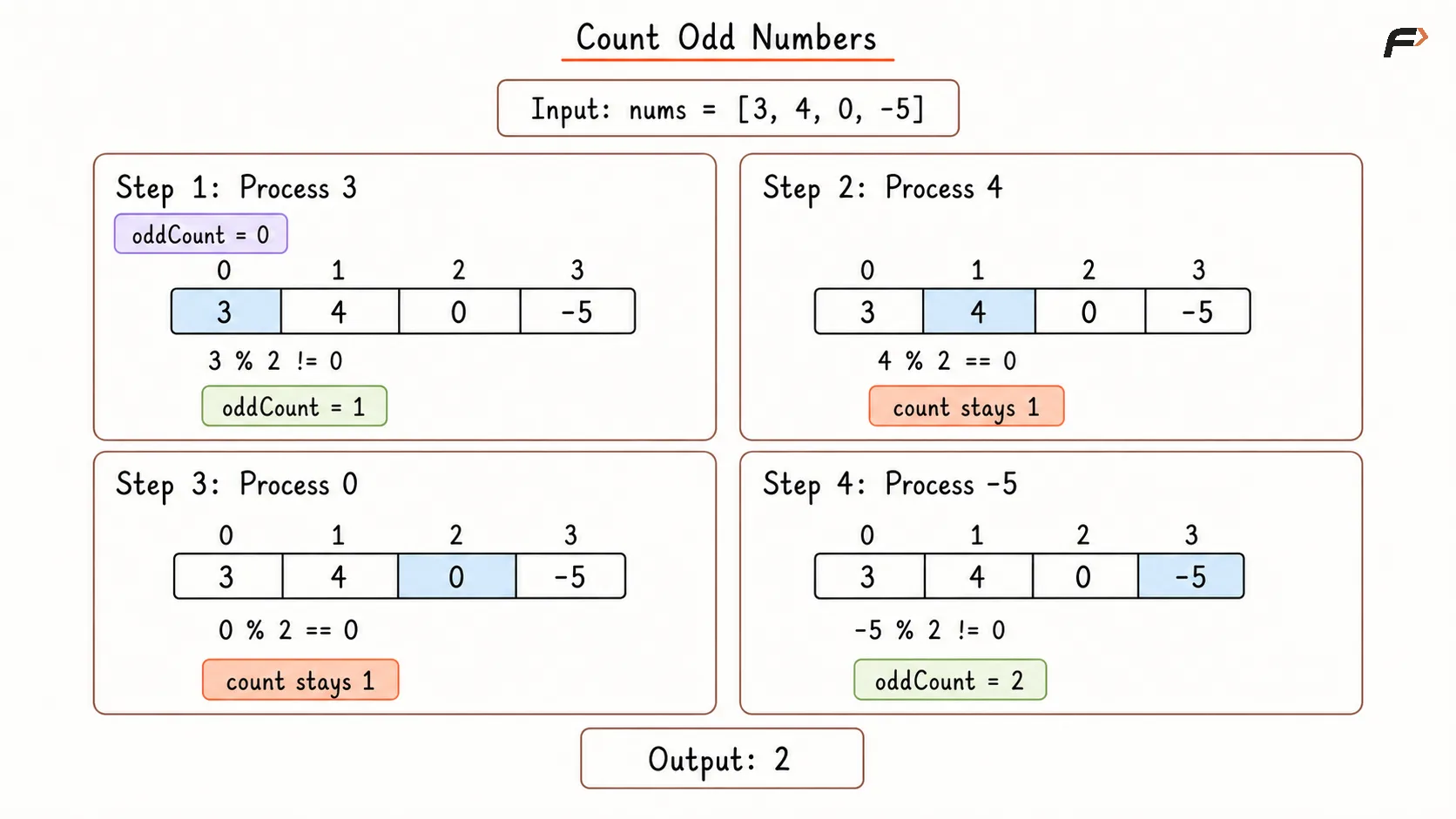
Count Odd Number in Array Using Modulo Operator Dry Run.png
Solution
#include <bits/stdc++.h>using namespace std;class Solution {public: int countOdd(vector<int>& nums) { int oddCount = 0; for (int num : nums) { // A non-zero remainder means the number is odd. if (num % 2 != 0) { oddCount++; } } return oddCount; }};int main() { vector<int> nums = {1, 2, 3, 4, 5}; Solution solution; cout << "Odd Count: " << solution.countOdd(nums) << endl; return 0;}Complexity Analysis
Time Complexity: O(N), where N represents the number of elements in the array. Every element is checked once.
Space Complexity: O(1), because only oddCount requires auxiliary storage.
Approach 2
The least significant bit of an odd integer is always 1.
Performing a bitwise AND operation with 1 checks this final bit. When (num & 1) is non-zero, the number is odd.
Algorithm
Initialize
oddCountwith0, where it stores the number of odd elements found during traversal.Traverse every element of
numsso that its least significant bit can be checked.For each element, evaluate
(nums[i] & 1). An odd number always has its least significant bit set to1.When
(nums[i] & 1) != 0, incrementoddCountbecause the current element is odd.Return
oddCountonce the complete array has been processed.
Dry Run
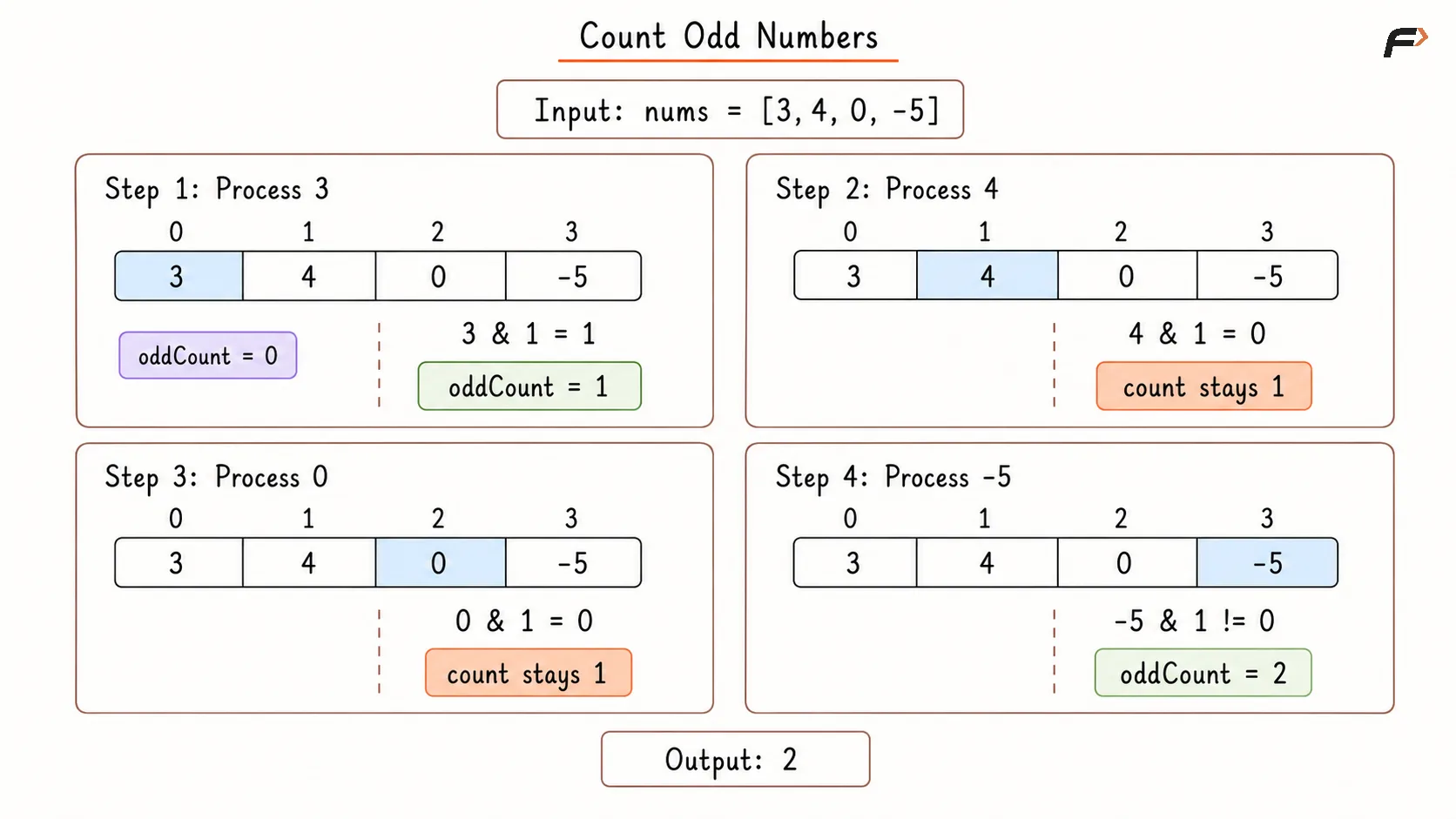
Count Odd Number in Array Using Bitwise AND Dry Run.png
Solution
#include <bits/stdc++.h>using namespace std;class Solution {public: int countOdd(vector<int>& nums) { int oddCount = 0; // Check the last bit of every number. for (int num : nums) { // If the last bit is 1, the number is odd. if ((num & 1) != 0) { oddCount++; } } return oddCount; }};int main() { vector<int> nums = {1, 2, 3, 4, 5}; Solution solution; cout << "Odd Count: " << solution.countOdd(nums) << endl; return 0;}Complexity Analysis
Time Complexity: O(N), where N represents the number of elements in the array. Every element is checked once.
Space Complexity: O(1), because only oddCount requires auxiliary storage.
FAQs
Q1. Why should num % 2 != 0 be used instead of num % 2 == 1?
For negative odd numbers, some languages produce -1 as the remainder after division by 2. Checking for a non-zero remainder correctly handles both positive and negative odd values.
Q2. Is zero considered an odd number?
No. Zero is perfectly divisible by 2, so it is even and must not be included in the odd count.
Q3. Which approach should be preferred in an interview?
The modulo approach is generally preferred because it clearly expresses the mathematical definition of an odd number. The bitwise approach may be discussed as an alternative.
Q4. Can the even count be calculated without another traversal?
Yes. After finding oddCount, the number of even elements can be calculated as nums.length - oddCount.
Q5. Can this problem be solved faster than O(N)?
No. Every element must be examined because any unchecked element could be odd. Therefore, O(N) time is optimal.
Q6. What should be returned when the array is empty?
The answer should be 0 because an empty array contains no odd elements.
Be the first to add a comment.