Given three integers n, r, and a prime number p, find the value of: nCr % p Here, nCr means the number of ways to choose r items from n items.
In simple words, the task is to compute combinations, but return the answer after dividing it by p and keeping only the remainder.
Example 1
Input: n = 10, r = 2, p = 13
Output: 6
Explanation: 10C2 = 45, and 45 % 13 = 6.
Example 2
Input: n = 1000, r = 900, p = 13
Output: 8
Explanation: Here n is much larger than p, so a direct factorial-based modular inverse method is not reliable. Lucas Theorem handles this case correctly, and the final remainder is 8.
Optimal Approach using Fermat Theoram
The combination formula is: nCr = n! / (r! * (n-r)!) The problem is that division under modulo is not done like normal arithmetic. A direct divide is not valid. This is where the prime modulus becomes useful. When p is prime and a number x is not divisible by p, Fermat's Little Theorem says:
x(p-1) % p = 1 From that, the modular inverse of x becomes:
x-1% p = x(p-2) % p So instead of dividing by r! * (n-r)!, the work changes into multiplying by its modular inverse.
This is the standard fast approach when p is prime and n < p. That condition matters because if n >= p, then n! % p becomes 0, and the direct factorial-inverse formula can break even when the final answer is not 0.
Algorithm
First, check whether
ris outside the valid range. Ifr > n, return0because the selection is impossible.If
ris0or equal ton, return1because there is only one valid way in both cases.Replace
rwithmin(r, n - r)so fewer factorial terms need to be handled.If
n >= p, do not use this direct method. That restriction is important because factorial values up tonwill includep, which makes normal modular inverse division invalid here.Compute
n! % p,r! % p, and(n-r)! % pusing loops.Multiply
r!and(n-r)!, then take modulop. This gives the denominator under modulo.Find the modular inverse of that denominator using fast exponentiation with power
p - 2. This step works becausepis prime.Multiply
n!by the modular inverse of the denominator and take modulop. That final multiplication givesnCr % p.
Dry Run
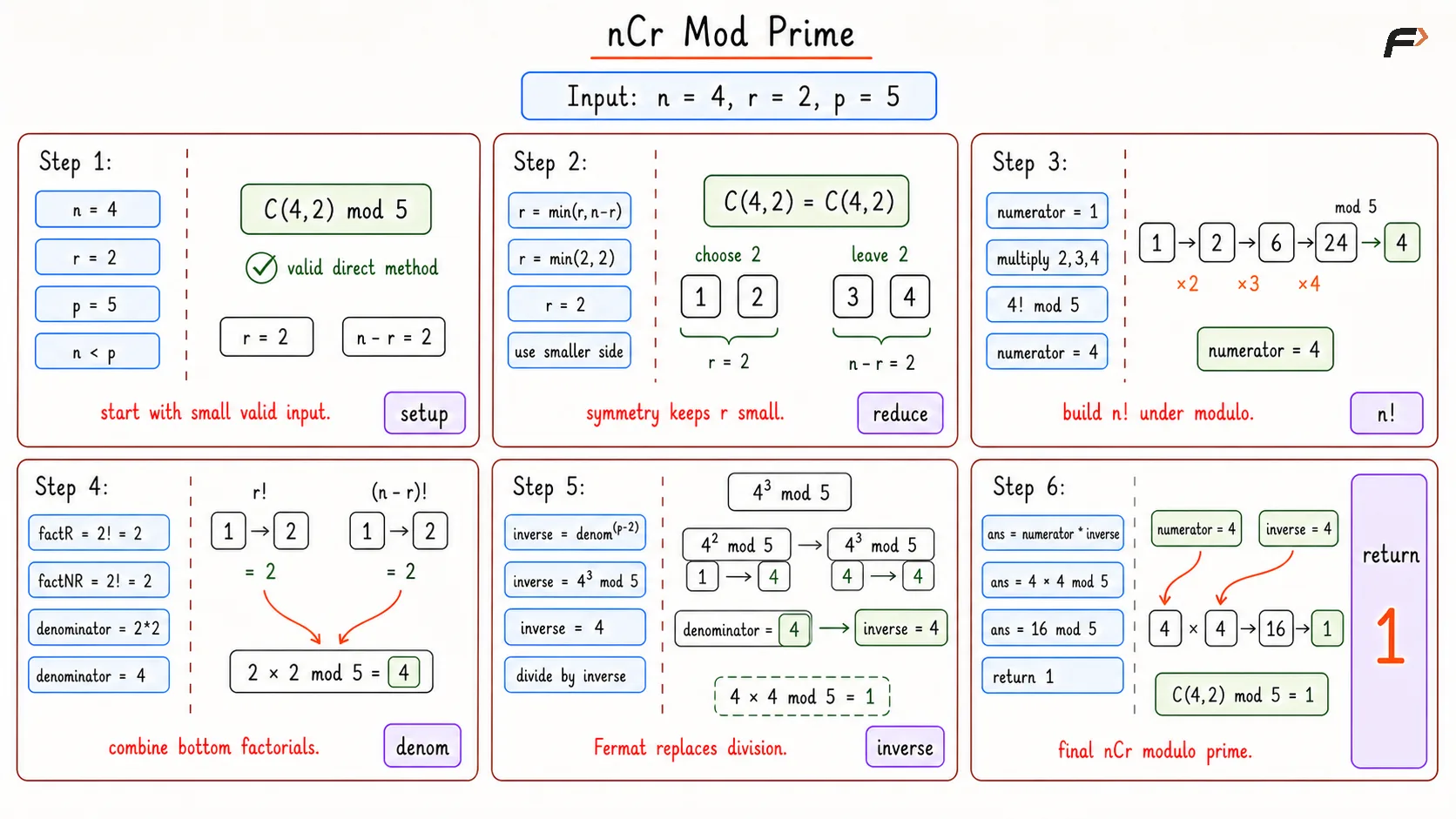
Computer ncR mod Prime Optimal Dry Run
Solution
#include <bits/stdc++.h>using namespace std;class Solution {private: /*Computes base raised to exponent under modulo using binary power.*/ long long powerMod(long long base, long long exponent, int mod) { // Stores the running answer under modulo. long long result = 1; // Keep base inside modulo before the loop starts. base %= mod; while (exponent > 0) { // Multiply now when the current bit contributes. if (exponent & 1LL) { result = (result * base) % mod; } // Square the base for the next binary bit. base = (base * base) % mod; // Shift right because the current bit is already handled. exponent >>= 1; } return result; } /*Computes modular inverse when mod is prime and value is not divisible by mod.*/ long long modInverse(long long value, int mod) { return powerMod(value, mod - 2, mod); } public: /*Computes nCr modulo p using factorials and Fermat's Little Theorem.*/ int nCrModPrimeFermat(int n, int r, int p) { // Return 0 because choosing more than n items is impossible. if (r > n) { return 0; // Fixed: Changed 0n to 0 } // Return 1 because nC0 and nCn always equal 1. if (r == 0 || r == n) { return 1; } // Use the smaller side because nCr equals nC(n-r). r = min(r, n - r); // Stop here because this direct method needs n to stay below p. if (n >= p) { return -1; // Fixed: Changed -1n to -1 } // Stores n! under modulo p. long long numerator = 1; for (int i = 2; i <= n; i++) { // Multiply each number into n! under modulo p. numerator = (numerator * i) % p; } // Stores r! under modulo p. long long factR = 1; for (int i = 2; i <= r; i++) { // Multiply each number into r! under modulo p. factR = (factR * i) % p; } // Stores (n-r)! under modulo p. long long factNR = 1; for (int i = 2; i <= n - r; i++) { // Multiply each number into (n-r)! under modulo p. factNR = (factNR * i) % p; } // Combine the denominator terms before taking inverse. long long denominator = (factR * factNR) % p; // Multiply by modular inverse instead of normal division. return (int)((numerator * modInverse(denominator, p)) % p); }};// Driver code startsint main() { int n = 10; int r = 2; int p = 13; Solution obj; cout << obj.nCrModPrimeFermat(n, r, p) << endl; return 0;}Complexity Analysis
Time Complexity: O(n + log p), because factorial values are built in O(n) time and modular exponentiation takes O(log p) time.
Space Complexity: O(1), because constant extra space is used in this direct implementation.
Optimal Approach using Lucas Theoram
The Fermat-based factorial formula is fast, but it has a very important limitation: the direct version needs n < p. So what happens when n is much larger than p, but the modulus is still prime?
Lucas Theorem solves exactly that case. It breaks n and r into digits in base p and turns one large combination problem into several much smaller combination problems:
nCr % p = product of (niCri) % p
Here ni and ri are the digits of n and r in base p.
This idea matters because every smaller piece now has values less than p, so the tricky large factorial issue disappears. Instead of fighting one huge combination, the work is divided into safe little subproblems.
This is one of the most important advanced approaches for nCr % p, and it should definitely be known when the problem allows very large values.
Algorithm
First, check whether
ris outside the valid range. Ifr > n, return0because the combination does not exist.If
ris0, return1because there is exactly one way to choose nothing.Take the last base-
pdigit ofnbyn % p, and take the last base-pdigit ofrbyr % p.If the digit of
ris greater than the digit ofn, return0immediately. This matters because that small combination is impossible, so the full answer also becomes impossible.Compute the small combination
niCri % pfor the current digits. A simple DP method is enough here because both digits are smaller thanp.Remove the last digits by dividing both
nandrbyp, then solve the remaining higher-digit problem.Multiply the current small answer with the recursive answer of the remaining digits, and take modulo
p.When
rbecomes0, stop and return1because no more digit choices are left.
Dry Run
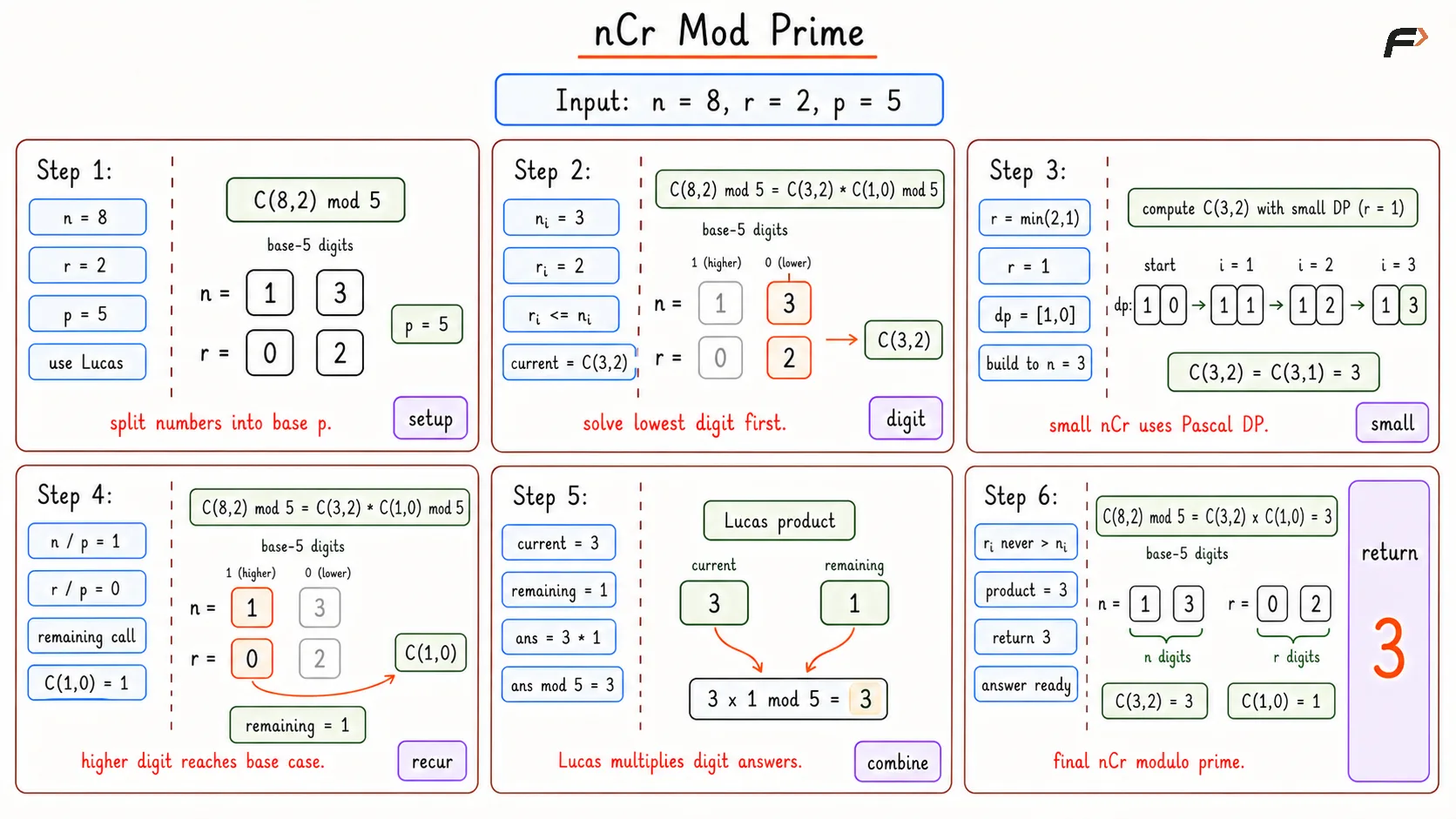
Computer ncR mod Prime Optimal Dry Run
Solution
#include <bits/stdc++.h>using namespace std;class Solution {private: /* Computes small nCr modulo p when both n and r are less than p. */ int smallNCrModP(int n, int r, int p) { // Return 0 because choosing more than n items is impossible. if (r > n) { return 0; } // Return 1 because nC0 and nCn always equal 1. if (r == 0 || r == n) { return 1; } // Use the smaller side because nCr equals nC(n-r). r = min(r, n - r); // Stores one Pascal row for the current small problem. vector<int> dp(r + 1, 0); // There is always one way to choose 0 items. dp[0] = 1; for (int i = 1; i <= n; i++) { // Stay inside the valid part of the current Pascal row. int limit = min(i, r); for (int j = limit; j >= 1; j--) { // Add the two parent values from Pascal's Identity. dp[j] = (dp[j] + dp[j - 1]) % p; } } return dp[r]; }public: /* Computes nCr modulo prime p even when n can be much larger than p. */ int nCrModPrimeLucas(long long n, long long r, int p) { // Return 0 because choosing more than n items is impossible. if (r > n) { return 0; } // Return 1 because no more choices are left to make. if (r == 0) { return 1; } // Take the current base-p digit from n. int ni = (int)(n % p); // Take the current base-p digit from r. int ri = (int)(r % p); // Return 0 because this digit-level combination is impossible. if (ri > ni) { return 0; } // Solve the current digit-level combination first. int current = smallNCrModP(ni, ri, p); // Solve the remaining higher digits recursively. int remaining = nCrModPrimeLucas(n / p, r / p, p); // Multiply both parts because Lucas combines digit answers. return (int)((1LL * current * remaining) % p); }};// Driver code startsint main() { long long n = 1000; long long r = 900; int p = 13; Solution obj; cout << obj.nCrModPrimeLucas(n, r, p) << endl; return 0;}Complexity Analysis
Time Complexity: O(p2 * logp n) in this implementation, because each base-p digit uses a small DP combination computation.
Space Complexity: O(p + logp n), because the helper DP array uses O(p) space and the recursion depth is O(logp n).
Interview follow-up Questions
Because modulo arithmetic does not allow normal division in the usual sense. Division must be replaced by multiplication with a modular inverse, and that inverse exists only in valid conditions.
Be the first to add a comment.