Given two integers A and M, find the modular multiplicative inverse of A under modulo M. Return an integer X such that: (A * X) % M = 1 If no such value exists, return -1.
Example 1
Input: A = 3, M = 11
Output: 4
Explanation: 3 * 4 = 12, and 12 % 11 = 1.
So, 4 is the modular inverse of 3 under modulo 11.
Example 2
Input: A = 2, M = 6
Output: -1
Explanation: There is no number X such that (2 * X) % 6 = 1.
So, the modular inverse does not exist.
Brute Force Approach
The definition says that the answer is a number X for which: (A * X) % M = 1 So the most direct idea is to try every possible value of X. Since modular answers repeat after M, only values from 1 to M - 1 need to be checked. If any value satisfies the condition, that value is the inverse. If no value works, the inverse does not exist.
Algorithm
First, reduce
Aunder moduloMso large values ofAare brought into the useful range.Try every possible value
Xfrom1toM - 1, because valid modular inverse values live inside this range.For every
X, check whether(A * X) % Mbecomes1. This directly tests the definition of modular inverse.If such an
Xis found, return it immediately because the required inverse has been found.If the loop finishes without finding any value, return
-1because no modular inverse exists.
Dry Run
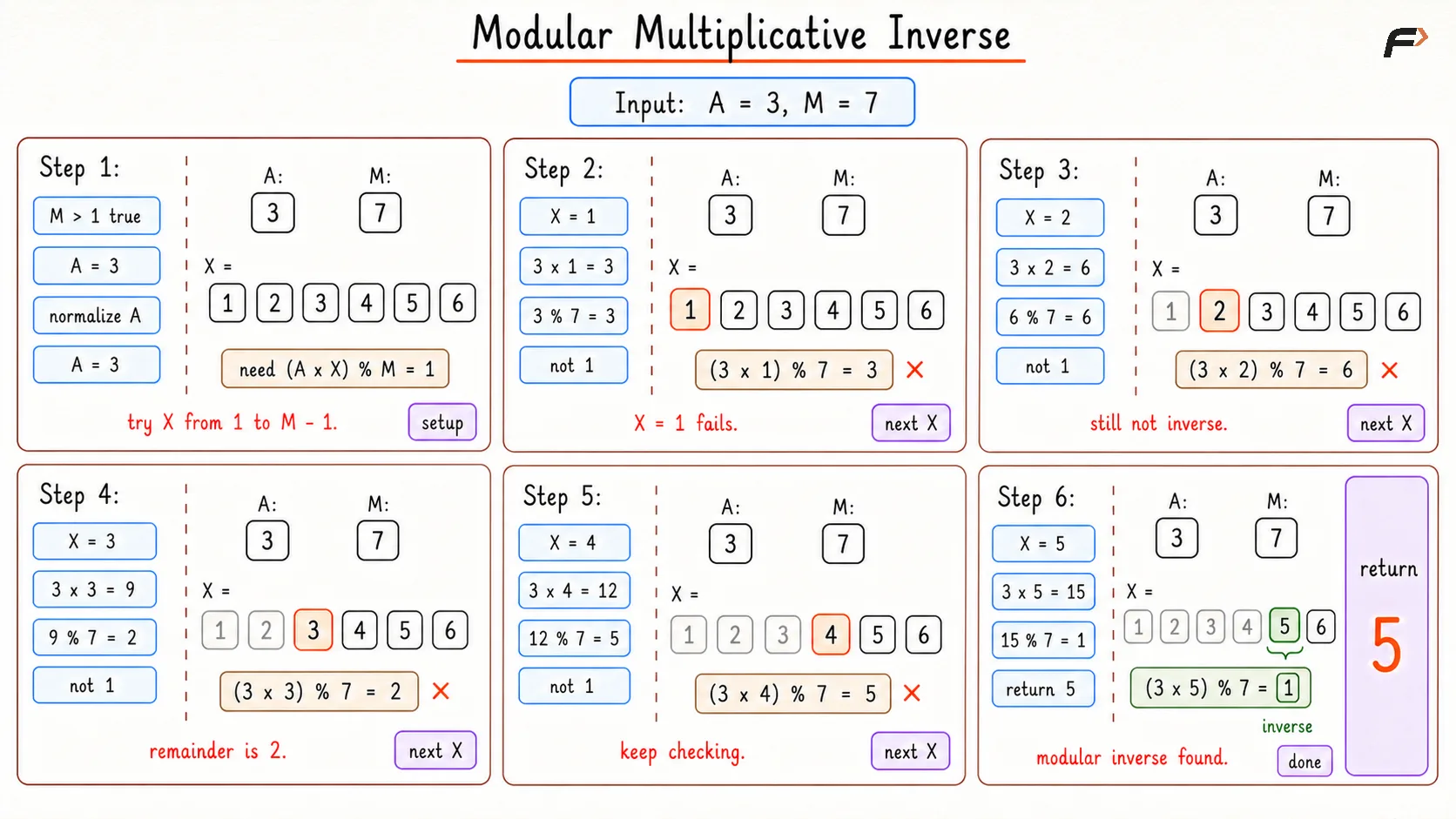
Modular Multiplicative Inverse Brute Dry Run
Solution
#include <bits/stdc++.h>using namespace std;class Solution {public: /* Finds the modular inverse by checking every possible value from 1 to M - 1. */ long long modInverse(long long A, long long M) { /* A modulus less than or equal to 1 cannot give a valid inverse range. */ if (M <= 1) { return -1; } /* This keeps A inside the standard modulo range, even when A is larger than M. */ A = ((A % M) + M) % M; for (long long X = 1; X < M; X++) { /* This condition directly checks whether X satisfies the modular inverse definition. */ if ((A * X) % M == 1) { return X; } } return -1; }};// Driver code startsint main() { Solution sol; long long A = 3; long long M = 11; cout << sol.modInverse(A, M); return 0;}Complexity Analysis
Time Complexity: O(M), because all values from 1 to M - 1 may be checked.
Space Complexity: O(1), because constant space is used.
Better Approach
The modular inverse exists only when A and M are coprime, meaning: gcd(A, M) = 1 The Extended Euclidean Algorithm helps because it finds integers x and y such that: A * x + M * y = gcd(A, M) If gcd(A, M) = 1, then: A * x + M * y = 1
Now take modulo M on both sides. The M * y part becomes 0 under modulo M, so: A * x ≡ 1 (mod M) That means x is the modular inverse. Sometimes x may be negative, so it is normalized using modulo.
Algorithm
First, check whether
Mis valid. A modulus less than or equal to1cannot give a useful inverse range.Reduce
Aunder moduloMso the algorithm works with the standard remainder form.Run the Extended Euclidean Algorithm on
AandM. This givesgcd(A, M)and also the coefficient ofA.If the gcd is not
1, return-1because the inverse exists only for coprime numbers.Otherwise, normalize the coefficient of
Ainto the range[0, M - 1]. This is done because Extended Euclid may return a negative coefficient, but modular answers are usually written as non-negative remainders.
Dry Run
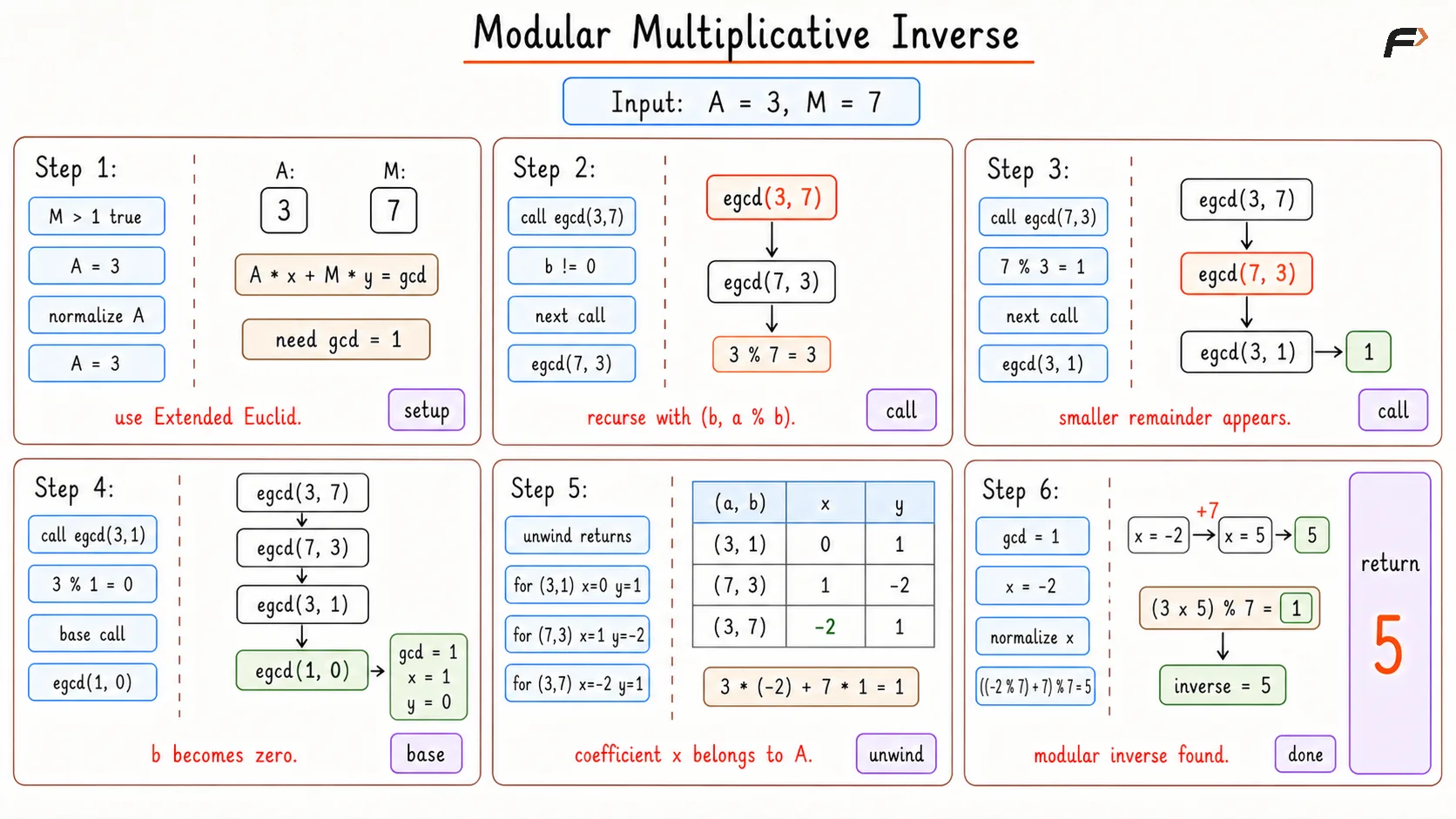
Modular Multiplicative Inverse Better Dry Run
Solution
#include <bits/stdc++.h>using namespace std;class Solution {public: /* Finds gcd(a, b) and coefficients x, y such that a * x + b * y = gcd(a, b). */ long long extendedGcd(long long a, long long b, long long &x, long long &y) { /* When b becomes 0, gcd is a and the coefficient of a is 1. */ if (b == 0) { x = 1; y = 0; return a; } long long x1; long long y1; long long gcdValue = extendedGcd(b, a % b, x1, y1); /* These assignments rebuild the coefficients while returning from recursion. */ x = y1; y = x1 - (a / b) * y1; return gcdValue; } /* Finds the modular inverse using Extended Euclidean Algorithm for any valid coprime A and M. */ long long modInverse(long long A, long long M) { /* A modulus less than or equal to 1 cannot give a valid inverse range. */ if (M <= 1) { return -1; } /* This keeps A inside the standard modulo range. */ A = ((A % M) + M) % M; long long x; long long y; long long gcdValue = extendedGcd(A, M, x, y); /* If gcd is not 1, A and M are not coprime, so the modular inverse does not exist. */ if (gcdValue != 1) { return -1; } /* x may be negative, so this converts it into the standard modulo range. */ return ((x % M) + M) % M; }};// Driver code startsint main() { Solution sol; long long A = 3; long long M = 11; cout << sol.modInverse(A, M); return 0;}Complexity Analysis
Time Complexity: O(log M), because the Euclidean algorithm reduces the numbers quickly.
Space Complexity: O(log M) for the recursive call stack.
Optimal Approach
This approach is used when M is prime. Fermat's Little Theorem says: A^(M - 1) ≡ 1 (mod M) when A is not divisible by prime M. Since the modular inverse of A is the value that turns A into 1 under multiplication, the formula becomes: A^(-1) ≡ A^(M - 2) (mod M)
So the answer is: pow(A, M - 2) % M The exponent can be huge, so binary exponentiation is used to calculate it quickly.
Algorithm
First, check whether
Mis valid. This approach assumesMis prime, so the caller should only use it in that case.Reduce
Aunder moduloMso values larger thanMare handled correctly.If
Abecomes0, return-1because0cannot have a modular inverse.Use binary exponentiation to calculate
A^(M - 2) % M. This is done because directly calculating the full power would be too large and slow.Return the computed power as the modular inverse.
Dry Run
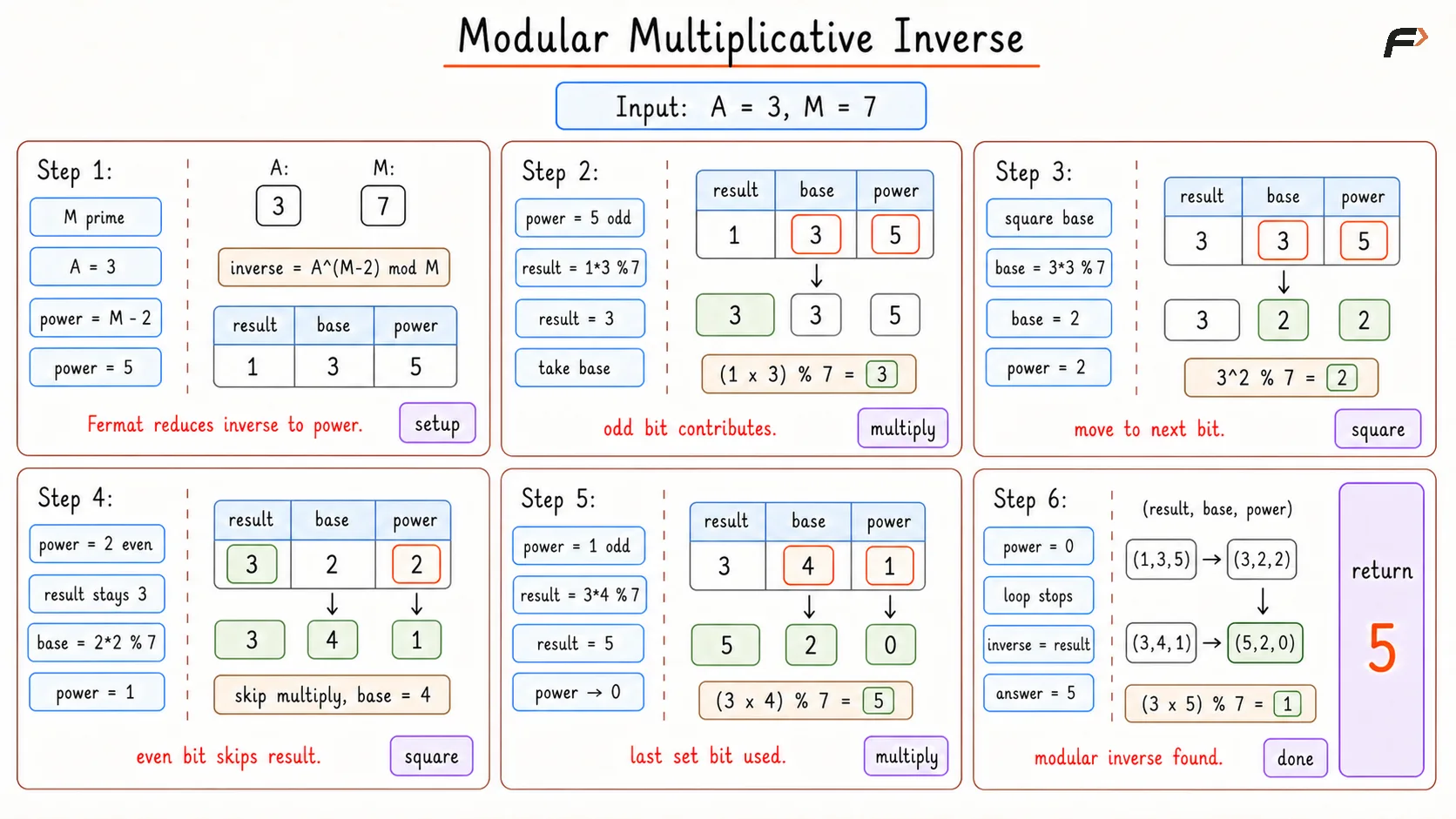
Modular Multiplicative Inverse Optimal Dry Run
Solution
#include <bits/stdc++.h>using namespace std;class Solution {public: /* Computes base^power under modulo M using binary exponentiation. */ long long powerMod(long long base, long long power, long long M) { /* result stores the answer built from the selected powers of base. */ long long result = 1; base = ((base % M) + M) % M; while (power > 0) { /* If the current bit is set, this power of base contributes to the final answer. */ if (power % 2 == 1) { result = (result * base) % M; } /* Squaring base prepares the next power of two. */ base = (base * base) % M; power /= 2; } return result; } /* Finds modular inverse using Fermat's Little Theorem. This function assumes M is prime. */ long long modInverse(long long A, long long M) { /* A modulus less than or equal to 1 cannot give a valid inverse range. */ if (M <= 1) { return -1; } A = ((A % M) + M) % M; /* Under a prime modulus, only multiples of M fail to have an inverse. */ if (A == 0) { return -1; } return powerMod(A, M - 2, M); }};// Driver code startsint main() { Solution sol; long long A = 3; long long M = 11; cout << sol.modInverse(A, M); return 0;}Complexity Analysis
Time Complexity: O(log M), because binary exponentiation halves the exponent at each step.
Space Complexity: O(1), because constant space is used.
Interview follow-up Questions
Because A * X must become 1 under modulo M. If A and M share a common factor greater than 1, then A * X will also keep sharing that factor, so it cannot become 1.
Be the first to add a comment.