Given two string arrays list1 and list2, where every string appears at most once within the same list, return all common strings having the minimum index sum.
For a common string present at index i in list1 and index j in list2, the index sum equals i + j.
The answer may be returned in any order. Return an empty array when no common string exists.
Example 1
Input: list1 = ["Shogun", "Tapioca Express", "Burger King", "KFC"], list2 = ["Piatti", "The Grill at Torrey Pines", "Hungry Hunter Steakhouse", "Shogun"]
Output: ["Shogun"]
Explanation: "Shogun" is the only string present in both lists. The corresponding index sum is 0 + 3 = 3.
Example 2
Input: list1 = ["Shogun", "Tapioca Express", "Burger King", "KFC"], list2 = ["KFC", "Shogun", "Burger King"]
Output: ["Shogun"]
Explanation: The common strings produce the following index sums:
"Shogun":0 + 1 = 1"Burger King":2 + 2 = 4"KFC":3 + 0 = 3
The minimum index sum is 1, so "Shogun" forms the answer.
Example 3
Input: list1 = ["Shogun", "Tapioca Express", "Burger King", "KFC"], list2 = ["KFC", "Shogun", "Burger King"]
Output: ["Shogun"]
Explanation: The common strings produce the following index sums:
"Shogun":0 + 1 = 1"Burger King":2 + 2 = 4"KFC":3 + 0 = 3
The minimum index sum is 1, so "Shogun" forms the answer.
Brute Force Approach
Every common string can be discovered by comparing each entry from list1 with each entry from list2. Without stored lookup information, complete pairwise comparison provides the most direct starting solution.
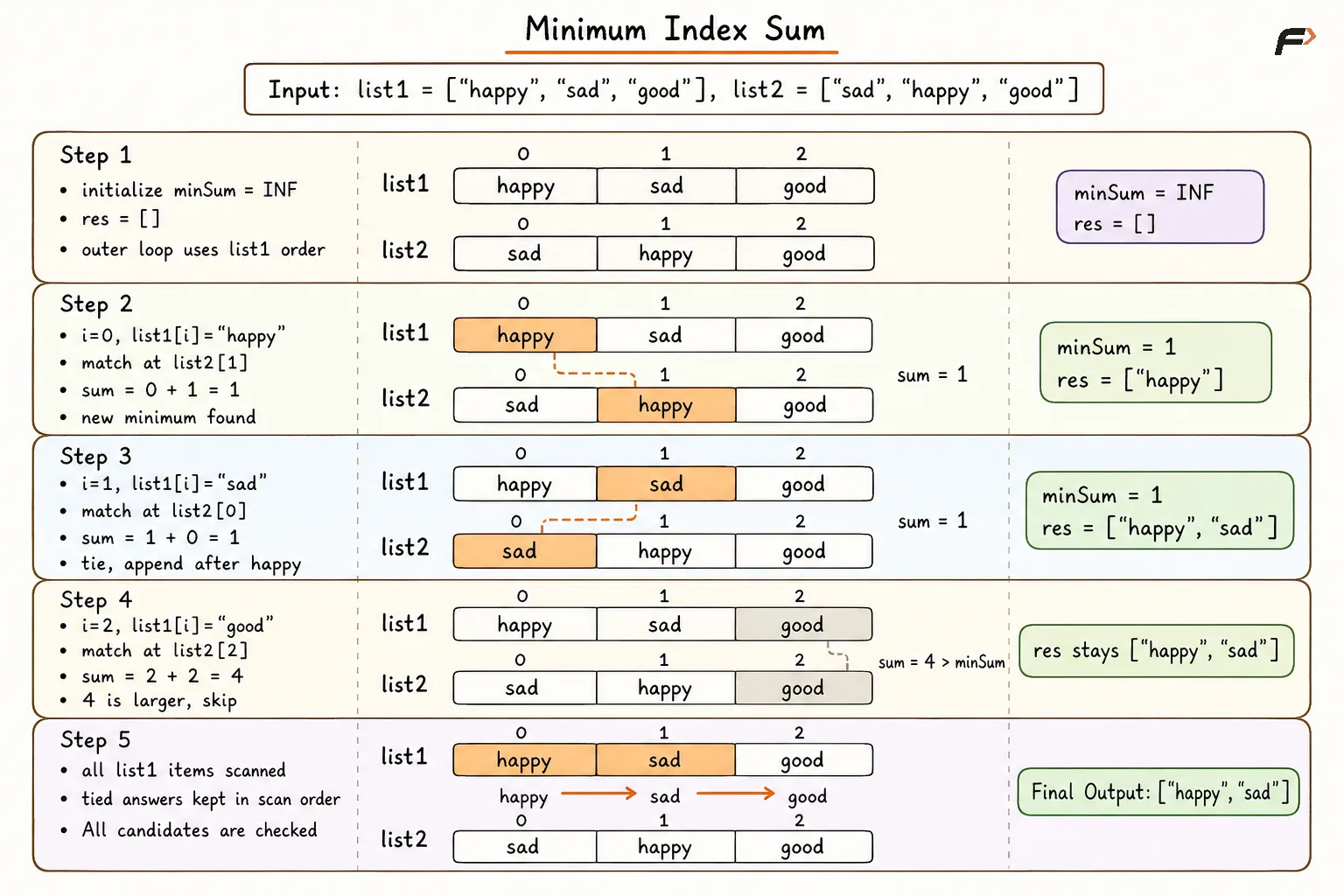
A running minimum avoids storing every common pair. A smaller index sum invalidates all previously collected answers, while an equal index sum represents another valid answer. Processing every pair guarantees that no common string remains unchecked.
Algorithm
Initialize an empty list
resultto store common strings having the smallest index sum.Initialize
minSumwith infinity so that the first common string always becomes the initial answer.Traverse every index
iinlist1.Traverse every index
jinlist2for each selected indexi.Skip the current pair when
list1[i]andlist2[j]differ.Calculate
currentSum = i + jafter finding equal strings.Handle the calculated sum:
Clear
result, updateminSum, and insert the current string whencurrentSum < minSum.Append the current string without clearing earlier answers when
currentSum == minSum.Ignore the current string when
currentSum > minSum.
Return
resultafter processing every possible pair.
Dry Run
j
Solution
#include <bits/stdc++.h>using namespace std;class Solution {public: /* Finds common strings through complete pair comparison. */ vector<string> findRestaurant( vector<string>& list1, vector<string>& list2 ) { vector<string> result; int minSum = INT_MAX; // Compare every possible string pair. for ( int i = 0; i < (int)list1.size(); i++ ) { for ( int j = 0; j < (int)list2.size(); j++ ) { // Skip pairs containing different strings. if (list1[i] != list2[j]) { continue; } int currentSum = i + j; // Replace answers after finding a smaller sum. if (currentSum < minSum) { minSum = currentSum; result.clear(); result.push_back(list1[i]); } // Preserve every answer tied at the minimum. else if (currentSum == minSum) { result.push_back(list1[i]); } } } return result; }};// Driver code to execute the solution.int main() { vector<string> list1 = { "happy", "sad", "good" }; vector<string> list2 = { "sad", "happy", "good" }; Solution solution; vector<string> answer = solution.findRestaurant( list1, list2 ); // Print the resulting strings. cout << "["; for ( int index = 0; index < (int)answer.size(); index++ ) { cout << '"' << answer[index] << '"'; if (index + 1 < (int)answer.size()) { cout << ", "; } } cout << "]" << endl; return 0;}Complexity Analysis
Time Complexity: O(N × M × L), where N represents the number of strings in list1, M represents the number of strings in list2, and L represents the maximum string length. Every pair can require an O(L) string comparison.
Space Complexity: O(1) auxiliary space, excluding the returned strings. A result containing A strings requires O(A × L) output space.
Better Approach
Complete pairwise comparison repeatedly searches list1 for every string in list2. A Hash Map removes the repeated search by associating every string from list1 with the corresponding index.
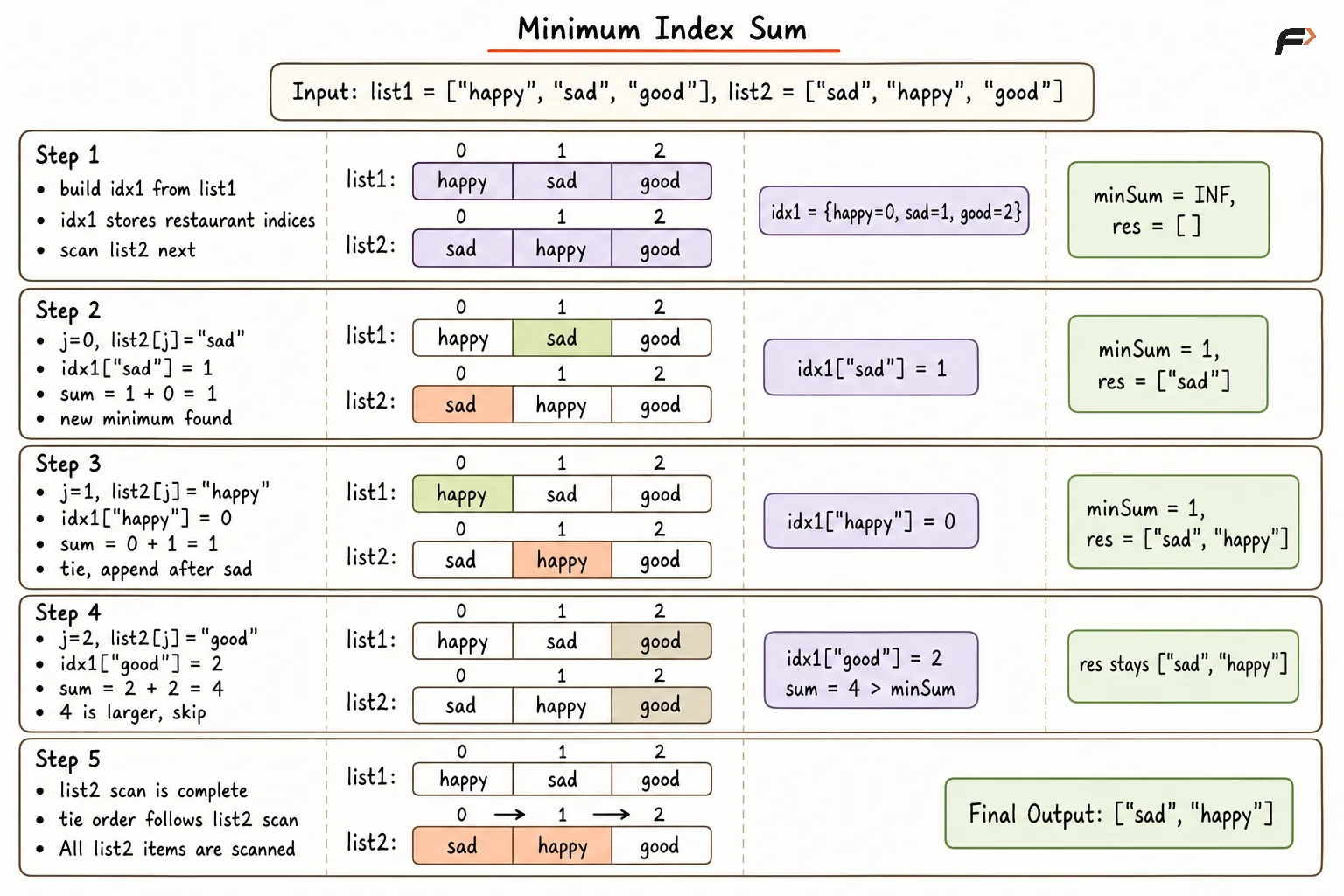
A single traversal of list2 can then identify all common strings and calculate every index sum. This intermediate approach stores those matches inside a temporary list. Separate passes over the temporary list find the minimum sum and collect all tied strings.
Nested comparisons disappear, but the temporary match list and additional passes remain.
Algorithm
Initialize a Hash Map
indexInList1to associate every string inlist1with the corresponding index.Traverse
list1and insert every string-index pair intoindexInList1.Initialize an empty list
commonMatches.Traverse
list2using indexj.Search for
list2[j]insideindexInList1.Store
(j, indexInList1[list2[j]] + j)insidecommonMatcheswhen a matching string exists.Traverse
commonMatchesonce to find the smallest stored index sum.Traverse
commonMatchesagain and append every string whose stored sum equals the minimum.Return an empty result naturally when
commonMatchescontains no entries.
Dry Run
l
Solution
#include <bits/stdc++.h>using namespace std;class Solution {public: /* Stores all common matches before selecting the minimum index sum. */ vector<string> findRestaurant( vector<string>& list1, vector<string>& list2 ) { unordered_map<string, int> indexInList1; // Map every list1 string to the index. for ( int index = 0; index < (int)list1.size(); index++ ) { indexInList1[list1[index]] = index; } vector<pair<int, int>> commonMatches; // Store each common string and index sum. for ( int index = 0; index < (int)list2.size(); index++ ) { auto entry = indexInList1.find( list2[index] ); if (entry != indexInList1.end()) { int currentSum = entry->second + index; commonMatches.push_back({ index, currentSum }); } } int minSum = INT_MAX; // Find the smallest stored index sum. for ( const auto& match : commonMatches ) { minSum = min( minSum, match.second ); } vector<string> result; // Collect every string tied at the minimum. for ( const auto& match : commonMatches ) { if (match.second == minSum) { result.push_back( list2[match.first] ); } } return result; }};// Driver code to execute the solution.int main() { vector<string> list1 = { "happy", "sad", "good" }; vector<string> list2 = { "sad", "happy", "good" }; Solution solution; vector<string> answer = solution.findRestaurant( list1, list2 ); // Print the resulting strings. cout << "["; for ( int index = 0; index < (int)answer.size(); index++ ) { cout << '"' << answer[index] << '"'; if (index + 1 < (int)answer.size()) { cout << ", "; } } cout << "]" << endl;Complexity Analysis
Time Complexity: O((N + M) × L + C) on average, simplified to O((N + M) × L). N and M represent the list lengths, L represents the maximum string length, and C represents the number of common strings. Hashing and matching all input strings requires average O((N + M) × L) time, followed by two O(C) passes.
Space Complexity: O(N × L + C) auxiliary space. The Hash Map stores N string-index entries, while the temporary list stores one index-sum pair for every common string. A result containing A strings additionally requires O(A × L) output space.
Optimal Approach
The Better Approach stores every common match even though only matches having the smallest index sum are required. Most temporary entries are eventually discarded.
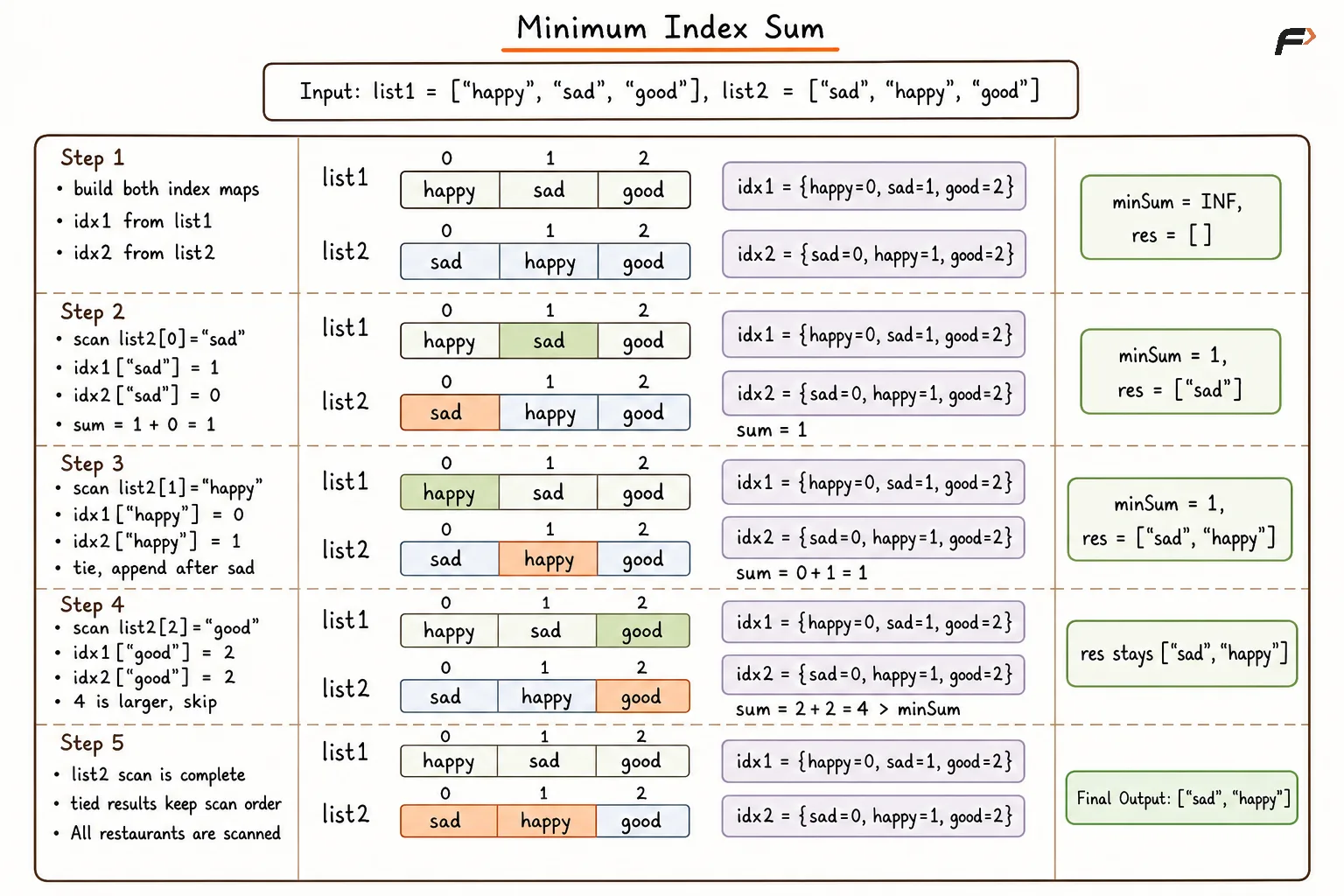
A running minimum can update the answer during the same traversal that discovers common strings. A smaller sum replaces the existing result, while an equal sum adds another answer. The temporary match list and both additional passes become unnecessary.
Indexing the smaller input list further reduces auxiliary storage. The sum of both indices remains unchanged after exchanging the roles of list1 and list2, because addition is commutative.
Algorithm
Compare both list sizes.
Select the smaller list as
indexedListand the other list asscannedList, reducing the maximum number of Hash Map entries.Initialize a Hash Map
indexMap.Traverse
indexedListand associate every string with the corresponding index.Initialize
minSumwith infinity andresultas an empty list.Traverse
scannedListusing indexj.Skip the current string when no matching key exists inside
indexMap.Calculate
currentSum = indexMap[currentString] + jafter finding a common string.Handle the calculated sum:
Clear
result, updateminSum, and insert the current string whencurrentSum < minSum.Append the current string when
currentSum == minSum.Ignore the current string when
currentSum > minSum.
Return
resultafter completing the traversal.
Dry Run
m
Solution
#include <bits/stdc++.h>using namespace std;class Solution {public: /* Tracks the minimum index sum during one Hash Map traversal. */ vector<string> findRestaurant( vector<string>& list1, vector<string>& list2 ) { const vector<string>* indexedList = &list1; const vector<string>* scannedList = &list2; // Index the smaller list to reduce space. if (list1.size() > list2.size()) { indexedList = &list2; scannedList = &list1; } unordered_map<string, int> indexMap; // Store strings from the smaller list. for ( int index = 0; index < (int)indexedList->size(); index++ ) { indexMap[(*indexedList)[index]] = index; } vector<string> result; int minSum = INT_MAX; // Evaluate every string from the other list. for ( int index = 0; index < (int)scannedList->size(); index++ ) { const string& currentString = (*scannedList)[index]; auto entry = indexMap.find(currentString); // Skip strings missing from the indexed list. if (entry == indexMap.end()) { continue; } int currentSum = entry->second + index; // Replace answers after a smaller sum. if (currentSum < minSum) { minSum = currentSum; result.clear(); result.push_back( currentString ); } // Preserve answers tied at the minimum. else if (currentSum == minSum) { result.push_back( currentString ); } } return result; }};// Driver code to execute the solution.int main() { vector<string> list1 = { "happy", "sad", "good" }; vector<string> list2 = { "sad", "happy", "good" }; Solution solution; vector<string> answer = solution.findRestaurant( list1, list2 ); // Print the resulting strings. cout << "["; for ( int index = 0; index < (int)answer.size(); index++ ) { cout << '"' << answer[index] << '"'; if (index + 1 < (int)answer.size()) { cout << ", "; } } cout << "]" << endl;Complexity Analysis
Time Complexity: O((N + M) × L) on average, where N and M represent the two list lengths and L represents the maximum string length. Building the Hash Map and scanning the other list process every input string once.
Space Complexity: O(min(N, M) × L) auxiliary space when string-key contents are included. The Hash Map stores entries from only the smaller list. A result containing A strings additionally requires O(A × L) output space.
FAQs about Minimum Index Sum of Two Lists
1. Why is the result cleared after finding a smaller index sum?
Every previously stored string belongs to a larger index sum. Such strings can no longer remain inside the final answer after a smaller sum appears.
2. Why are equal index sums appended instead of replacing the result?
The required output contains all common strings sharing the minimum index sum. An equal sum represents another valid answer.
3. Why can the smaller list be stored inside the Hash Map?
Hash Map construction requires one entry per indexed string. Selecting the smaller list reduces the number of stored entries without changing the index-sum calculation.
4. Does exchanging the list roles change the index sum?
No. For indices i and j, both i + j and j + i produce the same value.
5. What happens when no common string exists?
No successful lookup occurs, so the result remains empty.
6. Why does the Optimal Approach not need a temporary common-match list?
Every discovered sum is compared directly with the running minimum. Smaller sums replace the result immediately, while equal sums are appended immediately.
7. Do Hash Map operations always require constant time?
Hash Map insertion and lookup require O(1) average operation count. String hashing and comparison can inspect up to L characters, where L represents the maximum string length. Severe hash collisions can also produce slower worst-case performance.
8. Can sorting solve the problem?
Yes. Original indices can be stored with every string, followed by sorting both collections and processing common strings with two pointers. The resulting time complexity includes sorting and remains slower than the average linear Hash Map solution.
9. Why is string uniqueness within each list important?
One stored index is sufficient only when every string occurs once per list. Repeated strings would require storing the earliest index or handling multiple indices explicitly.
Be the first to add a comment.