Given an array lists containing the heads of k singly linked lists, merge every node into one linked list sorted in non-decreasing order. Every input list is already sorted in non-decreasing order. Return the head of the merged list.
Example 1
Input: lists = [[1, 4, 5], [1, 3, 4], [2, 6]]
Output: [1, 1, 2, 3, 4, 4, 5, 6]
Explanation: The smallest available values appear in the order 1, 1, 2, 3, 4, 4, 5, 6, so the merged linked list follows the same order.
Example 2
Input: lists = []
Output: []
Explanation: An empty collection contains no nodes, so the merged head is empty.
Brute Force Approach
The simplest way is to collect all node values from the k sorted linked lists into one array. Once all values are available together, sorting the array directly gives the final merged order.
After sorting, build a new linked list using these values. This approach is easy to understand, but it does not use the fact that the input lists are already sorted.
Algorithm
Create an empty array named
valuesto store all node values.Traverse every linked list and add each node value to
values, because every element must appear in the final merged list.Sort
valuesin non-decreasing order so all elements are arranged correctly.Create a dummy node and keep a
tailpointer, because this makes building the new list simpler.Traverse the sorted
valuesarray:Create a new node for each value.
Attach it after
tail.Move
tailto the newly created node.
Return
dummy.nextbecause it points to the first node of the merged sorted list.
Dry Run
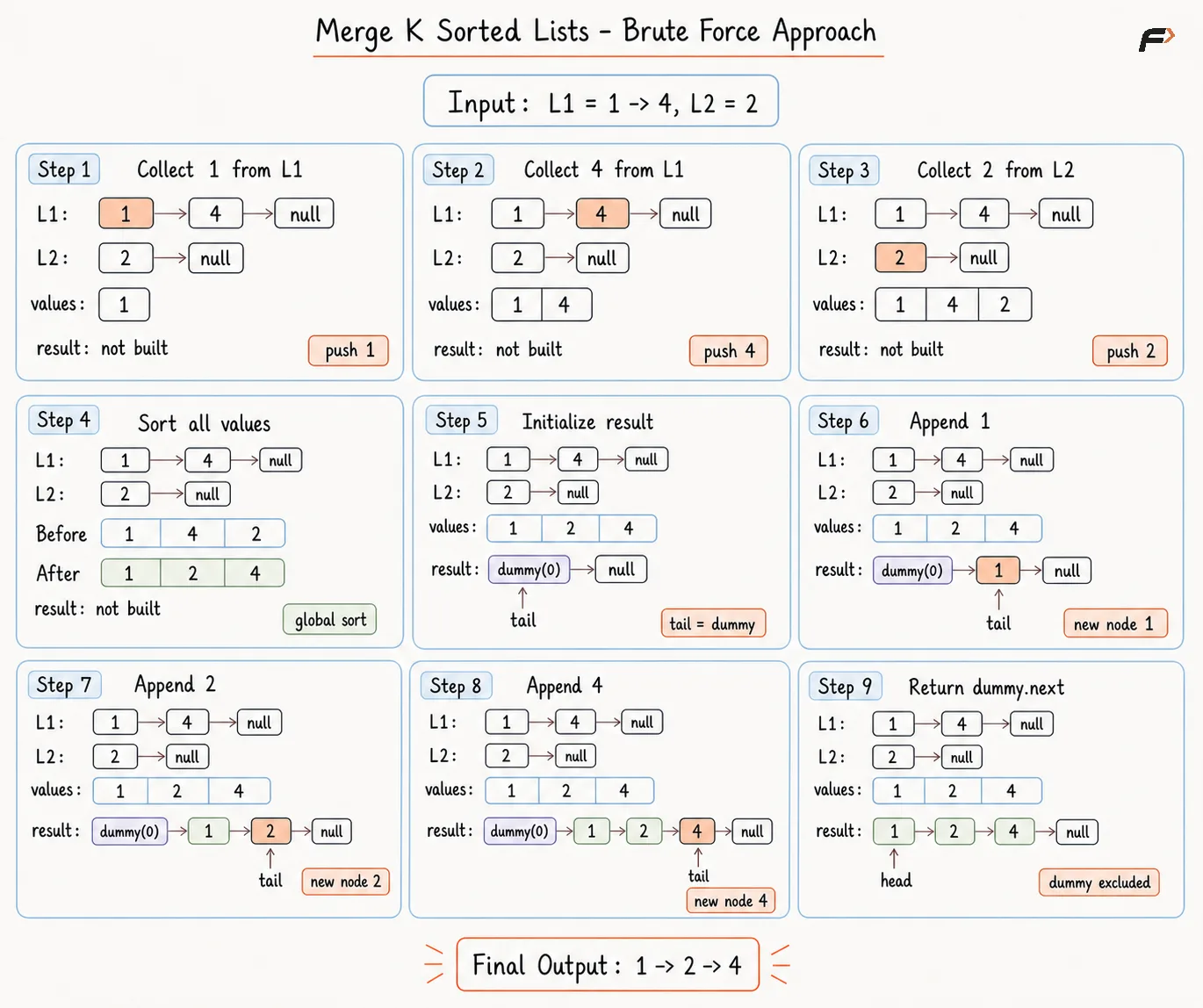
merge-k-sorted-lists-brute-force
Solution
#include <bits/stdc++.h>using namespace std;class ListNode {public: int val; ListNode* next; // Creates one linked-list node. ListNode(int value) { val = value; next = nullptr; }};class Solution {private: // Builds a linked list from fixed values. ListNode* buildList(vector<int> values) { ListNode* dummy = new ListNode(0); ListNode* tail = dummy; // Append every value in the supplied order. for (int value : values) { tail->next = new ListNode(value); tail = tail->next; } return dummy->next; } // Prints all values in one linked list. void printList(ListNode* head) { ListNode* current = head; // Print nodes from head to tail. while (current != nullptr) { cout << current->val; current = current->next; // Add separators only between adjacent values. if (current != nullptr) { cout << " "; } } cout << endl; }public: // Merges all lists by sorting every value. ListNode* mergeKLists(vector<ListNode*>& lists) { // Store every node value for global sorting. vector<int> values; // Visit every list because every node is required. for (ListNode* head : lists) { ListNode* current = head; // Collect values until the current list ends. while (current != nullptr) { values.push_back(current->val); current = current->next; } } // Arrange all collected values in final order. sort(values.begin(), values.end()); // Use a dummy node to simplify first insertion. ListNode* dummy = new ListNode(0); ListNode* tail = dummy; // Build a fresh list from the sorted values. for (int value : values) { tail->next = new ListNode(value); tail = tail->next; } // Skip the temporary dummy node in the result. return dummy->next; } // Runs the given example. void run() { vector<ListNode*> lists = { buildList({1, 4, 5}), buildList({1, 3, 4}), buildList({2, 6}) }; printList(mergeKLists(lists)); }};// Driver codeint main() { Solution obj; obj.run(); return 0;}Complexity Analysis
Time Complexity: O(N log N), where N is the total number of nodes across all linked lists. Collecting and rebuilding visit all N nodes, while sorting the N collected values dominates the running time.
Space Complexity: O(N), because the values array and the newly created result list require storage proportional to the total number of nodes.
Better Approach
The input lists are already sorted, so sorting all values again wastes useful information. Instead, merge two sorted lists at a time and keep the merged result sorted after every step.
Each merge reuses the existing nodes and needs no extra values array. However, the growing merged list may be traversed again for every new list, so the total work can become large when many lists are present.
Algorithm
Initialize
merged = nullso the first list can become the starting result.Process each linked list one by one and merge it with
merged, because both lists are already sorted.For each two-list merge, create a dummy node and a
tailpointer to simplify attaching nodes.Compare the current nodes of both lists:
Attach the node with the smaller value because it must come next in sorted order.
Move only the pointer of the chosen node.
Move
tailforward after attaching the node.
When one list becomes empty, attach the remaining part of the other list because it is already sorted.
Update
mergedwith the newly merged list after each step.Return
mergedafter all input lists have been processed.
Dry Run
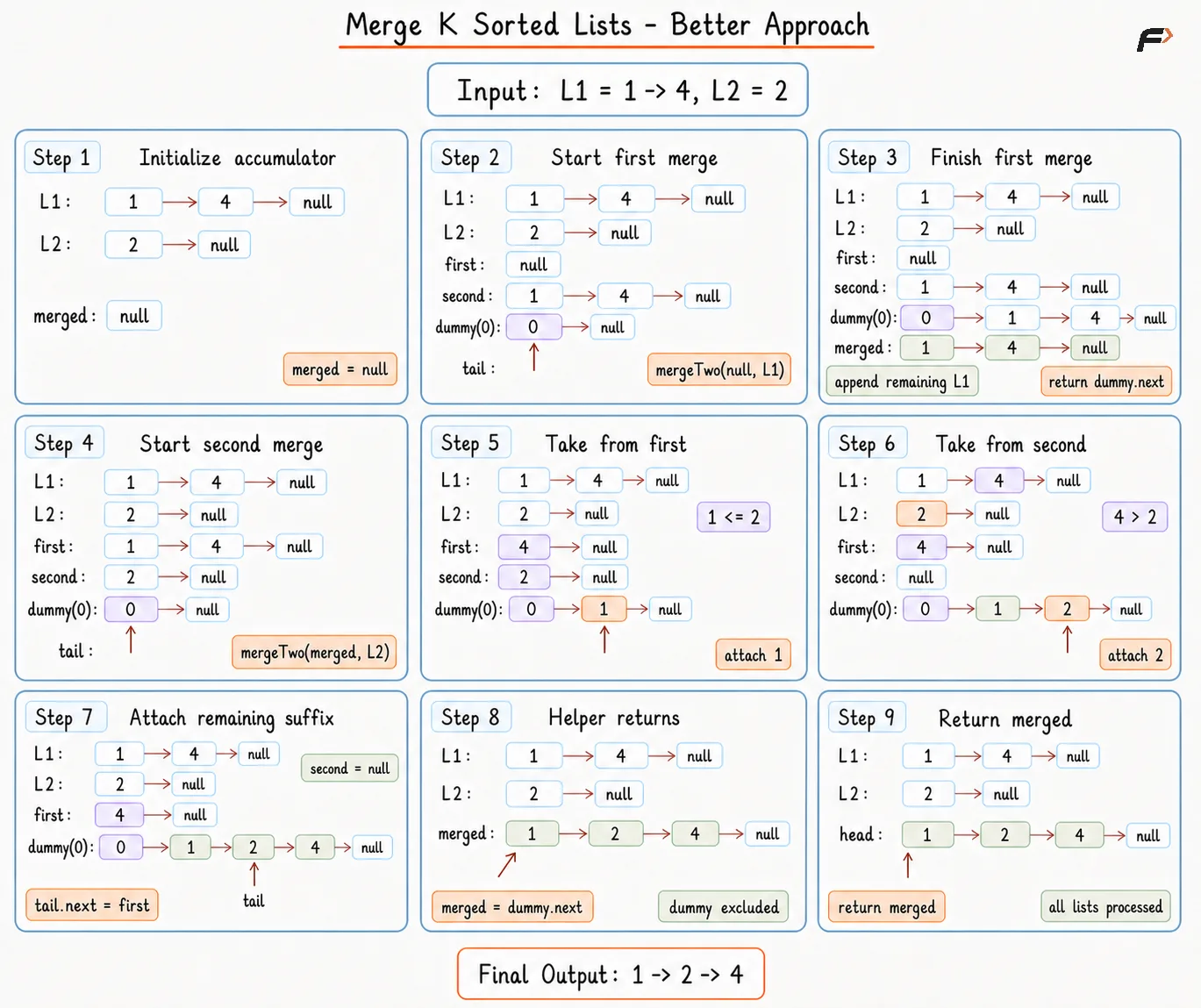
merge-k-sorted-lists-better
Solution
#include <bits/stdc++.h>using namespace std;class ListNode {public: int val; ListNode* next; // Creates one linked-list node. ListNode(int value) { val = value; next = nullptr; }};class Solution {private: // Merges two sorted linked lists in place. ListNode* mergeTwo(ListNode* first, ListNode* second) { // Use a dummy node to simplify first attachment. ListNode* dummy = new ListNode(0); ListNode* tail = dummy; // Compare heads while both lists contain nodes. while (first != nullptr && second != nullptr) { // Choose first when the first value is smaller. if (first->val <= second->val) { tail->next = first; first = first->next; } else { tail->next = second; second = second->next; } tail = tail->next; } // Append the sorted suffix still containing nodes. if (first != nullptr) { tail->next = first; } else { tail->next = second; } return dummy->next; } // Builds a linked list from fixed values. ListNode* buildList(vector<int> values) { ListNode* dummy = new ListNode(0); ListNode* tail = dummy; // Append every value in the supplied order. for (int value : values) { tail->next = new ListNode(value); tail = tail->next; } return dummy->next; } // Prints all values in one linked list. void printList(ListNode* head) { ListNode* current = head; // Print nodes from head to tail. while (current != nullptr) { cout << current->val; current = current->next; // Add separators only between adjacent values. if (current != nullptr) { cout << " "; } } cout << endl; }public: // Merges lists from left to right. ListNode* mergeKLists(vector<ListNode*>& lists) { ListNode* merged = nullptr; // Grow one sorted result with each input list. for (ListNode* head : lists) { merged = mergeTwo(merged, head); } return merged; } // Runs the given example. void run() { vector<ListNode*> lists = { buildList({1, 4, 5}), buildList({1, 3, 4}), buildList({2, 6}) }; printList(mergeKLists(lists)); }};// Driver codeint main() { Solution obj; obj.run(); return 0;}Complexity Analysis
Time Complexity: O(N × k), a node already present in the growing result can be scanned again during many later merges in the worst case.
Space Complexity: O(1), iterative pointer relinking uses only a dummy node and a few pointers beyond the returned list.
Optimal Approach
Since every linked list is already sorted, the next node in the merged list must be the smallest among the current list heads. A min-heap helps find this node quickly without checking all k lists every time.
Keep only one active node from each list in the heap. After removing the smallest node, add its next node from the same list. This keeps the heap size at most k and builds the merged list in sorted order.
Algorithm
Create a min-heap ordered by node value so the smallest current node is always available at the top.
Insert the head of every non-empty linked list because each head is the smallest remaining node from that list.
Create a dummy node and keep a
tailpointer to simplify building the merged list.While the heap is not empty:
Remove the smallest node from the heap because it must be the next node in sorted order.
Attach this node after
tail.Move
tailto the attached node.If the removed node has a next node, insert that next node into the heap because it becomes the new candidate from the same list.
Return
dummy.nextbecause it points to the first node of the completely merged sorted list.
Dry Run
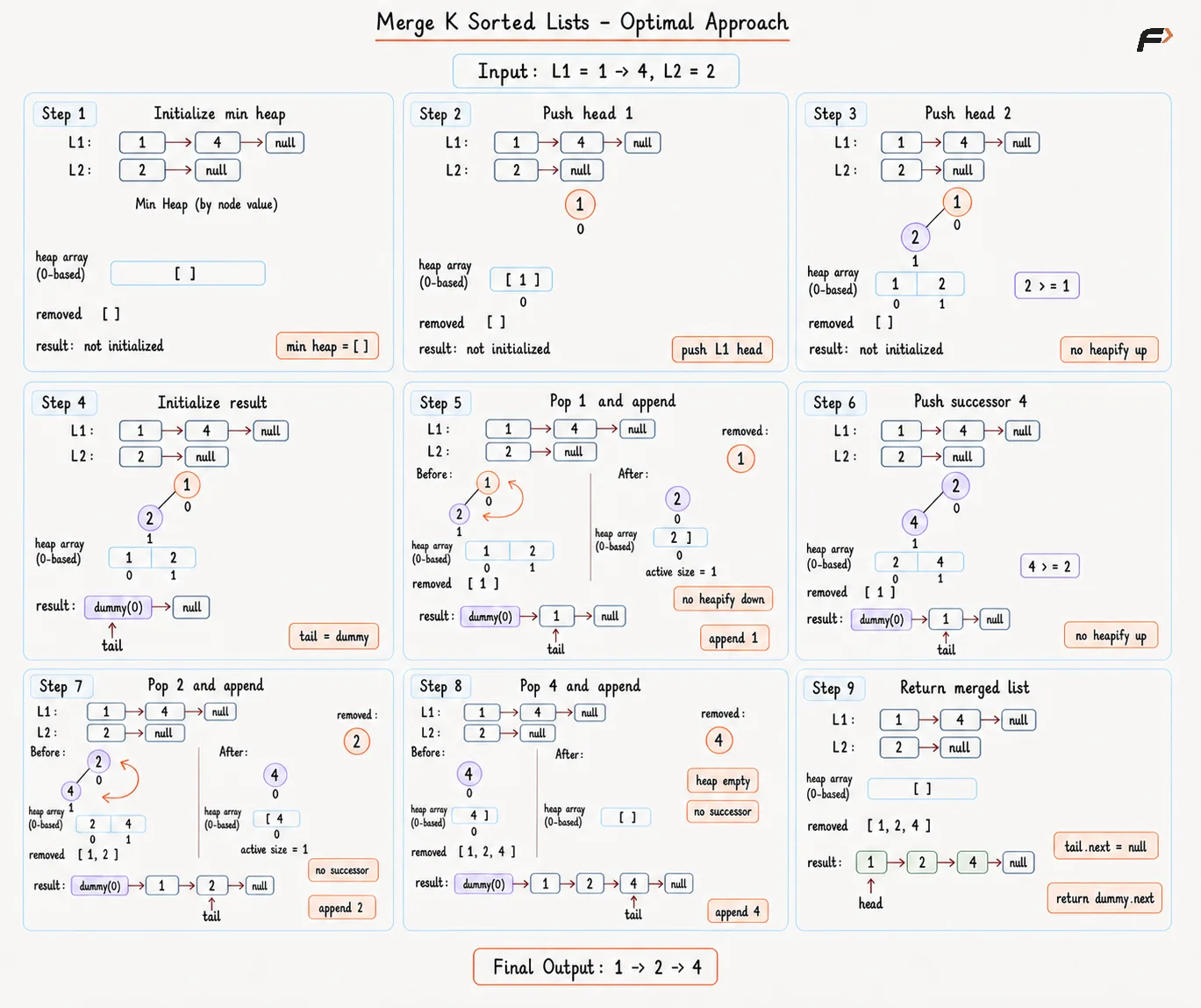
Merge k Sorted List Optimal
Solution
#include <bits/stdc++.h>using namespace std;class ListNode {public: int val; ListNode* next; // Creates one linked-list node. ListNode(int value) { val = value; next = nullptr; }};class Solution {private: class Compare { public: // Gives smaller values higher heap priority. bool operator()(ListNode* first, ListNode* second) { return first->val > second->val; } }; // Builds a linked list from fixed values. ListNode* buildList(vector<int> values) { ListNode* dummy = new ListNode(0); ListNode* tail = dummy; // Append every value in the supplied order. for (int value : values) { tail->next = new ListNode(value); tail = tail->next; } return dummy->next; } // Prints all values in one linked list. void printList(ListNode* head) { ListNode* current = head; // Print nodes from head to tail. while (current != nullptr) { cout << current->val; current = current->next; // Add separators only between adjacent values. if (current != nullptr) { cout << " "; } } cout << endl; }public: // Merges all lists with a min-heap. ListNode* mergeKLists(vector<ListNode*>& lists) { // Keep one active node from each non-empty list. priority_queue< ListNode*, vector<ListNode*>, Compare > minHeap; // Insert every available list head as a candidate. for (ListNode* head : lists) { // Empty lists provide no heap candidate. if (head != nullptr) { minHeap.push(head); } } // Use a dummy node to simplify first attachment. ListNode* dummy = new ListNode(0); ListNode* tail = dummy; // Extract the smallest remaining candidate. while (!minHeap.empty()) { ListNode* smallest = minHeap.top(); minHeap.pop(); tail->next = smallest; tail = tail->next; // Add the next candidate from the same list. if (smallest->next != nullptr) { minHeap.push(smallest->next); } } // End the result after the final selected node. tail->next = nullptr; return dummy->next; } // Runs the given example. void run() { vector<ListNode*> lists = { buildList({1, 4, 5}), buildList({1, 3, 4}), buildList({2, 6}) }; printList(mergeKLists(lists)); }};// Driver codeint main() { Solution obj; obj.run(); return 0;}Complexity Analysis
Time Complexity: O(N log k), every node enters and leaves a heap containing at most k active nodes once.
Space Complexity: O(k), the min-heap stores at most one active node from each input list.
Interview follow-up Questions
Yes. Every node must remain in the result, so equal values from different lists appear as separate nodes.
Be the first to add a comment.