Problem Statement
Given a non-empty integer array nums, return the arithmetic mean of all its elements.
Example 1
Input: nums = [2, 4, 6, 8]
Output: 5
Explanation: Sum = 2 + 4 + 6 + 8 = 20, and total elements = 4. So, mean = 20 / 4 = 5.
Example 2
Input: nums = [5, -2, 10, 3]
Output: 4
Explanation: Sum = 5 + (-2) + 10 + 3 = 16, and total elements = 4. So, mean = 16 / 4 = 4.
Approach
Maintain a running sum while traversing the array.
After every element has been added, divide the total sum by the number of elements. The division must use a floating-point value so that any decimal part of the mean is preserved.
Algorithm
Store the number of elements in
n, since it will be needed to divide the total sum and calculate the mean.Initialize
sumwith0, where it keeps the running total of the elements processed so far.Traverse
numsonce and add each element tosum, ensuring every value contributes exactly once to the total.Divide
sumbynusing floating-point division so that the fractional part of the mean is not lost.Return the calculated mean after all elements have been included.
Dry Run
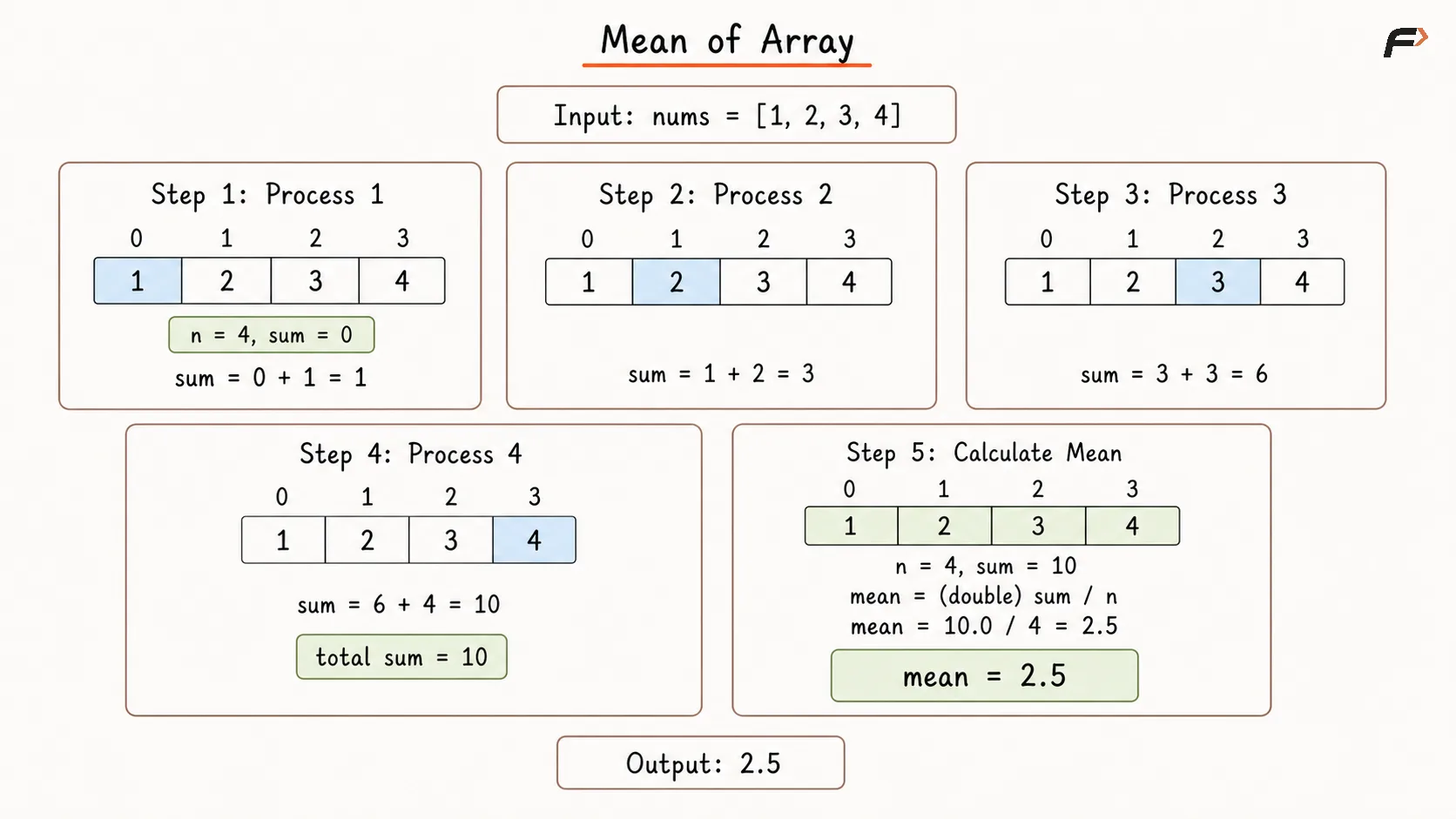
Mean of Array Elements Dry Run.png
Solution
#include <bits/stdc++.h>using namespace std;class Solution {public: // Calculates the arithmetic mean using the total sum and array size. double findMean(const vector<int>& nums) { // This defensive check prevents division by zero for empty input. if (nums.empty()) { return 0.0; } long long sum = 0; // Add every element once to calculate the complete total. for (int value : nums) { sum += value; } // Convert sum to double so the fractional part is preserved. return (double) sum / nums.size(); }};int main() { vector<int> nums = {1, 2, 3, 4}; Solution solution; cout << fixed << setprecision(2); cout << "Mean: " << solution.findMean(nums) << endl; return 0;}Complexity Analysis
Time Complexity: O(N), where N represents the number of elements in the array. Every element is visited exactly once.
Space Complexity: O(1), because only n, sum, and the calculated mean require extra storage.
Interview follow-up Questions
The mean may contain a fractional part. Floating-point division preserves this part, while integer division may discard it.
Be the first to add a comment.