Problem Statement
Given a binary array nums, return the maximum number of consecutive 1s present in the array.
A consecutive group must contain only 1s without any 0 between them.
Return 0 when the array is empty or contains no 1.
Example 1
Input: nums = [1, 1, 0, 1, 1, 1]
Output: 3
Explanation: The first two 1s form a consecutive group of length 2, and the last three 1s form a consecutive group of length 3. Therefore, the maximum number of consecutive 1s is 3.
Example 2
Input: nums = [1, 0, 1, 1, 0, 1]
Output: 2
Explanation: The longest continuous group of 1s is [1, 1], so the answer is 2.
Example 3
Input: nums = [0, 0, 0]
Output: 0
Explanation: There is no 1 present in the array, so the maximum number of consecutive 1s is 0.
Brute Force Approach
Every consecutive group can be represented by a starting and ending index.
The direct approach generates every possible subarray and checks whether the complete range contains only 1s. The longest valid range becomes the answer.
Many overlapping subarrays are checked repeatedly, leading to a high running time.
Algorithm
Store the array size in
n. If the array is empty, return0because no consecutive group of1s can exist.Initialize
maxLengthwith0, where it stores the longest all-ones subarray found so far.Use
startandendto generate every possible subarray[start, end], ensuring that every possible consecutive range is considered.For each range, assume it is valid and traverse from
starttoendto verify that every element is1.If a
0is encountered, mark the range invalid and stop checking it because that subarray can no longer represent consecutive1s.If the complete range remains valid, update
maxLengthwith its length. ReturnmaxLengthafter all subarrays have been examined.
Dry Run
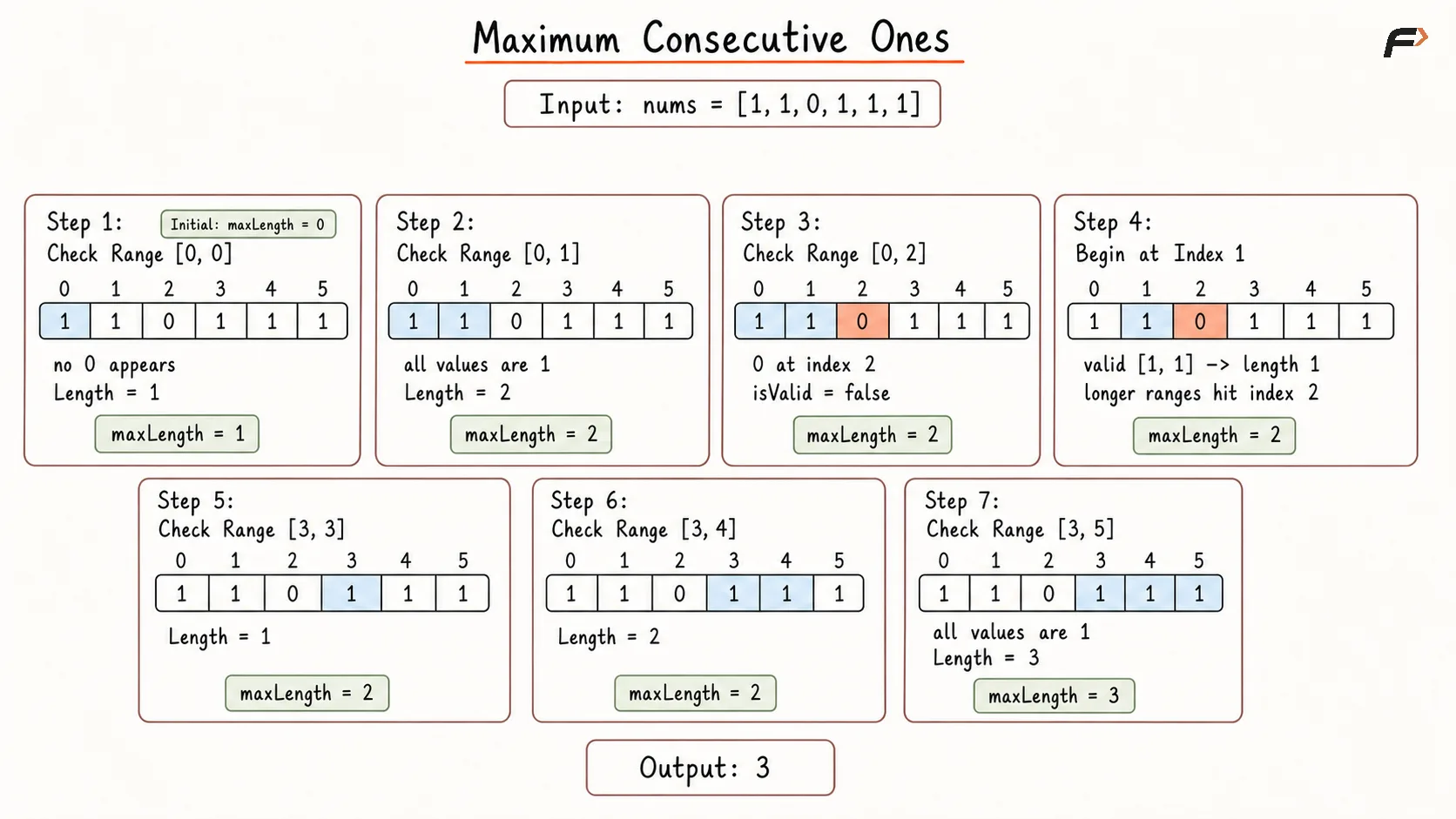
Max Consecutive Ones Brute Force Dry Run.png
Solution
#include <bits/stdc++.h>using namespace std;class Solution {public: int findMaxConsecutiveOnes(vector<int>& nums) { int n = nums.size(); int maxLength = 0; // Check every possible subarray. for (int start = 0; start < n; start++) { for (int end = start; end < n; end++) { bool isValid = true; /* * Check whether the complete range * contains only 1s. */ for (int index = start; index <= end; index++) { // A zero breaks the consecutive-ones range. if (nums[index] == 0) { isValid = false; break; } } // Update the answer only for an all-ones range. if (isValid) { maxLength = max(maxLength, end - start + 1); } } } return maxLength; }};int main() { vector<int> nums = {1, 1, 0, 1, 1, 1}; Solution solution; cout << solution.findMaxConsecutiveOnes(nums) << endl; return 0;}Complexity Analysis
Time Complexity: O(N³), where N represents the array size. Two loops generate O(N²) subarrays, and each selected range may require O(N) time for validation.
Space Complexity: O(1), because only loop variables, isValid, and maxLength require auxiliary storage.
Better Approach
For a fixed starting index, the selected range remains valid only while every visited value is 1.
Once a 0 appears, extending the same range cannot produce an all-ones subarray. The expansion can therefore stop immediately instead of checking longer invalid ranges.
Algorithm
Store the array size in
n. If the array is empty, return0because there is no streak to examine.Initialize
maxLengthwith0, where it keeps the longest consecutive-ones streak found across all starting positions.Treat every index
startas a possible beginning of a streak. Ifnums[start]is0, skip it because an all-ones range cannot begin there.For a valid starting position, initialize
currentLengthwith0and moveendtoward the right while the values remain1.Increase
currentLengthfor every1encountered and updatemaxLengthwhenever the active streak becomes longer than the best streak found earlier.Stop expanding as soon as a
0appears, since every longer range from the samestartwould also contain that zero. ReturnmaxLengthafter all starting positions have been processed.
Dry Run
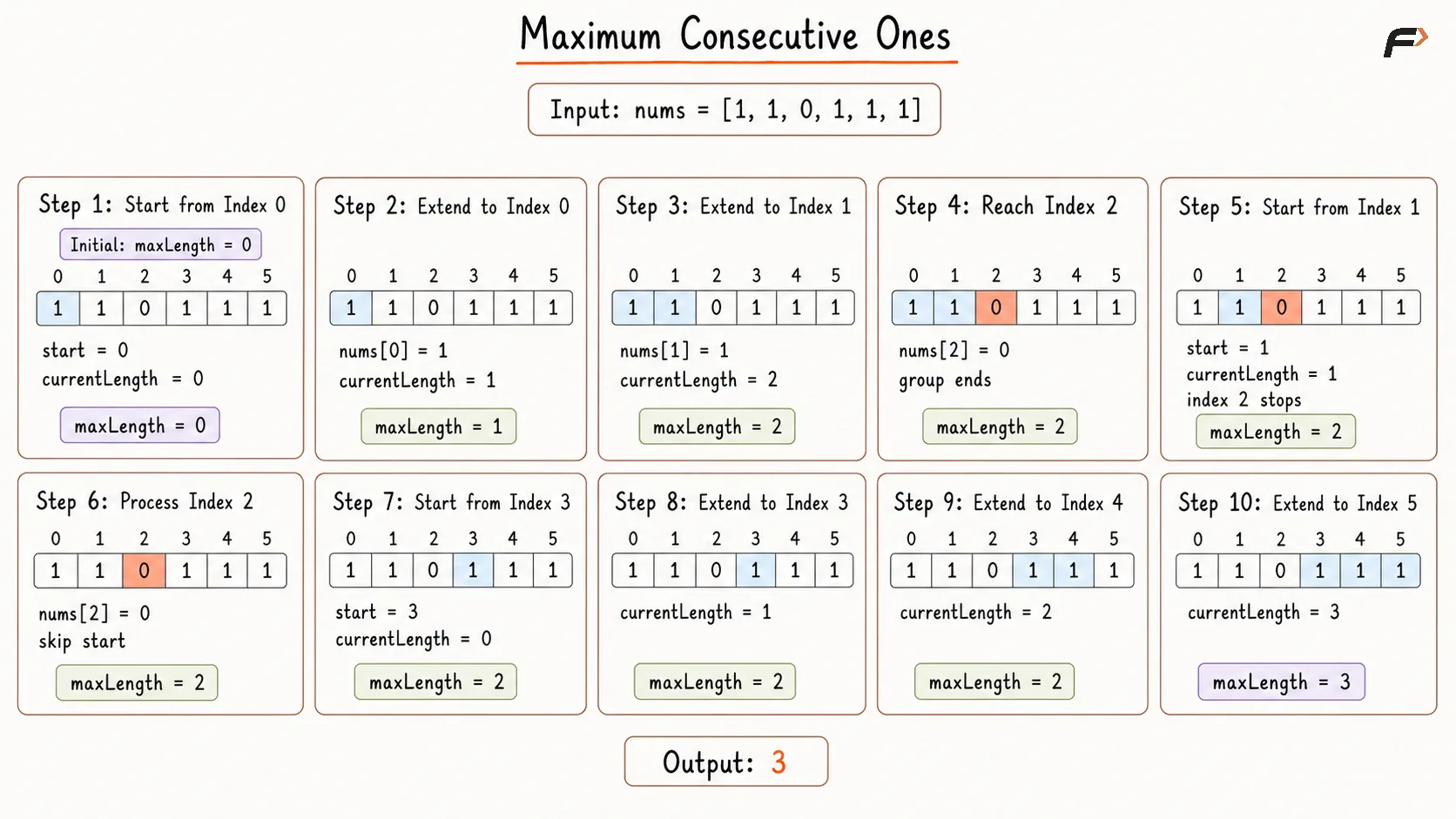
Max Consecutive Ones Better Approach Dry Run.png
Solution
#include <bits/stdc++.h>using namespace std;class Solution {public: int findMaxConsecutiveOnes(vector<int>& nums) { int n = nums.size(); int maxLength = 0; for (int start = 0; start < n; start++) { // A consecutive-ones range cannot start at 0. if (nums[start] == 0) { continue; } int currentLength = 0; /* * Extend the range until the first * zero breaks the current streak. */ for (int end = start; end < n; end++) { if (nums[end] == 0) { break; } currentLength++; maxLength = max(maxLength, currentLength); } } return maxLength; }};int main() { vector<int> nums = {1, 1, 0, 1, 1, 1}; Solution solution; cout << solution.findMaxConsecutiveOnes(nums) << endl; return 0;}Complexity Analysis
Time Complexity: O(N²), where N represents the array size. In an array containing only 1s, every starting index expands through all remaining positions.
Space Complexity: O(1), because only loop variables, currentLength, and maxLength require auxiliary storage.
Optimal Approach
Only the active streak and the best streak found earlier need to be tracked.
Every 1 extends the current consecutive group. A 0 breaks continuity, so the active count must return to 0.
Updating the maximum whenever a 1 extends the streak builds the answer during one traversal.
Algorithm
Initialize
currentCountwith0, where it stores the length of the consecutive-ones streak currently being processed.Initialize
maxCountwith0, where it keeps the longest streak found anywhere in the array.Traverse the array once so that every element contributes directly to the current streak state.
If the current value is
1, incrementcurrentCountbecause the active streak continues, and updatemaxCountif this streak becomes the longest seen so far.If the current value is
0, resetcurrentCountto0because a consecutive streak cannot continue across a zero.Return
maxCountafter the traversal, which also naturally gives0when the array is empty or contains no1.
Dry Run
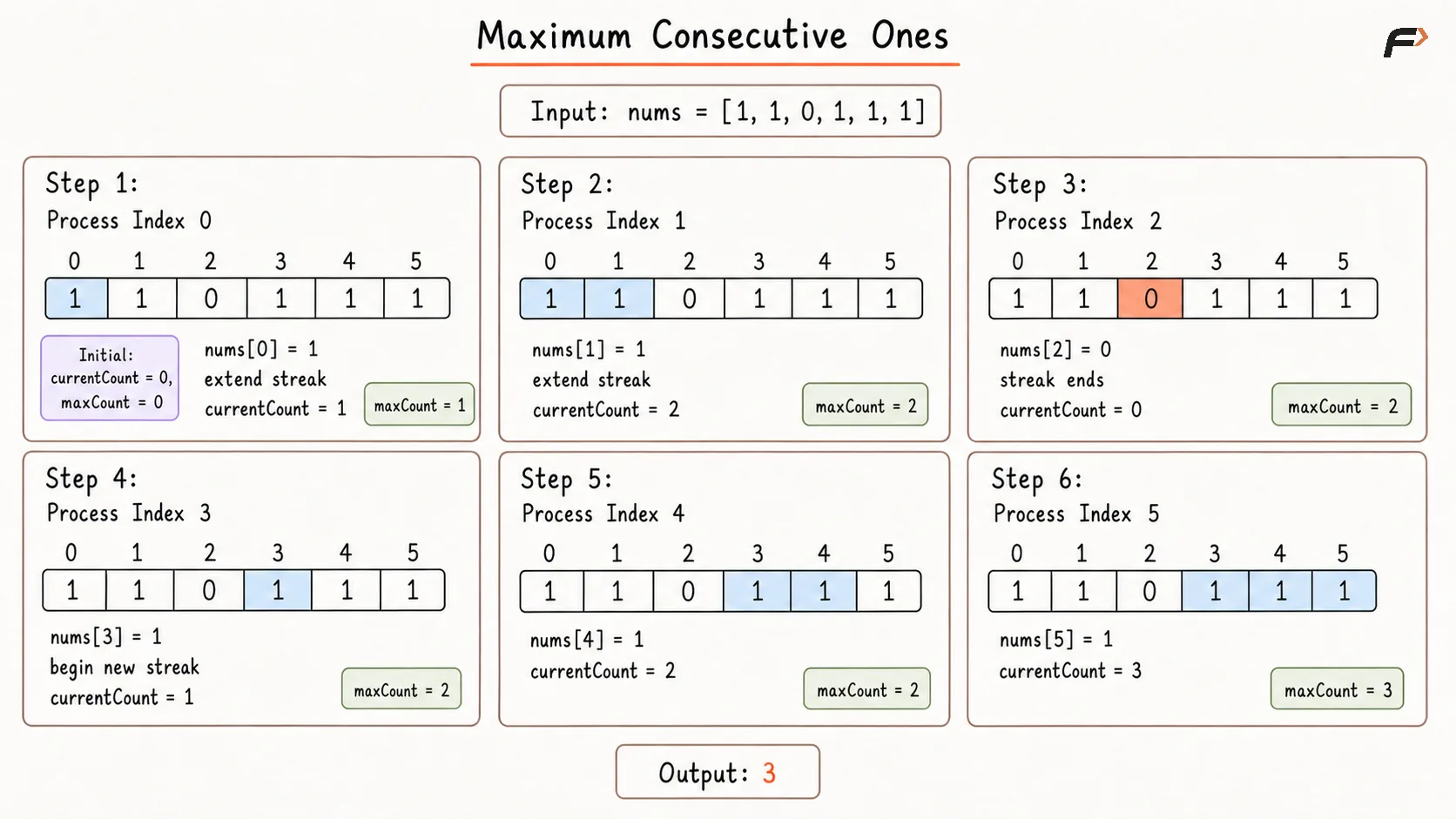
Max Consecutive Ones Optimal Approach Dry Run.png
Solution
#include <bits/stdc++.h>using namespace std;class Solution {public: int findMaxConsecutiveOnes(vector<int>& nums) { int currentCount = 0; int maxCount = 0; for (int num : nums) { // A 1 extends the current streak. if (num == 1) { currentCount++; maxCount = max(maxCount, currentCount); } // A zero breaks the current streak. else { currentCount = 0; } } return maxCount; }};int main() { vector<int> nums = {1, 1, 0, 1, 1, 1}; Solution solution; cout << solution.findMaxConsecutiveOnes(nums) << endl; return 0;}Complexity Analysis
Time Complexity: O(N), where N represents the array size. Every element is processed exactly once.
Space Complexity: O(1), because only currentCount and maxCount require auxiliary storage.
FAQs
Q1. Why must currentCount reset after encountering 0?
A consecutive-ones group cannot continue across a zero. Resetting currentCount begins a fresh streak for later positions.
Q2. Can maxCount be updated only after encountering 0?
Yes, but an additional update becomes necessary after traversal for a streak ending at the final index. Updating after every 1 avoids separate end handling.
Q3. How can the starting and ending indices of the longest streak be returned?
Track the starting index of the active streak. Update the best starting and ending indices whenever currentCount exceeds maxCount.
Q4. How does the solution change when one zero may be flipped?
A sliding window can maintain a range containing at most one zero. The longest valid window gives the answer.
Q5. Can the same one-pass pattern find maximum consecutive zeros?
Yes. Increase the active counter for 0 and reset the counter for 1.
Be the first to add a comment.