Given a string s, return the length of the longest substring with no repeating characters.
A substring is a continuous part of the string.
Only the length is required.
Example 1
Input: s = "abcabcbb"
Output: 3
Explanation: The longest substring without repeating characters is "abc", so the answer is 3.
Example 2
Input: s = "bbbbb"
Output: 1
Explanation: The longest substring without repeating characters is "b", so the answer is 1.
Example 3
Input: s = ""
Output: 0
Explanation: The string is empty, so there is no substring.
Brute Force Approach
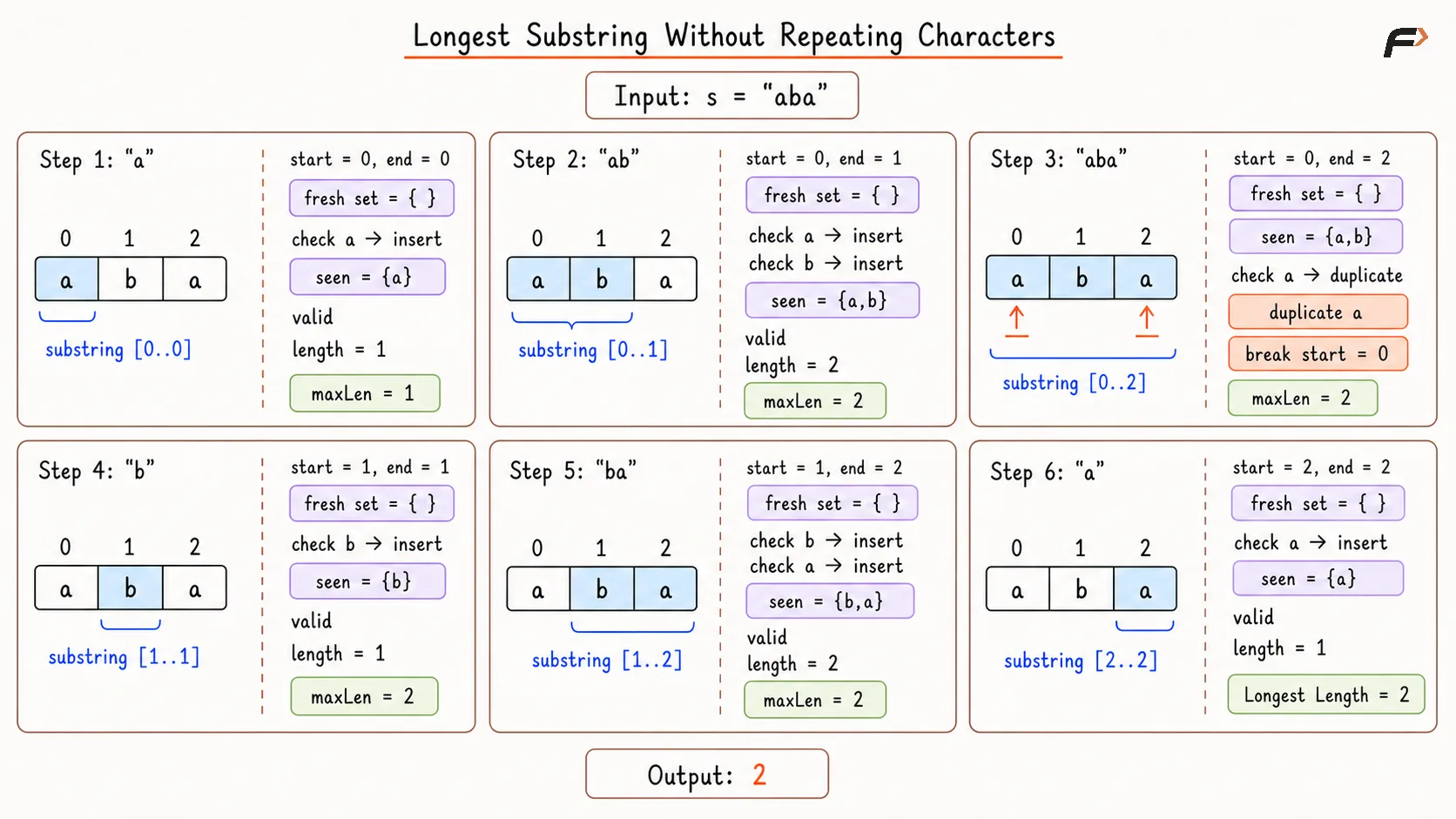
A direct solution examines every possible substring. Every pair of start and end indices defines one contiguous substring, so complete enumeration guarantees coverage of every possible answer.
A separate helper checks character uniqueness inside each selected range. A fresh set stores characters from only the current substring. Complete rechecking keeps the logic simple, but repeated scanning of overlapping substrings creates considerable extra work.
Algorithm
Initialize
maxLenwith0because no valid substring has been found initially.Traverse every possible
startindex from0toN - 1.For each
start, moveendfromstarttowardN - 1so every substring beginning at that position can be examined.Pass
s[start...end]to a helper that uses a fresh set to determine whether all characters in the range are distinct.If the helper finds a duplicate, break the current
endtraversal, because extending the same substring cannot remove that duplicate.Otherwise, update
maxLenwithend - start + 1, then returnmaxLenafter all starting positions are processed.
Dry Run
Longest Substring Without Repeating Characters Brute Force Dry Run.png
Solution
#include <bits/stdc++.h>using namespace std;class Solution {private: // Checks whether all characters // in the selected range are distinct. bool hasUniqueCharacters( const string& s, int start, int end ) { unordered_set<char> seen; // Scan the selected substring. for (int i = start; i <= end; i++) { // A repeated character // makes the substring invalid. if (seen.count(s[i])) { return false; } seen.insert(s[i]); } return true; }public: // Returns the longest substring length // without repeating characters. int lengthOfLongestSubstring(string s) { int n = s.size(); int maxLen = 0; // Try every possible start. for (int start = 0; start < n; start++) { // Extend the substring // from the current start. for (int end = start; end < n; end++) { // A longer range will still // contain the same duplicate. if (!hasUniqueCharacters(s, start, end)) { break; } maxLen = max( maxLen, end - start + 1 ); } } return maxLen; }};int main() { string s = "abcabcbb"; Solution solution; cout << solution.lengthOfLongestSubstring(s) << endl; return 0;}Complexity Analysis
Time Complexity: O(N³), where N represents the string length. O(N²) substrings exist, and every uniqueness check may scan up to N characters.
Space Complexity: O(N), because the helper set may store every character from one substring in the worst case.
Better Approach
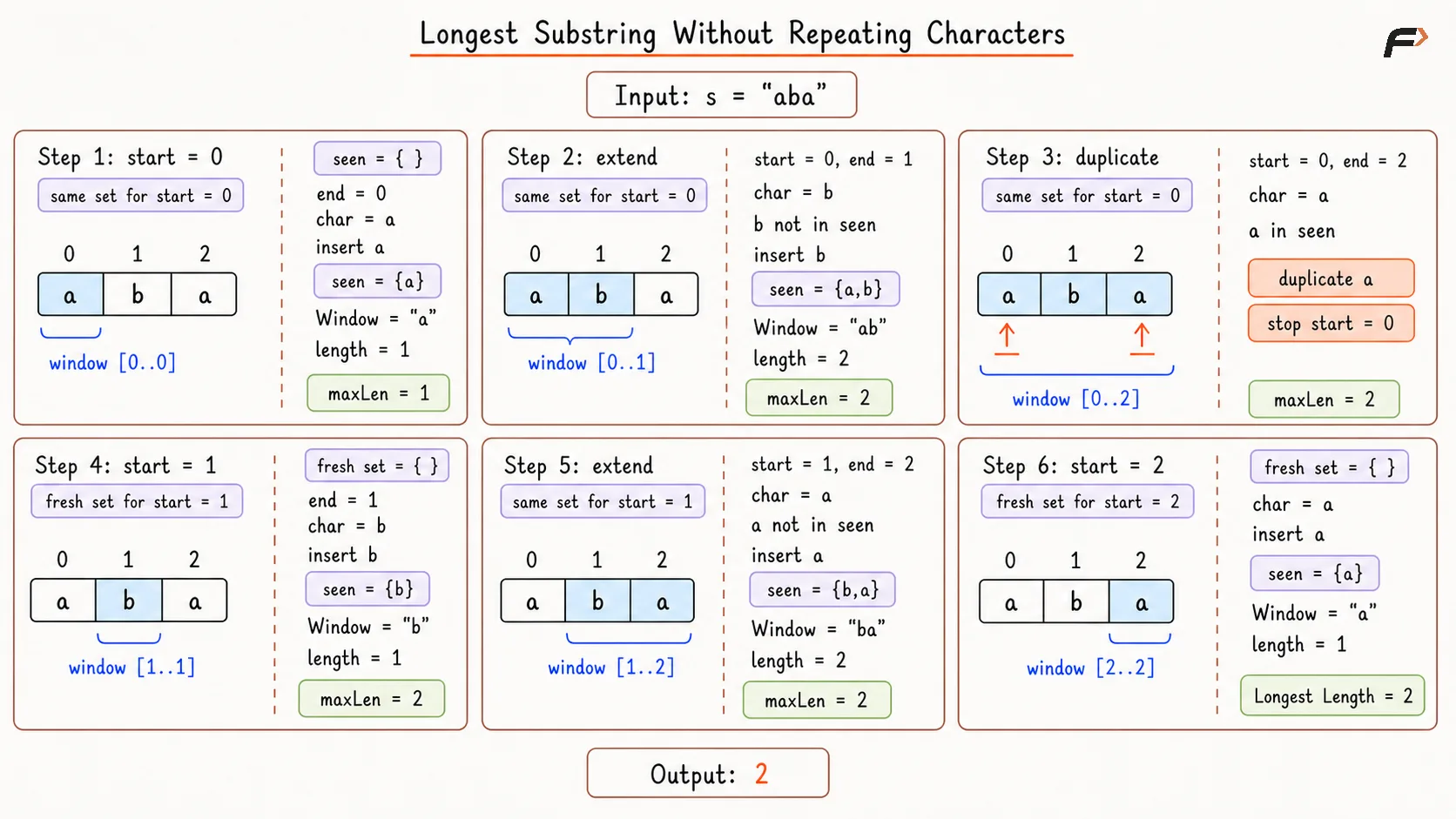
The Brute Force Approach checks every completed substring from the beginning. A more natural improvement grows a substring one character at a time from each starting position.
A set tracks characters already present in the current growing substring. After a repeated character appears, every longer substring from the same start remains invalid because the repeated pair stays inside the range. The current start can therefore stop immediately.
Algorithm
Initialize maxLen with 0 to store the longest duplicate-free length found so far.
Traverse every start index because the longest valid substring may begin at any position.
Create a fresh seen set for every start index so characters from a previous starting position cannot affect the new substring.
Move end from start toward the final index and check
s[end]before insertion.Stop the current expansion when
s[end]already exists in seen, because every longer substring from the same start will retain the duplicate; otherwise, insert the character and update maxLen.Return maxLen after expansion from every starting position has finished.
Dry Run
Longest Substring Without Repeating Characters Better Appraoch Dry Run.png
Solution
#include <bits/stdc++.h>using namespace std;class Solution {public: // Expands from every start // while keeping characters unique. int lengthOfLongestSubstring(string s) { int n = s.size(); int maxLen = 0; // Try every possible start. for (int start = 0; start < n; start++) { unordered_set<char> seen; // Grow the current substring. for (int end = start; end < n; end++) { // A duplicate makes every // longer range invalid too. if (seen.count(s[end])) { break; } seen.insert(s[end]); maxLen = max( maxLen, end - start + 1 ); } } return maxLen; }};int main() { string s = "abcabcbb"; Solution solution; cout << solution.lengthOfLongestSubstring(s) << endl; return 0;}Complexity Analysis
Time Complexity: O(N²), where N represents the string length. Expansion from each starting position may scan many later characters.
Space Complexity: O(N), because the set may store every distinct character from one growing substring.
Optimal Approach 1
Instead of restarting from every index, maintain one valid sliding window.
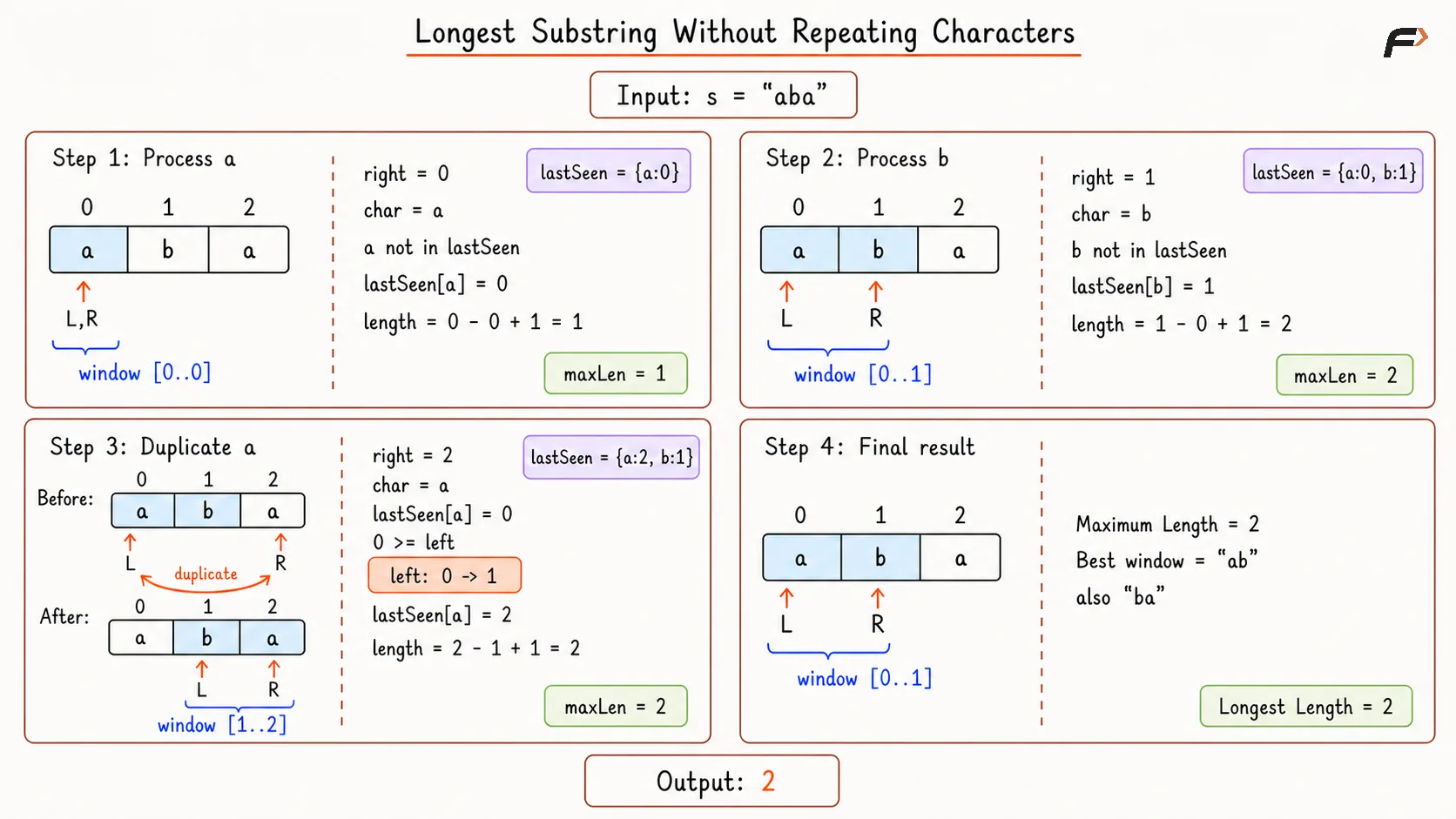
A map stores the latest index of each character. If s[right] previously appeared inside the current window, left can jump directly after that occurrence. If the saved index lies before left, it belongs to an old window and can be ignored.
This keeps both pointers moving only forward.
Algorithm
Create lastSeen for storing the latest index of every character, and initialize left and maxLen with 0.
Move right from 0 to N - 1 so every character becomes the right boundary exactly once.
Read the previous index of
s[right]; only an index greater than or equal to left represents a duplicate inside the active window.Move left to
lastSeen[s[right]] + 1after an active duplicate appears, because the jump removes the older occurrence without unnecessary one-by-one movement.Store right as the latest index of the current character, then update maxLen with
right - left + 1because the window is valid after the possible jump.Return maxLen after right reaches the end of the string.
Dry Run
Longest Substring Without Repeating Characters Optimal -1 Appraoch Dry Run.png
Solution
#include <bits/stdc++.h>using namespace std;class Solution {public: // Uses last-seen positions // to move the left boundary directly. int lengthOfLongestSubstring(string s) { unordered_map<char, int> lastSeen; int left = 0; int maxLen = 0; // Move right across the string. for (int right = 0; right < s.size(); right++) { // Move left only when the // duplicate is inside the window. if ( lastSeen.count(s[right]) && lastSeen[s[right]] >= left ) { left = lastSeen[s[right]] + 1; } lastSeen[s[right]] = right; maxLen = max( maxLen, right - left + 1 ); } return maxLen; }};int main() { string s = "abcabcbb"; Solution solution; cout << solution.lengthOfLongestSubstring(s) << endl; return 0;}Complexity Analysis
Time Complexity: O(N), where N represents the string length. Pointer right processes every character once, while pointer left only moves forward.
Space Complexity: O(N), because lastSeen may store an entry for every distinct character in the string.
Optimal Approach 2
When the character set is limited to 26 lowercase English letters, a hash map is unnecessary.
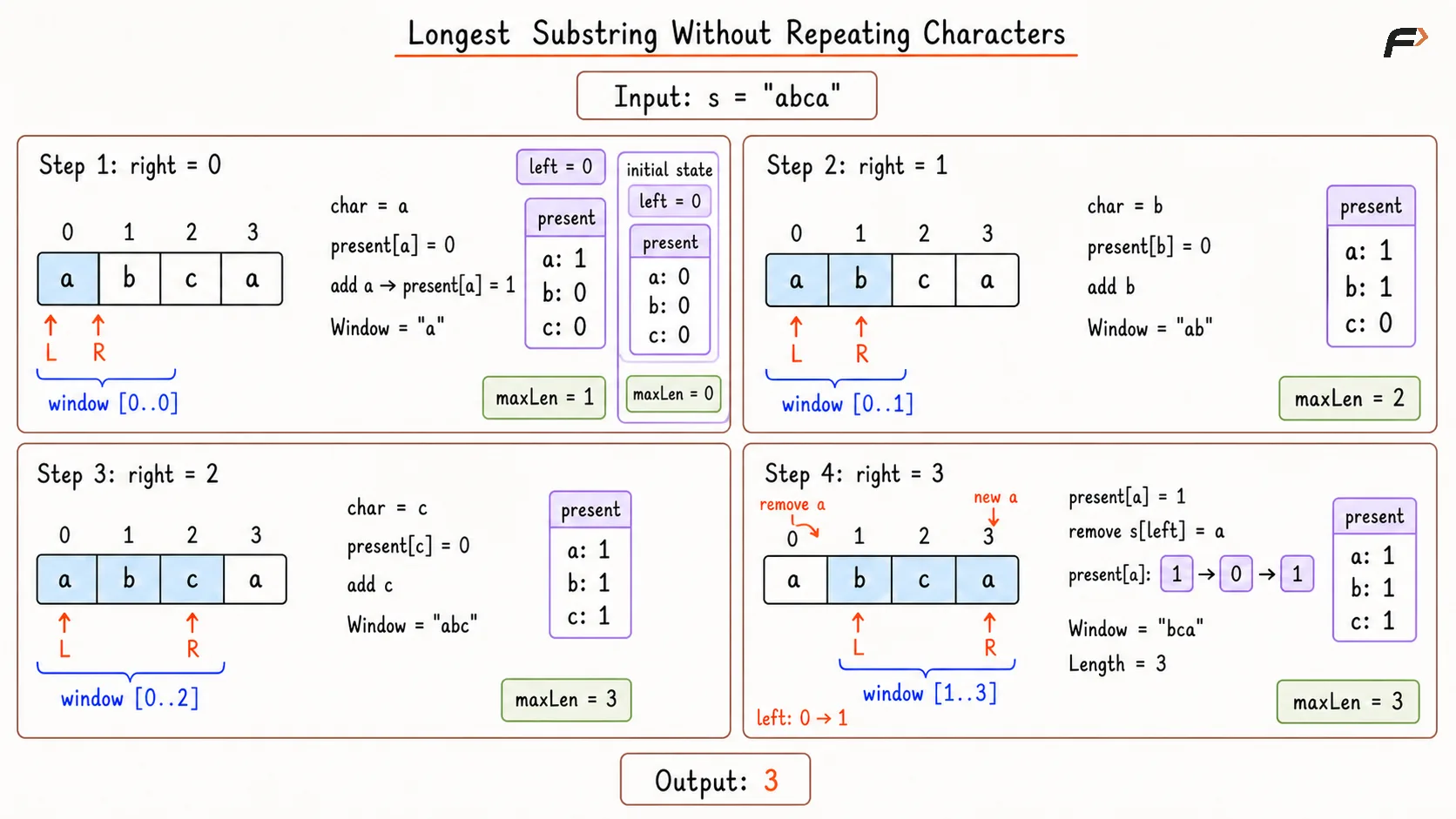
Use an array of size 26, where each position tells whether a character is currently present in the sliding window. When a duplicate enters, move left forward and mark outgoing characters as absent until the duplicate is removed.
Since the array size is fixed, the auxiliary space remains constant.
Algorithm
Create a boolean or integer array
presentof size26, wherepresent[c - 'a']tells whether characterccurrently exists inside the window.Initialize
left = 0andmaxLen = 0to represent the beginning of the active window and the best length found.Move
rightfrom0toN - 1and convert the current character into its array index usings[right] - 'a'.While the current character is already marked as present, remove
s[left]from the active window by setting its corresponding position to0, then moveleftforward.Mark
s[right]as present by setting its position to1. The window is now duplicate-free, so updatemaxLenwithright - left + 1.Return
maxLenafter the complete string is processed.
Dry Run
Longest Substring Without Repeating Characters Optimal -2 Appraoch Dry Run.png
Solution
#include <bits/stdc++.h>using namespace std;class Solution {public: // Uses a fixed array for // lowercase English characters. int lengthOfLongestSubstring(string s) { vector<int> present(26, 0); int left = 0; int maxLen = 0; // Expand the window with right. for (int right = 0; right < s.size(); right++) { int currentIndex = s[right] - 'a'; // Remove characters until // the duplicate leaves the window. while (present[currentIndex]) { int leftIndex = s[left] - 'a'; present[leftIndex] = 0; left++; } present[currentIndex] = 1; maxLen = max( maxLen, right - left + 1 ); } return maxLen; }};int main() { string s = "abcabcbb"; Solution solution; cout << solution.lengthOfLongestSubstring(s) << endl; return 0;}Complexity Analysis
Time Complexity: O(N), because each character enters the window once and leaves it at most once.
Space Complexity: O(1), because the presence array always contains exactly 26 positions.
Interview follow-up Questions
A substring contains consecutive characters, while a subsequence may skip positions. Only contiguous ranges qualify for the problem.
Be the first to add a comment.