Given an integer array nums and an integer k, rotate the array by k positions to the left.
Example 1
Input: nums = [1, 2, 3, 4, 5], k = 2
Output: [3, 4, 5, 1, 2]
Explanation: After rotating left by 2 places, 1 and 2 move to the end, and the remaining elements shift left.
Example 2
Input: nums = [10, 20, 30, 40, 50, 60], k = 3
Output: [40, 50, 60, 10, 20, 30]
Explanation: After rotating left by 3 places, 10, 20, and 30 move to the end.
Brute Force Approach
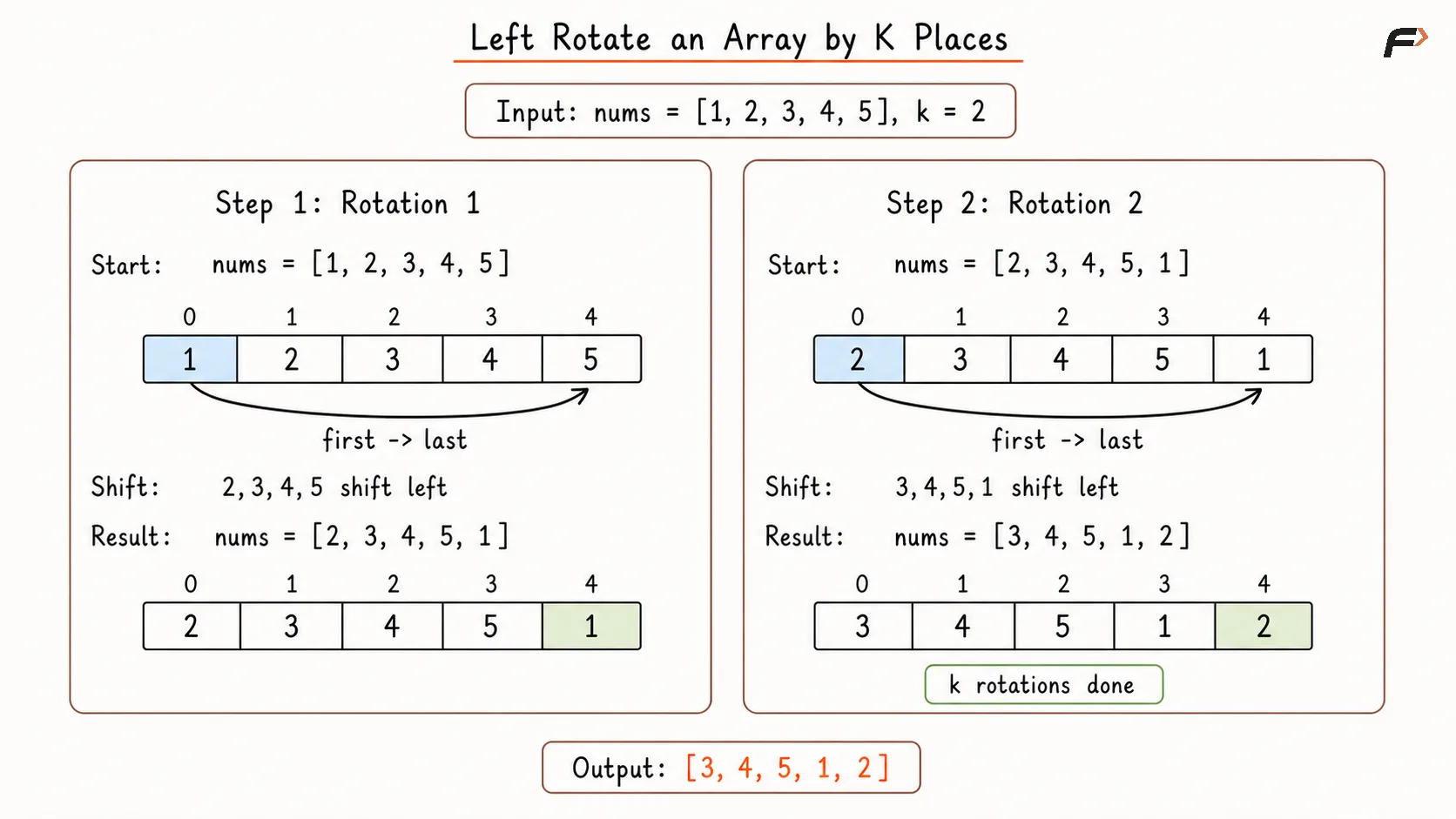
A left rotation by k positions can be performed as k consecutive one-place rotations.
During each rotation, preserve the first element, shift the remaining elements one position to the left, and place the preserved element at the end.
Since rotating an array of size N exactly N times restores its original arrangement, only k % N rotations are required.
Algorithm
If the array contains at most one element, return immediately because any rotation leaves its arrangement unchanged.
Normalize
kusingk % N, since everyNleft rotations bring the array back to its original arrangement.Perform the one-position left rotation
ktimes so that the array is shifted by the required number of positions.During each rotation, store
nums[0]before shifting because its value would otherwise be overwritten.Shift every element from index
1throughN - 1one position to the left, movingnums[index]tonums[index - 1].Place the stored first element at index
N - 1to complete the current one-position rotation.Dry Run
Left Rotate Array by K Places Brute Force Dry Run.png
Solution
#include <bits/stdc++.h>using namespace std;class Solution {public: void leftRotate(vector<int>& nums, int k) { // Rotation does not change an array with at most one element. if (nums.size() <= 1) { return; } int n = nums.size(); // Remove complete rotation cycles. k = k % n; for (int rotation = 0; rotation < k; rotation++) { // Preserve the first value before shifting overwrites it. int first = nums[0]; for (int index = 1; index < n; index++) { nums[index - 1] = nums[index]; } nums[n - 1] = first; } }};int main() { vector<int> nums = {1, 2, 3, 4, 5}; int k = 2; Solution solution; solution.leftRotate(nums, k); cout << "Rotated array: "; for (int value : nums) { cout << value << " "; } return 0;}Complexity Analysis
Time Complexity: O(N × K), where N represents the array size and K represents the normalized rotation count. Each one-place rotation shifts N - 1 elements, and this process is repeated K times.
Space Complexity: O(1), because only one temporary variable is used during each rotation.
Better Approach
The first k elements must eventually appear at the end of the array.
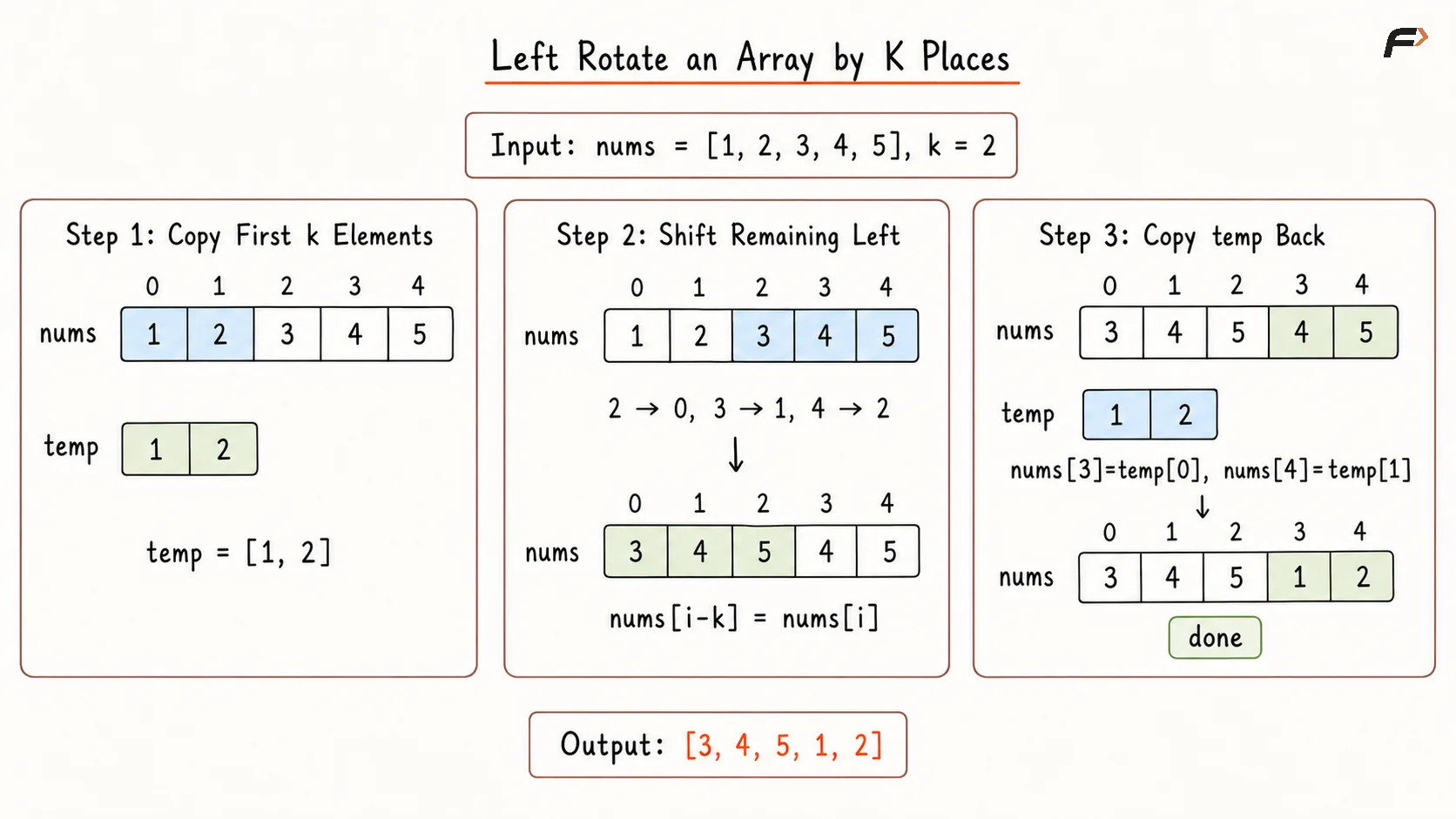
Store these elements temporarily before shifting the remaining values toward the beginning. The stored block can then be copied into the vacant positions at the end.
This avoids repeatedly shifting the same elements.
Algorithm
If the array contains at most one element, return immediately because rotating it does not change the arrangement.
Normalize
kusingk % Nto remove complete rotation cycles. If the normalized value is0, no further changes are required.Store the first
kelements in an auxiliary arraytemp, since these values will be overwritten while the remaining elements are shifted left.Traverse from index
kthroughN - 1and movenums[index]tonums[index - k], shifting the remaining blockkpositions toward the beginning.Copy the elements stored in
tempinto the finalkpositions, placing the original first block at the end and completing the rotation.
Dry Run
Left Rotate Array by K Places Better Appraoch Dry Run .png
Solution
#include <bits/stdc++.h>using namespace std;class Solution {public: void leftRotate(vector<int>& nums, int k) { // Rotation does not change an array with at most one element. if (nums.size() <= 1) { return; } int n = nums.size(); // Remove complete rotation cycles. k = k % n; if (k == 0) { return; } // Protect the first k elements before they are overwritten. vector<int> temp(k); for (int index = 0; index < k; index++) { temp[index] = nums[index]; } // Move the remaining block k positions to the left. for (int index = k; index < n; index++) { nums[index - k] = nums[index]; } // Place the protected block in the final k positions. for (int index = 0; index < k; index++) { nums[n - k + index] = temp[index]; } }};int main() { vector<int> nums = {1, 2, 3, 4, 5}; int k = 2; Solution solution; solution.leftRotate(nums, k); cout << "Rotated array: "; for (int value : nums) { cout << value << " "; } return 0;}Complexity Analysis
Time Complexity: O(N + K), which simplifies to O(N) because normalized K is smaller than N.
The operations require:
O(K)time to copy the firstKelements intotemp.O(N - K)time to shift the remaining elements left.O(K)time to copy the stored elements back.
Therefore:
O(K) + O(N - K) + O(K)
= O(N + K)
= O(N)
Space Complexity: O(K), because the auxiliary array stores the first K elements.
Optimal Approach
After a left rotation, the array contains the same elements, but two continuous parts exchange their positions.
For example:
[1, 2 | 3, 4, 5]After rotating by 2 positions, the required arrangement is:
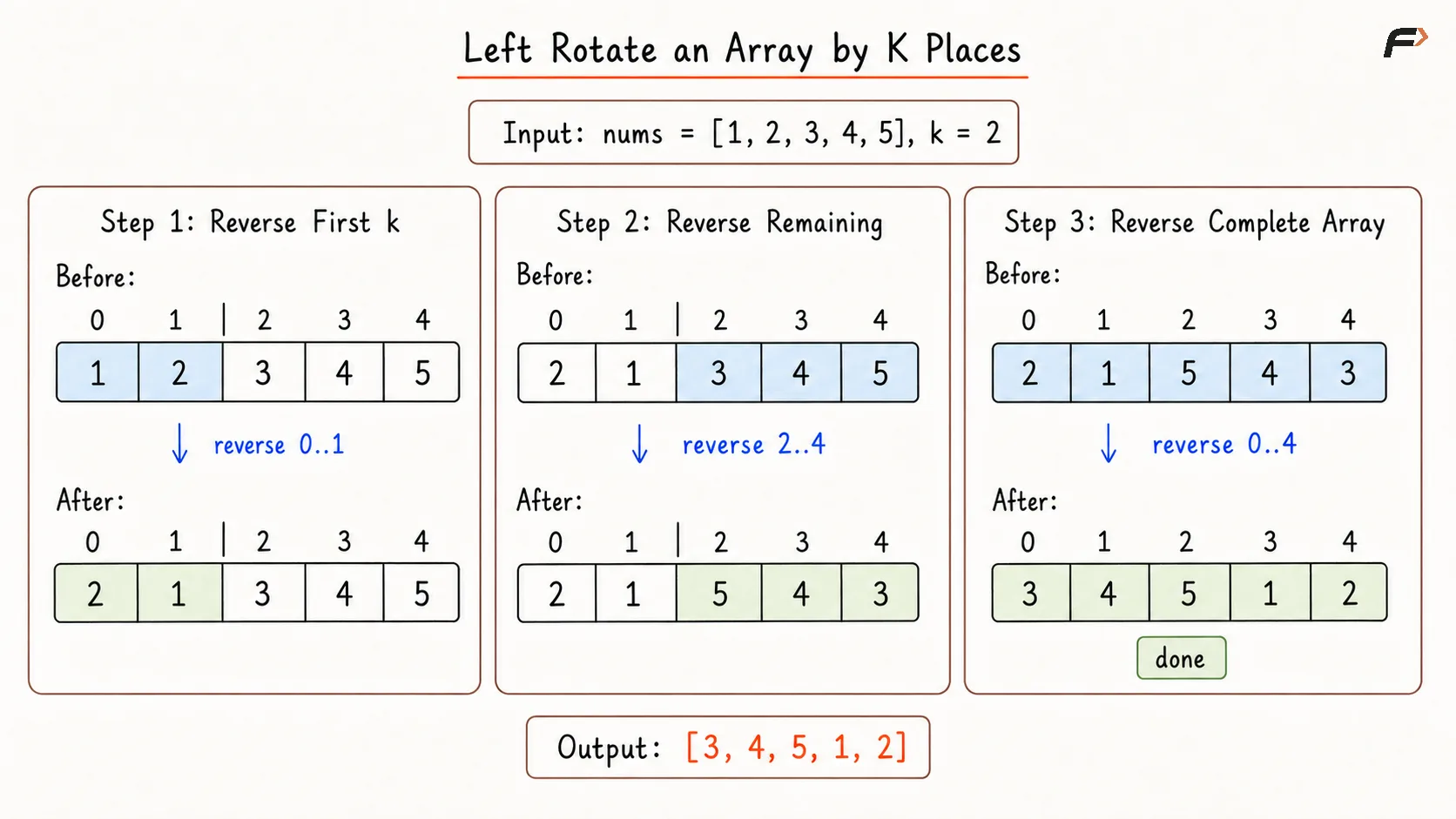
[3, 4, 5 | 1, 2]The challenge is to exchange these two parts without storing either of them in another array. Reversing selected portions allows the two blocks to change positions while their original internal order is recovered at the end.
Algorithm
If the array contains at most one element, return immediately because its arrangement remains unchanged after rotation.
Normalize
kusingk % Nto remove complete rotation cycles. If the normalized value is0, the array is already in the required arrangement.Reverse the first
kelements so that the block that must eventually move to the end is reversed internally.Reverse the remaining
N - kelements, preparing the second block in the same way before the complete array is reversed.Reverse the entire array. This exchanges the positions of the two blocks while restoring the original order within each block, producing the required left rotation.
Dry Run
Left Rotate Array by K Places optimal Dry Run .png
Solution
#include <bits/stdc++.h>using namespace std;class Solution {private: // Reverses the elements inside the inclusive index range. void reverseRange(vector<int>& nums, int left, int right) { while (left < right) { swap(nums[left], nums[right]); left++; right--; } }public: void leftRotate(vector<int>& nums, int k) { // Rotation does not change an array with at most one element. if (nums.size() <= 1) { return; } int n = nums.size(); // Remove complete rotation cycles. k = k % n; if (k == 0) { return; } // Prepare both blocks before exchanging their positions. reverseRange(nums, 0, k - 1); reverseRange(nums, k, n - 1); // Restore internal order after the block positions are exchanged. reverseRange(nums, 0, n - 1); }};int main() { vector<int> nums = {1, 2, 3, 4, 5}; int k = 2; Solution solution; solution.leftRotate(nums, k); cout << "Rotated array: "; for (int value : nums) { cout << value << " "; } return 0;}Complexity Analysis
Time Complexity: O(N), where N represents the number of elements.
The first two reversals process K and N - K elements, while the final reversal processes N elements:
O(K) + O(N - K) + O(N)
= O(2N)
= O(N)
Space Complexity: O(1), because all swaps are performed directly inside the input array.
Interview follow-up Questions
Every N left rotations restore the original arrangement. Normalizing k removes these complete cycles. For example, rotating an array of size 5 by 7 positions produces the same result as rotating it by:
Be the first to add a comment.