Given a sorted array of integers arr and a target value target, find the index of the last occurrence of target in the array. If the target is not present in the array, return -1.
Example 1
Input: arr = [1, 2, 4, 4, 4, 6, 8], target = 4
Output: 4
Explanation: The value 4 appears more than once, and its last appearance is at index 4.
Example 2
Input: arr = [1, 3, 5, 7, 9], target = 6
Output: -1
Explanation: The value 6 is not present in the array, so no last occurrence exists.
Brute Force Approach
The most direct idea is to scan the array and keep updating the answer whenever the target is found. Since the array is read from left to right, the latest stored matching index will naturally become the last occurrence. If the target never appears during the scan, the answer stays -1.
Algorithm
Start from index
0and check each element one by one because every match may push the answer further to the right.Keep a variable
answeras-1so it is easy to detect when the target was never found.Whenever the current element is equal to the target, store that index in
answer.Continue scanning the remaining elements because another same target may appear later.
After the loop ends, return
answer.
Dry Run
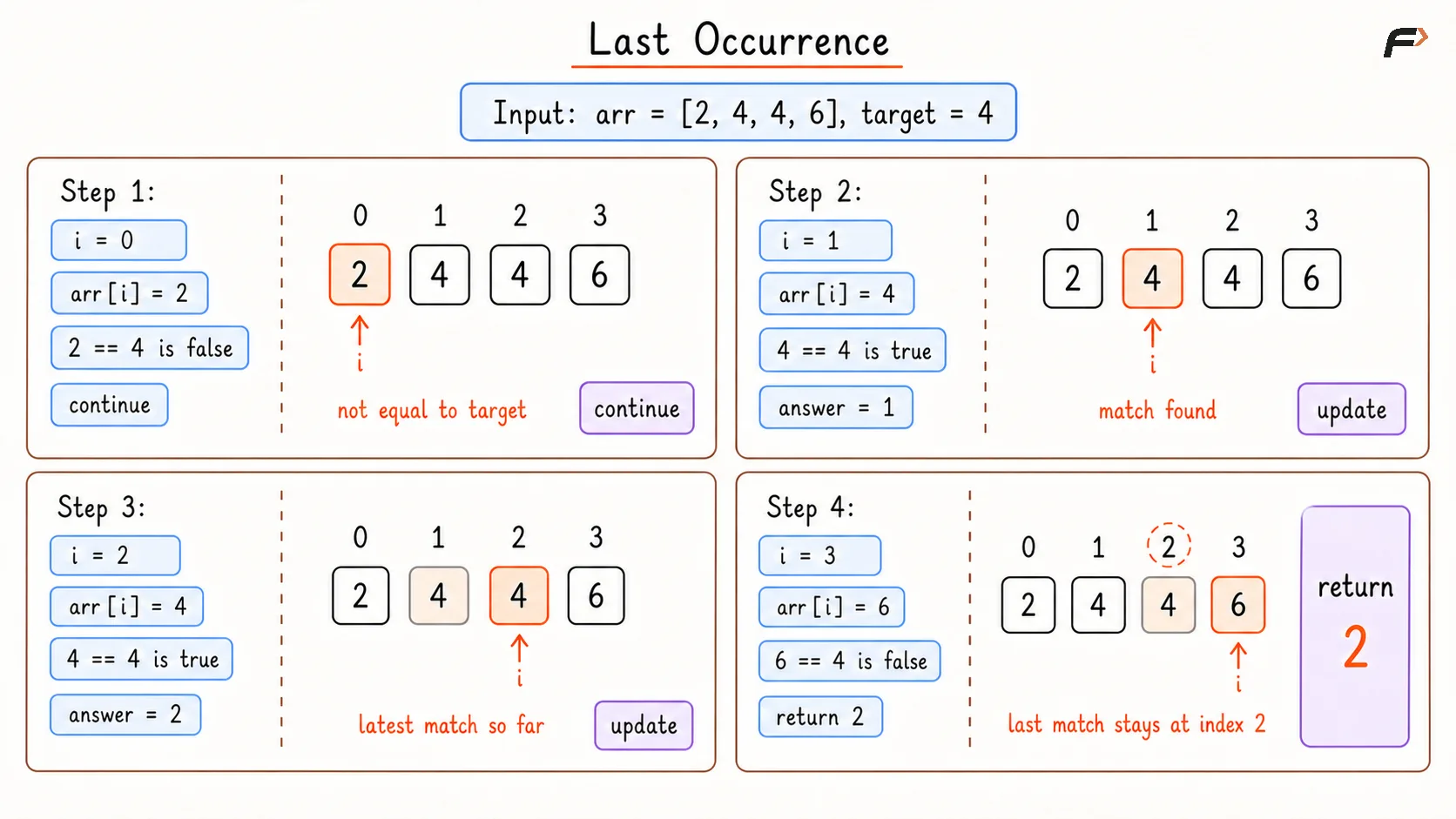
Last Occurrences Brute Dry Run
Solution
#include <bits/stdc++.h>using namespace std;class Solution {public: /* Returns the last index where target appears in the sorted array. */ int lastOccurrence(vector<int>& arr, int target) { // Stores the latest matching index found so far. int answer = -1; // Check each index from left to right. for (int i = 0; i < (int)arr.size(); i++) { // Update the answer whenever the target is seen again. if (arr[i] == target) { answer = i; } } return answer; }};// Driver code startsint main() { vector<int> arr = {1, 2, 4, 4, 4, 6, 8}; int target = 4; Solution obj; cout << obj.lastOccurrence(arr, target) << endl; return 0;}Complexity Analysis
Time Complexity: O(N), where N is length of array, because in the worst case the whole array must be scanned.
Space Complexity: O(1), because only one extra variable is used.
Optimal Approach
The useful observation is this: when arr[mid] is equal to the target, that index is valid, but it may not be the last one. Another same target may still exist on the right side. So the search should not stop immediately after finding a match. That is the core idea here. A valid match is remembered, and then the search continues toward the right to check whether a later occurrence exists. If arr[mid] is smaller than the target, the last occurrence can only be on the right side. If arr[mid] is greater than the target, the answer can only be on the left side.
Algorithm
Start with two pointers,
lowat0andhighat the last index, because the target can lie anywhere in the array.Keep a variable
answeras-1. This stores the best last occurrence found so far, and it remains-1if the target never appears.Find the middle index using
mid = low + (high - low) / 2so the middle position is calculated safely.If
arr[mid]is equal to the target, storemidinanswer. Then movelowtomid + 1because a later occurrence may still be present on the right side.If
arr[mid]is smaller than the target, movelowtomid + 1because every index up tomidbecomes useless for the last occurrence.If
arr[mid]is greater than the target, movehightomid - 1because the target, if present, must be on the left side.Continue this process while
low <= high.Return
answerat the end. If no match was found, it remains-1.
Dry Run
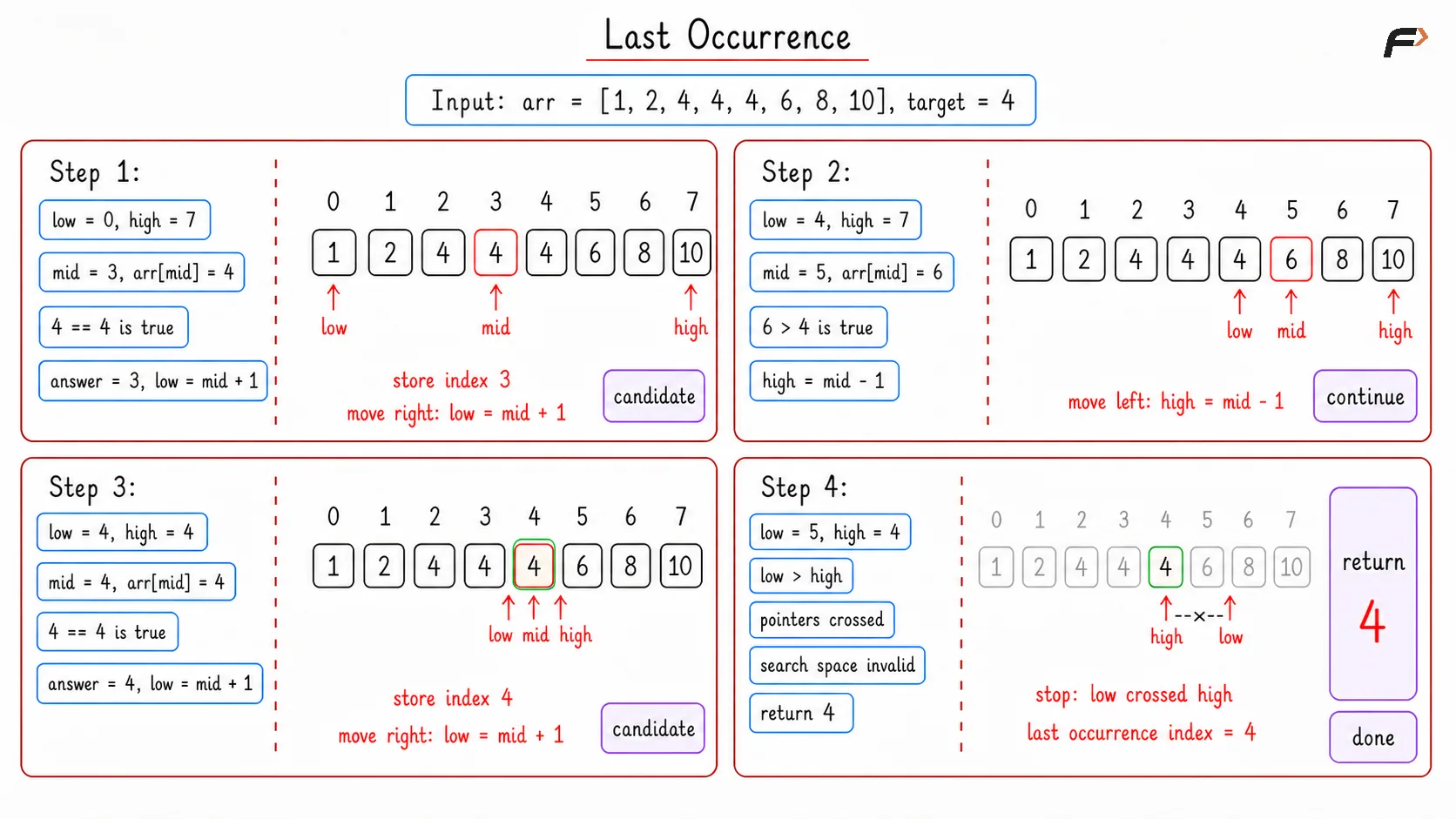
Last Occurrence Optimal Dry Run
Solution
#include <bits/stdc++.h>using namespace std;class Solution {public: /* Returns the last index where target appears in the sorted array. */ int lastOccurrence(vector<int>& arr, int target) { // Left boundary of the current search range. int low = 0; // Right boundary of the current search range. int high = (int)arr.size() - 1; // Stores the rightmost matching index found so far. int answer = -1; // Keep searching while a valid range still exists. while (low <= high) { // Calculate the middle index safely. int mid = low + (high - low) / 2; // A match is found, so remember it and continue on the right side. if (arr[mid] == target) { answer = mid; low = mid + 1; } else if (arr[mid] < target) { // Values up to mid are too small, so move to the right half. low = mid + 1; } else { // The current value is too large, so search only on the left side. high = mid - 1; } } return answer; }};// Driver code startsint main() { vector<int> arr = {1, 2, 4, 4, 4, 6, 8}; int target = 4; Solution obj; cout << obj.lastOccurrence(arr, target) << endl; return 0;}Complexity Analysis
Time Complexity: O(log2 N), N is the length of array, because the search range becomes half in each step.
Space Complexity: O(1), because only a few variables are used.
Interview follow-up Questions
Because the current match may not be the last one. Moving right helps check whether another same target appears later.
Be the first to add a comment.