In the Insert into a Binary Search Tree problem, you are given the root node of a binary search tree and an integer value. Your task is to insert this new value into the tree as a new node. You must ensure that after the insertion, the tree remains a valid binary search tree, where all left children are smaller and all right children are larger than their parent. It is guaranteed that the new value does not already exist in the tree. You must return the root node of the tree after completing the insertion.
Example 1
Input: root = [4, 2, 7, 1, 3], val = 5
Output: [4, 2, 7, 1, 3, 5]
Explanation: The tree has a root of 4. We want to insert 5. Since 5 is greater than 4, it goes to the right side. Since 5 is less than 7, it becomes the left child of 7. The tree remains perfectly sorted.
Example 2
Input: root = [], val = 5
Output: [5]
Explanation: The original tree is completely empty. We simply create a new node with the value 5, and it becomes the new root of the tree.
Brute Force Approach
A binary search tree acts like a sorted hierarchy. Think about placing a new file into a highly organized folder system. If the file is alphabetically smaller than the current folder, you hand it off to the sub-folder on the left. If it is larger, you hand it off to the sub-folder on the right. You repeat this hand-off process until you reach an empty space where no sub-folder exists. That empty space is exactly where the new file belongs. We can write a recursive function that delegates the insertion to its left or right child until it hits a null spot.
Algorithm
Check the base case: if the current node is null, it means we have found our empty spot. We create a new node with our value and return it.
If the value we want to insert is smaller than the current node's value, we make a recursive call to insert it into the left subtree. We then connect the returned result back to the left child pointer.
If the value is larger than the current node's value, we make a recursive call to insert it into the right subtree. We connect the result back to the right child pointer.
Finally, return the current node to keep the tree completely connected.
Dry Run
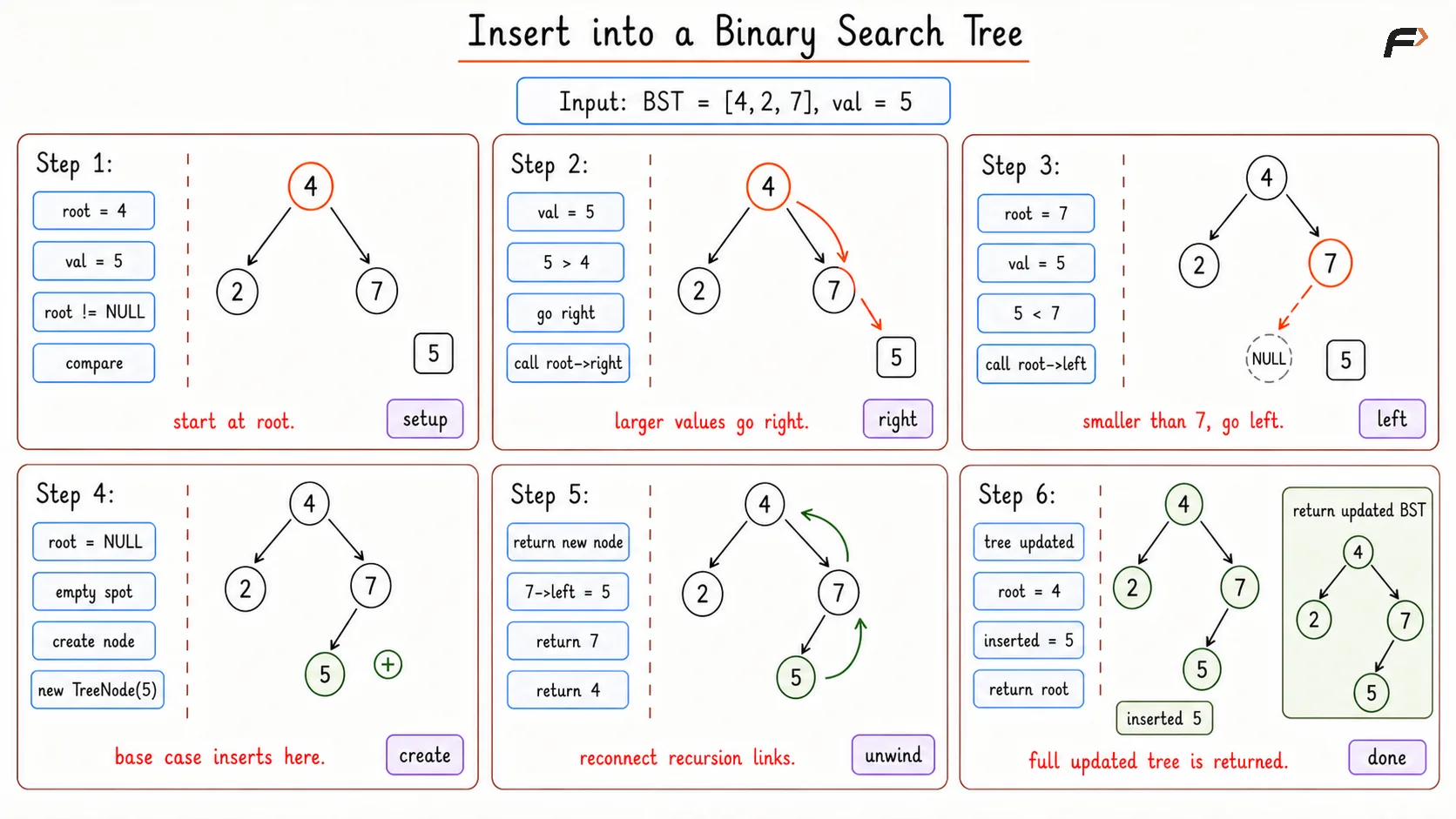
Insert into a BST Brute Dry Run
Solution
#include <bits/stdc++.h>using namespace std;/* Definition for a binary tree node*/struct TreeNode { int val; TreeNode *left; TreeNode *right; TreeNode(int x) : val(x), left(nullptr), right(nullptr) {}};class Solution {public: /* Recursively finds the correct empty position in the tree and attaches a newly created node maintaining the rules */ TreeNode* insertIntoBST(TreeNode* root, int val) { // Base case: we found the empty spot to place the new node if (root == nullptr) { return new TreeNode(val); } // If the value is smaller, delegate insertion to the left branch if (val < root->val) { root->left = insertIntoBST(root->left, val); } // If the value is larger, delegate insertion to the right branch else { root->right = insertIntoBST(root->right, val); } // Return the current node to maintain the entire tree structure return root; }};// Helper function to print in-order traversal of the treevoid printInOrder(TreeNode* node) { if (node == nullptr) return; printInOrder(node->left); cout << node->val << " "; printInOrder(node->right);}// Driver code starts hereint main() { // Construct the initial tree: [4, 2, 7, 1, 3] TreeNode* root = new TreeNode(4); root->left = new TreeNode(2); root->right = new TreeNode(7); root->left->left = new TreeNode(1); root->left->right = new TreeNode(3); // Instantiate the solution object Solution obj; int val = 5; // Perform the recursive insertion TreeNode* result = obj.insertIntoBST(root, val); // Output the entire tree via in-order traversal cout << "In-order traversal: "; printInOrder(result); cout << endl; return 0;}Complexity Analysis
Time Complexity: O(H), where H is the height of the tree. We only travel down a single path from the root to a leaf node.
Space Complexity: O(H), due to the recursive call stack memory used while diving deep into the tree branches.
Optimal Approach
The recursive approach is elegant and easy to read, but it inherently relies on system stack memory to keep track of its path. In an extremely deep and unbalanced tree, this could potentially cause a stack overflow error. We can optimize our space usage by eliminating recursion entirely. By using a single pointer to travel down the tree, we achieve the exact same insertion logic using strictly constant memory.
Instead of repeatedly calling a function to move down the tree, imagine you are personally walking down the branching hallways of a building. You hold the new room you want to build in your hand. At each intersection, you read the sign. If your room number is smaller, you walk left. If it is larger, you walk right. When you finally reach a dead end where no hallway continues in your needed direction, you simply build the room right there, link it to the current intersection, and your job is done. You do not need to remember the entire path you took.
Algorithm
Handle the extreme edge case immediately: if the given tree is totally empty (root is null), return a brand new node as the root.
Initialize a pointer to keep track of the current node, starting at the root.
Start an infinite loop that will only break once we attach the new node.
If the value to insert is smaller than the current node, we must move left. If the left child exists, we update our pointer to move to the left child. If the left child is null, we have found our spot, attach the new node, and break the loop.
If the value to insert is larger than the current node, we must move right. If the right child exists, we update our pointer to move to the right child. If the right child is null, we attach the new node and break the loop.
Finally, return the original root node.
Dry Run
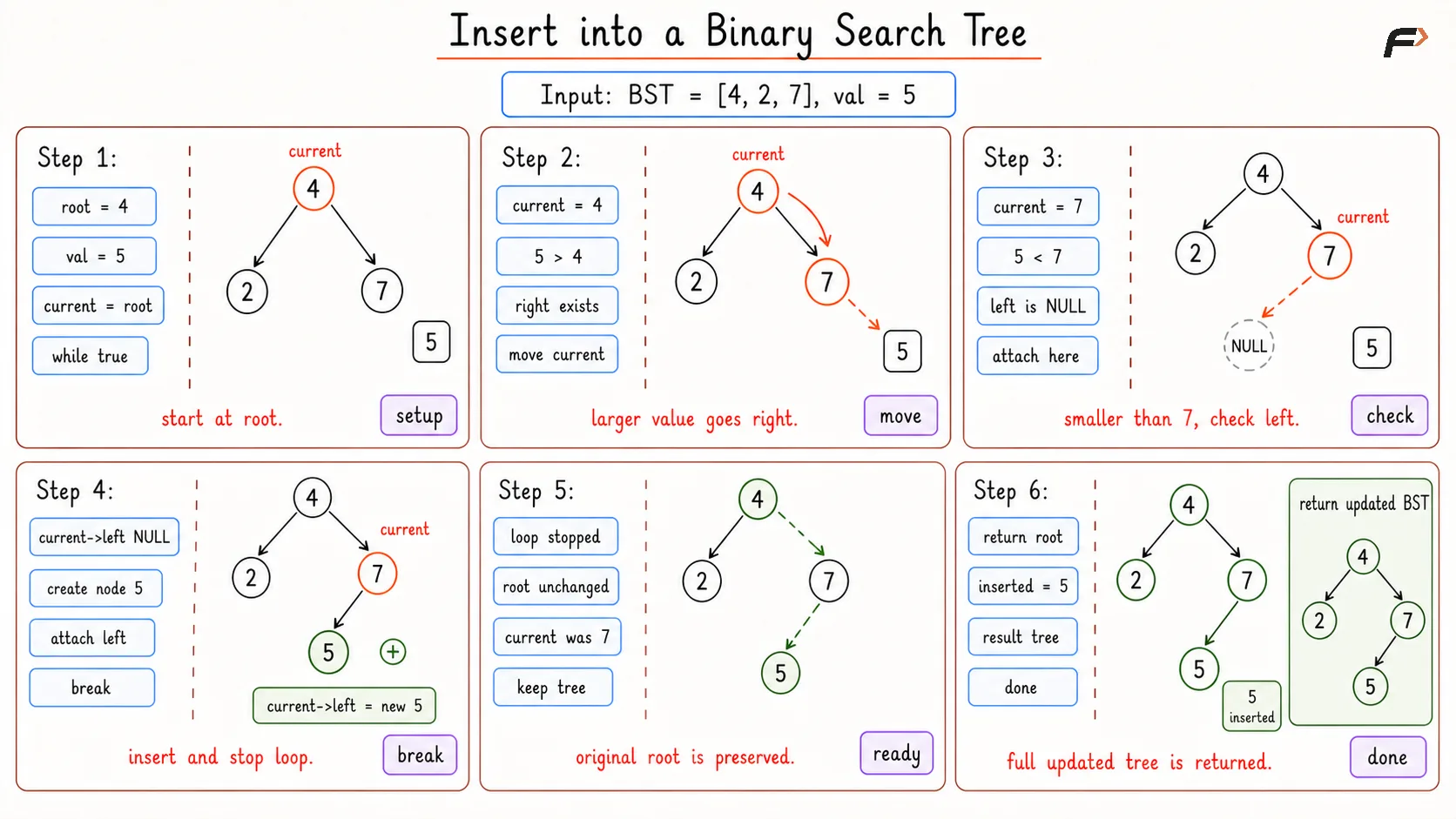
Insert into a BST Optimal Dry Run
Solution
#include <bits/stdc++.h>using namespace std;/* Definition for a binary tree node*/struct TreeNode { int val; TreeNode *left; TreeNode *right; TreeNode(int x) : val(x), left(nullptr), right(nullptr) {}};class Solution {public: /* Iteratively navigates the tree to find the correct empty leaf spot to attach the new node, avoiding stack overhead */ TreeNode* insertIntoBST(TreeNode* root, int val) { // If the tree is entirely empty, the new node becomes the root if (root == nullptr) { return new TreeNode(val); } // Pointer to traverse the tree downwards TreeNode* current = root; // Continue moving down until we successfully attach the node while (true) { // Target belongs on the left side if (val < current->val) { // If there is space, attach it and stop searching if (current->left == nullptr) { current->left = new TreeNode(val); break; } // Otherwise, keep moving down the left path current = current->left; } // Target belongs on the right side else { // If there is space, attach it and stop searching if (current->right == nullptr) { current->right = new TreeNode(val); break; } // Otherwise, keep moving down the right path current = current->right; } } // Return the unmodified root of the tree return root; }};// Helper function to print in-order traversal of the treevoid printInOrder(TreeNode* node) { if (node == nullptr) return; printInOrder(node->left); cout << node->val << " "; printInOrder(node->right);}// Driver code starts hereint main() { // Construct the initial tree: [4, 2, 7, 1, 3] TreeNode* root = new TreeNode(4); root->left = new TreeNode(2); root->right = new TreeNode(7); root->left->left = new TreeNode(1); root->left->right = new TreeNode(3); // Instantiate the solution object Solution obj; int val = 5; // Perform the optimized iterative insertion TreeNode* result = obj.insertIntoBST(root, val); // Output the entire tree via in-order traversal cout << "In-order traversal: "; printInOrder(result); cout << endl; return 0;}Complexity Analysis
Time Complexity: O(H), where H is the height of the tree. The maximum number of operations happens if we have to travel all the way from the top root down to the deepest leaf node.
Space Complexity: O(1), because we are exclusively manipulating a single pointer to travel down the tree, requiring absolute minimal constant memory.
Interview follow-up Questions
No. When following basic binary search tree insertion rules, a newly inserted node will always be placed as a new leaf at the very bottom of its specific path. It never wedges itself between existing connected nodes.
Be the first to add a comment.