Design a queue data structure using a fixed-capacity array of size capacity. The queue must support push(x), pop(), peek(), empty(), and size().
push(x)insertsxat the rear when the queue is not full.pop()removes and returns the front value.peek()returns the front value without removing it.empty()returns whether the queue contains no values.size()returns the current number of stored values.
When the queue is full, push(x) performs no insertion. When the queue is empty, pop() and peek() return -1.
Example 1
Input: Operations = push(10), push(20), push(30), peek(), pop(), peek(), empty()
Output: 10, 10, 20, false
Explanation: Values enter in order 10, 20, 30. The first front lookup gives 10, removal also returns 10, and the next front value becomes 20.
Example 2
Input: Operations = pop(), push(5), pop(), empty()
Output: -1, 5, true
Explanation: The first removal happens on an empty queue. After value 5 is inserted and removed, the queue becomes empty again.
Brute Force Approach
The simplest array queue keeps the front value at index 0. New values are added after the last stored value, so peek() remains simple.
The main cost appears during pop(). After removing the front value, every remaining value shifts one position left to place the next queue value at index 0.
Algorithm
Initialize a fixed-capacity array and set
size = 0.For
push(value):Return without insertion when
size == capacity, because the queue is full.Store the new value at index
size.Increase
sizeby one.
For
pop():Return
-1whensize == 0.Store the value at
arr[0].Shift every remaining value one position left.
Decrease
sizeby one.Return the stored value.
For
peek():Return
-1whensize == 0.Return
arr[0].
For
empty():Return whether
size == 0.
Dry Run
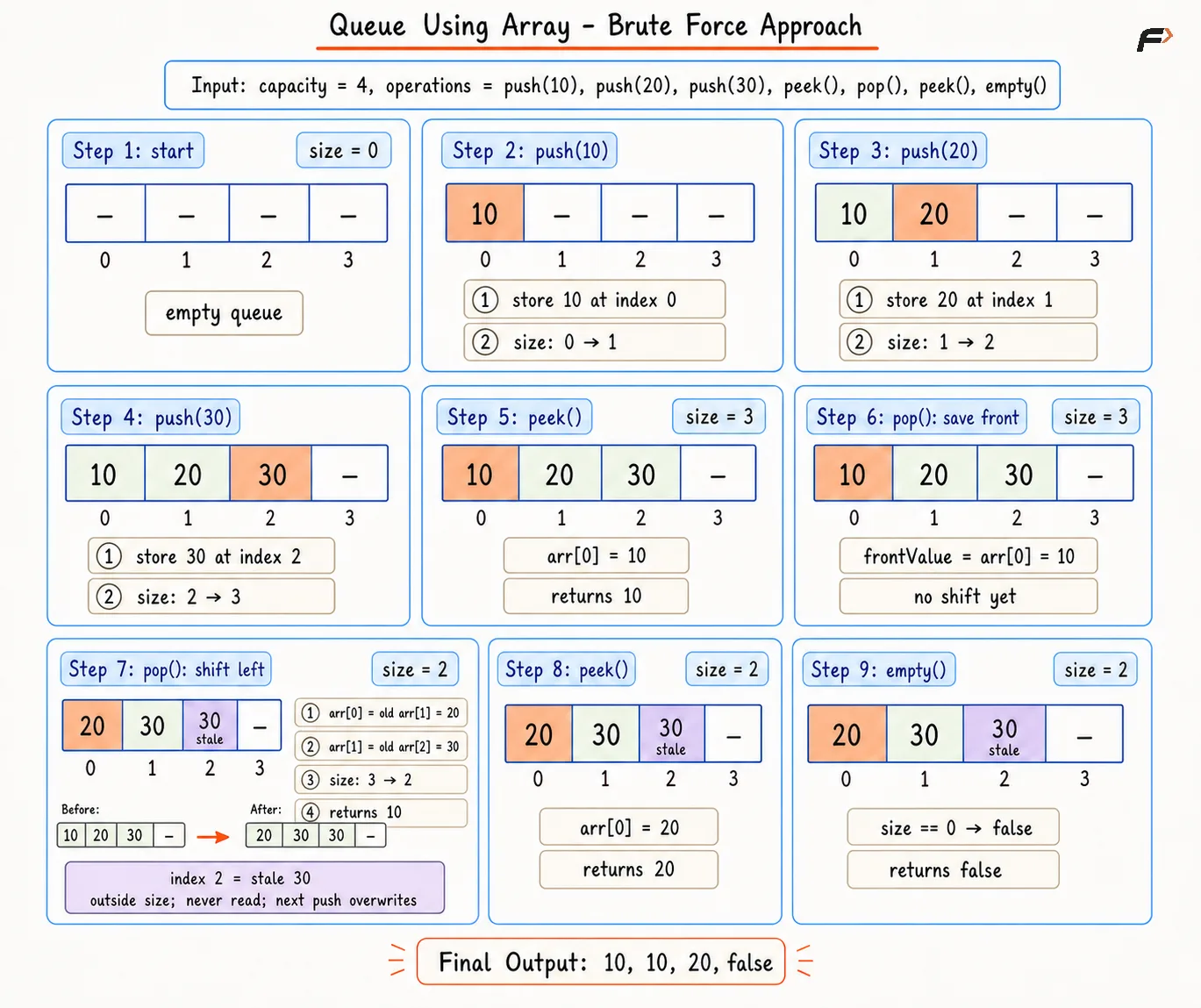
queue-using-array-brute-force
Solution
#include <bits/stdc++.h>using namespace std;class Solution {private: vector<int> arr; int capacity; int size;public: // Initializes a fixed-size array queue. Solution(int maxSize) { capacity = maxSize; size = 0; arr.resize(capacity); } // Adds a value at the rear of the queue. void push(int x) { // A full array has no free rear position. if (size == capacity) { return; } arr[size] = x; size++; } // Removes and returns the front value. int pop() { // An empty queue has no removable front value. if (size == 0) { return -1; } int frontValue = arr[0]; // Remaining values shift left to keep the front at index zero. for (int index = 1; index < size; index++) { arr[index - 1] = arr[index]; } size--; return frontValue; } // Returns the front value without removal. int peek() { // An empty queue has no front value. if (size == 0) { return -1; } return arr[0]; } // Checks whether the queue has no values. bool empty() { return size == 0; }};// Driver codeint main() { Solution obj(4); obj.push(10); obj.push(20); obj.push(30); cout << obj.peek() << " "; cout << obj.pop() << " "; cout << obj.peek() << " "; cout << boolalpha << obj.empty(); return 0;}Complexity Analysis
Time Complexity: O(N), because pop() may shift up to N - 1 values. push(), peek(), and empty() take O(1) time.
Space Complexity: O(CAP), where CAP is the given queue capacity. The array stores at most CAP queue values, and no additional data structure grows with the queue size.
Optimal Approach
Shifting values after every removal is unnecessary. The front index can simply move to the next position.
The array works like a circle. Modulo arithmetic moves front and rear back to index 0 after reaching the last index.
A removed value may still remain physically inside the array, but the value becomes stale after front moves forward. Queue operations read only active positions tracked by front, rear, and size, so stale values are never used. A future push() safely overwrites a stale value when rear reaches the same position again.
Algorithm
Initialize the array,
front,rear,size, andcapacity.For
push(value):Return without insertion when
size == capacity, because the queue is full.Store the value at index
rear.Move
rearto(rear + 1) % capacity.Increase
sizeby one.Any stale value at
reargets overwritten because the position no longer belongs to an active queue element.
For
pop():Return
-1whensize == 0.Store the value at index
front.Move
frontto(front + 1) % capacity.Decrease
sizeby one.Return the stored value.
For
peek():Return
-1whensize == 0.Return the value at index
front.
For
empty():Return whether
size == 0.
For
full():Return whether
size == capacity.
Dry Run
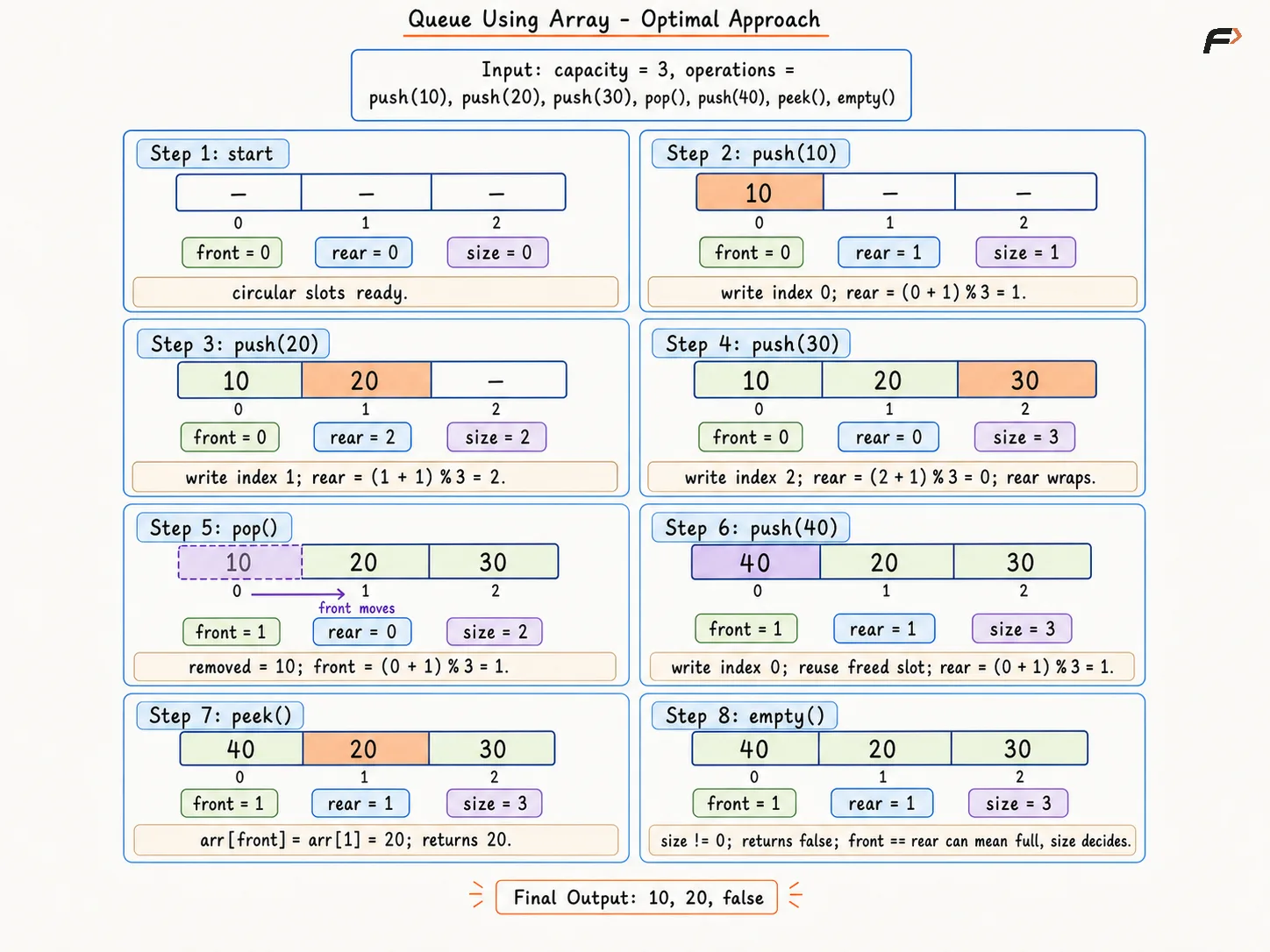
Queue Using Array Optimal
Solution
#include <bits/stdc++.h>using namespace std;class Solution {private: vector<int> arr; int capacity; int size; int front; int rear;public: // Initializes a circular array queue. Solution(int maxSize) { capacity = maxSize; size = 0; front = 0; rear = 0; arr.resize(capacity); } // Adds a value at the rear of the queue. void push(int x) { // A full circular queue has no reusable slot. if (size == capacity) { return; } arr[rear] = x; // Rear wraps around to reuse freed positions. rear = (rear + 1) % capacity; size++; } // Removes and returns the front value. int pop() { // An empty queue has no removable front value. if (size == 0) { return -1; } int frontValue = arr[front]; // Front advances to the next oldest value. front = (front + 1) % capacity; size--; return frontValue; } // Returns the front value without removal. int peek() { // An empty queue has no front value. if (size == 0) { return -1; } return arr[front]; } // Checks whether the queue has no values. bool empty() { return size == 0; }};// Driver codeint main() { Solution obj(3); obj.push(10); obj.push(20); obj.push(30); cout << obj.pop() << " "; obj.push(40); cout << obj.peek() << " "; cout << boolalpha << obj.empty(); return 0;}Complexity Analysis
Time Complexity: O(1), because push, pop, peek, and empty use only direct array access and constant-time index updates.
Space Complexity: O(CAP), where CAP is the given queue capacity. The array can store at most CAP values, while only a fixed number of extra variables are used.
Interview follow-up Questions
Yes. A fixed-capacity array queue becomes full after capacity successful insertions without enough removals. A size == capacity check prevents writing outside the array.
Be the first to add a comment.