Occurrences in Sorted Array One Shot
What are Occurrences in a Sorted Array?
An occurrence means the position where a target value appears in an array.
In a sorted array, the same values always appear together as one continuous block. This makes it easier to find the first position, last position, or total count of a target value using Binary Search.
Common occurrence-based problems include:
First Occurrence in a Sorted Array
Last Occurrence in a Sorted Array
Count Occurrences in a Sorted Array
How Occurrence-Based Binary Search Works
Normal Binary Search stops when the target is found.
Occurrence-based Binary Search does one extra thing: even after finding the target, it continues searching on one side to find the required boundary.
Most occurrence problems follow the same simple process:
Initialize low, high, and answer.
Find the middle index.
Compare the middle element with the target.
If the target is found, store the index.
Move left for first occurrence.
Move right for last occurrence.
Use first and last positions to count total occurrences.
The sorted order is important because it tells which half can be ignored safely.
First Occurrence in a Sorted Array
Given a sorted array and a target value, find the first position where the target appears. If the target does not exist, return -1.
For a detailed explanation, see the original TUF blog: First Occurrence
Example 1
Input: arr = [1, 2, 2, 2, 3, 4], target = 2
Output: 1
Explanation: 2 occur first at the index 1
Example 2
Input: arr = [5, 7, 7, 8, 8, 10], target = 8.
Output: 3
Explanation: 8 occur first at the index 3.
Algorithm
Start with two pointers:
low = 0, which marks the start of the search range andhigh = n - 1, which marks the end of the search range.Create a variable
ans = -1. This stores the first occurrence if we find it. It stays-1if the target is not present.Repeat while
low <= high:Find
mid = low + (high - low) / 2.If
arr[mid] == target: Storemidinans. Move left by settinghigh = mid - 1. Because there may be an earlier occurrence on the left side.If
arr[mid] < target: Move right by settinglow = mid + 1. Because the target can only be on the right side in a sorted array.If
arr[mid] > target: Move left by settinghigh = mid - 1. Because the target can only be on the left side.
After the loop ends Return
ans. If it is still-1, the target was not found.Edge cases:
If the array is empty, return
-1.If the target is smaller than all elements or larger than all elements, return
-1.If all elements are equal to the target, the first index should be returned.
Dry Run
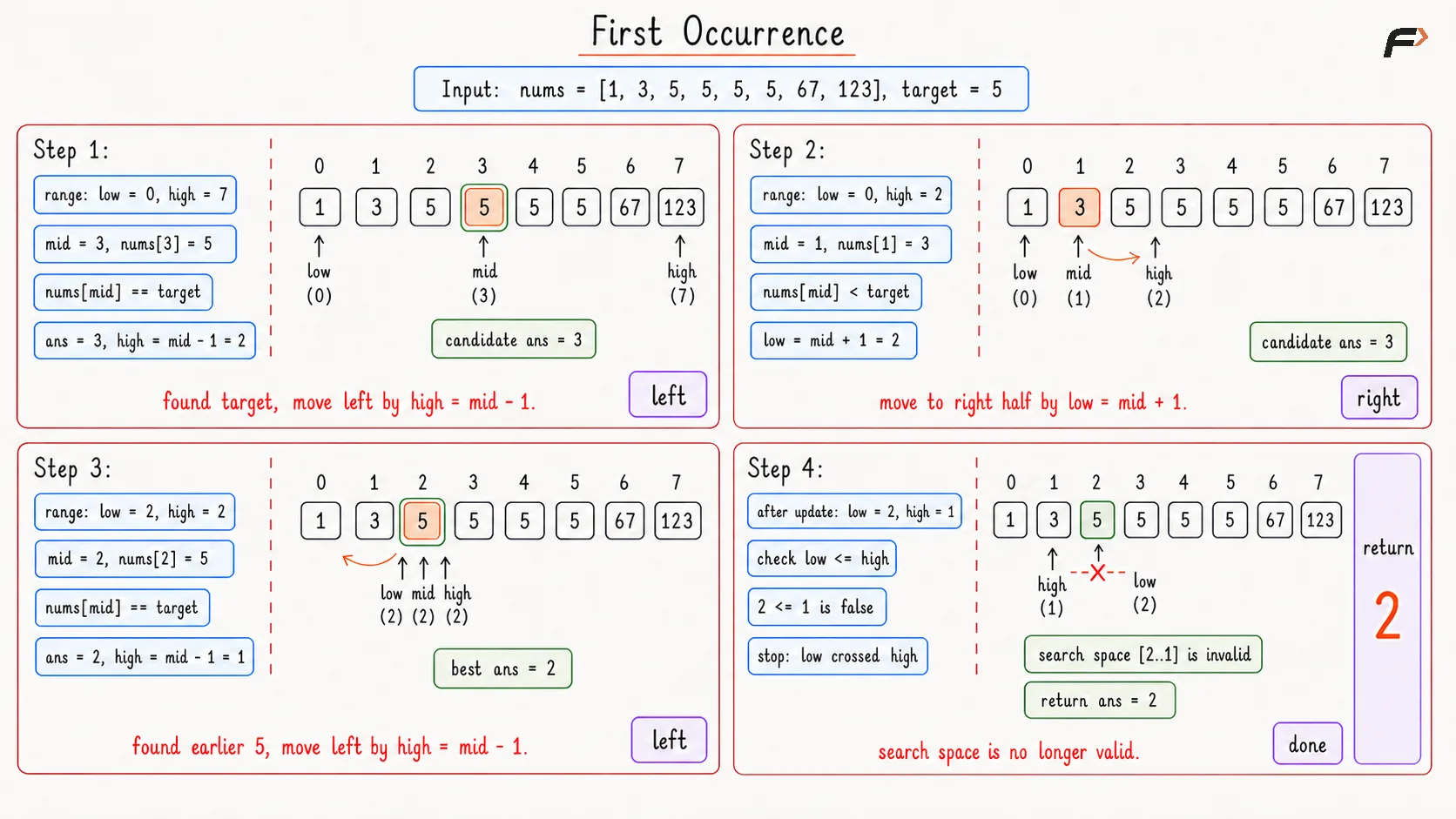
First Occurrence Optimal Dry Run
Complexity Analysis
Time Complexity: O(log2 N), N is the size of array, because we cut the search space in half at every step.
Space Complexity: O(1), because we only use a few extra variables.
Last Occurrence in a Sorted Array
Given a sorted array and a target value, find the last position where the target appears. If the target does not exist, return -1.
For a detailed explanation, see the original TUF blog: Last Occurrece
Example 1
Input: arr = [1, 2, 2, 2, 3, 4], target = 2
Output: 3
Explanation: 2 occur last at the index 3.
Example 2
Input: arr = [5, 7, 7, 8, 8, 10], target = 8.
Output: 4
Explanation: 8 occur last at the index 3.
Algorithm
Start with two pointers:
low = 0, which marks the start of the search range.high = n - 1, which marks the end of the search range.Create a variable
ans = -1. This stores the first occurrence if we find it. It stays-1if the target is not present.Repeat while
low <= high:Find
mid = low + (high - low) / 2.If
arr[mid] == target: Storemidinans. Move right by settingleft = mid + 1Because there may be an later occurrence on the left side.If
arr[mid] < target: Move right by settinglow = mid + 1. Because the target can only be on the right side in a sorted array.If
arr[mid] > target: Move left by settinghigh = mid - 1. Because the target can only be on the left side.
After the loop ends Return
ans. If it is still-1, the target was not found.Edge cases:
If the array is empty, return
-1.If the target is smaller than all elements or larger than all elements, return
-1.If all elements are equal to the target, the first index should be returned.
Dry Run
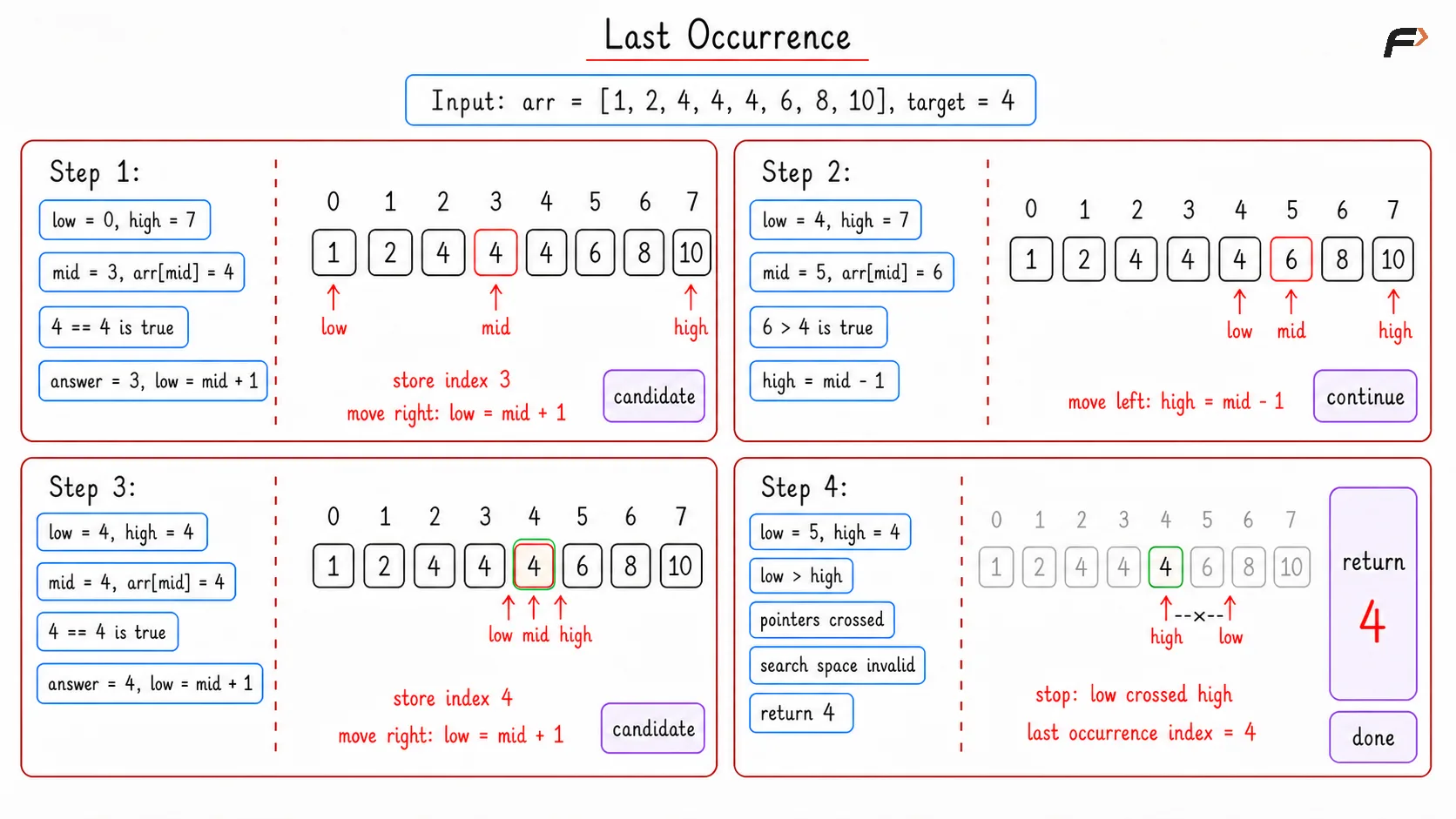
Last Occurrence Optimal Dry Run
Complexity Analysis
Time Complexity: O(log2 N), N is the size of array, because binary search divides the array into half each time.
Space Complexity: O(1), because only a few variables are used.
Count Occurrences in a Sorted Array
Given a sorted array and a target value, count how many times the target appears. If the target does not exist, return 0.
For a detailed explanation, see the original TUF blog: Count Occurrences
Example 1
Input: arr = [1, 2, 2, 2, 3, 4], target = 2
Output: 3
Explanation: 2 appears first at the index 1 and last at the index 3, so a total of 3 times.
Example 2
Input: arr = [5, 7, 7, 8, 8, 10], target = 6
Output: 0
Explanation: Target is not present.
Algorithm
First, find the first occurrence of the target using binary search. Use
low,high, andans. Save the leftmost position where the target appears.If first occurrence is
-1Return0. Because the target is not present at all.Then find the last occurrence of the target using binary search. Again use
low,high, andans. Save the rightmost position where the target appears.Compute the count using:
count = last - first + 1Because both ends are included in the block.Return
count.Edge cases:
If the array is empty, return
0.If the target is not present, return
0.If the target appears once, the count will be
1.If all elements are the target, the count will be
n.
Dry Run
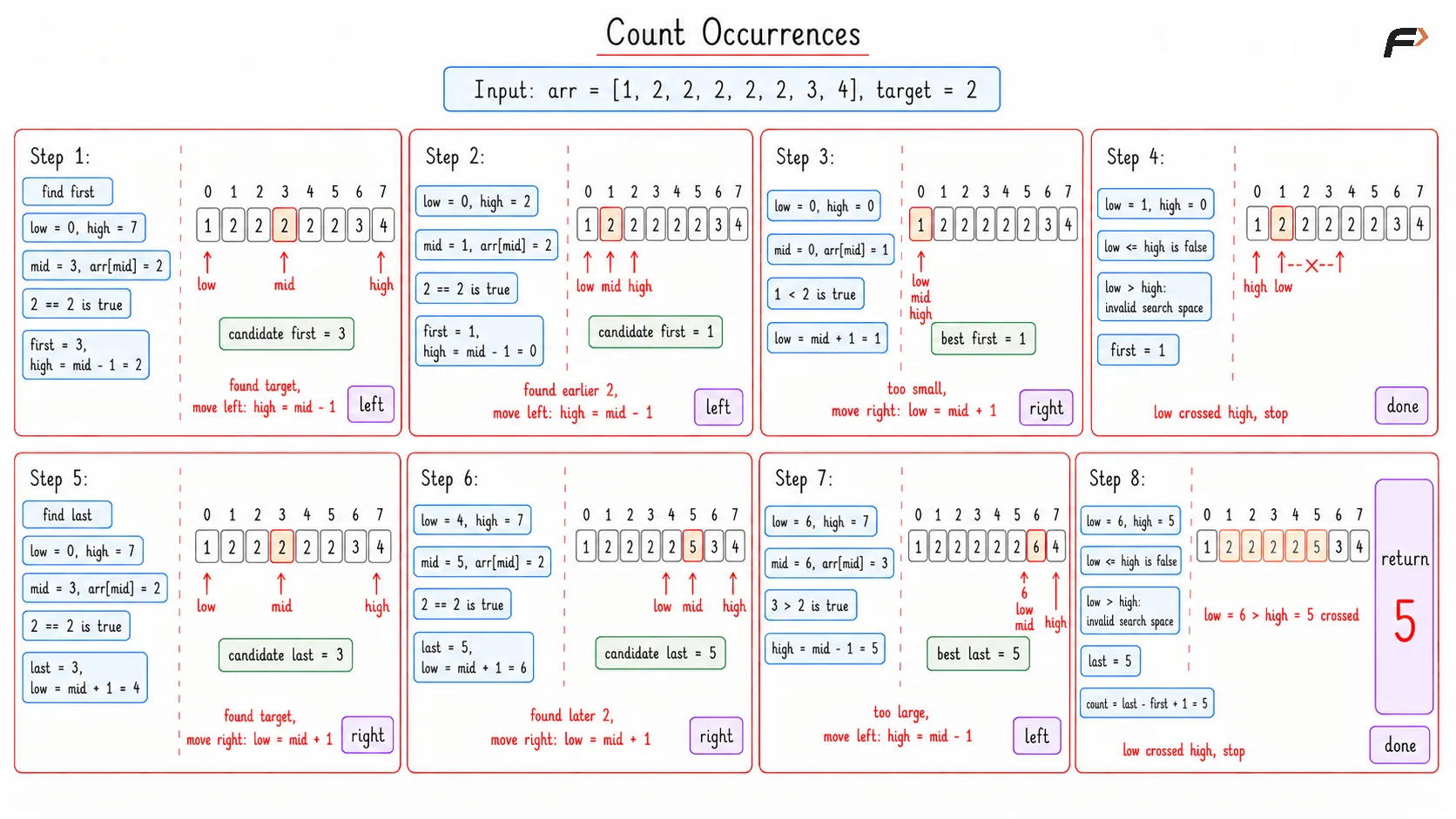
Count Occurrence Optimal Dry Run
Complexity Analysis
Time Complexity: O(log2 N), N is the size of array, because we cut the search space in half at every step.
Space Complexity: O(1), because we only use a few extra variables.
Be the first to add a comment.