Given two strings s and p, both containing lowercase English letters, return the starting indices of all substrings of s that are anagrams of p.
Every considered substring must have the same length as p. The indices may be returned in any order.
Example 1
Input: s = "cbaebabacd", p = "abc"
Output: [0, 6]
Explanation: The substring starting at index 0 is "cba", which contains the same character frequencies as "abc". The substring starting at index 6 is "bac", which is also an anagram of "abc".
Example 2
Input: s = "abab", p = "ab"
Output: [0, 1, 2]
Explanation: The substrings "ab", "ba", and "ab" begin at indices 0, 1, and 2. Every substring contains one 'a' and one 'b'.
Brute Force Approach
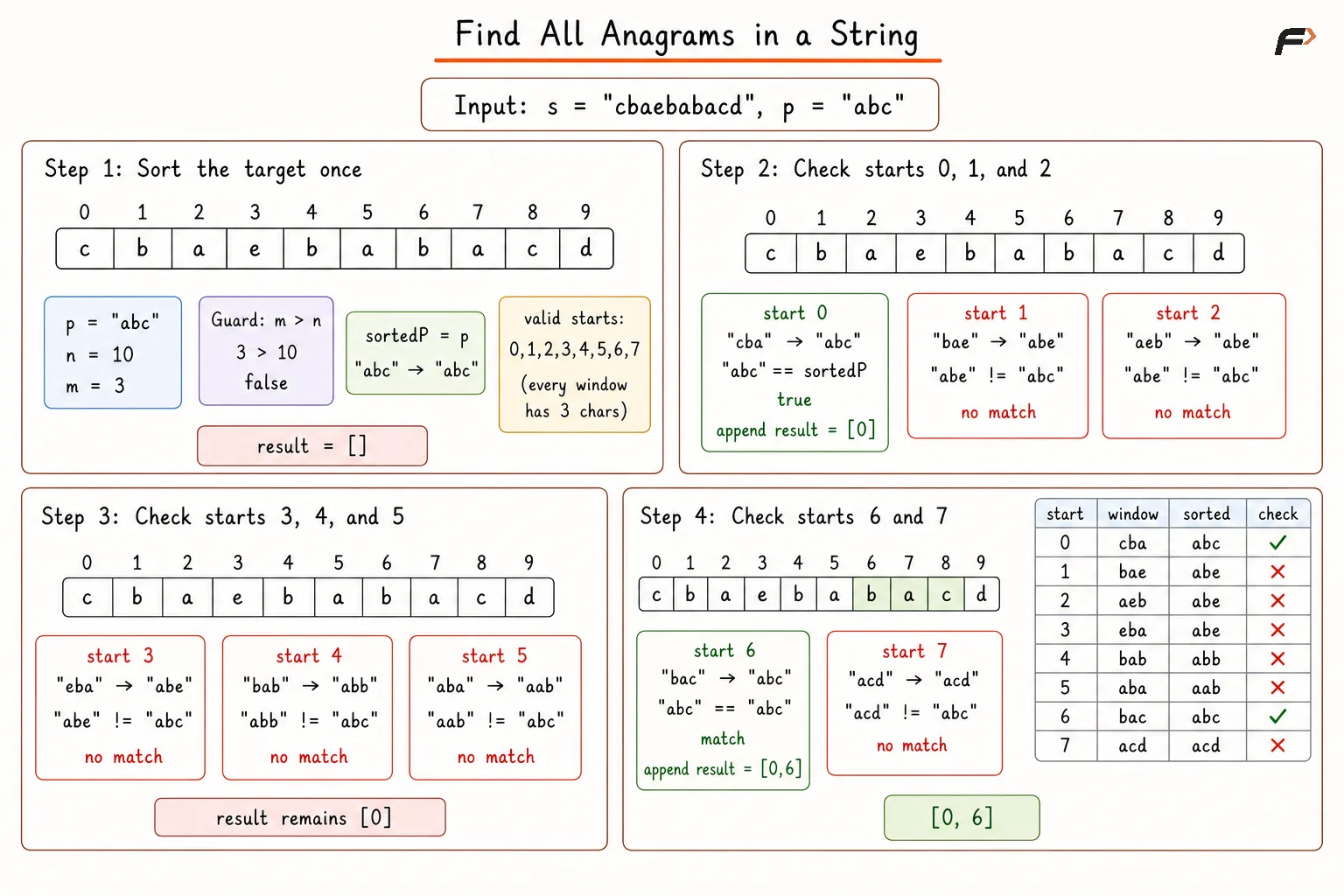
Every anagram contains identical characters with identical frequencies. Sorting places those characters in a fixed order, so two strings are anagrams when both sorted forms match.
Every candidate substring must have length M, where M represents the length of p. Sorting p once creates the target form. Sorting every length-M substring of s and comparing both forms checks every possible answer directly.
Algorithm
Store the lengths of
sandpasNandM.Return an empty result when
M > N, because no substring ofscan containMcharacters.Create
sortedPas a sorted copy ofp, preserving the original target string.Traverse every valid starting index from
0toN - M.Extract the length-
Msubstring beginning at the current index.Sort the extracted substring to create a canonical character order.
Append the current starting index when the sorted substring matches
sortedP.Return the result after checking every possible window.
Dry Run
fa
Solution
#include <bits/stdc++.h>using namespace std;class Solution {public: /* Finds all anagram starts by sorting every candidate window. */ vector<int> findAnagrams(string s, string p) { vector<int> result; int n = s.length(); int m = p.length(); // Stop when no window can match the target length. if (m > n) { return result; } // Build one canonical form for the target string. string sortedP = p; sort(sortedP.begin(), sortedP.end()); // Generate and validate every window of length m. for (int start = 0; start + m <= n; start++) { string window = s.substr(start, m); // Sort the current candidate substring. sort(window.begin(), window.end()); // Record a window with the same sorted form. if (window == sortedP) { result.push_back(start); } } return result; }};// Driver code to execute the solution.int main() { string s = "cbaebabacd"; string p = "abc"; Solution solution; vector<int> answer = solution.findAnagrams(s, p); // Print the resulting indices. cout << "["; for ( int index = 0; index < (int)answer.size(); index++ ) { cout << answer[index]; if (index + 1 < (int)answer.size()) { cout << ", "; } } cout << "]" << endl; return 0;}Complexity Analysis
Time Complexity: O((N - M + 1) × M log M), where N represents the length of s and M represents the length of p. Every candidate substring contains M characters and is sorted independently.
Space Complexity: O(M) auxiliary space, excluding the returned indices. A temporary substring and the corresponding sortable character storage can contain M characters. A result containing A matching indices requires O(A) output space.
Better Approach
Sorting every candidate substring performs more work than necessary. Anagram verification only depends on character frequencies, not character order.
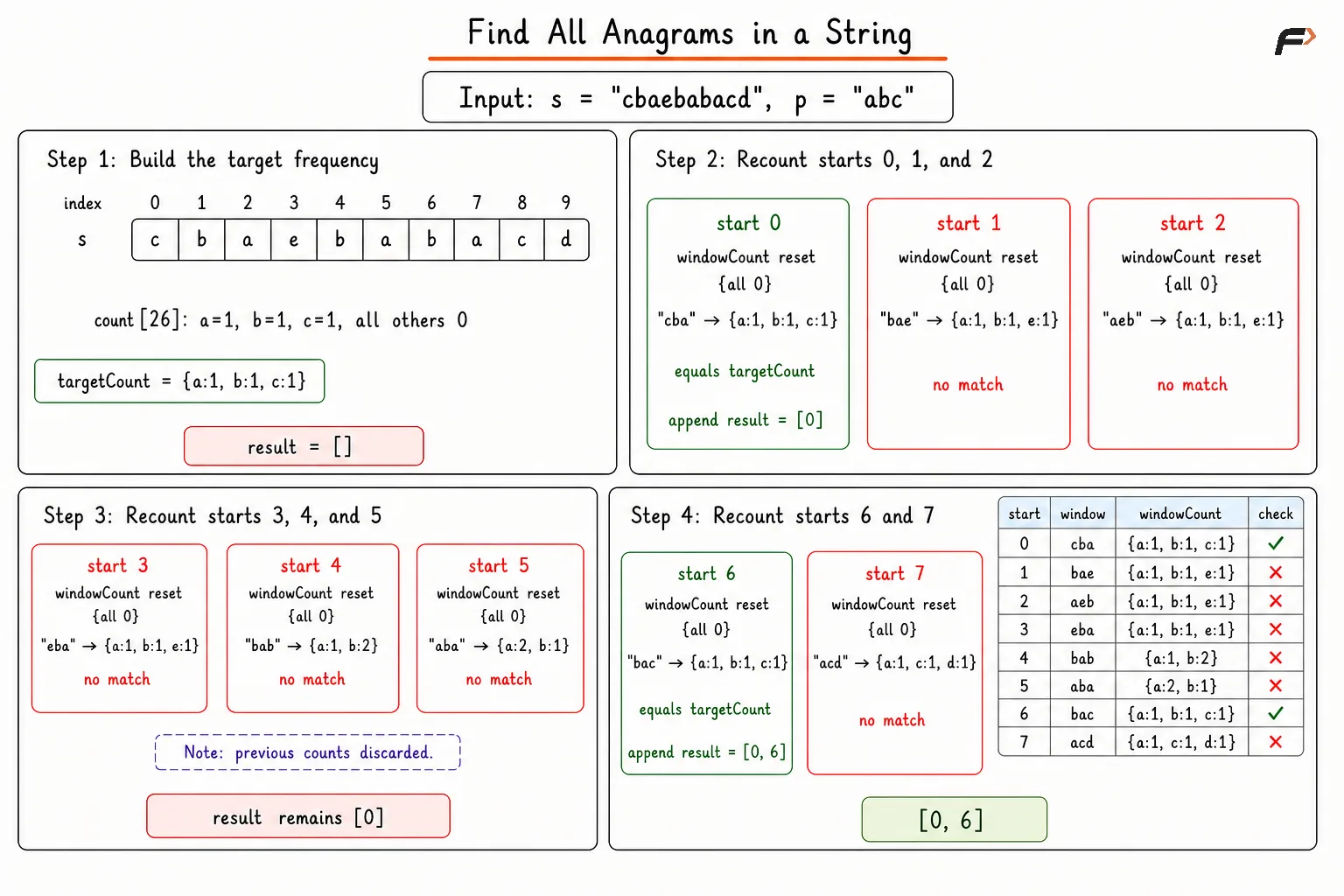
A fixed array of size 26 can represent the frequency of every lowercase English letter. One frequency array stores the target counts. A new frequency array is built for every candidate substring. Equal arrays confirm an anagram without sorting.
The approach removes repeated sorting, but every new window still recounts all M characters from the beginning.
Algorithm
Store the lengths of
sandpasNandM.Return an empty result when
M > N.Initialize a frequency array
targetCountof size26.Traverse
pand increase the frequency associated with every character.Traverse every valid starting index from
0toN - M.Initialize a new frequency array
windowCountof size26for the current substring.Traverse all
Mcharacters beginning at the current starting index and updatewindowCount.Compare
windowCountwithtargetCount.Append the starting index when both arrays match.
Return the result after processing every candidate substring.
Dry Run
fa
Solution
#include <bits/stdc++.h>using namespace std;class Solution {public: /* Finds all anagram starts by recounting every candidate window. */ vector<int> findAnagrams(string s, string p) { vector<int> result; int n = s.length(); int m = p.length(); // Stop when no window can match the target length. if (m > n) { return result; } // Store target frequencies for lowercase letters. vector<int> targetCount(26, 0); for (char character : p) { targetCount[character - 'a']++; } // Build a fresh frequency array for every window. for (int start = 0; start + m <= n; start++) { vector<int> windowCount(26, 0); // Count all characters in the current window. for (int offset = 0; offset < m; offset++) { char character = s[start + offset]; windowCount[character - 'a']++; } // Equal frequencies confirm an anagram. if (windowCount == targetCount) { result.push_back(start); } } return result; }};// Driver code to execute the solution.int main() { string s = "cbaebabacd"; string p = "abc"; Solution solution; vector<int> answer = solution.findAnagrams(s, p); // Print the resulting indices. cout << "["; for ( int index = 0; index < (int)answer.size(); index++ ) { cout << answer[index]; if (index + 1 < (int)answer.size()) { cout << ", "; } } cout << "]" << endl; return 0;}Complexity Analysis
Time Complexity: O((N - M + 1) × M), simplified to O(N × M), where N represents the length of s and M represents the length of p. Every candidate window recounts all M characters. Comparing two arrays of size 26 requires constant alphabet work.
Space Complexity: O(26), simplified to O(1) auxiliary space, excluding the returned indices. A result containing A matching indices requires O(A) output space.
Optimal Approach
The Better Approach avoids sorting but rebuilds the complete frequency array for every window. Two consecutive windows share M - 1 characters, so recounting the shared portion repeats unnecessary work.
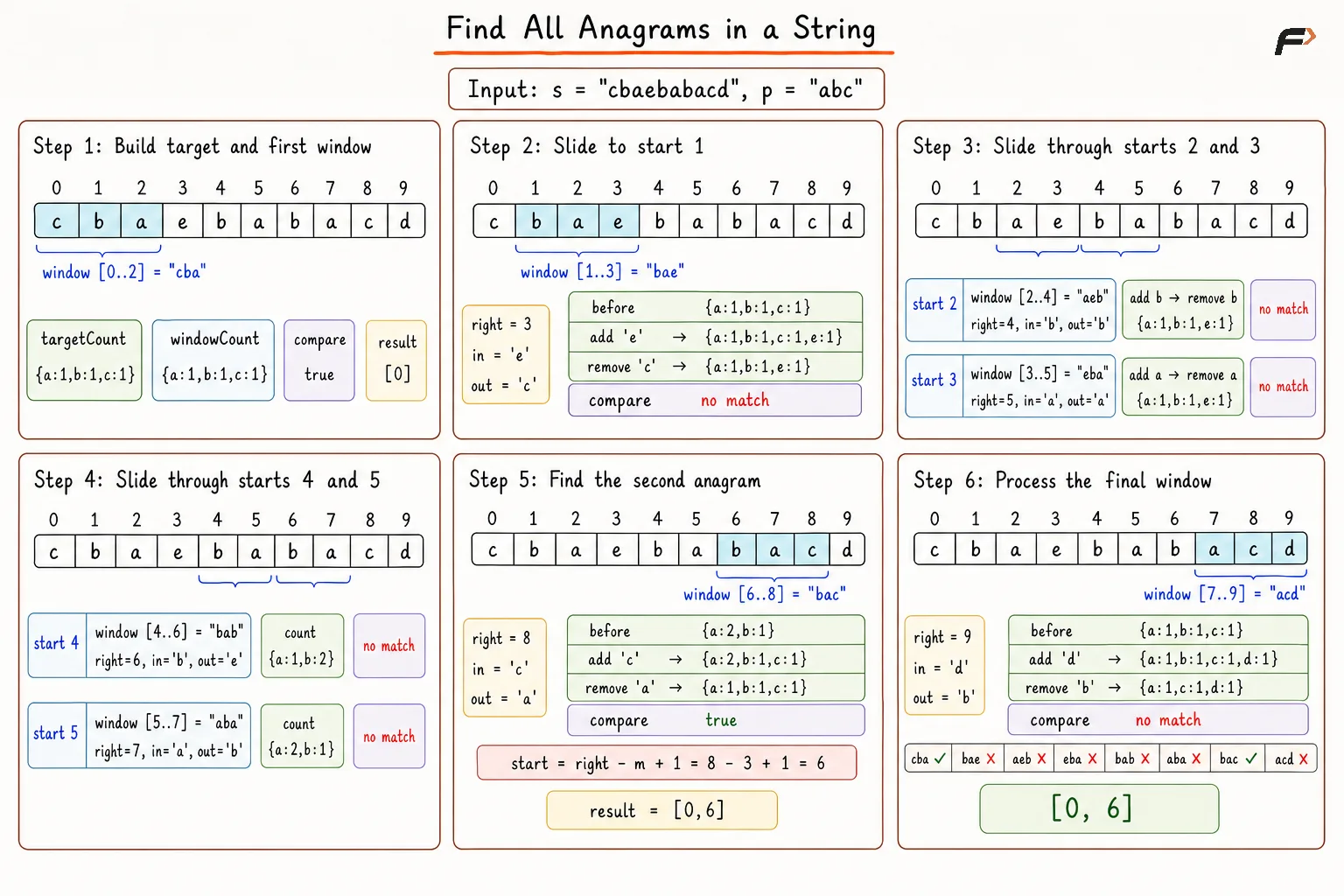
A fixed-size Sliding Window preserves the current frequency array. Moving the window one position to the right causes only two changes:
One character leaves from the left.
One character enters from the right.
Updating those two frequencies keeps the complete window state available in constant time. Frequency equality after every movement identifies all anagram starting positions, including overlapping occurrences.
Algorithm
Store the lengths of
sandpasNandM.Return an empty result when
M > N.Initialize two arrays of size
26:targetCountfor character frequencies inp.windowCountfor character frequencies in the active window ofs.
Traverse the first
Mpositions.Increase the frequency of
p[index]insidetargetCount.Increase the frequency of
s[index]insidewindowCount.
Append index
0when both frequency arrays match.Traverse
rightfromMtoN - 1.Add the incoming character
s[right]towindowCount.Remove the outgoing character
s[right - M]fromwindowCount, maintaining a window of exactlyMcharacters.Calculate the new starting index as
right - M + 1.Append the new starting index when
windowCountmatchestargetCount.Return the result after the right boundary reaches the end of
s.
Dry Run
fa
Solution
#include <bits/stdc++.h>using namespace std;class Solution {public: /* Finds all anagram starts with a sliding window. */ vector<int> findAnagrams(string s, string p) { vector<int> result; int n = s.length(); int m = p.length(); // Stop when no window can match the target length. if (m > n) { return result; } vector<int> targetCount(26, 0); vector<int> windowCount(26, 0); // Build target counts and the first window. for (int index = 0; index < m; index++) { targetCount[p[index] - 'a']++; windowCount[s[index] - 'a']++; } // Record the first window when frequencies match. if (windowCount == targetCount) { result.push_back(0); } // Move the fixed-size window across the string. for (int right = m; right < n; right++) { char incoming = s[right]; char outgoing = s[right - m]; // Add the incoming right-side character. windowCount[incoming - 'a']++; // Remove the outgoing left-side character. windowCount[outgoing - 'a']--; // Record the new window when frequencies match. if (windowCount == targetCount) { int start = right - m + 1; result.push_back(start); } } return result; }};// Driver code to execute the solution.int main() { string s = "cbaebabacd"; string p = "abc"; Solution solution; vector<int> answer = solution.findAnagrams(s, p); // Print the resulting indices. cout << "["; for ( int index = 0; index < (int)answer.size(); index++ ) { cout << answer[index]; if (index + 1 < (int)answer.size()) { cout << ", "; } } cout << "]" << endl; return 0;}Complexity Analysis
Time Complexity: O(N) because target and initial-window construction requires O(M) time, followed by N - M window movements. Every movement changes two frequencies and compares two fixed arrays of size 26, which remains constant alphabet work.
Space Complexity: O(26), simplified to O(1) auxiliary space, excluding the returned indices. A result containing A matching starting indices requires O(A) output space.
FAQs about Find All Anagrams in a String
1. Why must every candidate substring have the same length as p?
An anagram uses every target character exactly once. A shorter or longer substring cannot contain the same complete frequency distribution.
2. Why do equal frequency arrays confirm an anagram?
Every frequency-array position represents one lowercase English letter. Equal values at all 26 positions mean that both strings contain identical character counts.
3. Why is the outgoing character located at right - M?
After adding s[right], the active range temporarily contains M + 1 characters. Index right - M represents the oldest character and must leave to restore the required window size.
4. Can overlapping anagrams be detected?
Yes. Moving the window by one position checks every possible starting index, so overlapping matches remain included.
For s = "abab" and p = "ab", valid windows begin at indices 0, 1, and 2.
5. Why is an array of size 26 sufficient?
Both strings contain lowercase English letters only. Character 'a' maps to index 0, while character 'z' maps to index 25.
6. What happens when p is longer than s?
No length-M substring can exist inside s. An empty list is returned immediately.
7. Are the returned indices always in increasing order?
The provided implementations traverse s from left to right, so indices naturally appear in increasing order. The problem also accepts any order.
8. Can a Hash Map replace the frequency array?
Yes. A Hash Map supports larger or unknown character sets. A fixed array remains simpler and faster for a known lowercase-English alphabet.
9. Can repeated comparison of all 26 entries be removed?
Yes. A mismatch counter can track the number of unequal frequency positions. Every incoming or outgoing character changes only one position, allowing constant-time validity checks without scanning all 26 entries.
Be the first to add a comment.