Design a circular queue with a fixed capacity k. The queue must support insertion at the rear, deletion from the front, access to both end values, and checks for empty and full states.
Implement the following operations:
enQueue(value): Inserts
valueat the rear of the queue. Returnstrueif the insertion is successful; otherwise, returnsfalsewhen the queue is full.deQueue(): Removes the front value from the queue. Returns
trueif the deletion is successful; otherwise, returnsfalsewhen the queue is empty.Front(): Returns the front value of the queue. Returns
-1when the queue is empty.Rear(): Returns the rear value of the queue. Returns
-1when the queue is empty.isEmpty(): Returns
truewhen the queue contains no values; otherwise, returnsfalse.isFull(): Returns
truewhen the queue has reached its capacityk; otherwise, returnsfalse.
Built-in queue libraries cannot be used.
Example 1
Input: ["MyCircularQueue", "enQueue", "enQueue", "enQueue", "enQueue", "Rear", "isFull", "deQueue", "enQueue", "Rear"]
values = [[3], [1], [2], [3], [4], [], [], [], [4], []]
Output: [null, true, true, true, false, 3, true, true, true, 4]
Explanation: A queue of capacity 3 stores 1, 2, and 3. Insertion of 4 fails while the queue is full. Deletion removes 1, and the next insertion places 4 in the freed array position. The rear value becomes 4.
Example 2
Input: ["MyCircularQueue", "Front", "deQueue", "enQueue", "isFull", "Rear"]
values = [[1], [], [], [7], [], []]
Output: [null, -1, false, true, true, 7]
Explanation: An empty queue returns -1 from Front and rejects deletion. Insertion of 7 fills the single available position, so isFull returns true and Rear returns 7.
Brute Force Approach
The simplest queue implementation uses a dynamic array to store values from left to right.
Insertion
Add each new value immediately after the current rear element, so the queue grows from left to right.
Reject insertion when the array size reaches capacity
k.
Deletion
Remove the first value from the array.
Shift every remaining value one position toward the beginning.
Shifting keeps the front value at index
0, but makes deletion expensive.
Front and Rear
The first array value represents the front.
The last array value represents the rear.
Return
-1when the queue is empty.
Empty and Full Checks
The queue is empty when the array size is
0.The queue is full when the array size is equal to
k.
The main drawback is that every deletion may require shifting all remaining values. A circular array avoids this repeated shifting.
Algorithm
Initialize an empty dynamic array and store the maximum capacity
k.Before insertion, check whether the current size is equal to
k. Returnfalsewhen the queue is full.Insert the new value immediately after the current rear element and return
true.Before deletion, check whether the current size is
0. Returnfalsewhen the queue is empty.Remove the first value and shift all remaining values one position toward the beginning.
Return the first value for
Front()and the last value forRear(). Return-1when the queue is empty.Return
size == 0forisEmpty()andsize == kforisFull().
Dry Run
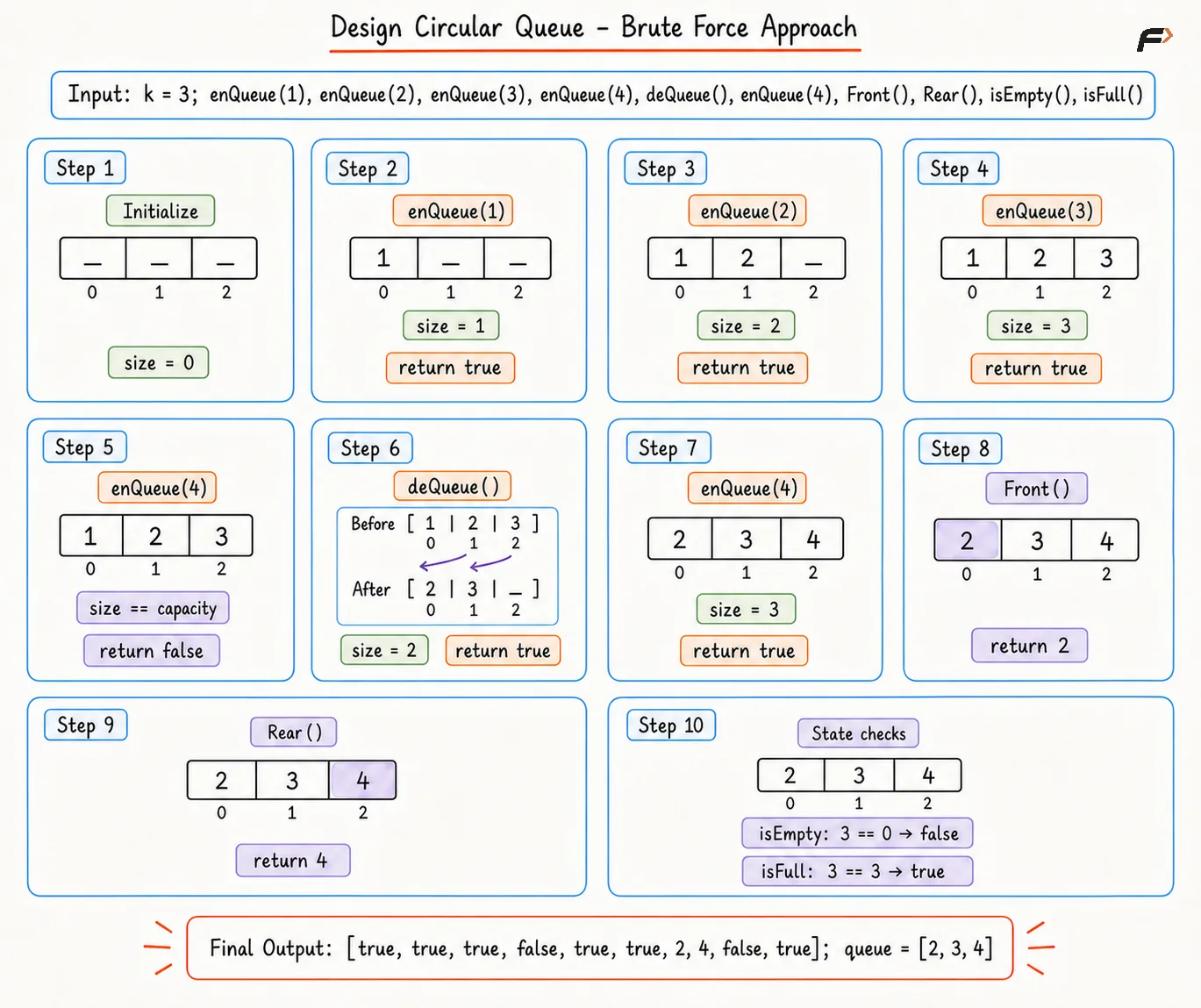
Circular Queue Brute
Solution
#include <bits/stdc++.h>using namespace std;class Solution {private: vector<int> queue; int capacity;public: // Initialize an empty queue with fixed capacity. Solution(int k) { capacity = k; } // Insert a value at the rear when space remains. bool enQueue(int value) { // Full capacity prevents another insertion. if (isFull()) { return false; } // Appending preserves arrival order. queue.push_back(value); return true; } // Remove the front value and compact the array. bool deQueue() { // An empty queue has no removable value. if (isEmpty()) { return false; } // Front removal shifts every later value left. queue.erase(queue.begin()); return true; } // Return the oldest stored value. int Front() { // An empty queue has no front value. if (isEmpty()) { return -1; } return queue[0]; } // Return the newest stored value. int Rear() { // An empty queue has no rear value. if (isEmpty()) { return -1; } return queue[queue.size() - 1]; } // Check for an empty queue. bool isEmpty() { return queue.empty(); } // Check for a full queue. bool isFull() { return queue.size() == capacity; }};// Driver codeint main() { Solution obj(3); cout << boolalpha << obj.enQueue(1) << "\n"; cout << boolalpha << obj.enQueue(2) << "\n"; cout << boolalpha << obj.enQueue(3) << "\n"; cout << boolalpha << obj.deQueue() << "\n"; cout << boolalpha << obj.enQueue(4) << "\n"; cout << obj.Rear() << "\n"; return 0;}Complexity Analysis
Time Complexity: O(k), each deQueue operation can shift up to k - 1 values; insertion takes amortized constant time, and access or state checks take constant time.
Space Complexity: O(k), the dynamic array stores at most k queue values.
Optimal Approach
A normal array queue may shift every value after deleting the front element. This shifting takes extra time. A circular queue avoids this problem by moving the front index instead of moving the stored values.
Using
frontandrearfrontpoints to the first value of the queue.rearpoints to the last inserted value.During deletion, move
frontforward.During insertion, move
rearforward.
Using Modulo
An index may reach the end of the array while empty positions exist at the beginning.
Use
% capacityto move the index back to0.This allows previously freed positions to be reused.
Tracking the Queue Size
The positions of
frontandrearalone may not clearly show whether the queue is empty or full.Maintain a separate
sizecounter.size == 0means the queue is empty.size == capacitymeans the queue is full.
Algorithm
Create an array of size
kto store the queue values. Setfront = 0,rear = -1, andsize = 0because the queue is initially empty.Before insertion, check whether
size == k. Returnfalsewhen both values are equal because the queue has no empty position.For a successful Insertion:
Move
rearusing(rear + 1) % kso the index can wrap back to the beginning.Store the new value at
queue[rear].Increment
sizebecause one new value has been added.Return
true.
Before deletion, check whether
size == 0. Returnfalsebecause an empty queue has no front value to remove.For a successful Deletion:
Move
frontusing(front + 1) % kinstead of shifting the array values.Decrement
sizebecause one value has been removed.Return
true.
For
Front(), returnqueue[front]becausefrontpoints to the first queue value. Return-1when the queue is empty.For
Rear(), returnqueue[rear]becauserearpoints to the last queue value. Return-1when the queue is empty.For
isEmpty(), returnsize == 0. ForisFull(), returnsize == k.
Dry Run
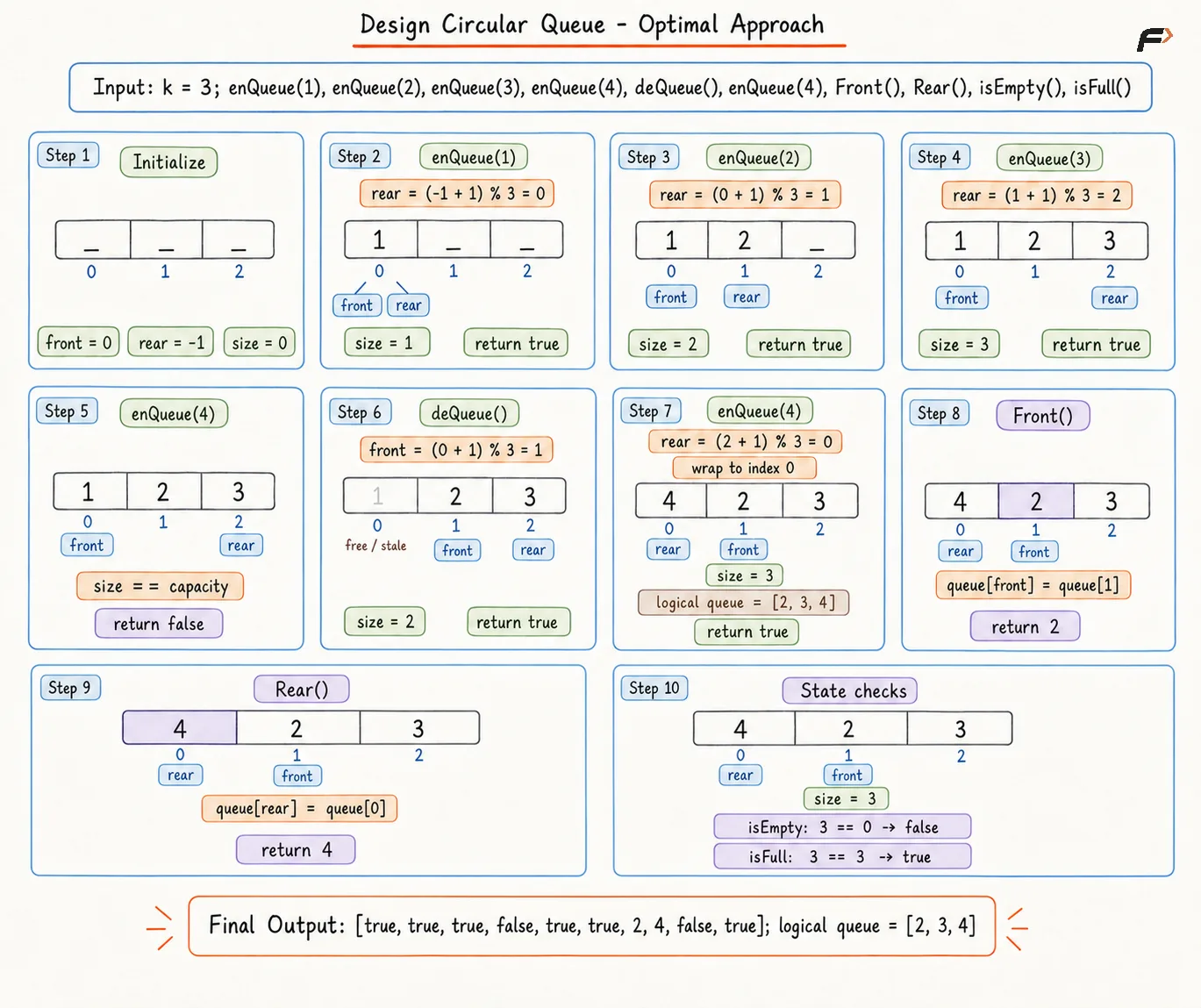
Circular Queue Optimal
Solution
#include <bits/stdc++.h>using namespace std;class Solution {private: vector<int> queue; int capacity; int front; int rear; int size;public: // Initialize circular-array state with fixed capacity. Solution(int k) { queue.resize(k); capacity = k; front = 0; rear = -1; size = 0; } // Insert a value at the next circular rear position. bool enQueue(int value) { // Full capacity prevents another insertion. if (isFull()) { return false; } // Modulo reuses the first position after the array end. rear = (rear + 1) % capacity; queue[rear] = value; size++; return true; } // Remove the front value without shifting stored values. bool deQueue() { // An empty queue has no removable value. if (isEmpty()) { return false; } // Modulo advances the front across the array boundary. front = (front + 1) % capacity; size--; return true; } // Return the oldest stored value. int Front() { // An empty queue has no front value. if (isEmpty()) { return -1; } return queue[front]; } // Return the newest stored value. int Rear() { // An empty queue has no rear value. if (isEmpty()) { return -1; } return queue[rear]; } // Check for an empty queue. bool isEmpty() { return size == 0; } // Check for a full queue. bool isFull() { return size == capacity; }};// Driver codeint main() { Solution obj(3); cout << boolalpha << obj.enQueue(1) << "\n"; cout << boolalpha << obj.enQueue(2) << "\n"; cout << boolalpha << obj.enQueue(3) << "\n"; cout << boolalpha << obj.deQueue() << "\n"; cout << boolalpha << obj.enQueue(4) << "\n"; cout << obj.Rear() << "\n"; return 0;}Complexity Analysis
Time Complexity: O(1) per queue operation because every operation performs a constant number of comparisons, index calculations, or array accesses; construction takes O(k) time to create the fixed storage.
Space Complexity: O(k), the fixed array stores exactly k positions and the remaining state uses constant auxiliary space.
Interview follow-up Questions
A circular queue wraps the rear index to the beginning after free positions appear near index 0. A linear array queue can leave such positions unused unless values are shifted.
Be the first to add a comment.