Given an integer N, determine whether it is a Prime Number or not. Return true if it is prime, otherwise return false.
A prime number is a positive integer greater than 1 that has no positive divisors other than 1 and itself.
Example 1
Input: N = 7
Output: true
Explanation: The number 7 is divisible only by 1 and 7, so it is a prime number.
Example 2
Input: N = 12
Output: false
Explanation: The number 12 is divisible by 2, 3, 4, and 6 as well, so it is not a prime number.
Brute Force Approach
The most natural way to think about this problem is to search for an extra divisor. A prime number is only allowed to have 1 and itself as divisors, so if even one number from 2 to N - 1 divides N, the answer becomes false.
Algorithm
First, return
falseifN <= 1because prime numbers are defined only for numbers greater than1.Start checking every integer from
2toN - 1because any extra divisor in this range is enough to prove thatNis not prime.If
N % i == 0for any checked value, returnfalseimmediately because an extra exact divisor has been found.Return
trueafter the loop finishes because no number other than1andNwas able to divide it.
Key Points
1is not a prime number because it has only one positive divisor.0and negative numbers are not prime.
Dry Run
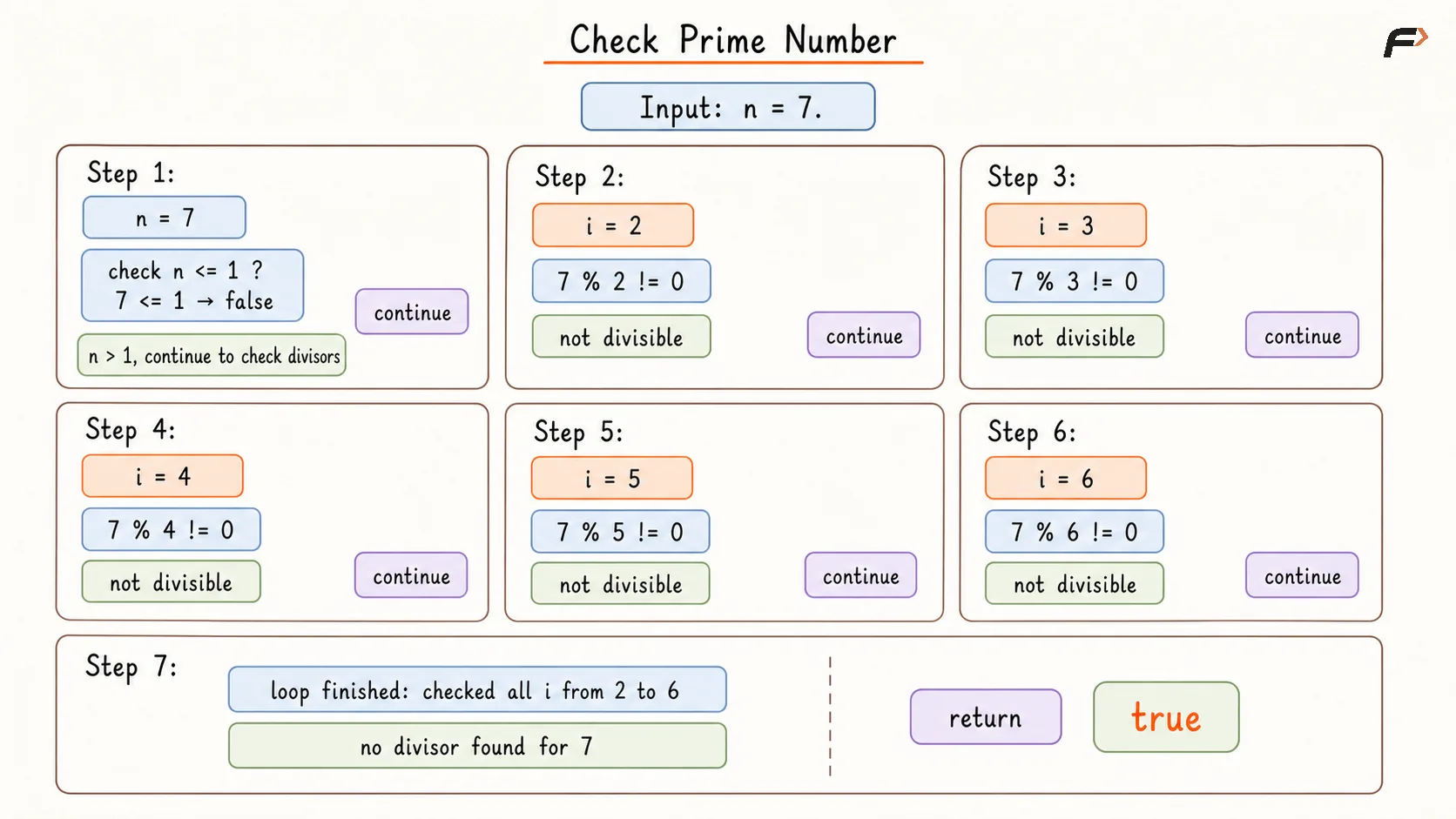
Check Prime Number Brute Force Dry Run
Solution
#include <bits/stdc++.h>using namespace std;class Solution {public: /* Checks whether the given number is prime using brute force. */ bool isPrime(int n) { // Numbers less than or equal to 1 are not prime. if (n <= 1) { return false; } // Check every possible divisor from 2 to n - 1. for (int i = 2; i < n; i++) { // If a divisor is found, the number is not prime. if (n % i == 0) { return false; } } return true; }};// Driver code startsint main() { Solution sol; int n = 29; if (sol.isPrime(n)) { cout << "true\n"; } else { cout << "false\n"; } return 0;}Complexity Analysis
Time Complexity: O(N), because in the worst case almost all numbers from 2 to N - 1 are checked.
Space Complexity: O(1), because only a few variables are used.
Optimal Approach
The key observation is that factors always come in pairs. If i is a factor of N, then N / i is also a factor because i × (N / i) = N. For example, for 36, the factor pairs are 2×18, 3×12, 4×9, and 6×6. After 6, the pairs simply repeat in reverse. The important point is that at least one factor in every pair must be less than or equal to √N. If both factors were greater than √N, their product would be greater than N, which is impossible. Therefore, we only need to check factors up to √N.
Instead of calculating √N, we use i * i <= N. This is exactly the same condition because i <= √N means i × i <= N. For example, when N = 36, 6 * 6 = 36, so we check 6. For i = 7, 7 * 7 = 49 > 36, meaning we have crossed √36 = 6, so we can stop. Any factor after 6, such as 9, 12, or 18, would already have its smaller partner (4, 3, or 2) checked. Thus, i * i <= N lets us find all possible factors without checking unnecessary values.
Algorithm
First, return
falseifN <= 1because such numbers do not satisfy the definition of a prime number.Return
trueimmediately ifNis2because it is the smallest prime number.Return
falseimmediately ifNis even and greater than2because divisibility by2already proves it is not prime.Start checking odd divisors from
3because even divisors are no longer needed after the earlier even-number check.Continue the loop only while
i * i <= Nbecause any divisor beyond the square root would already have a matching smaller divisor.If
N % i == 0for any checked value, returnfalsebecause an extra exact divisor has been found.Return
trueafter the loop finishes because no valid divisor exists other than1andN.
Key Points
Checking up to
sqrt(N)is enough because factors always come in pairs.2is the smallest prime number.Every even number greater than
2is automatically not prime.The condition
i * i <= Nis often preferred over using an actual square root function.
Dry Run
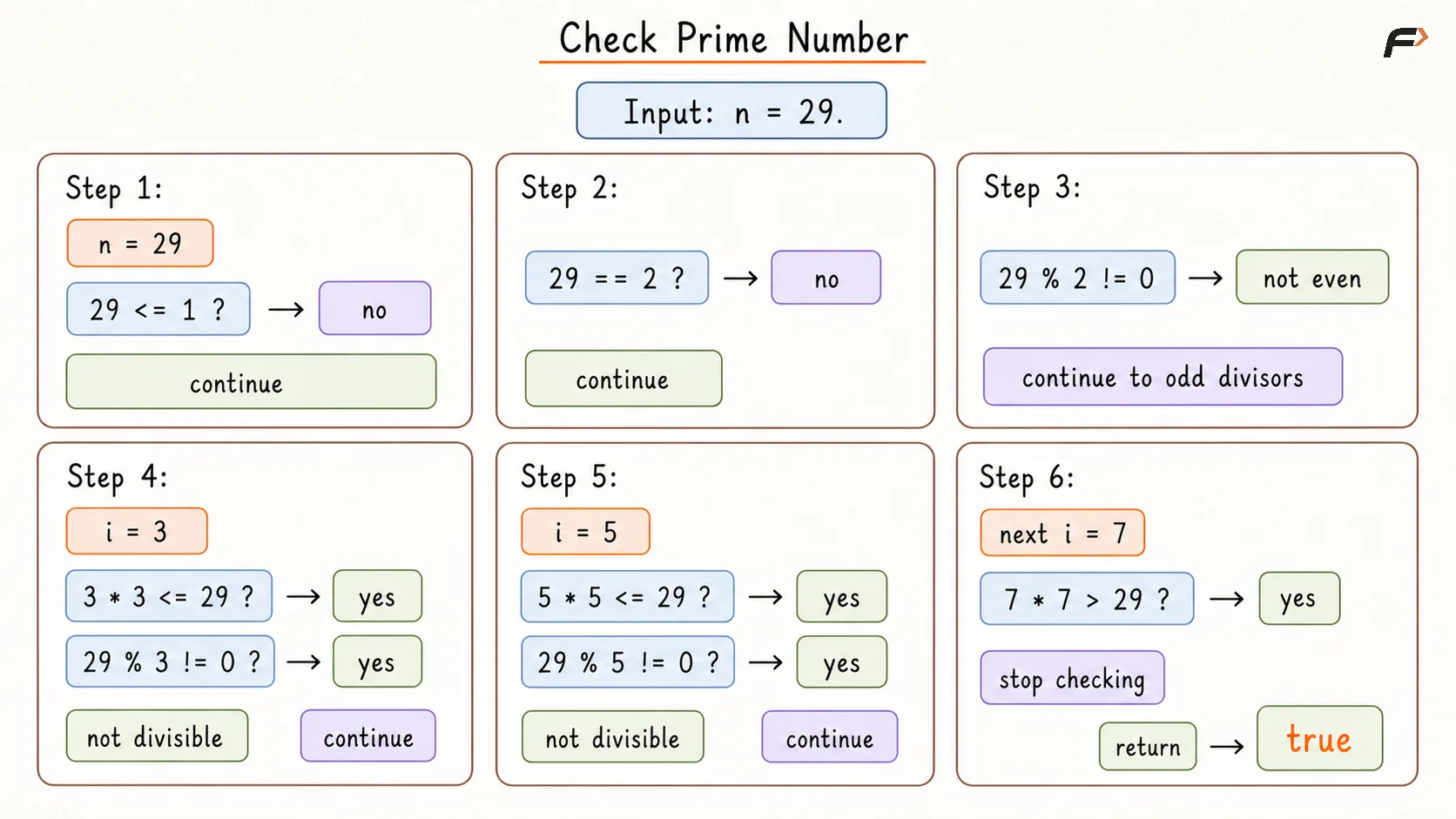
Check Prime Number Binary Search Dry Run
Solution
#include <bits/stdc++.h>using namespace std;class Solution {public: /* Checks whether the given number is prime or not. */ bool isPrime(int n) { // Numbers less than or equal to 1 are not prime. if (n <= 1) { return false; } // 2 is the smallest prime number. if (n == 2) { return true; } // Any even number greater than 2 is not prime. if (n % 2 == 0) { return false; } // Check only odd divisors up to the square root of n. for (int i = 3; i * i <= n; i += 2) { // If a divisor is found, the number is not prime. if (n % i == 0) { return false; } } return true; }};// Driver code startsint main() { Solution sol; int n = 29; if (sol.isPrime(n)) { cout << "true\n"; } else { cout << "false\n"; } return 0;}Complexity Analysis
Time Complexity: O(sqrt(N)), because only divisors up to the square root are checked, and even numbers are skipped after the initial check.
Space Complexity: O(1), because no extra data structure is needed.
FAQs
Q1. Why is 1 not a prime number?
Because a prime number must have exactly two positive divisors. The number 1 has only one positive divisor, which is 1 itself.
Q2. Why do we check only up to the square root of N?
Because if N has a divisor larger than sqrt(N), then the paired divisor must be smaller than sqrt(N). So one side of the factor pair is always enough to detect it.
Q3. Is 2 a prime number?
Yes. The number 2 has exactly two divisors, 1 and 2, so it is prime.
Q4. Are all odd numbers prime?
No. Many odd numbers are not prime. For example, 9 is odd but divisible by 3.
Q5. Can negative numbers be prime?
No. Prime numbers are defined only for positive integers greater than 1.
Q6. What is the difference between prime and composite numbers?
A prime number has exactly two positive divisors, while a composite number has more than two positive divisors.
Be the first to add a comment.