Given an integer n, check whether it is a palindrome number or not.
A palindrome number stays the same even after its digits are reversed.
Example 1
Input: n = 121
Output: true
Explanation: Reading 121 from both sides gives the same number.
Example 2
Input: n = 10
Output: false
Explanation: Reversing 10 gives 01, which is not the same as 10.
Brute Force Approach
A palindrome number follows the same pattern as a palindrome word. The digit at the beginning should match the digit at the end, then the next digit from the left should match the next digit from the right, and this checking keeps moving inward.
That observation naturally suggests converting the number into a string. Once the digits are available as characters, comparing the outer pairs becomes simple and direct.
A small edge case appears before that. Negative numbers are not palindrome numbers in the standard version of this problem, because the minus sign appears only on the left side and has no matching character on the right side.
Algorithm
First, check whether the number is negative. This is necessary because a minus sign breaks the mirror pattern, so the number cannot read the same from both directions.
Convert the number into a string. This helps access digits from both ends easily, without repeatedly extracting digits using division and modulo.
Keep one pointer at the start of the string and another at the end. These pointers mark the two digits that should match if the number is truly a palindrome.
Compare the digits at both pointers. If they are different, the answer should immediately become
falsebecause one mismatch is enough to prove the number is not a palindrome.If the digits match, move the left pointer one step to the right and the right pointer one step to the left. This is done to continue checking the next inner pair.
Repeat this process until the pointers meet or cross. At that moment, every important pair has already been checked, so the number is a palindrome.
Dry Run
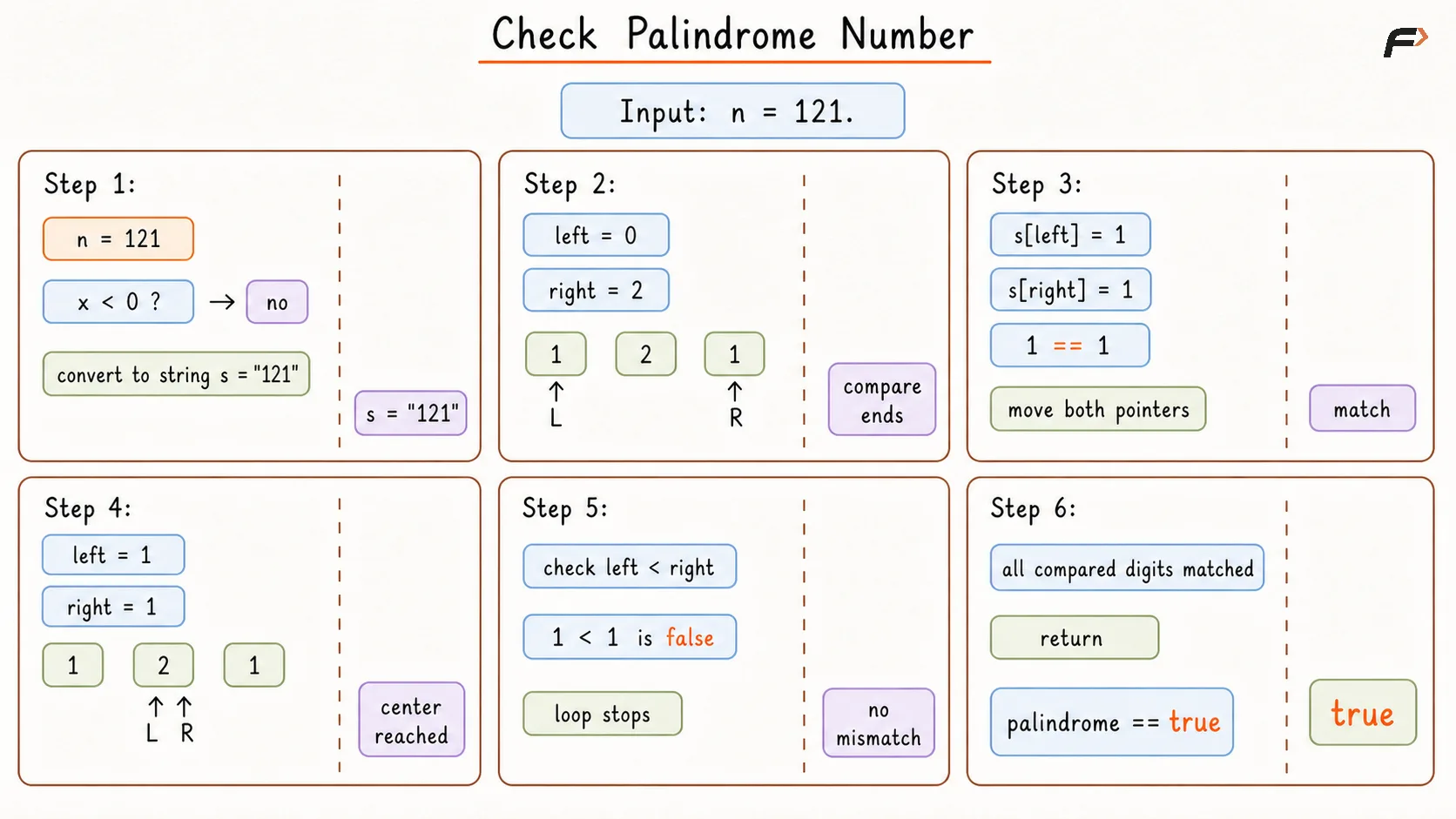
Check Palindrome Number Brute Dry Run
Solution
#include <bits/stdc++.h>using namespace std;class Solution {public: /* Checks if the number is a palindrome using string comparison. */ bool isPalindrome(int n) { // Negative numbers are not palindromes. if (n < 0) { return false; } // Convert number to string. string s = to_string(n); // Pointers for both ends. int left = 0; int right = (int)s.size() - 1; // Compare digits from both sides. while (left < right) { // Mismatch means not a palindrome. if (s[left] != s[right]) { return false; } // Move to the next left digit. left++; // Move to the next right digit. right--; } return true; }};// Driver code startsint main() { Solution sol; cout << (sol.isPalindrome(121) ? "true" : "false") << endl; return 0;}Complexity Analysis
Time Complexity: O(log10 n) because every digit is checked at most once.
Space Complexity: O(log10 n) because the number is stored as a string.
Better Approach
A number is a palindrome if it reads the same from left to right and right to left. Instead of converting the number into a string, we can mathematically reverse the digits and compare the reversed number with the original.
Algorithm
Store
original = n. We need the original value after modifyingn.Initialize
reverse = 0. This will store the reversed number.While
n > 0perform the following operations:Extract the last digit using
n % 10.Add it to
reverse.Remove the last digit using
n /= 10to process next numbers.
Compare
reversewithoriginal. Equality means the number is identical to its reverse.Handle negative numbers separately, they cannot be a palindrome.
Dry Run
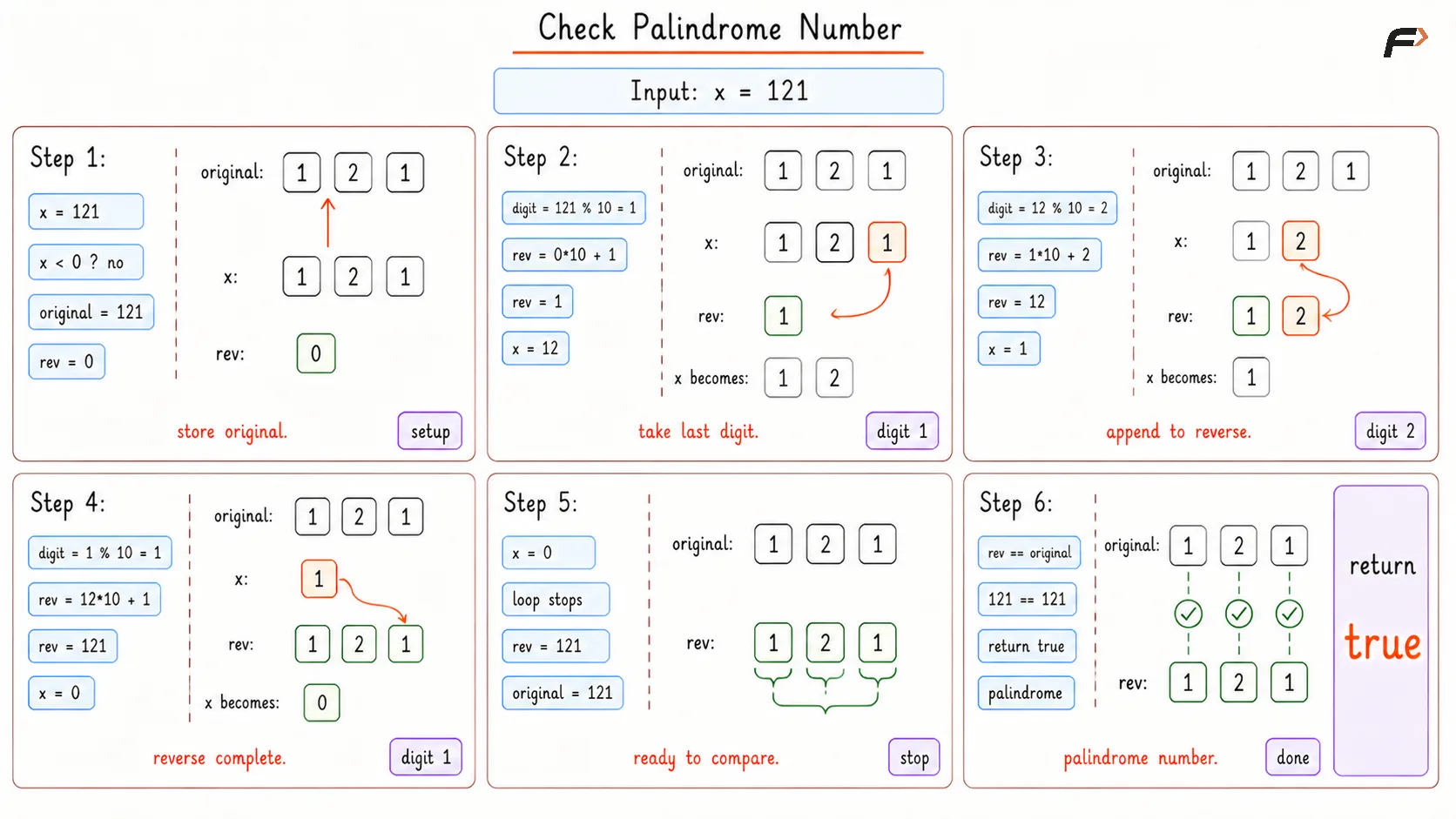
Check Palindrome Number Better Dry Run
Solution
#include <bits/stdc++.h>using namespace std;class Solution {public: // Checks whether a number is palindrome or not bool isPalindrome(int n) { // Negative numbers cannot be palindromes. if (n < 0) return false; // Store the original number because x will be modified. int original = n; // Store the reversed number. long long rev = 0; // Process every digit of the number. while (n > 0) { // Extract the last digit. int digit = n % 10; // Append the extracted digit to the reversed number. rev = rev * 10 + digit; // Remove the last digit from x. n /= 10; } // A palindrome is equal to its reversed form. return rev == original; }};// Driver codeint main() { Solution s; cout << s.isPalindrome(121) << endl; return 0;}Complexity Analysis
Time Complexity: O(log10 n) because the number of digits processed depends on the number of digits in the number.
Space Complexity: O(1) because only a few variables are used.
Optimal Approach
The key observation is that a palindrome matches from both ends.
So instead of reversing the full number, only the last half of the digits can be reversed and compared with the first half. Once the reversed half becomes greater than or equal to the remaining half, enough digits have already been processed.
This also explains two important edge cases quickly:
Any negative number is not a palindrome because of the minus sign.
Any number ending in
0cannot be a palindrome unless the number itself is0, because a palindrome cannot start with0.
Algorithm
First, return
falseif the number is negative, because a minus sign breaks the palindrome pattern.Return
falseif the number ends with0but is not0, because a palindrome cannot start with0.Build the reversed second half of the number, because only half is enough for comparison.
In each step, take the last digit from the number and add it to the reversed half.
Remove that last digit from the original number so the remaining part acts like the first half.
Stop when the remaining number becomes smaller than or equal to the reversed half, because half the digits have already been checked.
Compare both halves. For odd-length numbers, ignore the middle digit by dividing the reversed half by
10.
Key Points
0is a palindrome.Negative numbers are not treated as palindromes in the standard version of this problem.
For odd-length numbers like
121, the middle digit can be ignored during the final comparison.
Dry Run
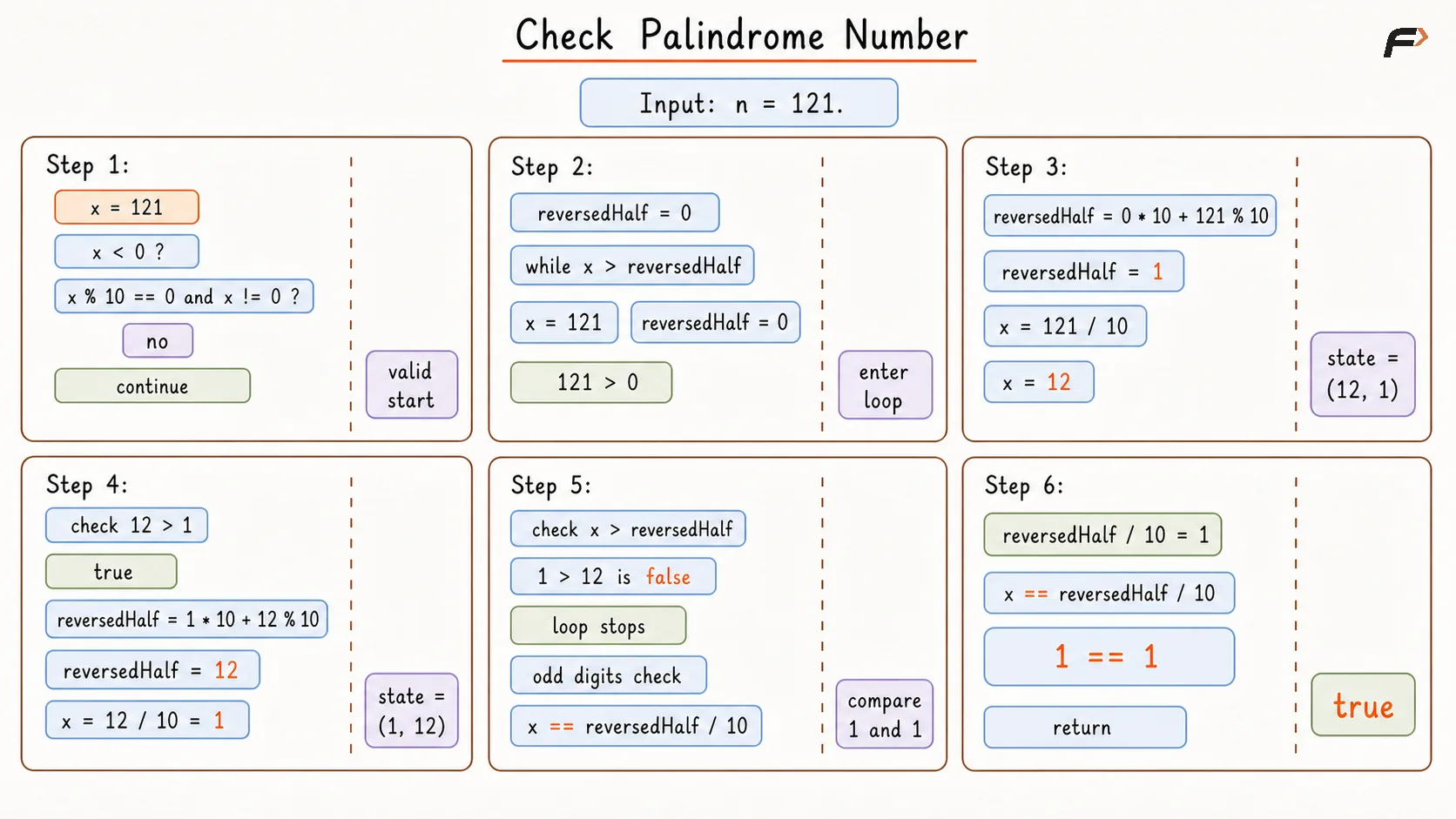
Check Palindrome Number Optimal Dry Run
Solution
#include <bits/stdc++.h>using namespace std;class Solution {public: /* Checks whether the given integer is a palindrome without converting it to a string. */ bool isPalindrome(int n) { // Negative numbers and numbers ending in 0 cannot be palindromes, // except the number 0 itself. if (n < 0 || (n % 10 == 0 && n != 0)) { return false; } // This stores the reversed second half of the number. int reversedHalf = 0; while (n > reversedHalf) { // Add the current last digit into the reversed half. reversedHalf = reversedHalf * 10 + n % 10; // Remove the current last digit from remaining first half. n /= 10; } // For even digits, both halves must match. // For odd digits, the middle digit is removed from reversedHalf. return n == reversedHalf || n == reversedHalf / 10; }};// Driver code startsint main() { int n = 121; Solution obj; cout << (obj.isPalindrome(n) ? "true" : "false") << "\n"; return 0;}Complexity Analysis
Time Complexity: O(log10 n) because the number of digits processed depends on the number of digits in the number.
Space Complexity: O(1) because only a few variables are used.
Interview follow-up Questions
Because of the minus sign. For example, -121 does not look the same when reversed.
Be the first to add a comment.