A network contains n cities numbered from 0 to n-1. Every directed flight [from,to,price] travels from from to to for the listed price.
Given source city src, destination city dst, and integer k, return the cheapest price from source to destination with at most k intermediate stops. Return -1 when no valid route exists. A limit of k stops permits at most k+1 flights.
Example 1
Input: n = 4, flights = [[0,1,100],[1,2,100],[2,0,100],[1,3,600],[2,3,200]], src = 0, dst = 3, k = 1
Output: 700
Explanation: Route 0->1->3 costs 700 and uses one stop. Route 0->1->2->3 costs 400 but uses two stops, exceeding the limit.
Example 2
Input: n = 3, flights = [[0,1,100],[1,2,100],[0,2,500]], src = 0, dst = 2, k = 0
Output: 500
Explanation: Zero stops permit only a direct flight, so flight 0->2 supplies the valid minimum price.
Approach 1
Bounded Bellman–Ford builds cheapest prices by flight count. After round r, the distance array stores the minimum price using at most r flights. Since K stops allow at most K+1 flights, exactly K+1 rounds cover every valid route.
Each round reads from the previous distance layer and writes into a copy. Separate arrays prevent several flights from chaining within one round.
Algorithm
Initialize all city prices as infinity and set the source price to
0, establishing the starting state before taking any flight.Perform exactly
K+1rounds, since a route containing at mostKintermediate stops can use at mostK+1flights.Copy the current distance array at the beginning of every round, preserving prices calculated with fewer flights.
Traverse every directed flight and skip an edge when the departure city remains unreachable.
Calculate the candidate price using the previous distance array and update the arrival city only in the copied array.
Replace the distance array with the completed copy after processing all flights, advancing the allowed flight count by one.
Return
-1when the destination remains unreachable; otherwise, return the minimum destination price.
Dry Run
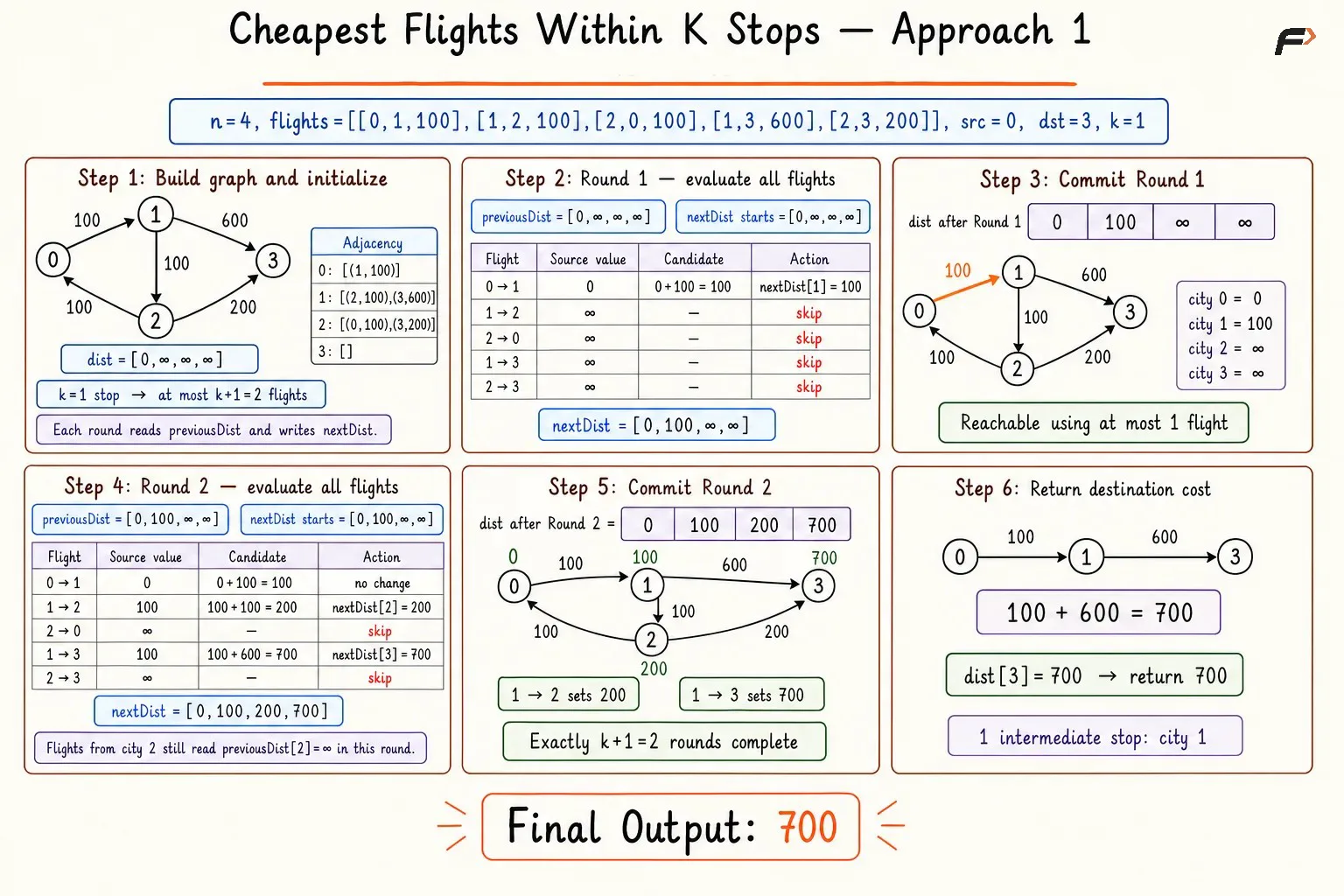
cheapest flights 1
Solution
#include <bits/stdc++.h>using namespace std;class Solution {public: // Returns the cheapest price using at most k stops. long long findCheapestPrice(int n, vector<vector<int>>& flights, int src, int dst, int k) { // Use a wide sentinel outside valid accumulated prices. const long long INF = numeric_limits<long long>::max() / 4; // Store prices using a wide integer type. vector<long long> distance(n, INF); // Set the zero-flight price for the source city. distance[src] = 0; // Build prices using at most k + 1 flights. for (int used = 0; used <= k; used++) { vector<long long> nextDistance = distance; // Relax every directed flight from the previous layer. for (const vector<int>& flight : flights) { int from = flight[0]; int to = flight[1]; long long price = flight[2]; // Skip unreachable departure cities. if (distance[from] == INF) { continue; } // Update only the next flight-count layer. nextDistance[to] = min( nextDistance[to], distance[from] + price ); } // Move to the next layer after all flights are relaxed. distance = nextDistance; } // Convert an unreachable destination into -1. return distance[dst] == INF ? -1 : distance[dst]; }};// Driver code.int main() { int n = 4; vector<vector<int>> flights = { {0, 1, 100}, {1, 2, 100}, {2, 0, 100}, {1, 3, 600}, {2, 3, 200} }; Solution solution; cout << solution.findCheapestPrice(n, flights, 0, 3, 1); return 0;}Complexity Analysis
Time Complexity: O((K+1)×E), where K is the stop limit and E is the number of directed flights; every round scans all flights.
Space Complexity: O(N), where N is the number of cities; two wide-integer distance arrays store consecutive flight-count layers.
Approach 2
State-aware Dijkstra treats {flightsUsed, city} as the complete state. Reaching the same city with different flight counts creates different remaining possibilities, so a city-only distance array is insufficient.
A min-heap processes the lowest-cost valid state first. Non-negative flight prices make the first destination state removed from the heap the cheapest valid route.
Algorithm
Build a directed weighted adjacency list from all flights, storing each destination city with the corresponding price.
Initialize a
besttable withK+2flight layers andNcities, where every entry initially contains infinity.Set
best[0][source]=0and insert{0, source, 0}into a min-heap, representing zero price with no flights used.Continue processing while the heap contains states, remove the state having the smallest price, and skip stale entries that differ from the matching table value.
Return the current price when the removed city is the destination, as no cheaper valid state remains in the min-heap.
When fewer than
K+1flights have been used, relax every outgoing flight into the next layer and insert each improved state into the heap.Return
-1when the heap becomes empty without reaching the destination within the allowed flight count.
Dry Run
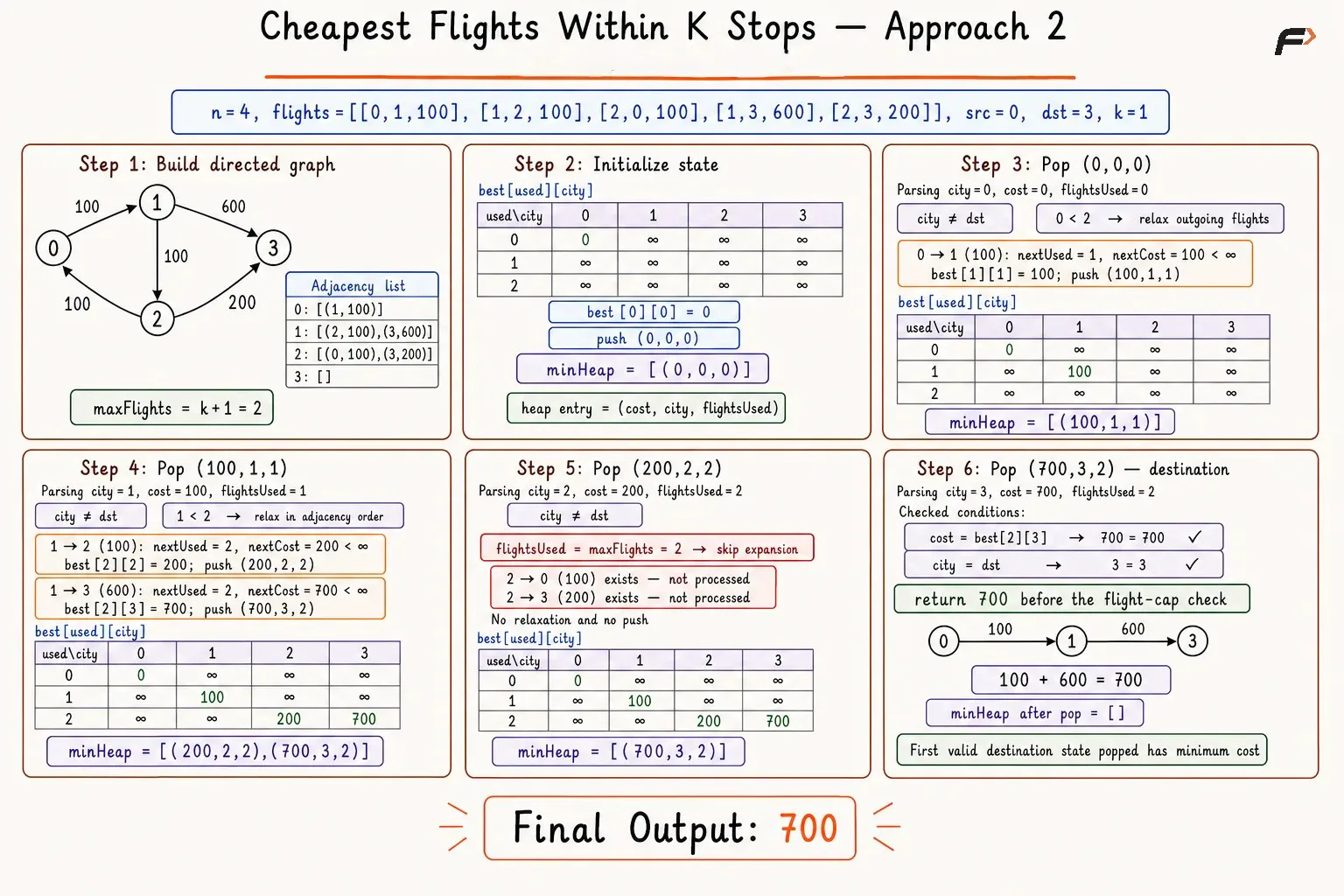
cheapest flight 2
Solution
#include <bits/stdc++.h>using namespace std;class Solution {public: // Returns the cheapest price using at most k stops. long long findCheapestPrice(int n, vector<vector<int>>& flights, int src, int dst, int k) { // Build the directed weighted adjacency list. vector<vector<pair<int, int>>> adjacency(n); for (const vector<int>& flight : flights) { adjacency[flight[0]].push_back({flight[1], flight[2]}); } // Use a wide sentinel outside valid accumulated prices. const long long INF = numeric_limits<long long>::max() / 4; int maxFlights = k + 1; // Store the best price for every flight-count and city state. vector<vector<long long>> best(maxFlights + 1, vector<long long>(n, INF)); using State = tuple<long long, int, int>; // Process states by increasing total price. priority_queue<State, vector<State>, greater<State>> minHeap; // Start from source with zero flights and zero price. best[0][src] = 0; minHeap.push({0, src, 0}); while (!minHeap.empty()) { auto [cost, city, used] = minHeap.top(); minHeap.pop(); // Skip states replaced by cheaper matching states. if (cost != best[used][city]) { continue; } // Destination popped first is the cheapest valid answer. if (city == dst) { return cost; } // Stop paths exceeding k + 1 flights. if (used == maxFlights) { continue; } // Relax outgoing flights into the next layer. for (const auto& [neighbor, price] : adjacency[city]) { int nextUsed = used + 1; long long nextCost = cost + price; // Update only when the new price is cheaper. if (nextCost < best[nextUsed][neighbor]) { best[nextUsed][neighbor] = nextCost; minHeap.push({nextCost, neighbor, nextUsed}); } } } // Return -1 when destination cannot be reached. return -1; }};// Driver code.int main() { int n = 4; vector<vector<int>> flights = { {0, 1, 100}, {1, 2, 100}, {2, 0, 100}, {1, 3, 600}, {2, 3, 200} }; Solution solution; cout << solution.findCheapestPrice(n, flights, 0, 3, 1); return 0;}Complexity Analysis
Time Complexity: O((K+1)×E×log((K+2)×N)), where N is the city count, E is the flight count, and K is the stop limit. Heap operations introduce a logarithmic factor, so bounded Bellman–Ford has the better worst-case asymptotic bound.
Space Complexity: O((K+2)×N+(K+1)×E), where the layered state table stores city prices, while the adjacency list and heap store flight transitions.
Interview follow-up Questions
Stops count only intermediate cities. A route containing one intermediate city contains two flight edges.
Be the first to add a comment.