Given a directed weighted graph with V vertices numbered from 0 to V-1, an edge list containing entries [from,to,weight], and a source vertex, compute the shortest distance from the source to every vertex.
Negative edge weights are allowed. Store 100000000 for every unreachable vertex. Return [-1] when a negative-weight cycle is reachable from the source because finite shortest distances do not exist for the affected graph.
Example 1
Input: V = 5, edges = [[0,1,5],[1,2,1],[1,3,2],[2,4,1],[4,3,-1]], source = 0
Output: [0,5,6,6,7]
Explanation: The shortest distance to vertex 3 is 6 through path 0->1->2->4->3.
Example 2
Input: V = 4, edges = [[0,1,4],[1,2,-6],[2,3,5],[3,1,-2]], source = 0
Output: [-1]
Explanation: Cycle 1->2->3->1 has total weight -3 and is reachable from the source.
Approach
Bellman–Ford computes shortest distances by repeatedly scanning the complete edge list. After V-1 passes, every shortest simple path has propagated through at most V-1 edges.
An additional edge scan detects reachable negative cycles. Any further improvement after V-1 passes indicates a repeatedly usable cycle having negative total weight.
Algorithm
Initialize every distance to
100000000, representing infinity, and set the source distance to0.Perform at most
V-1relaxation passes and initialize an update flag as false before every pass.Traverse every edge and skip relaxation when the source endpoint remains unreachable.
Calculate
distance[from]+weight; upon finding a smaller value, updatedistance[to]and set the update flag to true.End the relaxation phase early when a complete pass produces no update, as all reachable shortest distances have stabilized.
Scan every edge once more and return
[-1]when any reachable edge can still be relaxed, confirming a negative cycle reachable from the source.Return the final distance array when no reachable negative cycle is detected.
Dry Run
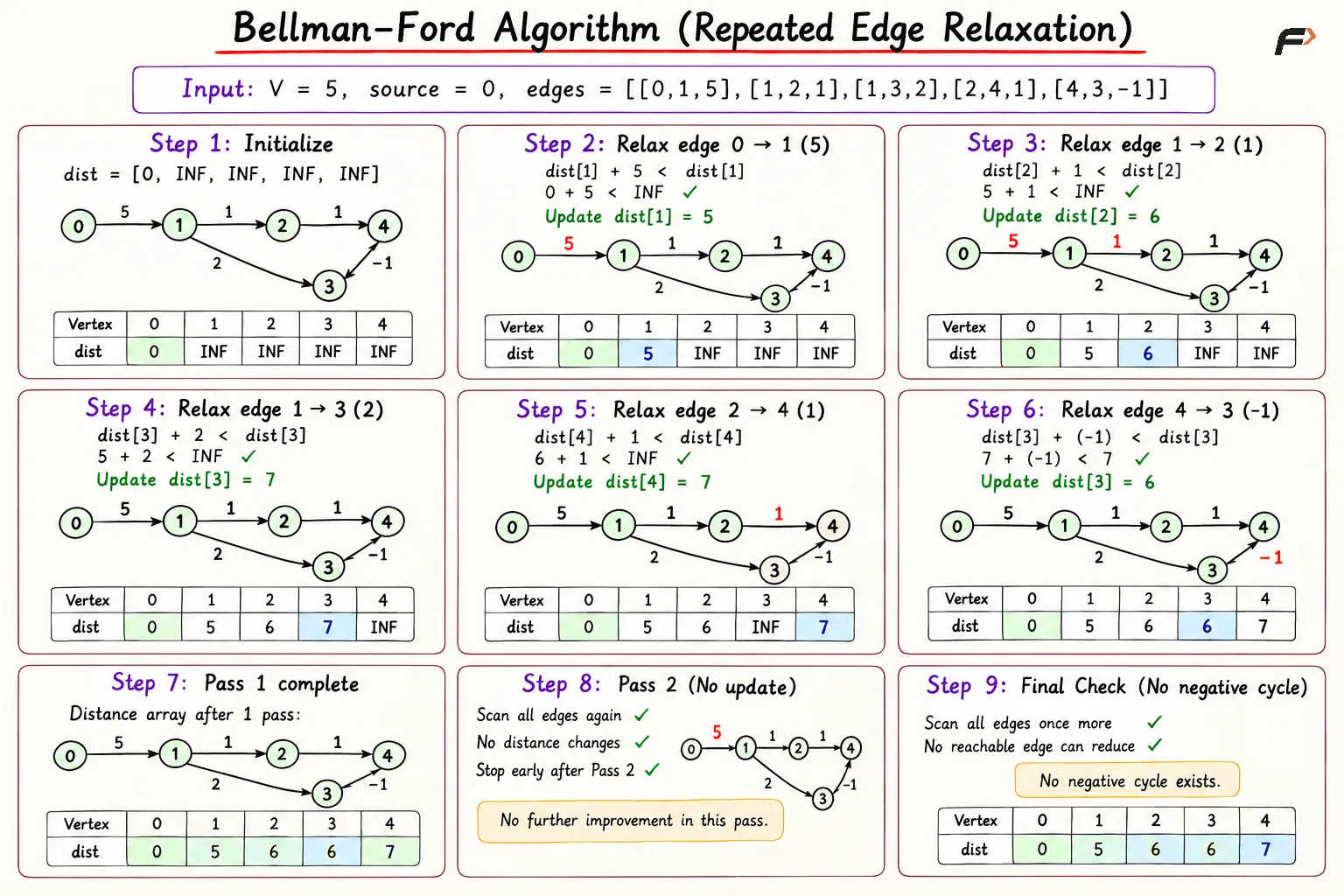
Diagram 1
Solution
#include <bits/stdc++.h>using namespace std;class Solution {public: // Return shortest distances or {-1} for a reachable negative cycle. vector<long long> bellmanFord(int vertices, vector<vector<int>>& edges, int source) { const long long INF = numeric_limits<long long>::max() / 4; vector<long long> dist(vertices, INF); // Set the source distance before edge relaxation. dist[source] = 0; // Relax every edge up to vertices - 1 times. for (int pass = 1; pass <= vertices - 1; pass++) { bool updated = false; // Scan the complete directed edge list. for (const vector<int>& edge : edges) { int from = edge[0]; int to = edge[1]; long long weight = edge[2]; // Ignore edges leaving unreachable vertices. if (dist[from] == INF) { continue; } // Record a shorter path through the departure vertex. if (dist[from] + weight < dist[to]) { dist[to] = dist[from] + weight; updated = true; } } // Stop after a pass with no distance change. if (!updated) { break; } } // Detect a negative cycle reachable from the source. for (const vector<int>& edge : edges) { int from = edge[0]; int to = edge[1]; long long weight = edge[2]; // A further relaxation means a reachable negative cycle exists. if (dist[from] != INF && dist[from] + weight < dist[to]) { return {-1}; } } // Return all shortest distances. return dist; }};// Driver code.int main() { int vertices = 5; vector<vector<int>> edges = { {0, 1, 5}, {1, 2, 1}, {1, 3, 2}, {2, 4, 1}, {4, 3, -1} }; Solution sol; vector<long long> answer = sol.bellmanFord(vertices, edges, 0); // Print the returned distance array. for (long long distance : answer) { cout << distance << " "; } return 0;}Complexity Analysis
Time Complexity: O(V×E), where V and E are the numbers of vertices and directed edges; up to V-1 passes and one detection scan examine all edges.
Space Complexity: O(V), where the distance array stores one shortest-path value for each of the V vertices.
Interview follow-up Questions
Every shortest simple path contains at most V-1 edges.
Be the first to add a comment.