Given an integer N, determine whether it is an Armstrong number or not. Return true if it is an Armstrong number, otherwise return false.
An Armstrong number, also known as a Narcissistic number, is a number that is equal to the sum of its own digits, where each digit is raised to the power of the total number of digits.
Example 1
Input: n = 153
Output: true
Explanation: 153 has 3 digits, and 1^3 + 5^3 + 3^3 = 1 + 125 + 27 = 153, so it is an Armstrong number.
Example 2
Input: n = 123
Output: false
Explanation: 123 has 3 digits, and 1^3 + 2^3 + 3^3 = 1 + 8 + 27 = 36, which is not equal to 123.
Approach
The first observation is the one given directly by the definition: the answer depends only on the digits of the number and on how many digits the number has. So before anything else, the number of digits must be known.
Once that count is available, the rest of the idea becomes natural. Pick each digit one by one, raise it to that digit count, keep adding the result, and finally check whether the total comes back to the original number. If it does, the number is Armstrong. If it does not, it is not.
Algorithm
First, handle the negative case by returning
false, because Armstrong numbers are defined for positive numbers and, in practice, the usual beginner version also includes0as a valid Armstrong number.Keep a copy of the original number, because the number will be broken apart digit by digit during processing, but the final comparison must still be made with the original value.
Count how many digits are present in the number. This count matters because every digit must be raised to exactly that power.
Extract digits one by one using
% 10, raise each digit to the power of the digit count, and keep adding those values to a running sum. This step builds exactly the quantity described in the problem definition.After all digits have been processed, compare the final sum with the original number. If both values are equal, return
true; otherwise, returnfalse.
Key Points
Negative numbers are not Armstrong numbers in the usual DSA definition.
0is considered an Armstrong number because it has one digit and0^1 = 0.Every single-digit non-negative number is an Armstrong number.
Dry Run
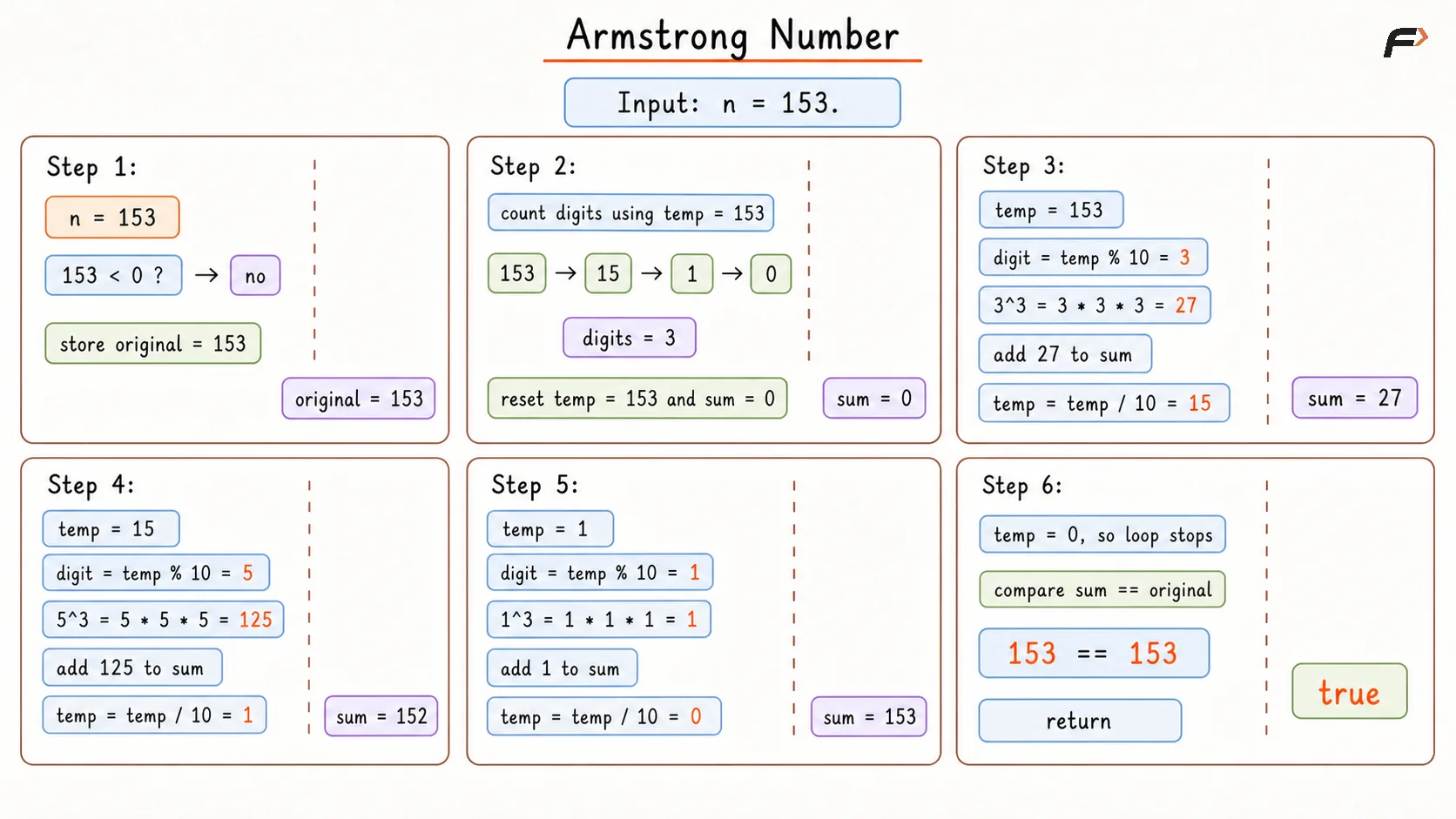
Armstrong Number Dry Run
Solution
#include <bits/stdc++.h>using namespace std;class Solution {public: /* Returns true if n is an Armstrong Number by summing each digit raised to the digit count. */ bool isArmstrong(int n) { // Negative numbers are not Armstrong numbers. if (n < 0) { return false; } // Stores the original value for the final comparison. int original = n; // The number 0 has exactly one digit. int digits = (n == 0) ? 1 : 0; int temp = n; // Count how many digits are present in the number. while (temp > 0) { digits++; temp /= 10; } // Reset temp so the digits can now be processed one by one. temp = n; // Stores the sum built from digit powers. int sum = 0; // Handle 0 directly because its digit extraction loop would not run. if (temp == 0) { sum = 0; } while (temp > 0) { // Extract the current last digit. int digit = temp % 10; // Build digit^digits using integer multiplication. int powerValue = 1; for (int i = 0; i < digits; i++) { powerValue *= digit; } // Add the current digit contribution to the total sum. sum += powerValue; temp /= 10; } // Compare the computed digit-power sum with the original number. return sum == original; }};// Driver code startsint main() { int n = 153; Solution obj; cout << (obj.isArmstrong(n) ? "true" : "false") << endl; return 0;}Complexity Analysis
Time Complexity: O(d * k), where d is the number of digits and k is the digit count used as the power, because each digit is processed once and each power is computed over k multiplications in this implementation.
Space Complexity: O(1), because only a few variables are used.
Optimal Approach
The core idea of Armstrong Number does not change: every digit must be raised to the power of the number of digits.
However, we can compute the same power much faster using Fast Exponentiation (Binary Exponentiation). Instead of multiplying one by one, it repeatedly squares the current value and uses the binary representation of the exponent to decide which powers to include. Since the exponent is roughly halved in every step, the number of operations reduces from O(p) to O(log p).
Algorithm
If the number is negative, return
falsebecause Armstrong numbers are usually considered for non-negative integers.If the number is
0, treat it as a 1-digit Armstrong number.Count how many digits are present in the number.
Traverse each digit one by one using modulus and division.
For every digit, calculate digit^count using fast exponentiation.
Initialize
result = 1andbase = 1.While the exponent is greater than
0:If the exponent is odd, multiply
resultby the current base.Square the base (
base = base × base) so it represents the next power of two.Divide the exponent by
2(ignore the remainder), effectively processing its binary representation one bit at a time.
When the exponent becomes
0,resultcontainsdigit^count.
Add all these powered values into a sum.
If the final sum becomes equal to the original number, return
true. Otherwise, returnfalse.
Dry Run
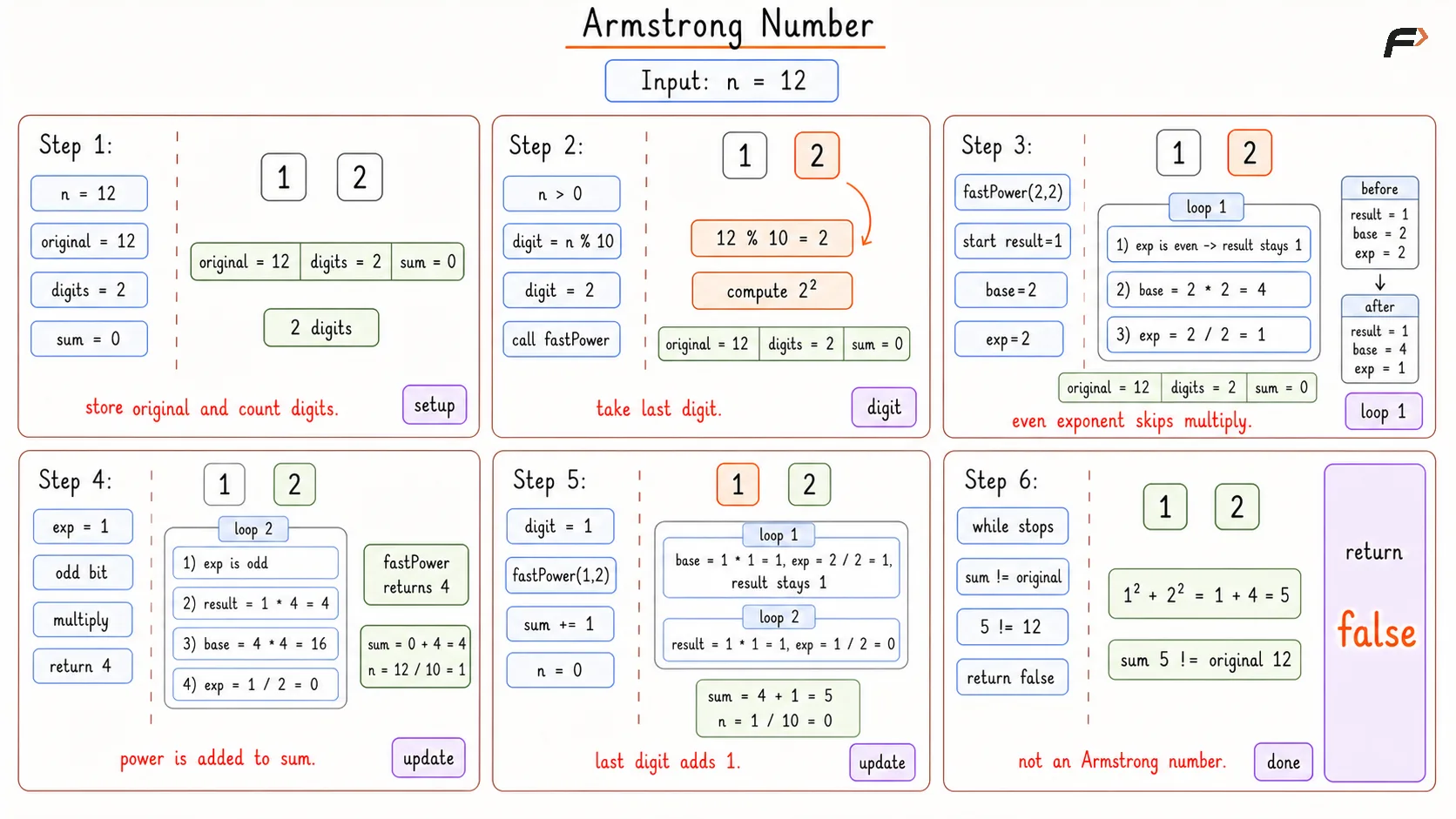
Armstrong Number Optimal Dry Run
Solution
#include <bits/stdc++.h>using namespace std;class Solution {public: /* Checks whether the given number is an Armstrong number. */ bool isArmstrong(int n) { // Negative numbers are not considered Armstrong numbers here. if (n < 0) { return false; } // Zero is a valid Armstrong number. if (n == 0) { return true; } int original = n; // This stores how many digits are present in the number. int digits = countDigits(n); // This variable stores the sum of powered digits. int sum = 0; while (n > 0) { int digit = n % 10; sum += fastPower(digit, digits); n /= 10; } // The number is Armstrong only if the computed sum matches the original value. return sum == original; }private: int countDigits(int n) { int count = 0; while (n > 0) { count++; n /= 10; } return count; } int fastPower(int base, int exponent) { int result = 1; while (exponent > 0) { // If the current bit is set, include the current base in the answer. if (exponent & 1) { result *= base; } base *= base; exponent >>= 1; } return result; }};// Driver code startsint main() { Solution sol; int n = 9474; if (sol.isArmstrong(n)) { cout << "true\n"; } else { cout << "false\n"; } return 0;}Complexity Analysis
Time Complexity: O(d log d), where d is the number of digits. There are d digits, and each power calculation takes O(log d) time and d = log10 N.
Space Complexity: O(1) because constant space is used.
Interview follow-up Questions
Yes. It is a single-digit number, and 0^1 = 0, so it satisfies the condition.
Be the first to add a comment.