Breaking the Myth: DSA Is Language-Independent
Data structures and algorithms (DSA) are about concepts, patterns, and problem-solving. C++, Java, and Python are ways to express a solution; the core reasoning transfers across languages.
Logic comes before syntax
Solving a problem means understanding what is required and deciding which steps produce the answer. Programming syntax tells you how to write those steps in a particular language.
Knowing a language’s keywords does not automatically give you a solution. It is like knowing words without knowing what you want to say. If the logic is unclear, switching languages will not fix it.
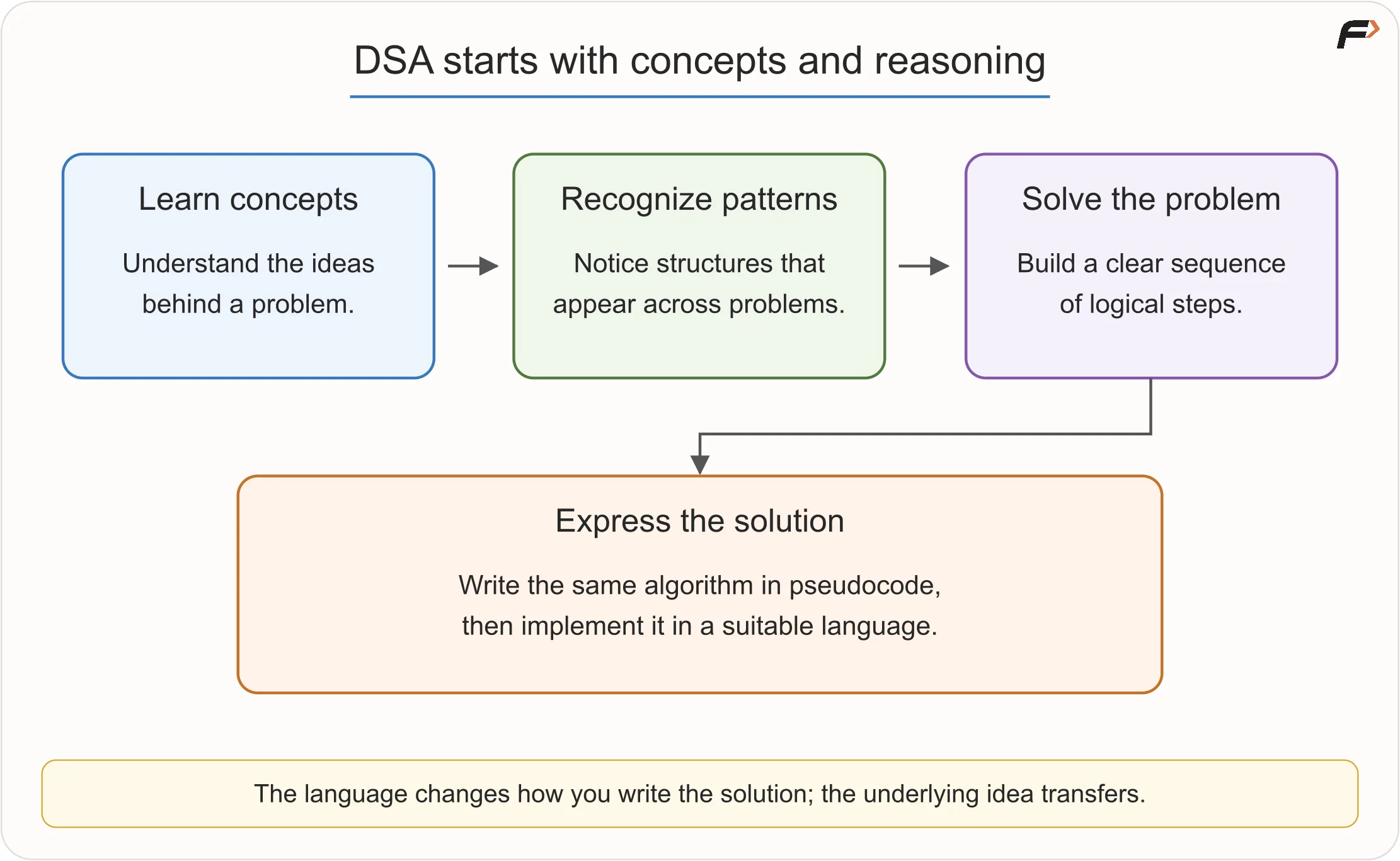
Logic and Language
Languages do differ in their syntax, libraries, and execution behaviour. Language-independent means the underlying ideas can transfer—not that every implementation is identical.
Pseudocode expresses the idea
Pseudocode describes an algorithm using readable, structured instructions without requiring a specific language’s grammar.
Consider a simple problem: read an integer and report whether it is even or odd. The logic is to check whether division by 2 leaves a remainder of zero.
READ N

IF N MOD 2 = 0
    DISPLAY "Even"
ELSE
    DISPLAY "Odd"
END IF
MOD means remainder. For 8, the remainder is zero, so the output is “Even.” For 7, it is not zero, so the output is “Odd.”
C++, Java, and Python use different syntax for input, conditions, and output, but this decision stays the same. Once you understand the pseudocode, you can translate it into the language you know.
Learn to reason about the problem, then use a programming language to make the solution executable.