Image 1
Why Do Computer Networks Exist?
A computer network is a system that enables multiple computing devices to communicate and share information with one another. While a single computer can perform computations, run applications, and store data, its true potential is realized only when it can interact with other devices. Networking exists because computing becomes significantly more useful and powerful when machines are able to exchange information and collaborate.
A Powerful Computer Can Still Be Isolated
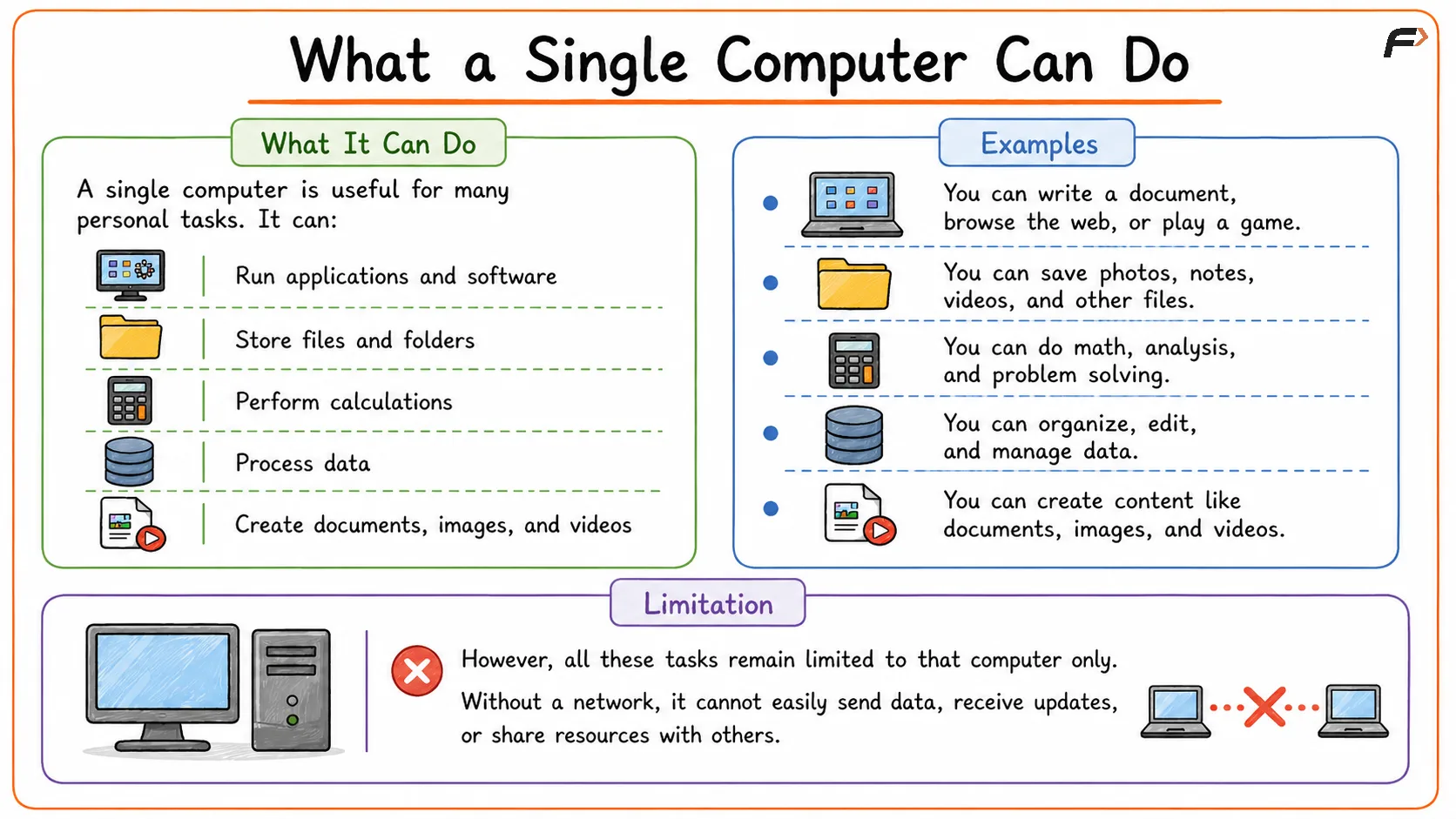
Imagine having an extremely powerful computer capable of running advanced applications, executing Large Language Models (LLMs), playing locally stored media, and performing complex computations without requiring an Internet connection. From a computational perspective, the machine is highly capable. However, despite all its power, it has one major limitation: it operates in isolation.
- If a computer is not connected to any network, applications running on it remain accessible only on that local machine.
- Thousands or even millions of computers around the world may host valuable services, databases, and applications.
- Without communication between these computers, users would not be able to access services hosted on other systems.
- Information, files, and resources would remain isolated within individual devices.
- Networking enables computers to exchange data and make remote services available to users anywhere in the world.
- The modern Internet is essentially a massive network that allows billions of devices to communicate and share services with one another.
This is exactly why computer networks exist. A powerful computer without a network is similar to a highly intelligent person locked alone in a room. The capabilities are present, but there is no mechanism to share knowledge, communicate, or collaborate with others.
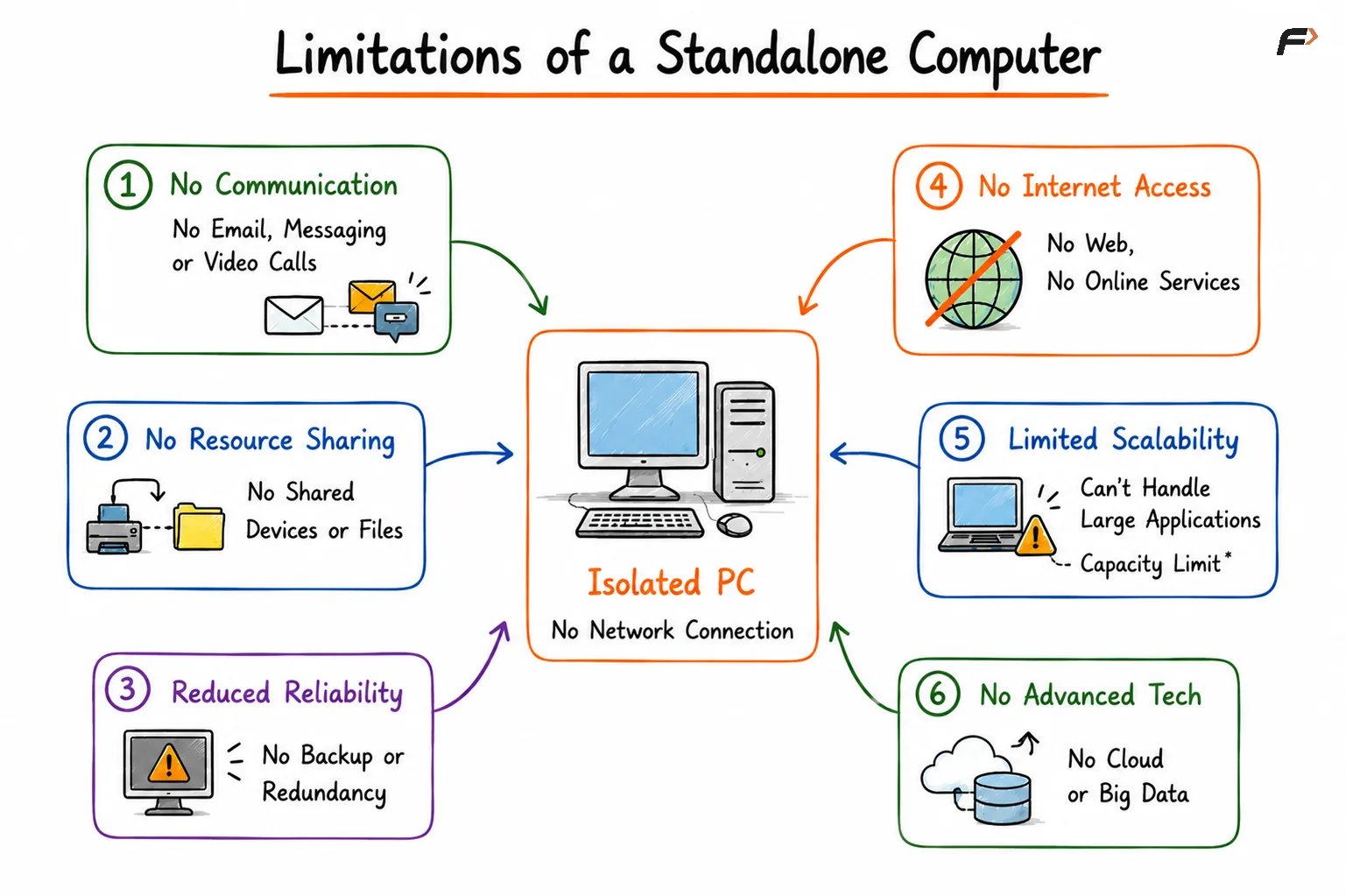
Image 8
Why Machines Need to Communicate
Modern computing is built around communication between devices. Most applications that we use daily depend on machines exchanging information across a network. Without networking, many technologies that we take for granted simply would not exist.
Some common examples include:
- Sending messages through WhatsApp
- Sharing files using Google Drive
- Accessing websites and web applications
- Sending and receiving emails
- Participating in video conferences
- Playing online multiplayer games
- Using cloud-based applications and services
Consider a few of these examples. When you send a WhatsApp message, the message must travel from your device to another user's device. When you upload a file to Google Drive, that file is transferred to remote servers. Similarly, whenever you access a website, information is exchanged between your device and the server hosting the website. All of these interactions rely on networking.
The fundamental purpose of networking can therefore be summarized as follows:
- Enable communication between devices
- Allow information sharing
- Provide access to remote services and applications
- Support collaboration between users and systems
- Enable large-scale distributed computing
Networking Does Not Always Mean Internet
One of the most common misconceptions among beginners is assuming that a network and the Internet are the same thing. In reality, a network is a much broader concept. A network refers to any collection of devices that can communicate with each other, regardless of whether they are connected to the Internet.
The relationship can be summarized as:
- Every Internet connection involves networking.
- Not every network requires Internet connectivity.
- A network can exist entirely within a room, building, or organization.
- The Internet is simply the world's largest interconnected network.
Examples of Networks Without Internet
Many networks operate perfectly well without any connection to the public Internet. The only requirement is that the participating devices should be able to communicate with one another.
AirPods and a Smartphone
Consider a pair of AirPods connected to a smartphone through Bluetooth. The phone continuously sends audio data to the AirPods, while the AirPods communicate status information such as battery levels and connection details back to the phone. Since these devices are exchanging information, they form a network even though no Internet connection is involved.
Laptop Connected to Wi-Fi Without Internet
You may have encountered situations where your laptop is connected to a Wi-Fi network but the Wi-Fi itself does not have Internet access. Even in such cases, the laptop remains part of a network because communication with other devices connected to the same network is still possible.
Office Networks
Organizations commonly maintain internal networks consisting of computers, printers, servers, and other devices connected through switches and cables. Such networks allow users to:
- Share files
- Access shared printers
- Communicate with internal servers
- Use common organizational resources
Even if the organization's Internet connection fails, these services can continue operating within the local network.
Servers Inside a Data Center
A data center is a facility containing a large number of interconnected servers. These servers continuously exchange information with one another to support applications, cloud services, and websites. Most of this communication happens through private networking infrastructure within the data center itself.
The Internet becomes necessary only when these servers need to communicate with users or systems located outside the data center.
What Is the Internet Then?
If networks can exist independently of the Internet, then what exactly is the Internet? The Internet is a global system that connects multiple networks together. For this reason, it is often described as a network of networks.
For example, consider two data centers located in different parts of the world. Each data center has its own internal network of servers. If these networks need to exchange information across continents, a larger communication infrastructure is required. This worldwide interconnection is provided by the Internet.
In simple terms:
- A network connects devices.
- The Internet connects networks.
Network vs Internet
| Network | Internet |
|---|---|
| A collection of devices that can communicate with each other. | A global collection of interconnected networks. |
| Can be very small in size. | Operates on a worldwide scale. |
| May function without Internet access. | Connects multiple independent networks together. |
| Examples include Bluetooth connections, office LANs, and data center networks. | Examples include websites, cloud services, and online communication systems. |
Conclusion
Computer networks exist because computing becomes truly useful when machines can communicate with one another. A standalone computer may be powerful, but its capabilities remain limited if it cannot exchange information, share resources, or provide services to other systems.
Whether it is a Bluetooth connection between a phone and AirPods, an office LAN, a data center network, or the global Internet, the underlying goal remains the same: enabling devices to communicate and share information. The Internet is simply the largest example of networking, connecting millions of individual networks together across the world.