Trigonometry and Height & Distance
Trigonometry studies the connection between the angles and sides of a triangle. Here we mainly use a right-angled triangle, which has one angle of . The main decision is to identify the sides we know, the side we need, and the ratio that connects them.
Imagine a ladder leaning against a wall. The wall, ground and ladder make a right triangle. If we know the ladder's length and its angle with the ground, trigonometry helps us find how high it reaches without measuring the wall directly.
Every later method grows from this one triangle. We first need to name its sides correctly, understand the six ratios, and learn a few standard values. We can then use those ideas in identities, towers, shadows, ramps, angles of elevation and angles of depression.
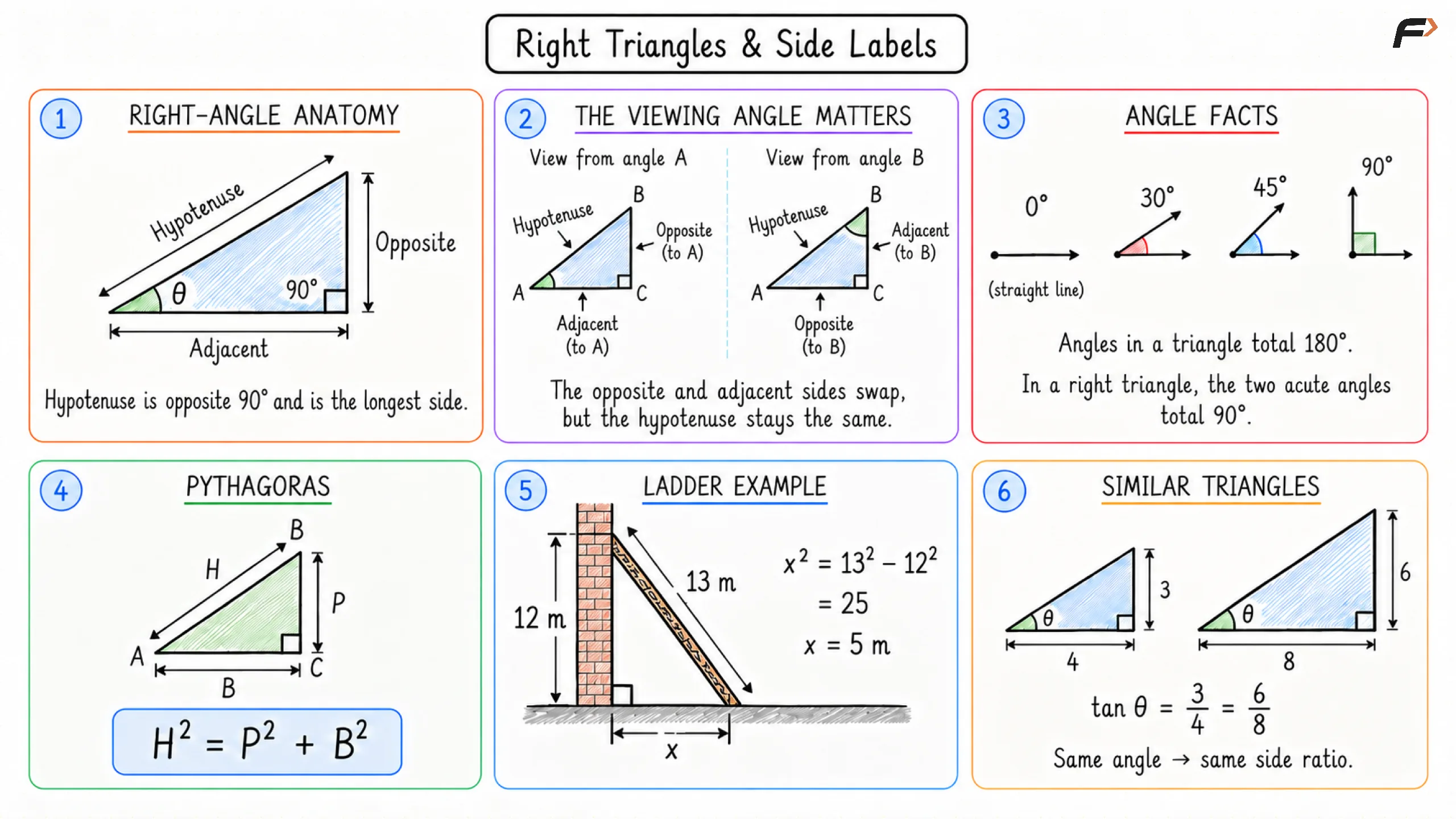
Right triangles and side labels
Basics: A Right-Angled Triangle
A triangle has three sides and three angles. A right-angled triangle has one angle equal to . The small square drawn at a corner marks this right angle.
The three sides have special names:
- The hypotenuse is opposite the angle. It is always the longest side.
- The opposite side is directly across from the angle we are studying.
- The adjacent side touches the angle we are studying, but it is not the hypotenuse.
The hypotenuse stays the same no matter which acute angle we choose. However, opposite and adjacent can swap. A side that is opposite to angle may be adjacent to the other acute angle.
How to label the sides
Follow this order:
- Find the angle. The side across from it is the hypotenuse.
- Mark the known angle, such as .
- The side across from is the opposite side.
- The remaining side beside is the adjacent side.
Do not label a side as opposite or adjacent before choosing the angle. Those two names depend on the viewing angle.
Understanding Angles and Degrees
An angle tells us how much one line turns away from another line. We measure angles in degrees and write the degree sign as .
- A angle has no opening.
- A angle has a small opening.
- A angle is half of a right angle.
- A angle is a right angle.
The three angles inside every triangle add to . Since a right triangle already has a angle, its other two angles must add to . Each of those remaining angles is less than , so each is called an acute angle.
This matters because all six trigonometric ratios are positive for an acute angle. When is known to be acute, we use positive side lengths and choose the positive value after taking a square root.
The Pythagoras Theorem
For a right triangle, the square of the hypotenuse equals the sum of the squares of the other two sides.
Here is the hypotenuse, is the perpendicular or opposite side, and is the base or adjacent side.
Example: A ladder is 13 m long and reaches a window 12 m above the ground. How far is its foot from the wall?
The ladder is opposite the right angle, so it is the hypotenuse. The wall height is one shorter side. Let the ground distance be .
Subtract 144 from both sides:
Distance cannot be negative, so . The foot of the ladder is 5 m from the wall.
Common side groups such as , , and are useful because they satisfy this theorem.
The Six Trigonometric Ratios
A trigonometric ratio compares two sides of a right triangle. The first three ratios are sine, cosine and tangent.
A common memory line is SOH-CAH-TOA:
- SOH means sine is Opposite over Hypotenuse.
- CAH means cosine is Adjacent over Hypotenuse.
- TOA means tangent is Opposite over Adjacent.
The other three ratios are reciprocals. A reciprocal turns a fraction upside down.
Why the Ratios Depend on the Angle, Not the Triangle Size
Suppose two ramps make the same angle with the ground, but one ramp is twice as large as the other. If the smaller triangle has opposite side 3 and adjacent side 4, the larger one may have opposite side 6 and adjacent side 8.
Their tangent ratios are:
The second fraction simplifies to . Every side grew by the same scale factor, so the comparison between matching sides stayed unchanged.
Triangles that have the same angles but different sizes are called similar triangles. Their matching sides are in the same proportion. This is the reason , and have fixed values. The triangle can become larger or smaller, but its side ratios do not change as long as the angle stays the same.
This also explains why we may use convenient sides when a ratio is given. If , we can use 5 and 12 as sample sides even when the real triangle is 10 and 24 or 15 and 36.
Choosing the correct ratio
Do not choose a formula only because you remember it. Look at the two sides involved.
- Opposite and hypotenuse means sine.
- Adjacent and hypotenuse means cosine.
- Opposite and adjacent means tangent.
- Reverse the matching basic ratio to find cosecant, secant or cotangent.
Example: The side opposite angle is 9 cm and the adjacent side is 12 cm. Find .
The opposite and adjacent sides are known. Tangent connects exactly these sides:
Divide the numerator and denominator by 3:
The answer means the opposite side is three-fourths of the adjacent side.
Finding a Missing Ratio from One Given Ratio
A ratio such as does not say the actual sides must be 5 and 12. It says the opposite and adjacent sides are in that ratio. We may choose 5 and 12 because their common scale does not change any trigonometric ratio.
Example: If and is acute, find .
Tangent gives opposite over adjacent, so take:
Sine needs opposite and hypotenuse. Find the hypotenuse with Pythagoras:
Now use the sine ratio:
Because is acute, all side lengths and all six ratios are positive.
Another example: If , then the hypotenuse is . Therefore:
Standard Trigonometric Values
The standard angles , , , and appear often. Learning their values saves time.
Where the values come from
Take a right triangle whose two shorter sides are both 1. Since those sides are equal, its two acute angles are both .
Pythagoras gives the hypotenuse:
Therefore:
Where the and values come from
Start with an equal-sided triangle of side 2. Cut it into two equal halves by drawing a vertical line from the top. Each half is a right triangle with hypotenuse 2, base 1, and angles and .
Find its height:
For the angle, the opposite side is 1, the adjacent side is , and the hypotenuse is 2. Therefore:
For the angle, opposite and adjacent swap. This gives , , and .
| Not defined |
When a ratio is not defined
A fraction is not defined when its denominator is zero. At , the adjacent part becomes zero, so tangent would require division by zero. Therefore, and are not defined.
At , the opposite part is zero. Therefore, and are not defined. “Not defined” is not the same as zero. It means the division itself is not allowed.
The sine row rises from 0 to 1. The cosine row contains the same values in reverse order. Tangent can be found from .
Example: Find .
Both standard values are :
Similarly, and , so their sum is 2. Also:
Basic Trigonometric Identities
An identity is an equality that works for every angle for which both sides are defined. The most important identity comes from the Pythagoras theorem.
To see why, write and :
Dividing the same identity by gives:
Dividing it by gives:
Therefore, .
Example: If , find .
The required product appears when we square the given sum:
Substitute the given value and use :
Complementary Angles
The two acute angles in a right triangle add to . They are called complementary angles. When we move from one acute angle to the other, opposite and adjacent swap, so sine and cosine swap too.
Tangent and cotangent also swap, as do secant and cosecant.
Example: If , find .
The expression is the complementary-angle form of cosine:
No new triangle is needed because the identity directly matches the expression.
Heights and Distances
Trigonometry can find a height without climbing an object. A vertical object and horizontal ground form a right angle. The line from the observer to the top becomes the hypotenuse of an imagined triangle.
For most tower, pole, shadow, ramp and road situations, tangent is the quickest ratio because it connects vertical height and horizontal distance.
Angle of elevation
An angle of elevation is measured upward from a horizontal line. If a person looks from the ground to the top of a tower, the angle between the ground-level horizontal line and the line of sight is the angle of elevation.
Example: A point is m from a tower. The angle of elevation to its top is . Find the tower's height.
Let the height be . The height is opposite the angle, and the ground distance is adjacent. Therefore:
Use :
Multiply both sides by :
The tower is 30 m high.
Finding an angle from a height and shadow
Example: A 12 m pole casts a m shadow. Find the sun's angle of elevation.
The pole is the opposite side and the shadow is the adjacent side:
The standard value matches this ratio. Therefore, .
If a stick's shadow equals its height, then , so .
Ladders, Kites and Sloping Paths
A ladder or a tight kite string is usually the slant side, so it is the hypotenuse. When the angle with the ground and the vertical height are involved, use sine.
Example: A 10 m ladder makes an angle of with the ground. How high does it reach on the wall?
The ladder is the hypotenuse. The height is opposite the angle at the ground. Sine connects these sides:
The ladder reaches m up the wall.
For a 50 m kite string making with the ground, the same reasoning gives:
This assumes the string is straight and the person's hand is at ground level. If an eye or hand height is known, add it when the full height is needed.
Eye Level and Full Height
An angle of elevation starts from the observer's eye, not from the ground. The triangle therefore gives only the height above eye level.
Example: A person stands 18 m from a pole. The person's eye is 1.5 m above the ground, and the angle of elevation to the top is . Find the full pole height.
Let be the part of the pole above eye level. Then:
Since , m. This is not yet the full pole height. Add the 1.5 m below the eye-level line:
Angle of Depression
An angle of depression is measured downward from a horizontal line at the observer's eye. A horizontal line at the top and the horizontal ground are parallel. Because of this, the angle of depression from the top equals the angle of elevation from the lower point.
This lets us redraw an angle of depression as an ordinary elevation triangle.
Example: A window is 10 m above the ground. The angle of depression to the foot of a tower is , and the angle of elevation to the top is . Find the tower's full height.
Let the horizontal distance be . The depression triangle uses the 10 m window height:
Since tangent is 1, m.
Let be the tower part above window level. Use the elevation:
This is only the part above the window. The full height is:
Two Observation Points on the Same Side
When two points are on the same side of a tower, the farther distance equals the nearer distance plus the gap between the points. Both triangles share the same height.
Example: Two points are 40 m apart on the same side of a tower. Their angles of elevation are at the nearer point and at the farther point. Find the height.
Let the nearer distance be and the tower height be . The farther distance is .
From the nearer point:
From the farther point:
Replace with :
Cross multiplication gives , so . We need the height, not the distance:
The larger angle belongs to the nearer point. This direction check helps us place the distances correctly.
A Person Moving Toward a Tower
When a person moves toward a tower, the new distance is smaller. It is often easiest to name the new distance , so the old distance is plus the walking distance.
Example: The angle of elevation is first . After walking 20 m toward the tower, it becomes . Find the tower height.
Let the new distance be and height be . At the new point:
Therefore, .
The old distance was . At the old point:
Replace with :
Cross multiplication gives:
Rationalise the denominator by multiplying by :
Rationalising removes a square root from the denominator without changing the value of the fraction.
Observation Points on Opposite Sides
If a tower or drone lies between two observers, their two ground distances add to the full distance between the observers.
Example: A tower lies between two points that are 60 m apart. The angles of elevation are and . Find the tower height.
Let the height be . Let the distance on the side be . The distance on the other side is .
From the side:
From the side:
Add the two parts of the full distance:
The opposite-side setup uses addition of ground distances. The same-side setup uses their difference.
Finding Only an Extra Height
A flagstaff may stand on a building, or the tops of two towers may be compared. The tangent triangle may give a total height or a difference in heights. Identify what the vertical side actually represents before forming the equation.
Example: A point is 30 m from a building. The angle to the building top is , while the angle to the top of a flagstaff on the building is . Find only the flagstaff height.
Let the building height be and the flagstaff height be .
For the building top:
For the flagstaff top, the opposite side is the total height :
Subtract the building height:
The larger value was the total height. We needed only the added flagstaff, so subtraction was necessary.
Looking from the top of a shorter building
Suppose a 20 m building and a taller tower stand on level ground. From the building's foot, the angle to the tower top is . From the building's top, it is .
Let the tower height be and the distance be . From the foot:
From the building top, the visible vertical rise is only :
Substitute :
This gives . Multiply by 3:
Using instead of in the second triangle would ignore the observer's 20 m starting height.
Two Towers and a Shared Ground Distance
When two towers stand on the same level ground, the distance between their feet is the base for both right triangles. If an observation begins at a tower's foot, the opposite side is the full height of the other tower. If it begins at the top, the opposite side is the difference between their heights.
Example: One tower is 50 m high. From the foot of a second tower, the angle of elevation to the first tower's top is . From the second tower's top, the angle of elevation to the same point is . Find the second tower's height.
Let the distance between towers be , and let the second height be .
First use the observation from the foot. The full 50 m height is opposite:
Now use the observation from the top of the second tower. The observer is already metres high, so the vertical rise to the first top is :
Substitute the distance:
Multiply both sides by :
The second tower is m high. The step is the main idea. The second line of sight does not begin at ground level.
Finding the difference between two tower heights
If two towers are 30 m apart, and the angles from their opposite feet are and , calculate each height using the shared 30 m base:
The difference is:
Because we need a difference, finding either height alone is not the final answer.
A Lighthouse and Two Ships
For two ships on the same side of a lighthouse, the larger angle belongs to the nearer ship. The angle of depression from the lighthouse equals the corresponding elevation angle from the ship.
Suppose the angles are and , and the ships are 120 m apart. Let the lighthouse height be , the nearer distance be , and the farther distance be .
The ships are on the same side, so their separation is :
This is the same-side two-point method. The only new wording is “angle of depression,” which we changed into the equal elevation angle at each ship.
Expressions Made from Trigonometric Ratios
An expression may look long even when the given ratio makes it short. First turn reciprocal ratios into known values, then simplify one small step at a time.
Example: If , find:
Square the given tangent:
Cotangent is the reciprocal of tangent:
Substitute:
Dividing by a fraction means multiplying by its reciprocal:
The final value is , which is also .
Using
Example: If , find .
Write the ratios using opposite , adjacent and hypotenuse :
Use the common denominator :
Pythagoras says , so:
Take reciprocals:
But:
Therefore, .
Testing Standard Angles in Trigonometric Equations
A trigonometric equation needs an angle that makes two expressions equal. When a small list of standard angles is available, checking each candidate can be safe and quick. Substitute each proposed angle into both sides and keep the one that makes them equal.
Example: For an acute angle, solve from the standard options and .
Try :
The sides are not equal.
Try :
Both sides match, so among these options.
A Reliable Method for Heights and Distances
- Draw a simple diagram. Mark vertical lines, horizontal ground and the line of sight.
- Mark the right angle and the known angle.
- Label the vertical height, horizontal distance and slant line.
- Decide what the vertical side means. It may be full height, height above eye level, extra height, or a difference between two heights.
- Choose sine, cosine or tangent by looking only at the sides known and needed.
- Write one equation for each observation point.
- If two triangles see the same object, connect them through their shared height or distance.
- Solve slowly, then answer exactly what was asked.
- Check whether a nearer point has the larger elevation angle and whether the unit is correct.
Quick Reasonableness Checks
A check does not replace the solution, but it can catch a wrong side label or standard value.
- In a right triangle, the hypotenuse must be longer than either shorter side.
- For an acute angle, sine and cosine lie between 0 and 1 because a shorter side is divided by the hypotenuse.
- Tangent may be greater than 1. It is greater than 1 when the opposite side is longer than the adjacent side.
- If the height equals the horizontal distance, tangent is 1 and the angle is .
- From the same ground line, moving nearer to an object makes the angle of elevation larger.
- A calculated full height must be larger than the eye level or building level from which the upper part was viewed.
For example, if a tower is viewed from the same point at and , the line must point to the higher top. If a solution gives the opposite result, the two angles or vertical heights were probably swapped.
Common Mistakes
- Calling the slant side the hypotenuse without first checking that it is opposite the right angle.
- Forgetting that opposite and adjacent depend on the chosen angle.
- Using sine when the known sides are height and horizontal distance, which are connected by tangent.
- Mixing degree values, especially and .
- Treating a side ratio such as as fixed side lengths instead of proportional lengths.
- Forgetting to use Pythagoras before finding a ratio that needs the missing side.
- Using the full tower height when the observer is already above ground.
- Forgetting to add eye level when the full height is required.
- Adding distances for points on the same side instead of using their difference.
- Subtracting distances when observers are on opposite sides and the object lies between them.
- Using an angle of depression directly without recognising its equal angle of elevation.
- Stopping after finding an intermediate distance when the required value is height.
- Forgetting to rationalise an answer when a cleaner denominator is required.
Formulas and Cheat Sheet
| Concept | Formula or reminder |
|---|---|
| Pythagoras theorem | |
| Sine | |
| Cosine | |
| Tangent | |
| Cosecant | |
| Secant | |
| Cotangent | |
| Main identity | |
| Tangent identity | |
| Cotangent identity | |
| Complementary angles | |
| Height and distance | |
| Same-side observations | Far distance = near distance + gap |
| Opposite-side observations | Two ground distances add to full gap |
| Eye-level situations | Full height = triangle height + eye height |
The safest way to use trigonometry is to begin with the picture, not the formula. Label the right triangle, decide what each side means, and then choose the ratio that contains only the known side and the side you need. The calculation becomes much easier once the triangle has been read correctly.
Safe Shortcuts
- Check common right-triangle triples such as , and before using the square-root formula. Scale every side by the same factor.
- Use directly when only vertical height and horizontal distance are involved.
- For complementary angles, use and .
- If one ratio is known, draw a right triangle with matching side parts, then use Pythagoras to find the third side. This is safer than memorising many converted formulas.
- An angle of depression from a horizontal line equals the corresponding angle of elevation because the two horizontal lines are parallel.
- For two observation points on the same side of a tower, the nearer distance is the farther distance minus the distance moved. On opposite sides, the ground distances add.
- Add eye level only after finding the vertical height above the observer's horizontal line.
These shortcuts are safe only for the stated right-triangle or parallel-line conditions. They should reduce repeated steps after the diagram is correct.
Frequently Asked Questions
What is trigonometry in simple words?
Trigonometry connects the angles and side lengths of triangles. In a right triangle, knowing an angle and one side can help us find another side without measuring it directly.
How do I identify opposite, adjacent and hypotenuse?
First find the angle. The side across from it is always the hypotenuse. Then look at the chosen angle. The side across from that angle is opposite, and the remaining non-hypotenuse side is adjacent.
When should I use sine, cosine or tangent?
Use sine for opposite and hypotenuse, cosine for adjacent and hypotenuse, and tangent for opposite and adjacent. Choose from the sides given and the side asked for.
What is SOH-CAH-TOA?
It is a memory aid. SOH means sine equals opposite over hypotenuse. CAH means cosine equals adjacent over hypotenuse. TOA means tangent equals opposite over adjacent.
Why is tangent used often in height and distance questions?
Tangent directly connects a vertical height with a horizontal ground distance. These are the two measurements most often given in tower, pole, shadow and building questions.
What is the difference between elevation and depression?
An angle of elevation is measured upward from a horizontal line. An angle of depression is measured downward. For parallel horizontal lines, the depression angle from the top equals the elevation angle from the lower point.
Why do we add eye level to the calculated height?
The right triangle begins at the observer's eye. It gives only the height above that eye-level line. Add the eye height when the question asks for the object's full height from the ground.
Are and equal?
Yes. Multiplying by gives . This process is called rationalising the denominator.
What are the three main trigonometric identities?
They are , , and .
Why must the acute-angle condition be checked?
For an acute angle in a right triangle, all six ratios are positive. Outside the acute-angle range, the sign of a ratio can change, so the same numerical square may lead to positive or negative possibilities.
Why do different-sized triangles have the same trigonometric ratio?
Triangles with the same angles are similar. Every matching side changes by the same scale factor, so that common factor cancels when one side is divided by another. The side ratio therefore depends on the angle, not the overall size.
Which trigonometric ratios can be undefined?
Any ratio whose denominator becomes zero is undefined. For example, is undefined because cosine is zero there, and is undefined because sine is zero there.