Simplification: Complete Beginner Guide with Easy Examples
Simplification means changing a mathematical expression into a clearer or smaller form without changing its value. An expression is a group of numbers, signs, brackets or letters that stand for a value. The central idea is knowing which part must be handled first and which rule makes the calculation easier.
For example, is not 30. Multiplication comes before addition, so and the answer is . The same numbers give a different answer when brackets change the grouping: .
Once we understand this order, we can apply it to fractions, decimals, percentages, powers, roots, algebraic identities and equations. Every later method grows from the basic rules explained first.
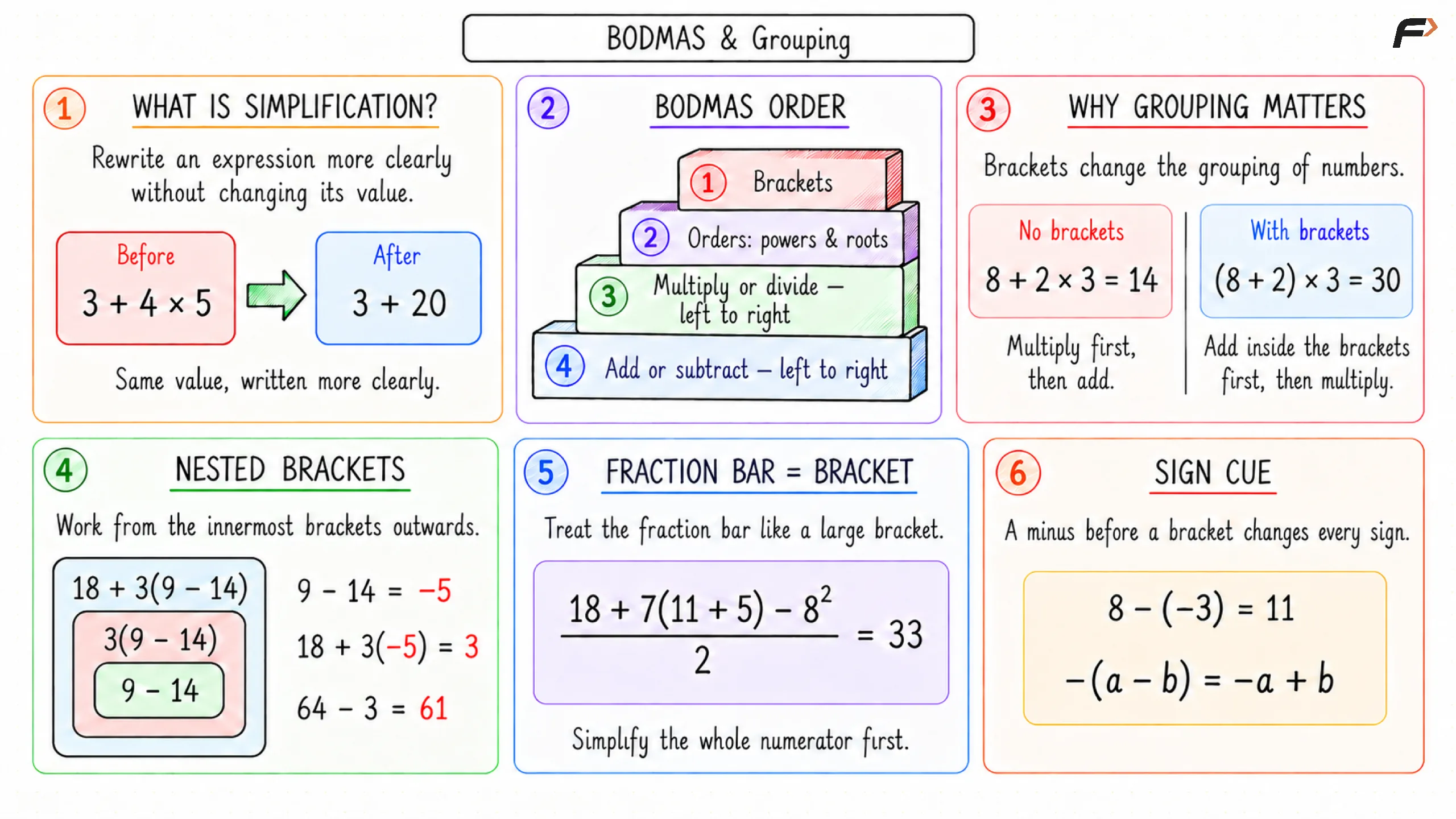
BODMAS and grouping rules
Basics: Numbers, Operations and Expressions
An operation is an action performed on numbers. The four basic operations are addition, subtraction, multiplication and division.
Addition joins amounts. For example, means 3 is added to 5. Subtraction removes an amount or finds a difference, so .
Multiplication combines equal groups. For example, means four groups of 3. Division separates an amount into equal groups, so .
An expression can contain more than one operation. Its parts must be handled in a fixed order. Without that shared order, different people could get different answers from the same expression.
Terms, factors and brackets
A term is a part separated from another part by addition or subtraction. In , the two terms are 8 and .
A factor is a number or expression being multiplied. In , both 2 and 3 are factors.
Brackets show that the part inside them belongs together. The brackets tell us to add 8 and 2 before multiplying the result by another number.
A horizontal fraction bar also groups the entire top and the entire bottom. Therefore:
The expression does not mean . The whole numerator must be understood as one grouped part.
BODMAS Rule
BODMAS gives the usual order for handling operations in an expression:
- B means brackets.
- O means orders, such as powers and roots.
- D means division.
- M means multiplication.
- A means addition.
- S means subtraction.
The letters provide a helpful order, but two details are important. Division and multiplication have the same priority, so they are handled from left to right. Addition and subtraction also have the same priority, so they are handled from left to right.
The order can therefore be remembered as brackets first, then powers and roots, then multiplication or division from left to right, and finally addition or subtraction from left to right.
Example: Simplify .
What we know: The expression has multiplication, division, addition and subtraction. There are no brackets or powers.
What we are finding: We need one final value without changing the meaning of the expression.
Why we use this idea: Multiplication and division must be completed before addition and subtraction.
Slow solution: First calculate the multiplication:
Now calculate the division:
The expression becomes:
Addition and subtraction have the same priority, so move from left to right:
Meaning of the answer: The value of the complete expression is 38.
Division and multiplication have equal priority
The order of the letters D and M does not mean every division must happen before every multiplication. These operations share the same level.
Example: Simplify .
Slow solution: Move from left to right:
The answer is 8. Multiplying first would change the grouping and wrongly give .
Addition and subtraction have equal priority
The letters A and S do not mean all addition must happen before subtraction.
Example: Simplify .
Slow solution: Work from left to right:
The answer is 15. Adding first would wrongly change the expression to .
Brackets and Nested Brackets
Brackets show which pieces belong together. If one bracket appears inside another, begin with the innermost bracket, which means the bracket deepest inside the expression.
Round brackets , square brackets and curly brackets may all be used to show grouping. Their shapes help us see the layers clearly.
Example: Simplify .
What we know: The small bracket is inside the larger square bracket.
What we are finding: We need the value of the whole expression.
Why we use this idea: The inner bracket must be simplified before its result can be multiplied by 3.
Slow solution: Begin with the inner bracket:
The expression becomes:
Multiply 3 by :
Now simplify the larger bracket:
The full expression is now:
Meaning of the answer: The nested brackets together reduce to 3, so the final value is 61.
A fraction bar acts like a bracket
When a long expression appears above a fraction bar, the entire top is grouped. This prevents a common reading mistake.
Example: Simplify:
What we know: The complete numerator is divided by 2. The numerator contains a bracket and a square.
Why we use this idea: The fraction bar groups everything on top together, so we must simplify the whole top before dividing.
Slow solution: Begin inside the bracket:
Now find the square:
Multiply:
The numerator becomes:
Finally divide the entire numerator by 2:
Meaning of the answer: The whole expression equals 33 because the denominator divides the complete numerator, not only the last term.
Positive and Negative Signs
A positive number lies above zero, and a negative number lies below zero. The sign tells us the direction of the value.
Adding a negative number is the same as subtracting its positive size:
Subtracting a negative number changes to addition:
For multiplication and division, matching signs give a positive answer, while different signs give a negative answer:
The same sign rule applies to division.
Removing a minus sign before a bracket
A minus sign outside a bracket changes the sign of every term inside it:
This happens because the bracket is being multiplied by .
Example: Simplify .
Slow solution: First find the value inside the bracket:
Now subtract that negative value:
Meaning of the answer: Subtracting negative 3 increases the value by 3.
Fractions: Numerator, Denominator and Equal Parts
A fraction shows how many equal parts of a whole are being used. In , the number 3 is the numerator, and 5 is the denominator.
The denominator tells us the whole has been divided into 5 equal parts. The numerator tells us that 3 of those parts are being counted.
Two fractions can have different-looking numbers but the same value:
They are called equivalent fractions. Multiplying the numerator and denominator by the same nonzero number does not change the value, because we are simply cutting the same whole into smaller equal pieces.
Simplifying a fraction
To simplify a fraction, divide the numerator and denominator by a common factor.
Example: Simplify .
Slow solution: Both 18 and 24 are divisible by 6:
Meaning of the answer: The fractions and represent the same amount, but uses smaller numbers.
Adding and Subtracting Fractions Using LCM
Fractions can be added or subtracted directly only when their denominators are the same. The denominator names the size of the parts. We cannot join thirds and quarters as if both were the same-sized part.
The Least Common Multiple, or LCM, is the smallest positive number that is a multiple of all the denominators. It gives a convenient common denominator.
Example: Simplify:
What we know: The denominators are 4, 6 and 12.
What we are finding: We need a single fraction or whole number.
Why we use this idea: The fractions describe pieces of different sizes. A common denominator changes them into equal-sized pieces.
Slow solution: The LCM of 4, 6 and 12 is 12.
Change into twelfths. Since , multiply its numerator by 3 too:
Change into twelfths. Since , multiply its numerator by 2:
The last fraction already has denominator 12. Combine the numerators:
Meaning of the answer: After all fractions are changed into twelfths, their combined value is exactly one whole.
Another example with three different denominators
Example: Simplify:
Slow solution: The LCM of 8, 3 and 12 is 24. Convert each fraction:
Now work only with the numerators:
Meaning of the answer: The simplified value is .
Multiplying Fractions and Finding a Fraction of a Number
The word of usually means multiplication. Therefore:
Dividing by the denominator first is often easier because it keeps the numbers small. This is called cancellation, but it works only between factors being multiplied.
Example: Simplify:
What we know: We need three-fifths of 150 and seven-eighths of 64.
What we are finding: We need the sum of those two amounts.
Why we use this idea: The denominator tells us to split the whole into equal parts, and the numerator tells us how many parts to take.
Slow solution: For the first term, divide 150 into 5 equal parts:
Take 3 of those parts:
For the second term, divide 64 into 8 equal parts:
Take 7 parts:
Add both results:
Meaning of the answer: Three-fifths of 150 is 90, seven-eighths of 64 is 56, and their sum is 146.
Where cancellation is not allowed
In , the 6 cannot simply be cancelled from only one term while the 12 is ignored. The whole numerator is being divided.
First add the numerator:
Alternatively, factor the whole numerator:
Cancellation becomes safe only after 6 is shown as a factor of the complete numerator.
Dividing Fractions and Reciprocals
The reciprocal of a nonzero fraction is . Their product is 1:
Dividing by a fraction is the same as multiplying by its reciprocal:
This works because dividing by asks how many pieces of size fit into the first amount.
For example, because two half-pieces fit into one whole.
Example: Simplify:
What we know: Each denominator contains a sum of fractions.
What we are finding: We need to simplify both denominators, take their reciprocals, and add.
Why we use this idea: A fraction must be fully simplified before its reciprocal is taken. The reciprocal of a sum is not the sum of the separate reciprocals.
Slow solution: In the first bracket, use denominator 6:
Taking the reciprocal gives:
In the second bracket, use denominator 12:
Taking the reciprocal gives:
Add both results:
Meaning of the answer: The first part equals 2, the second part equals 3, and the full expression equals 5.
Reciprocals with subtraction and different final denominators
Example: Simplify:
Slow solution: In the first bracket:
Its reciprocal is . In the second bracket:
Its reciprocal is . Add using denominator 6:
Meaning of the answer: The simplified result is , or .
Mixed Numbers and Improper Fractions
A mixed number combines a whole number and a proper fraction, such as .
An improper fraction has a numerator at least as large as its denominator, such as .
To change a mixed number into an improper fraction, first change the whole-number part into pieces of the same size:
For example, 2 wholes contain 6 thirds. Adding one more third gives 7 thirds, so .
Example: Simplify:
What we know: The values contain whole numbers and fractional parts.
What we are finding: We need one final mixed number.
Why we use this idea: Converting to improper fractions makes every part a fraction, so the ordinary common-denominator rule can be used.
Slow solution: Change each mixed number:
The LCM of 3, 4 and 6 is 12. Convert:
Divide 51 by 12. Four full groups use , leaving remainder 3:
Meaning of the answer: The expression is equal to four whole units and one quarter.
Decimals and Place Value
A decimal writes parts of a whole using place value. The first digit after the decimal point shows tenths, the second shows hundredths, and the third shows thousandths.
For example:
Understanding these fractions explains why the decimal rules work.
Multiplying decimals
Multiply the digits as whole numbers first. Then count the total number of decimal places in both original values and place that many decimal places in the answer.
Example: Find .
What we know: Both numbers have one decimal place.
Why we use this idea: Each number has denominator 10, so their product has denominator .
Slow solution: Write the decimals as fractions:
Multiply the whole numbers:
Now divide by 100:
Meaning of the answer: The product is 12. There are two decimal places in the product before trailing decimal zeros are removed.
Dividing decimals
To remove a decimal from the divisor, multiply both numbers by the same power of 10. The value of the division stays the same because the top and bottom are scaled equally.
Example: Find .
Slow solution: Multiply both numbers by 10:
Meaning of the answer: Six groups of 0.6 make 3.6.
Decimals with BODMAS
Example: Simplify .
What we know: Multiplication and division must be handled before subtraction.
Slow solution: First multiply:
Now remove the decimals from the division by multiplying both numbers by 10:
Subtract:
Meaning of the answer: The first part is 9, the second part is 8, and the complete value is 1.
Percentages and the Meaning of “Of”
Percent means “out of 100.” Therefore:
The word of means multiplication, so:
Some percentages become easy fractions:
For example, 25% of 80 means one quarter of 80, which is .
Example: Simplify:
What we know: Each percentage applies only to the number following the word “of.”
What we are finding: We need all three percentage amounts before adding or subtracting them.
Why we use this idea: A percentage is a fraction out of 100. Changing it to a fraction makes the amount clear.
Slow solution: Find the first amount:
Find the second amount:
Since , the third amount is:
Combine the results from left to right:
Meaning of the answer: The three percentage amounts combine to give 127.
Percentages inside a fraction
Example: Simplify:
What we know: The full percentage expression is the numerator, and the fraction of 72 is the denominator.
Slow solution: Convert to :
Find the denominator:
Divide the complete numerator by the complete denominator:
Meaning of the answer: The numerator is twice the denominator, so the full expression equals 2.
Approximation and Rounding
Approximation means finding a value close to the exact answer. It is useful only when an approximate, nearest or estimated value is acceptable.
To approximate, replace a difficult number with a nearby easy number. The new number must stay close enough that the result still makes sense.
For example, 49.8% is close to 50%, 602 is close to 600, and 396 is close to 400.
Example: Find an approximate value of:
What we know: The percentages and quantities are close to easy values.
What we are finding: We need a nearby value, not an exact value.
Why we use this idea: Small rounding changes make the percentage calculations easy while keeping the result close.
Slow solution: Round each value to a nearby useful number:
Now calculate:
Add the easy results:
Meaning of the answer: The expression is close to 400. The symbol means “approximately equal to.”
When approximation is not safe
Do not round when an exact value is required. Also, do not round so much that two possible answers become hard to separate.
For example, replacing 32.1% with 30% changes it more than replacing it with 32%. The safer choice is usually the nearby value that keeps both the calculation and the error small.
Powers and Exponents
A power shows repeated multiplication. In , the number 2 is the base, and 5 is the exponent:
The exponent counts how many factors of the base appear.
Multiplying powers with the same base
When the bases match, add the exponents:
This works because copies of and more copies make copies altogether.
Dividing powers with the same base
When the bases match and the base is nonzero, subtract the exponents:
This works because matching copies of cancel from the top and bottom.
Example: Simplify:
What we know: The powers of 2 share the same base, while is a separate term.
Why we use this idea: Same-base powers can be combined without calculating large values.
Slow solution: First multiply the powers in the numerator by adding their exponents:
Now divide by and subtract exponents:
Find the other power:
Add the two values:
Meaning of the answer: The complete expression simplifies to 43.
Zero and negative exponents
For a nonzero base:
This follows from .
A negative exponent means the reciprocal of the positive power:
For example, .
Square Roots and Perfect Squares
A square is made by multiplying a number by itself. For example, .
A square root asks for the nonnegative number whose square gives the original value:
A whole number such as 144 is called a perfect square because its square root is a whole number.
Square root using the long division method
The long division method finds one square-root digit at a time. Digits are grouped in pairs from the right because squaring a place value changes its size in groups of two decimal places.
Example: Find .
What we know: We need the whole number whose square is 2304.
Why we use this idea: The long division method finds the root without testing every whole number.
Slow solution: Group the digits from right to left:
The largest perfect square not greater than 23 is . Therefore, the first root digit is 4.
Subtract 16 from the first group:
Bring down the next group 04 to make 704.
Double the current root digit:
Now find a digit such that the two-digit number multiplied by does not pass 704. Try :
It fits exactly, so 8 is the next root digit. The complete root is 48.
Check:
Meaning of the answer: The square root of 2304 is 48.
Cube Roots and Perfect Cubes
A cube is made by multiplying a number by itself three times:
A cube root reverses that operation:
For a perfect cube, grouping digits in threes from the right can help identify the size of its cube root.
Example: Simplify:
What we know: The expression contains two square roots and one cube root.
Why we use this idea: Roots belong to the “orders” part of BODMAS, so find each root before adding or subtracting.
Slow solution: Since :
Since :
Since :
Now work from left to right:
Meaning of the answer: The complete root expression has value 40.
Surds and Like Radicals
A surd is a root that cannot be simplified to a whole number or an exact ordinary fraction. For example, and are surds.
A radical is an expression written with a root sign. The value under the root sign is called the radicand.
To simplify a square root, separate the largest perfect-square factor:
For example:
The perfect-square part 25 becomes 5 outside the root. The part 3 stays inside because it is not a perfect square.
Like radicals have the same root part. For example, and are like radicals because both contain .
They can be combined just like five apples and three apples:
Example: Simplify:
What we know: Both roots in the numerator contain a perfect-square factor and a factor of 3.
What we are finding: We need to simplify the roots and then divide.
Why we use this idea: Turning both roots into multiples of makes them like radicals.
Slow solution: Split 75 into :
Split 27 into :
Add the like radicals:
Now divide:
Meaning of the answer: The common root factor cancels after the full numerator has been combined, leaving 8.
Subtracting like surds
Example: Simplify:
Slow solution: Separate the perfect-square factors:
Subtract the like surds:
Divide by :
Meaning of the answer: The simplified value is 4.
Roots do not split across addition
The rule works for multiplication. It does not mean:
For example, , but . Since 5 and 7 are different, the addition rule is false.
Distributive Property
The distributive property means a factor outside a bracket multiplies every term inside the bracket:
For example, means three groups of . We can count them as three groups of 4 plus three groups of 2.
Example: Solve .
What we know: The number 6 multiplies both terms inside the bracket.
What we are finding: We need the value of .
Why we use this idea: Opening the bracket correctly shows how much of the expression depends on .
Slow solution: Multiply 6 by each bracket term:
Substitute into the equation:
The positive 18 and negative 18 cancel:
Divide both sides by 6:
Check:
Meaning of the answer: The value makes both sides equal.
Common Factor Method and Factorisation
Factorisation reverses the distributive property. Instead of opening a bracket, we take a common factor outside:
This is useful when two large products share the same number. The common factor can often cancel with the denominator.
Example: Simplify:
What we know: Both numerator terms contain 18 as a factor.
What we are finding: We need the value of the full fraction.
Why we use this idea: Factoring 18 from the complete numerator creates a common factor with the denominator.
Slow solution: Take 18 outside the bracket:
Substitute:
Now the factor 18 divides the whole numerator and denominator, so it can cancel:
Meaning of the answer: The expression equals 100 without multiplying 18 by either large number.
Example: Simplify:
Slow solution: Factor out 24:
The bracket becomes 25. Since :
Meaning of the answer: The common factor reduces the expression to 50.
Algebraic Identities
An algebraic identity is a statement that remains true for all allowed values of its letters. It helps us recognise a familiar pattern and rewrite an expression without carrying out every large calculation.
The letters and can represent numbers or other expressions.
Difference of squares
The difference of squares identity is:
To see why it works, multiply the right side:
The middle terms cancel.
Example: Simplify .
What we know: Both terms are squares and one is subtracted from the other.
What we are finding: We need their difference.
Why we use this idea: The numbers are close, so their difference is small and their sum is easy to calculate.
Slow solution: Apply the identity with and :
Find each bracket:
Multiply:
Meaning of the answer: The difference between the two squares is 760.
Difference of squares with a denominator
Example: Simplify:
Slow solution: Factor the numerator:
Now divide the complete product by 16:
Meaning of the answer: The factor 16 in the numerator cancels the denominator, leaving 100.
Square of a sum
The identity for the square of a sum is:
The middle term is because multiplying creates one from each direction.
Example: Simplify .
What we know: The first and last terms are squares. The middle term is twice the product of their roots.
Why we use this idea: The expression matches exactly.
Slow solution: Take and :
Add inside the bracket:
Square 50:
Meaning of the answer: The entire expression is the square of 50, so its value is 2500.
Square of a difference
The identity for the square of a difference is:
Notice that the last term remains positive because .
Example: Simplify .
Slow solution: The expression matches the identity with and :
Subtract inside the bracket:
Meaning of the answer: The expression equals 2500.
Near-square Products and Consecutive Numbers
Numbers equally spaced around a middle value have a useful product:
The first number is below , and the second is above . The formula is the difference-of-squares identity written around a middle value.
When the gap is 1:
Example: Simplify .
What we know: The numbers 50 and 52 are equally spaced around 51.
Why we use this idea: Their product can be rewritten in terms of .
Slow solution: Write 50 and 52 around their middle value:
Substitute into the original expression:
Remove the bracket carefully. The minus sign changes the signs inside:
Meaning of the answer: The product is exactly 1 less than , so the difference is 1.
Example: Simplify .
Slow solution: Write the product around 75:
Now subtract :
Meaning of the answer: The product of 74 and 76 is 1 less than , so the final value is .
Equations and Transposition
An equation says that two expressions have the same value. The left-hand side and right-hand side must remain balanced.
Transposition is a short way of describing what happens when we remove a term from one side by performing the same opposite operation on both sides.
For example, in , subtracting 5 from both sides gives . We sometimes say “move +5 to the other side as -5,” but the real reason is that 5 was subtracted equally from both sides.
Addition is undone by subtraction. Multiplication is undone by division. Division is undone by multiplication.
Example: Solve:
What we know: The value has 17 added to it.
What we are finding: We need the original value of .
Why we use this idea: We undo the operations in reverse order while keeping both sides equal.
Slow solution: First remove the added 17 by subtracting 17 from both sides:
Now undo division by 4 by multiplying both sides by 4:
Check the original equation:
Meaning of the answer: The value 112 makes the left-hand side equal to 45.
Finding a Missing Operator
An operator is a sign such as , , or . When a sign is missing, the rest of the expression still follows BODMAS.
First simplify any part whose operation is already known. Then decide which missing action makes both sides match.
Example: Find the operator that makes:
What we know: The multiplication must happen before addition.
What we are finding: We need the sign that belongs between 48 and 6.
Why we use this idea: Once the known multiplication is completed, the missing operation must create the amount needed before adding 21.
Slow solution: Simplify the known multiplication:
Therefore:
The part before must equal:
Now ask which operation changes 48 and 6 into 8:
Check:
Meaning of the answer: The missing operator is division.
Working backward from the final result
Example: Find the missing operator in:
Slow solution: First calculate the power:
The missing operation must therefore satisfy:
Add 16 to both sides to find the earlier value:
Since , the missing operator is multiplication.
Meaning of the answer: Multiplication gives , so it is the correct sign.
Sequential Operations
Sequential operations are actions given in a specific order. When the instructions say “first subtract, then multiply, then divide,” that order must be preserved with brackets.
This does not break BODMAS. Instead, brackets are used to write the spoken order correctly.
For example, “start with 10, add 2, then multiply by 3” means . It does not mean .
Example: Start with 84, subtract 18, multiply the result by 5, and then divide by 11.
What we know: Each operation applies to the result of the previous operation.
What we are finding: We need the final value after all four instructions.
Why we use this idea: The written brackets preserve the order in which the actions were given.
Slow solution: First subtract 18:
Now the remaining expression is:
Because 66 and 11 are factors of a product and denominator, cancel first:
Multiply the remaining values:
Meaning of the answer: Following the instructions in the given order produces 30.
Choosing the Right Simplification Method
The correct method depends on the shape of the expression. Start by looking for the part that controls the structure.
If an expression contains nested brackets, begin at the innermost bracket. If a fraction bar covers a long numerator or denominator, treat that entire part as one group.
If fractions are added or subtracted, first make their denominators the same. If fractions are multiplied, look for safe cancellation between factors.
If the expression contains percentages, change them into fractions out of 100. If it contains powers with the same base, use exponent rules. If it contains a familiar square pattern, use the matching identity.
For roots, first check whether the value is a perfect square or cube. For a surd, separate the largest perfect-square factor. When the result need only be approximate, round carefully to nearby useful values.
Common Mistakes
Treating BODMAS as six completely separate priority levels
Division and multiplication share one level. Addition and subtraction share another level. Within either pair, work from left to right.
Ignoring a fraction bar
A fraction bar groups the whole numerator and the whole denominator. Do not divide only the term closest to the bar.
Forgetting to change signs after a minus bracket
In , the result is . The minus sign affects every term inside the bracket.
Adding fractions without a common denominator
The values and cannot be added as . First change them into sixths: .
Cancelling across addition or subtraction
Cancellation works between factors, not between separate terms joined by or . Factor the complete numerator or denominator before cancelling.
Taking the reciprocal before simplifying a bracket
The reciprocal of is the reciprocal of , which is 2. It is not .
Applying exponent rules to different bases
The rule needs the same base. It cannot combine and by adding the exponents.
Splitting a square root across addition
The rule is for multiplication. In general, is not equal to .
Dropping the middle term of a square
The identity contains , and . It is not simply .
Rounding when an exact answer is needed
Approximation is valid only when a nearby or estimated result is acceptable.
Forgetting brackets in sequential instructions
“Add first, then multiply” must be written with brackets. Otherwise, normal BODMAS may produce a different value.
Formulas and Cheat Sheet
| Concept | Formula or rule | Condition or meaning |
|---|---|---|
| BODMAS order | Brackets, powers or roots, multiplication or division, addition or subtraction | Equal-priority operations go from left to right |
| Fraction of a number | ||
| Equivalent fraction | Multiply top and bottom by the same nonzero | |
| Fraction addition | A common denominator is required | |
| Fraction subtraction | A common denominator is required | |
| Fraction multiplication | Cancel only between factors | |
| Fraction division | The divisor must not be zero | |
| Reciprocal | Both and must be nonzero | |
| Mixed number | ||
| Percentage | Percent means out of 100 | |
| Percentage of a value | The word “of” means multiplication | |
| Common percentage values | , , , | Use only for the matching percentage |
| Same-base multiplication | The bases must match | |
| Same-base division | Same nonzero base | |
| Zero exponent | ||
| Negative exponent | ||
| Square-root product | for real roots | |
| Distributive property | The outside factor multiplies every term | |
| Common factor method | The same factor must appear in every term | |
| Difference of squares | Both terms must be squares | |
| Square of a sum | The middle term is positive | |
| Square of a difference | The middle term is negative | |
| Near-square product | The numbers must be equally spaced around | |
| Neighbours around a square | Both numbers are 1 away from | |
| Decimal division | Multiply both numbers by the same power of 10 | |
| Equation balance | Apply the same operation to both sides | Never divide by zero |
Safe Shortcuts
- For multiplication and division at the same level, move from left to right unless brackets give a different grouping.
- When a fraction is multiplied by a whole number, divide the whole number by the denominator first if it divides exactly.
- When fractions are added or subtracted, use the LCM of the denominators to keep the common denominator small.
- Convert , , and to , , and when those exact values appear.
- Remove a decimal divisor by multiplying both dividend and divisor by the same power of 10.
- Add or subtract exponents only when the base is the same and the operation is multiplication or division.
- For , use when both terms are perfect squares.
- For , use when the two factors are exactly 1 below and above the same middle number.
- Factor a common number from every numerator term before cancelling it against the denominator.
- Separate the largest perfect-square factor before combining like surds.
- For a missing operator, simplify known parts first and work backward from the required result.
- Round only when an approximate or nearest value is allowed, and choose nearby numbers that keep the error small.
A shortcut is safe only when its condition is satisfied. It should shorten correct reasoning, not replace understanding.
Frequently Asked Questions
What does simplification mean in mathematics?
Simplification means rewriting an expression in an easier or shorter form without changing its value. It may involve brackets, fractions, decimals, percentages, powers, roots or algebraic identities.
What is the BODMAS rule?
BODMAS tells us to handle brackets first, then powers and roots, then multiplication or division, and finally addition or subtraction. Operations at the same level are performed from left to right.
Does division always come before multiplication?
No. Division and multiplication have the same priority. Perform whichever comes first when reading from left to right, unless brackets change the grouping.
Does addition always come before subtraction?
No. Addition and subtraction have the same priority. Work from left to right.
Why do fractions need a common denominator before addition?
The denominator tells us the size of the parts. Fractions must describe equal-sized parts before their numerators can be joined or compared.
What is the easiest way to simplify a fraction of a number?
Divide the whole number by the denominator first when possible. Then multiply the result by the numerator.
What is a reciprocal?
The reciprocal of a nonzero number is the value that gives 1 when multiplied by it. The reciprocal of is .
How do I convert a mixed number into an improper fraction?
Multiply the whole-number part by the denominator, add the numerator, and keep the same denominator.
How are percentages used in simplification?
Convert the percentage into a fraction out of 100. Then multiply by the value after the word “of.”
When should approximation be used?
Use approximation only when a nearby, nearest or estimated result is acceptable. Do not round when an exact answer is needed.
What is the difference between a square root and a cube root?
A square root reverses multiplying a number by itself twice. A cube root reverses multiplying a number by itself three times.
What are surds?
Surds are roots that cannot be written as exact ordinary fractions, such as . They are simplified by taking perfect-square factors outside the root.
What is the difference of squares formula?
The formula is . It rewrites the difference between two squares as the product of their difference and sum.
What does transposition mean?
Transposition is a short way of describing the opposite operation applied to both sides of an equation to keep it balanced.
How are sequential operations different from ordinary expressions?
Sequential operations describe actions that must be applied in the stated order. Write brackets around earlier results so the written expression matches those instructions.
Summary
Simplification begins by understanding how an expression is grouped. Brackets and fraction bars control grouping, while BODMAS explains the order of operations. Multiplication and division share one level, and addition and subtraction share another.
Fractions must have a common denominator before addition or subtraction. Multiplication allows safe cancellation between factors, and division by a fraction uses its reciprocal. Decimals and percentages become easier when their place values and fraction forms are clear.
Powers follow same-base rules. Roots can be simplified by finding perfect-square or perfect-cube factors. The distributive property and factorisation connect brackets with common factors, while algebraic identities turn familiar square patterns into shorter calculations.
Equations stay balanced when the same operation is applied on both sides. Missing operators can be found by working backward, and sequential instructions must be written with brackets. Use the single cheat-sheet table and safe shortcuts only after the underlying ideas are understood.