Ratio and Proportion: Concepts, Formulas and Solved Examples
A ratio is a simple way to compare two or more quantities. Suppose a box has 2 red balls and 3 blue balls. For every 2 red balls, there are 3 blue balls. We write this comparison as and read it as “2 is to 3.”
A proportion is slightly different. It tells us that two ratios have the same value. For example, and are equal ratios. The second pair is exactly twice the first pair, so the comparison between the two quantities has not changed.
The most important idea is the idea of a part. In the ratio , the first quantity has 2 equal parts and the second quantity has 3 equal parts. We do not yet know the size of one part. Extra information, such as a total, a difference or a product, helps us find the size of one part.
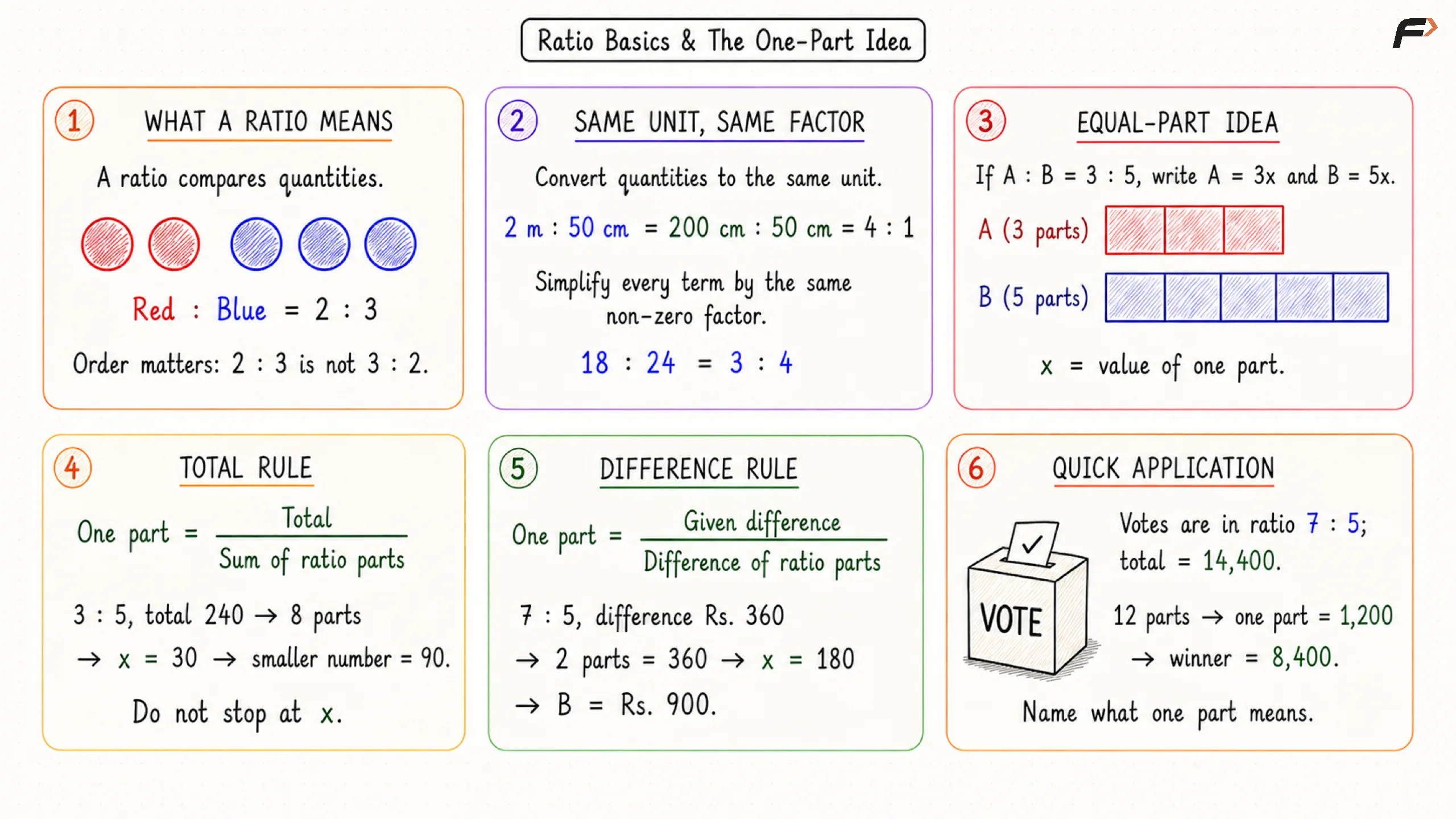
Ratio basics and the one-part idea
Basics: What a Ratio Means
The ratio can also be written as the fraction . The colon and the fraction bar both mean division.
A ratio is a comparison, not always the actual amount
If apples to oranges is , the basket does not have to contain exactly 2 apples and 3 oranges. It may contain:
- 4 apples and 6 oranges, because both ratio parts were multiplied by 2.
- 10 apples and 15 oranges, because both ratio parts were multiplied by 5.
- apples and oranges, where is the value of one part.
All these pairs have the same ratio. This is why a ratio alone usually cannot tell us the exact quantities. We need one more piece of information.
The order of a ratio matters
If boys to girls is , girls to boys is . These two ratios describe opposite comparison directions. A good habit is to write the names above or beside the numbers:
Then keep the same order in every later step.
Compare quantities in the same unit
A ratio should compare quantities in the same units. Convert 2 metres and 50 centimetres to one unit before comparing:
If we had written without changing metres to centimetres, we would be comparing 2 metres with 50 centimetres as if the units were equal. That would be wrong.
Simplifying a ratio
Simplifying a ratio is like simplifying a fraction. Divide every term by the same common factor. For , the greatest common factor is 6:
The comparison has not changed. In both ratios, the first quantity is three-fourths of the second quantity.
Multiplying or dividing every term by the same non-zero number creates an equivalent ratio. Never change only one term. For example, can become , but it cannot become .
The Common-Multiplier Method
If two quantities are in ratio , write them as and . The letter is the value of one ratio part.
For example, if two numbers are in ratio , imagine 3 equal boxes for the first number and 5 equal boxes for the second number. Every box has the same value, . Therefore, the numbers are and .
Example: Two numbers are in ratio and their sum is 240. Find the smaller number.
Step 1: Turn the ratio into quantities.
Let the smaller number be and the larger number be .
Step 2: Use the given total.
Together, the numbers have equal parts. Their sum is 240, so:
This means one ratio part is 30.
Step 3: Find the number asked for.
The smaller number has 3 parts:
Step 4: Check the answer.
The other number is . Their sum is , and their ratio simplifies to . Both facts match the original conditions.
Do not stop at . That is only one part, not the requested number.
Dividing a Total in a Ratio
If a total is divided in ratio , there are total parts. First find how much one part is worth. Then multiply that value by the number of parts in the required share.
Example: A and B divide Rs. 1,540 in ratio . Find B's share.
Step 1: Count all the parts.
There are equal parts.
Step 2: Find the value of one part.
Step 3: Find B's 6 parts.
The fraction method gives the same result:
A's share is . The two shares add to Rs. 1,540, so the answer is correct.
Finding Values from a Difference
When a difference is known, do not add all the ratio parts. Subtract the related parts because the known number tells us how far apart the quantities are.
Example: A and B have money in ratio . A has Rs. 360 more than B. Find B's amount.
Step 1: Write the two amounts.
Let A have and B have .
Step 2: Turn the difference into ratio parts.
A has more parts than B. Those 2 parts are worth Rs. 360:
One part is worth Rs. 180.
Step 3: Find B's 5 parts.
To check, A has . The difference is .
For three shares, use the same idea. If and C gets Rs. 750 more than A, compare only C and A. Their difference is parts. Therefore, one part is . B has 5 parts, so B has .
Ratios with Sums, Products and Squares
The ratio gives the form of the numbers. The other condition determines .
Example: Two positive numbers are in ratio and their product is 1,728. Find their sum.
Let the positive numbers be and . Their product means multiplication, so:
Taking the square root gives because the numbers are positive. The numbers are:
Their required sum is . A quick check gives and .
The same plan works when the sum of squares is known. If three numbers are in ratio , write them as , and . If their squared sum is 504:
For positive numbers, , so the largest number is .
If negative values are allowed, check their actual order after solving. For a negative multiplier, the term with the larger ratio coefficient becomes the smaller number. This is why blindly calling the smaller value after finding can produce a wrong conclusion.
For example, suppose two values are written as and , and subtracting 30 from both changes their ratio to :
Cross multiplication gives , so . The original values are and . On the number line, is smaller. The ratio coefficients alone cannot tell us the order after becomes negative.
Turning a Fraction Condition into a Ratio
Sometimes a ratio is not stated directly. Instead, it is hidden inside an equality involving fractions.
Example: Two amounts A and B satisfy . Find .
The equation says two-fifths of A equals three-sevenths of B. Remove the fraction denominators by multiplying both sides by 35:
Now divide both sides by :
Therefore, . Notice that the numbers appear in the opposite positions from the original fraction coefficients. Always solve the equality instead of guessing.
If , there are parts. One part is , so .
What Is a Proportion?
A proportion states that two ratios are equal:
In fraction form:
Why does cross multiplication work? Start with . Multiply both sides by . On the left, cancels. On the right, cancels. This leaves:
The first and fourth terms are called extremes. The middle terms are called means.
Small example: Is proportional to ?
The cross products are equal, so the ratios form a proportion.
Third, Fourth and Mean Proportional
Third proportional
If , then is the third proportional.
The middle value is repeated. This is the clue that the missing value is a third proportional.
Example: Find the third proportional to 8 and 20.
Check: simplifies to , and also simplifies to .
Fourth proportional
If , then is the fourth proportional.
The four positions are , , and the unknown . The first three values are known, and the fourth is missing.
Example: Find the fourth proportional to 8, 12 and 18.
Write the values in the same order as the words:
Cross multiply:
Check: and .
Mean proportional
If , then is the mean proportional. It is also called the geometric mean. The unknown appears in the two middle positions.
Find the mean proportional between 36 and 225:
Cross multiplication gives . For a positive mean proportional:
The same idea is called continued proportion. If , then , so .
Direct Proportion
Two quantities are directly proportional when they move in the same direction and change by the same factor. If one becomes twice as large, the other also becomes twice as large. If one becomes three times as large, the other also becomes three times as large.
Think about identical notebooks sold at a fixed price. More notebooks cost more money. If 2 notebooks cost Rs. 40, then 4 notebooks cost Rs. 80. The number of notebooks doubled, and the cost also doubled. The ratio of cost to notebooks stays fixed.
For two situations:
Example: When , . Find when .
Step 1: Check the relationship. This is direct proportion, so stays constant.
Step 2: Keep corresponding values in the same positions.
Step 3: Check the direction. The value of rose from 24 to 40, so should also rise. It rose from 18 to 30, which makes sense.
Inverse Proportion
Two quantities are inversely proportional when one increases while the other decreases in a balanced way. Their product stays constant.
Imagine a fixed amount of work. If more equally skilled people help, fewer hours are needed. Doubling the number of people should cut the time in half. The number of people and the time move in opposite directions.
Example: When , . Find when .
Because the relationship is inverse, use a constant product:
The value of increased from 15 to 24, so should decrease. It decreased from 40 to 25, which supports the answer.
Fixed budget as inverse proportion
If a budget is fixed:
Suppose the old price to the new price is , and a person could buy 60 items at the old price. Let the new quantity be . The total money spent before and after is the same:
The price rose from 4 parts to 5 parts, so the affordable quantity fell from 60 to 48. This direction check is very helpful. If your calculation had produced more than 60 items, you would know something was wrong.
Percentage Changes Applied to a Ratio
Write the original quantities as ratio parts, then apply the percentage change to each quantity separately.
A 20% increase means the new value is 120% of the old value:
A 25% decrease means 75% remains:
Example: Two quantities are in ratio . The first rises by 20% and the second falls by 25%.
Let the original quantities be and .
The first quantity keeps its original 100% and gains another 20%, so multiply it by 1.20:
The second quantity keeps only 75% after losing 25%, so multiply it by 0.75:
The new ratio is . Both new quantities are equal.
Do not add 20 and subtract 25 directly from the ratio numbers. Percentages act on the quantities, not on the ratio notation.
The same method works when both values increase. If salaries are in ratio , A rises by 25% and B rises by 20%:
Ratios Based on a Common Third Quantity
Example: The first number is 25% more than a third number. The second is 60% more than the same third number. Find their ratio.
Let the third number be .
To remove the fraction denominators, multiply both ratio terms by 20:
The common cancels because both quantities use the same base.
Combining Linked Ratios
When ratios share a variable, make the shared part equal before joining them. Think of the shared letter as a bridge. The bridge must have the same size on both sides.
Example: , , and .
First match B. In , B has 7 parts. In , B has 14 parts. Multiply both terms of the first ratio by 2 so B becomes 14:
Now match C. In the three-way ratio, C has 15 parts. In , C has 10 parts. The smallest common value of 15 and 10 is 30.
Multiply by 2 and by 3:
Scaling one ratio requires scaling every term in that ratio.
For a shorter two-link example, if and , make B equal to 30. Multiply the first ratio by 3 and the second ratio by 2:
Therefore, , so .
Comparing Ratios
A ratio is a fraction, so comparing ratios means comparing fractions. Do not compare only the first numbers or only the second numbers.
For two ratios, cross multiplication is usually the quickest method.
To compare and , cross multiply:
Therefore, is larger. Cross multiplication is usually shorter than finding a large LCM when comparing only two ratios.
When there are many ratios, you may turn them into decimals or give them a common denominator. For example:
The largest value is , so the largest ratio is .
Map Scale
A scale of means 1 centimetre on the map represents 250,000 centimetres in reality.
Example: A map distance is 4.8 cm.
Step 1: Use the scale.
Step 2: Convert centimetres to kilometres. There are 100 cm in 1 m and 1,000 m in 1 km. Therefore, there are cm in 1 km.
Keep units attached until the final conversion.
Similar Figures: Length, Area and Volume Ratios
Similar figures have the same shape but may have different sizes. Every matching length changes by the same scale factor.
If matching sides are in ratio :
- Side ratio is .
- Perimeter ratio is also , because a perimeter is made by adding lengths.
- Area ratio is .
- Volume ratio is .
Why do powers appear? Area uses two directions, such as length times width, so the scale factor is used twice. Volume uses three directions, such as length times width times height, so it is used three times.
Example: Similar solids have side ratio . The smaller volume is 64.
The smaller volume matches 8 ratio parts. If 8 parts equal 64, one part is . The larger volume has 27 parts:
Do not use the side ratio directly for volume. Volume changes in three dimensions.
Mixtures: Finding Initial Quantities
Mixture ratios become easier when you first turn the ratio into actual amounts. If milk and water are in ratio in 144 litres, the whole mixture has equal parts.
One part is:
Milk has 7 parts and water has 5 parts:
This first step is needed before handling additions or replacement.
Adding One Ingredient to Change a Ratio
Only the added ingredient changes. The other ingredient stays fixed.
Example: The 144-litre mixture above has 84 L milk and 60 L water. Water is added until milk to water becomes .
The milk amount remains 84 L because only water is added. Let the added water be litres. The new water amount is .
Cross multiply and solve slowly:
Check: after adding 48 L, water is L. The new ratio is , which simplifies to .
The same fixed-component idea works when milk is added. Suppose 96 L of a mixture has milk to water ratio . Milk is 36 L and water is 60 L. If the final ratio must be , the two amounts must be equal. Water stays at 60 L, so milk must rise from 36 L to 60 L. Therefore, 24 L of milk is added.
Replacing Mixture with Water
When some mixture is removed, every ingredient leaves in the current ratio. Adding the same amount back keeps total volume fixed but changes the ingredients.
Example: An 80-litre milk-water mixture is in ratio . Some mixture is removed and replaced by water. The new ratio is .
The starting ratio has parts. Initial milk is:
After replacement, the total is still 80 L because the amount added equals the amount removed. The final ratio has parts, so final milk is:
Milk fell from 70 L to 56 L, so 14 L of milk was removed. The original mixture was milk. Therefore, every litre removed contained L of milk. If litres of mixture were removed:
The answer is 16 L of mixture. Of this, L was milk and L was water. Adding 16 L of water then gives 56 L milk and 24 L water. Their ratio is .
The 14 L value is only the milk removed, not the total mixture removed. Confusing these two values is the most common mistake in this problem.
Alligation and Weighted Average
Alligation finds the ratio in which two items should be mixed to get a required average value. One item has a lower value, one has a higher value, and the required mean lies between them.
Here is cheaper value, is dearer value and is mean value.
Example: Mix items costing Rs. 72 and Rs. 96 per kg to obtain Rs. 84 per kg.
The cheaper item is Rs. 12 below the mean:
The dearer item is Rs. 12 above the mean:
The two gaps are equal. Equal amounts will therefore balance each other:
Why are the gaps placed opposite each item? Every kilogram of the cheaper item creates a shortage of Rs. 12 from the target. Every kilogram of the dearer item creates an excess of Rs. 12. One kilogram of each balances the shortage and excess.
We can also prove the answer with a weighted average. If the cheaper and dearer quantities are and kilograms:
Multiply both sides by :
Therefore, , which is the same ratio.
Combining Group Averages
The combined average is weighted by group sizes. A large group affects the final average more than a small group.
Example: Groups have averages 72 and 84. Their combined average is 78. Find the group-size ratio.
Let the first group contain people and the second group contain people. The total score of the first group is , because average times number of people gives total. The second group's total is .
Therefore, . The result also makes sense without calculation. The combined average 78 is exactly halfway between 72 and 84, so the two groups must have equal sizes.
Partnership and Profit Sharing
In a partnership, profit depends on two things:
- how much money a person invested;
- how long that money stayed in the business.
Investing twice as much should give twice the profit share. Keeping the same money invested for twice as long should also give twice the profit share. Therefore, we multiply money by time.
Example: A invests Rs. 8,000 for 9 months. B invests Rs. 6,000 for 12 months. Profit is Rs. 9,600.
Calculate each person's money-month value:
Therefore:
There are 2 equal profit parts. Each part is . Therefore, A gets Rs. 4,800 and B also gets Rs. 4,800.
Do not compare only Rs. 8,000 and Rs. 6,000. B invested less money, but B kept it invested for longer. The time difference makes their final money-month values equal.
Compound Proportion in Production
Output may depend directly on several quantities at the same time. With the same work speed:
- more workers produce more units;
- more working hours per day produce more units;
- more working days produce more units.
This is called compound proportion because more than two changing quantities are involved.
Example: Twelve workers working 8 hours for 15 days make 720 units. Find output for 18 workers working 6 hours for 20 days.
Compare every new value with its old value:
The worker factor is , the hours factor is , and the days factor is . Because all three have a direct relationship with output, each factor is written new over old.
Simplify the product:
Although daily hours fell, both the number of workers and the number of days rose. Their combined effect makes the final output larger.
Ratio in Votes and Other Shares
Vote shares use the same total-sharing idea.
Example: Two candidates receive votes in ratio . Together they receive 14,400 votes. Find the winner's votes.
The winner has the larger share, 7 parts. Total parts are .
The other candidate receives votes. The two counts add to 14,400.
Data Sufficiency
Data sufficiency does not always ask you to calculate the final number. It asks whether the information is enough to produce one definite answer.
Suppose we need the ratio .
- Statement 1 gives . This tells us nothing about C, so it is not enough.
- Statement 2 gives . This tells us nothing about A, so it is not enough.
- Using both statements, B joins the two ratios. Double the first ratio to get . Now , so .
Each statement fails alone, but the two statements work together.
Data sufficiency asks whether one unique answer is possible, not merely whether some calculation can be started.
A Reliable Step-by-Step Method
When several ratios are connected, use this order:
- Write what every ratio term represents. Keep the order exactly as stated.
- Convert quantities to the same unit.
- Write the quantities as , and so on, or find one part directly.
- Identify the extra information. Is it a total, difference, product, percentage change or fixed product?
- Form one equation from that information.
- Solve for one part or the unknown value.
- Answer the exact thing asked. Do not stop at an intermediate value.
- Check the ratio and the given condition with your answer.
Common Mistakes
- Reversing the order of a ratio.
- Comparing quantities before converting them to the same units.
- Treating ratio parts as actual values.
- Stopping after finding the value of one part.
- Using the sum of parts when the known value is a difference.
- Calling smaller after finding a negative without comparing actual values.
- Using constant ratio for an inverse-proportion problem instead of constant product.
- Applying percentage changes directly to ratio numbers without growth factors.
- Joining linked ratios before matching the common term.
- Using side ratio instead of squared or cubed ratio for area or volume.
- Changing both mixture ingredients when only one is added.
- Treating the removed milk quantity as total mixture removed.
- Dividing partnership profit only by investment and ignoring time.
Formulas and Cheat Sheet
| Concept | Formula or rule |
|---|---|
| Ratio form | |
| Divide total in | and |
| Proportion | |
| Third proportional | |
| Fourth proportional | |
| Mean proportional | |
| Direct proportion | constant |
| Inverse proportion | constant |
| Similar areas | Side ratio squared |
| Similar volumes | Side ratio cubed |
| Alligation | Cheaper:dearer |
| Partnership | Profit investment time |
| Production | Output workers hours days |
The safest ratio method is to name what one part means. Then ask whether the problem gives a total, difference, product, fixed ratio or fixed product. That single decision tells you how to turn the ratio into actual values.
Safe Shortcuts
- If a total is divided in the ratio , the shares are and . Use this only when the stated total contains both parts.
- If two values are in ratio and their difference is , one ratio part equals . This requires a known difference, not a known sum.
- To combine and , first make the two values of equal, then join the ratios. Never join them while the common term has different sizes.
- In direct proportion, multiply both quantities by the same factor. In inverse proportion, keep their product fixed. Check the direction of change before using either rule.
- In alligation, the quantity ratio is opposite differences from the mean: cheaper : dearer . The mean must lie between the two values.
- Partnership profit follows capital time. A capital invested for twice as long has twice the weight.
Use these shortcuts only after the compared quantities and their common units are clear. A ratio method is unsafe when the bases or time periods do not match.
Frequently Asked Questions
What is the difference between ratio and proportion?
A ratio compares two quantities. For example, compares 2 parts with 3 parts. A proportion states that two ratios are equal. For example, is a proportion because both ratios have the same value.
How do I divide a number in a ratio?
Add all the ratio parts. Divide the total by this sum to find one part. Then multiply one part by the number of parts in each share. For example, to divide 80 in ratio , there are 8 parts. One part is 10, so the shares are 30 and 50.
What is the cross-multiplication rule?
If , then . It comes from multiplying both sides of the equation by . Cross multiplication helps us find a missing value in a proportion and check whether two ratios are equal.
How can I identify direct proportion?
In direct proportion, both quantities move in the same direction and change by the same factor. Their ratio remains constant. More items costing more money at a fixed price is a common example.
How can I identify inverse proportion?
In inverse proportion, one quantity rises while the other falls, and their product remains constant. More workers taking fewer days for the same job is a common example. Always check that the total work or another base condition is fixed.
How do I combine two ratios with a common term?
Scale both ratios until the common term has the same number of parts. You must multiply every term of a ratio by the same number. Once the shared term matches, join the ratios in the required order.
What is alligation used for?
Alligation finds the ratio in which two prices, concentrations or average values should be mixed to obtain a required mean value. The required mean must lie between the two starting values.
How are partnership profits divided?
Multiply each person's investment by the time for which it remained in the business. Simplify these money-time values into a ratio, then divide the total profit in that ratio.
Why do we use and for a ratio ?
The ratio tells us how many equal parts each quantity has, but it does not tell us the value of one part. We use for that unknown part value. Therefore, parts become and parts become .
Can ratio quantities have different units?
They may begin with different units, but you must convert them to the same unit before simplifying the ratio. For example, convert metres to centimetres before comparing metres with centimetres.
What is the fastest way to compare two ratios?
Write the ratios as fractions and cross multiply. For and , compare with . The larger cross product shows the larger fraction when all values are positive.
Why is area ratio squared and volume ratio cubed?
Area uses two measurements, such as length and width, so the side scale factor is multiplied twice. Volume uses three measurements, so the scale factor is multiplied three times.
What stays unchanged when only water is added to a mixture?
The amount of the other ingredient stays unchanged. If only water is added to milk and water, the milk amount is the fixed anchor. Use that fixed amount to form the new ratio.