Number Puzzles: Missing Number Figure Patterns with Easy Examples
A number puzzle places numbers in a figure and connects them through a repeated mathematical rule. The number at the centre, top or bottom is usually made from the surrounding numbers. The central decision is to identify which positions work together and which operation connects them.
For example, if two complete figures show and , the repeated rule is to add the three outside numbers. A third figure containing 10, 11 and 12 therefore gives .
This article begins with how to read a figure and test a rule. It then builds from addition and subtraction to multiplication, division, grouped positions, squares, cubes, inverse operations and longer multi-step patterns.
Basics: Read Positions Before Calculating
A figure puzzle may use triangles, circles, branches, crosses or number towers. The shape itself is usually a container. What matters is the role of each position.
Useful position names include:
- top, bottom and centre
- left and right
- top-left and top-right
- bottom-left and bottom-right
- inside and outside
- diagonal pairs
Name the positions before testing arithmetic. Saying “top-left times bottom-right” is much clearer than saying “multiply these two numbers.” It also helps preserve the same direction in every figure.
Complete figures are examples of the rule
Most missing-number sets contain two complete figures and one incomplete figure. The complete figures are not separate questions. They are evidence that reveals one common rule.
Use this order:
- Read the positions and the known result.
- Test a simple rule on the first complete figure.
- Verify the exact same rule on another complete figure.
- Apply it to the incomplete figure.
- Check that the answer fits its position and the available choices.
One matching figure is not enough. Many accidental calculations can fit one set of numbers. A rule becomes useful only when it works without changing across the complete figures.
Choosing the Most Reasonable Rule
Number puzzles can sometimes support several invented formulas. Aptitude tests normally expect the simplest rule that treats corresponding positions consistently.
A strong rule usually has these features:
- It works on every complete figure.
- It uses the same positions in the same order.
- It uses all relevant numbers unless the layout clearly marks one as separate.
- It uses familiar operations before unusual ones.
- It does not add a new constant or exception for only one figure.
- It produces one of the answer choices.
Begin with addition and subtraction. Then test multiplication and division. If those do not work, try position groups, squares, cubes or a short combination of operations.
The size of the result is a useful clue. A result near the inputs often suggests addition or subtraction. A much larger result may suggest multiplication, squares or cubes. This clue narrows the search, but it does not prove a rule.
Addition Patterns
Addition is the first operation to test when the result is close to the total of the visible inputs. The numbers may all be added, or two inputs may combine to form a third position.
Case 1: Add every outside number
Example: Three triangles follow this pattern:
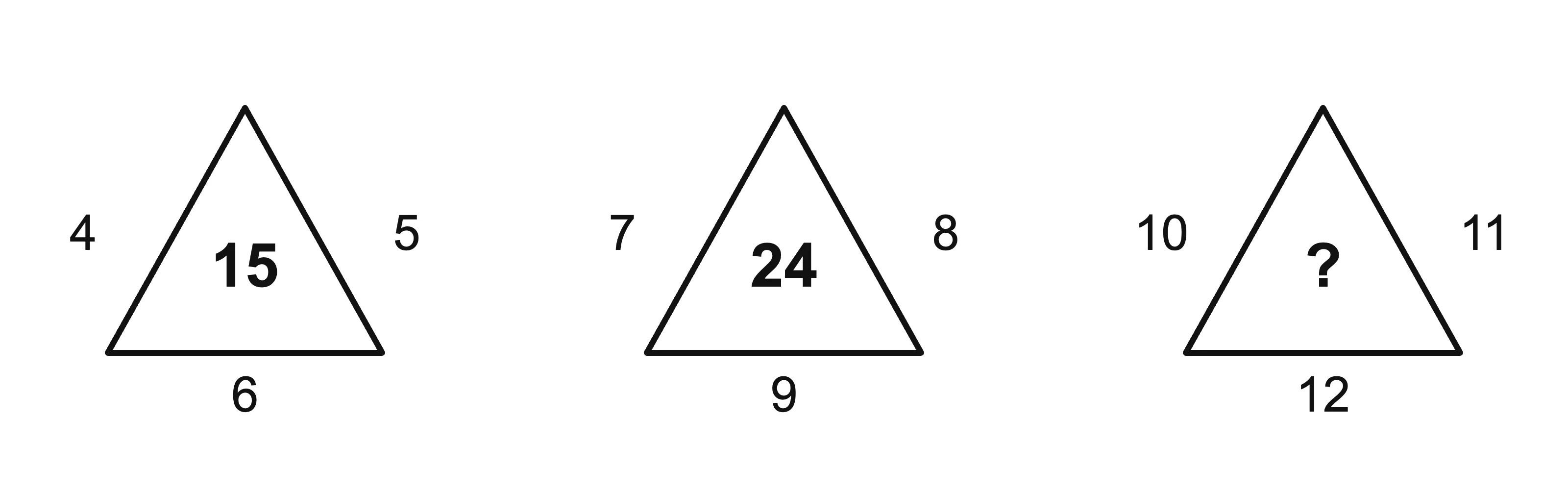
Three triangle number puzzles using the sum of outside numbers
What we know: Each triangle has three outside numbers and one inside result.
What we are finding: We need the inside number in the third triangle.
Why this method applies: Adding all three inputs gives the exact known result in both complete triangles.
Slow solution: Verify the first figure:
Verify the second without changing the order or operation:
Now apply the confirmed rule:
Meaning of the answer: The missing inside number is 33 because it is the sum of all three outside numbers.
The same idea works with four outside numbers. If and , then a figure containing 7, 8, 3 and 9 gives 27.
Case 2: Two branches form a result
Example: Find the missing result in the branch pattern below.
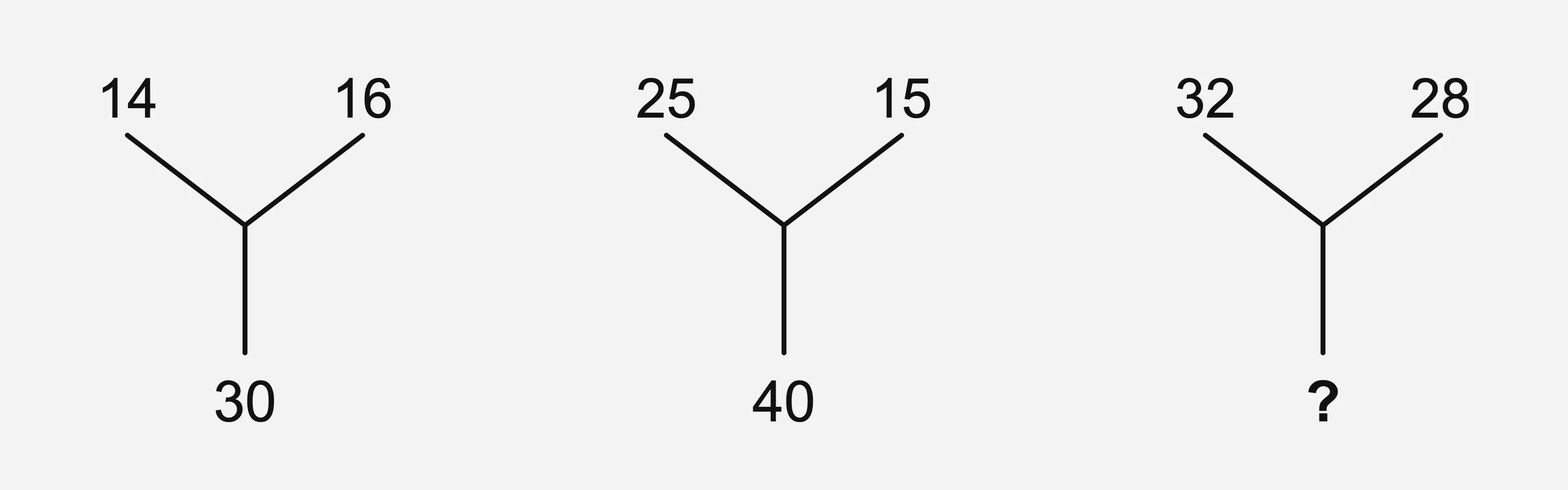
Three Y-shaped figures using addition
The two top branches are the inputs and the bottom position is the result. The same addition rule works in both known figures:
Meaning of the answer: The bottom number is 60.
The direction may be reversed. A top number may equal the sum of two bottom numbers. Position labels decide where the result belongs, but the arithmetic relationship stays the same.
Subtraction and Difference Patterns
A difference is the result of subtraction. When a puzzle asks for a positive missing number, subtract the smaller input from the larger one unless the figure clearly gives a fixed left-to-right direction.
Example: Find the missing top number in the pattern below.
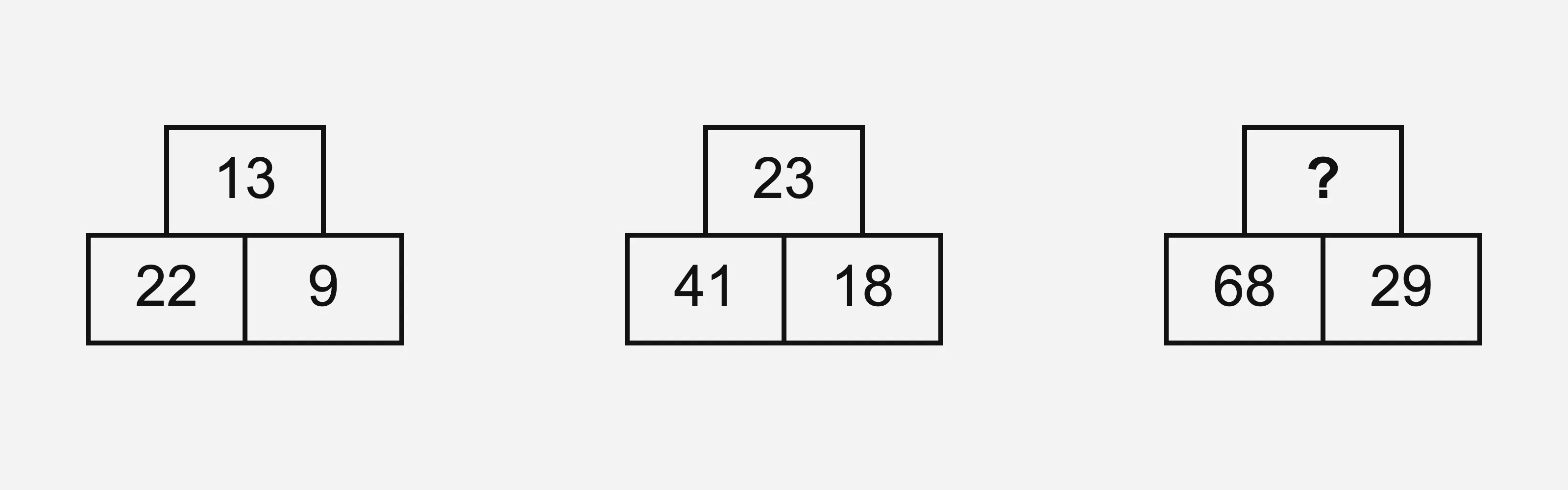
Number towers using the difference of two bottom numbers
What we know: The top result is smaller than the larger bottom input.
Why this method applies: The difference matches both complete figures:
Apply the same order to the third figure:
Meaning of the answer: The missing top number is 39.
Finding a missing input with inverse operations
Sometimes the result and one input are known. Instead of guessing the missing number, write the relationship as an equation.
Example: Find the missing bottom number in the figure below.

Tree figure with top 65, bottom 40 and a missing addend
Let the missing number be :
Subtraction reverses addition, so remove 40 from both sides:
Meaning of the answer: The missing bottom input is 25. Checking gives .
Mixed Addition and Subtraction
A one-step operation may not use all the positions. The next useful idea is to combine a small group, then add or subtract another position.
Case 1: Add two sides, then subtract the bottom
Example: Find the missing centre in the triangle pattern below.
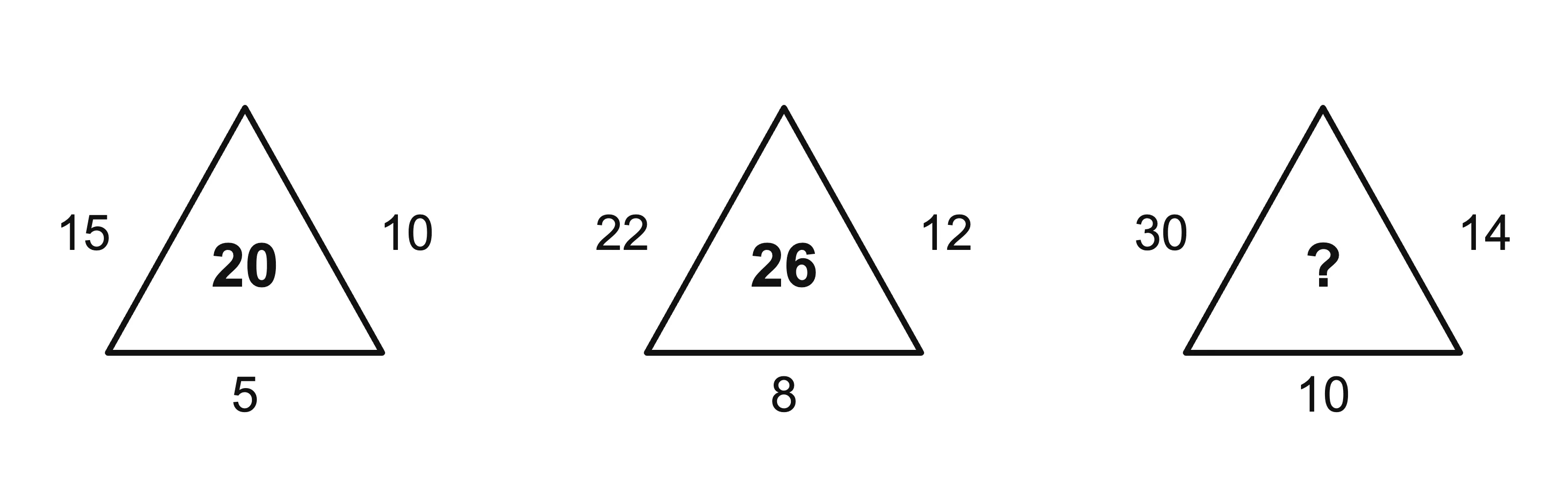
Triangle puzzles using left plus right minus bottom
Find the inside value when the side numbers are 30 and 14 and the bottom number is 10.
What we know: The first two figures use the left and right positions as one pair, then use the bottom position separately.
Why this method applies: The same ordered expression gives both known inside values.
Slow solution: Add the side numbers first:
Then subtract the bottom number:
Meaning of the answer: The inside number is 34.
Case 2: Compare two group totals
Four outside numbers may form a top pair and a bottom pair. Find each pair's total before comparing them.
Example: Find the missing centre in the four-position figure below.

Four-position puzzle comparing top and bottom sums
The top total is:
The bottom total is:
Now compare the two groups:
Meaning of the answer: The centre number is 20. Grouping first prevents the four inputs from being mixed in the wrong order.
Multiplication Patterns
Multiplication often produces results much larger than the inputs. Test it when addition gives a value far below the known result.
Example: Find the missing result in the triangle pattern below.
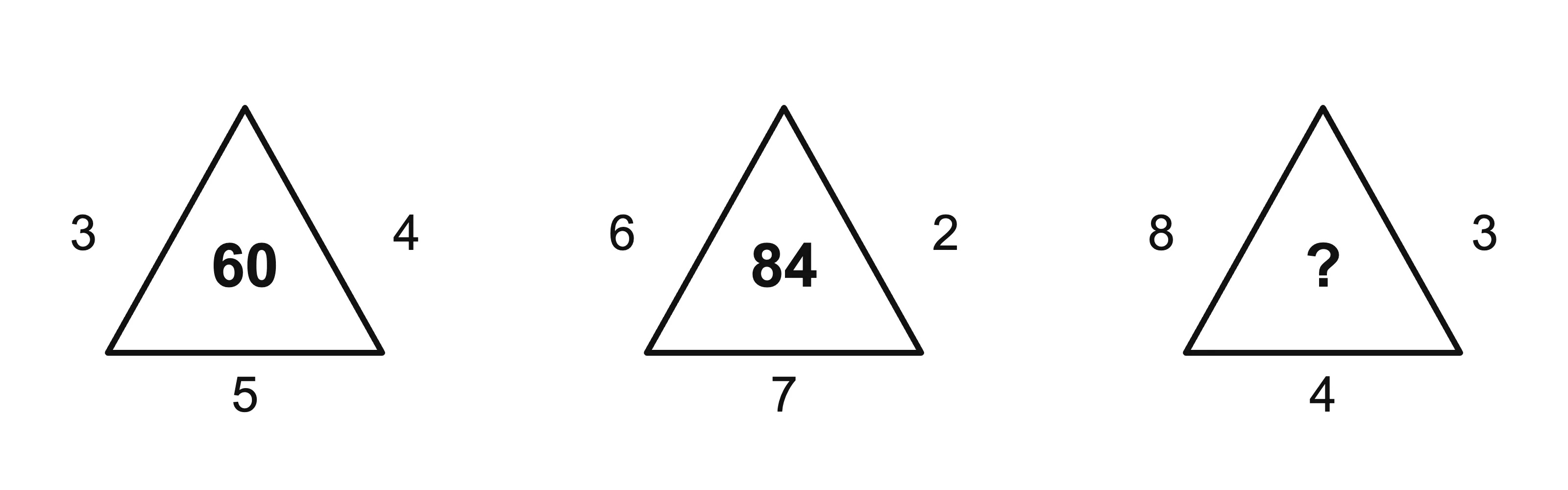
Triangle puzzles multiplying three outside numbers
The first figure suggests a product:
The second confirms the same rule:
Use all three inputs again:
Meaning of the answer: The missing number is 96.
Finding a missing factor
Division reverses multiplication.
Example: Find the missing factor in the number pyramid below.

Number pyramid with top 144 and one missing factor
Write:
Divide by the known factor:
Meaning of the answer: The missing factor is 12, and checks the result.
Division and Quotient Patterns
Division needs a clear order because is not the same as . Position and size usually show which number is the dividend.
Example: Find the missing top number in the division pattern below.
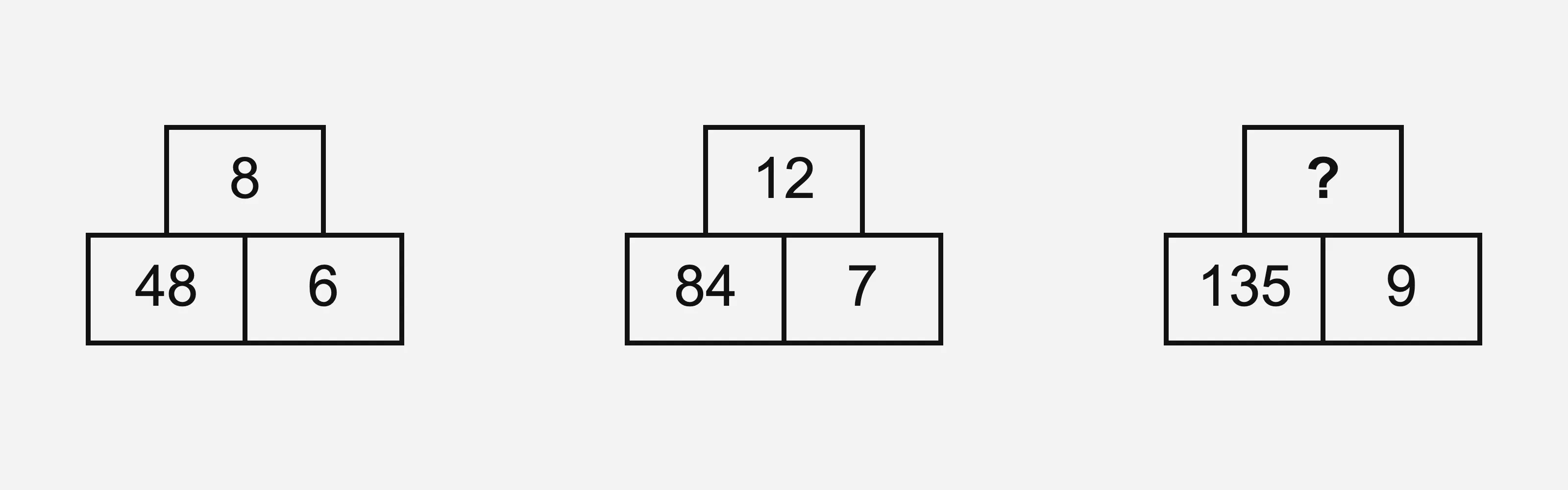
Tree figures using division of bottom numbers
What we know: In each complete figure, the larger left-bottom number is divided by the right-bottom number.
Why this method applies: The order works exactly in both figures:
Apply it to the third:
Meaning of the answer: The missing top number is 15.
If a divisor is missing, use the inverse relationship. From , we get .
Multiply and Then Add or Subtract
Intermediate figure puzzles often use two operations. The layout usually tells which numbers form the product and which number is added or removed afterward.
Case 1: Multiply two positions, then subtract another
Example: Find the missing centre in the triangle pattern below.
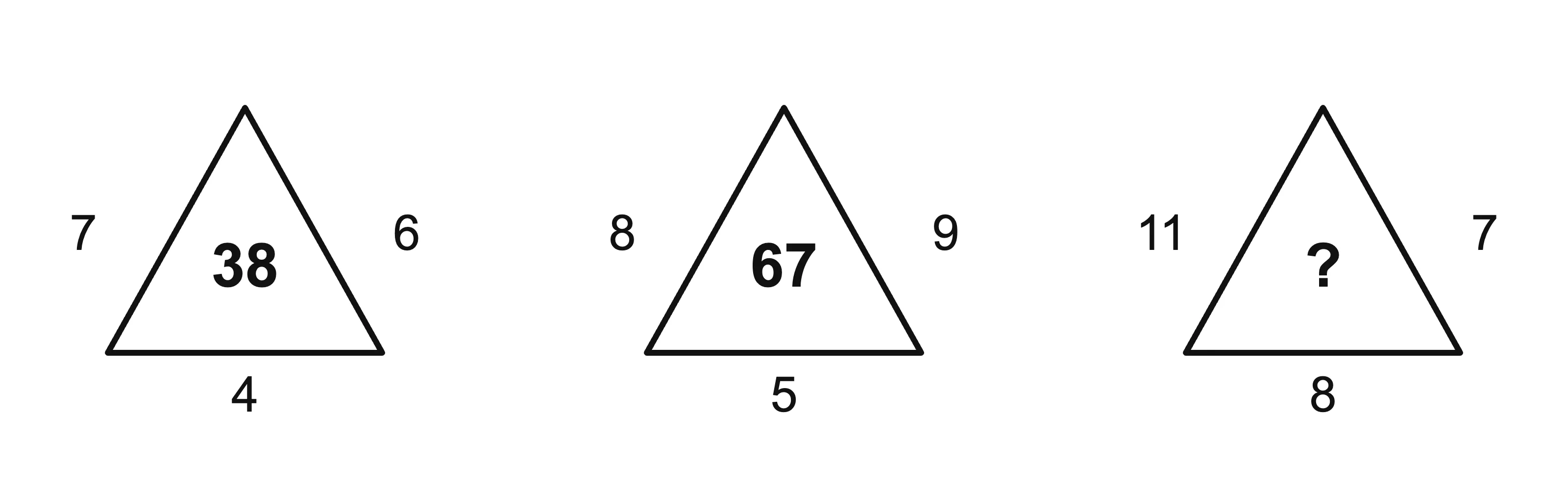
Triangle puzzles using side product minus bottom
The same expression structure is:
Multiply the side numbers first:
Then subtract the bottom number:
Meaning of the answer: The missing centre is 69.
Case 2: Multiply two positions, then divide
Example: Find the missing result in the triangle pattern below.
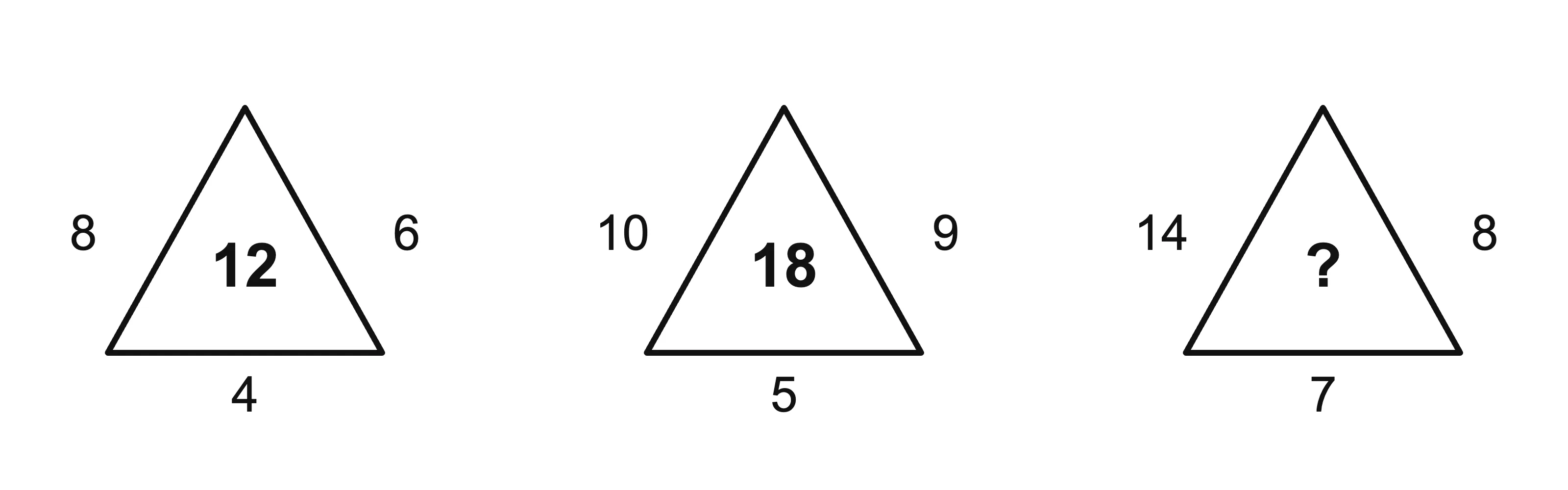
Triangle puzzles using side product divided by bottom
The consistent rule is:
First multiply:
Then divide by 7:
Meaning of the answer: The missing inside number is 16. The bottom number acts as a divisor, not another factor.
Pairing Numbers by Rows or Diagonals
Four-position figures often create two products. The correct pairs may be horizontal rows or diagonals. Follow the visual symmetry and verify the same pairing in every complete figure.
Case 1: Products of rows
Example: Find the missing centre in the four-corner figure below.

Four-corner puzzle adding top and bottom row products
Find each product separately:
Then add them:
Meaning of the answer: The centre is 58.
The two row products may also be subtracted. For top numbers 12 and 8 and bottom numbers 7 and 4:
Case 2: Products of diagonals
Example: Find the missing centre in the diagonal-pair figure below.

X-shaped puzzle adding two diagonal products
Meaning of the answer: The missing centre is 87. Using horizontal pairs would be a different rule and must not replace the diagonal pairing established by the complete figures.
Product Minus Sum
A common two-input pattern first multiplies the inputs and then subtracts their sum:
Example: Find the missing top number in the pyramid below.

Number pyramid using product minus sum
What we know: The complete figures confirm that the product is reduced by the total of the same two inputs.
Slow solution: Find the product:
Find the sum:
Subtract the sum from the product:
Meaning of the answer: The top number is 76.
Brackets matter. The intended expression is , not .
Square Patterns
The square of a number is the number multiplied by itself:
Results such as 41 from inputs 5 and 4 suggest squares because .
Case 1: Sum of squares
Example: Find the missing result in the squared-input figure below.

Y-shaped puzzle using the sum of squares of 16 and 7
Square each input separately:
Then add:
Meaning of the answer: The missing result is 305.
Case 2: Difference of squares
Example: Find the missing result in the squared-input figure below.

Y-shaped puzzle using the difference of squares of 14 and 11
Meaning of the answer: The missing bottom number is 75.
The same calculation can be shortened after the full method is understood:
For 14 and 11, this gives .
Finding a missing number from its square
Example: Find the missing bottom number in the squared-input tree below.

Tree figure finding a missing input from a sum of squares
Let the missing number be :
First remove the known square:
The positive figure entry is the square root:
Meaning of the answer: The missing number is 7. Substituting it gives .
Squares Combined with Other Positions
A square rule can be one part of a longer positional expression.
Example: Find the missing centre in the four-position figure below.

Four-position puzzle using top squares minus bottom sum
For top numbers 8 and 6 and bottom numbers 3 and 4, square the top pair:
Add the bottom pair:
Now subtract:
Meaning of the answer: The centre is 93. The positions decide which pair is squared and which pair is only added.
Another advanced form may square all four outside values, add them and subtract a fixed constant. A constant is reasonable only when the same value is clearly used in every complete figure.
Cube Patterns
The cube of a number is the product of three equal factors:
Useful small cubes include , , , , , , , , , and .
Case 1: Difference of cubes
Example: Find the missing result in the cubed-input figure below.

Y-shaped puzzle using the difference of cubes of 11 and 5
Cube the left input:
Cube the right input:
Subtract in the confirmed left-to-right order:
Meaning of the answer: The missing result is 1206.
Case 2: Sum of cubes and an inverse step
Example: Find the missing bottom number in the cubed-input pyramid below.

Number pyramid finding a missing input from a sum of cubes
Let the missing input be :
Since :
Take the cube root:
Meaning of the answer: The missing input is 4 because .
Longer Multi-step Rules
Advanced puzzles may use three or four operations, but the expression should still follow the positions clearly.
Case 1: Product plus a square
Example: Find the missing centre in the triangle below.

Triangle puzzle using side product plus bottom square
The positional rule is:
Calculate the two parts:
Then combine them:
Meaning of the answer: The centre number is 172.
Case 2: Product of three positions plus the fourth
Example: Find the missing centre in the four-position figure below.

Four-position puzzle multiplying three inputs and adding the fourth
First use the three positions assigned to the product:
Then add the remaining position:
Meaning of the answer: The missing centre is 284.
Case 3: A repeated constant
Example: Find the missing centre in the triangle below.

Triangle puzzle using sum times ten minus ten
Add the outside values:
Apply the same scale and constant used in both complete figures:
Meaning of the answer: The centre is 300. The constants 10 and are acceptable only because they stay unchanged across the set.
When More Than One Pattern Seems Possible
A finite set of numbers can fit many formulas. The intended answer in an aptitude puzzle depends on a convention: choose the simplest consistent positional rule supported by all complete figures and the options.
Do not choose a rule merely because it creates an answer in one figure. Compare competing rules by asking:
- Does each use the same positions?
- Does each use the same number of steps?
- Does one need an unexplained exception?
- Does one ignore a number that the other uses naturally?
- Which rule matches the progression from simple to complex operations in the set?
If two equally simple rules still survive and produce different listed answers, the puzzle is ambiguous. A well-written aptitude item should include enough complete figures or restrictions to remove that ambiguity.
Common Mistakes
Accepting a rule after one figure
A calculation may match by accident. Verify the unchanged rule on every available complete figure before applying it.
Ignoring position and direction
Subtraction and division depend on order. Keep left-to-right, top-to-bottom or larger-to-smaller order consistent with the complete figures.
Using only some numbers without a visual reason
Every prominent input usually has a role. Ignoring one is reasonable only when the layout or confirmed rule clearly separates it.
Changing the grouping between figures
If the first figure uses top and bottom rows, the next cannot suddenly use diagonals. The positional map is part of the rule.
Forgetting the order of operations
In , multiplication and the bracketed sum happen before subtraction. Write intermediate values to avoid mixing steps.
Squaring or cubing the combined total
is not the same as . Square or cube each input separately when that is the established pattern.
Guessing a missing factor or root
Use inverse operations. Divide to reverse multiplication, take a square root to reverse a square, and take a cube root to reverse a cube.
Inventing a constant too early
A fixed adjustment such as or should be tried only after simpler positional rules fail, and it must remain identical in every complete figure.
Safe Shortcuts
- Test addition and subtraction before multiplication, division, powers or constants. This is safe as a search order, but every candidate still needs verification.
- Use result size as a clue. A result far larger than the inputs may point to products or powers, but size alone never proves the rule.
- For , use after the square-difference pattern has been confirmed.
- Memorise squares from to and cubes from to . This shortens arithmetic without changing the rule.
- When the result and one factor are known, divide instead of testing possible factors one by one.
- When or is known, use the square root or cube root instead of guessing.
- In a four-position figure, test visually natural rows and diagonals before irregular pairings. Use this only as a search order and verify it on all complete figures.
- Keep each intermediate product, sum or power on its own line. This prevents order-of-operations errors in multi-step patterns.
A shortcut should make a confirmed method faster. It should not replace rule verification or justify a pattern that works only once.
Frequently Asked Questions
What is a missing-number figure puzzle?
It is a number pattern shown through shapes or positions. Complete figures demonstrate a mathematical rule, and the same rule is used to find an unknown number in another figure.
Which operation should I try first?
Begin with addition and subtraction, then test multiplication and division. Move to grouped operations, squares, cubes or constants only when simpler rules do not fit every complete figure.
How do I know that a pattern is correct?
The unchanged rule must work on every complete figure, use corresponding positions consistently and produce a sensible listed answer. One successful calculation is not enough.
Must every number in the figure be used?
Usually yes. A visible input should not be ignored without a clear reason from the layout or the repeated examples.
How do I decide between rows and diagonals?
Test the most visually balanced pairs and verify them across all complete figures. Once a pairing is chosen, it must stay unchanged.
What should I do when the missing number is an input?
Write the confirmed rule as an equation and reverse its operations. Use subtraction for a missing addend, division for a missing factor, and roots for missing squared or cubed inputs.
Why are answer choices useful in number puzzles?
Options help check arithmetic and can separate competing patterns. They should confirm a well-supported rule, not replace the need to find one.
Can a number puzzle have more than one answer?
Yes, if too little information is supplied. Several formulas can fit a small set. Aptitude tests expect the simplest consistent positional rule, but an item is genuinely ambiguous when equally simple rules give different answers.
How can I solve square and cube patterns faster?
Learn common squares and cubes, keep the powers separate, and use difference-of-squares factoring when appropriate. For a missing input, reverse the power with a root.
Does the shape of a puzzle determine the operation?
No. A triangle can use addition, multiplication, squares or another rule. The shape helps identify positions, while the complete numerical figures determine the operation.
Summary
Number figure puzzles become manageable when positions are named before operations are tested. Start with the simplest arithmetic rule, verify it on every complete figure and keep the same direction and grouping throughout the set.
As the patterns grow, build them from familiar parts: pair positions, calculate products or powers, then add, subtract or divide. When an input is missing, reverse the confirmed operation instead of guessing. A valid answer comes from both arithmetic and consistent structure.