Progressions: AP, GP and HP Formulas with Easy Examples
A progression is a sequence of numbers that follows a fixed rule. A term is one number in the sequence, and its position tells us where it appears. The central decision is to find how one term changes into the next: are we adding the same number, multiplying by the same number, or getting an arithmetic pattern after taking reciprocals?
For example, grows by adding 3 each time. The number 11 is the third term, while the sum of the first three terms is . This difference between one term and a total is important because they use different formulas.
This article begins with the words and symbols used in sequences. It then builds through arithmetic progression (AP), geometric progression (GP) and harmonic progression (HP), followed by inserted means, infinite sums, selected-position terms and mixed patterns.
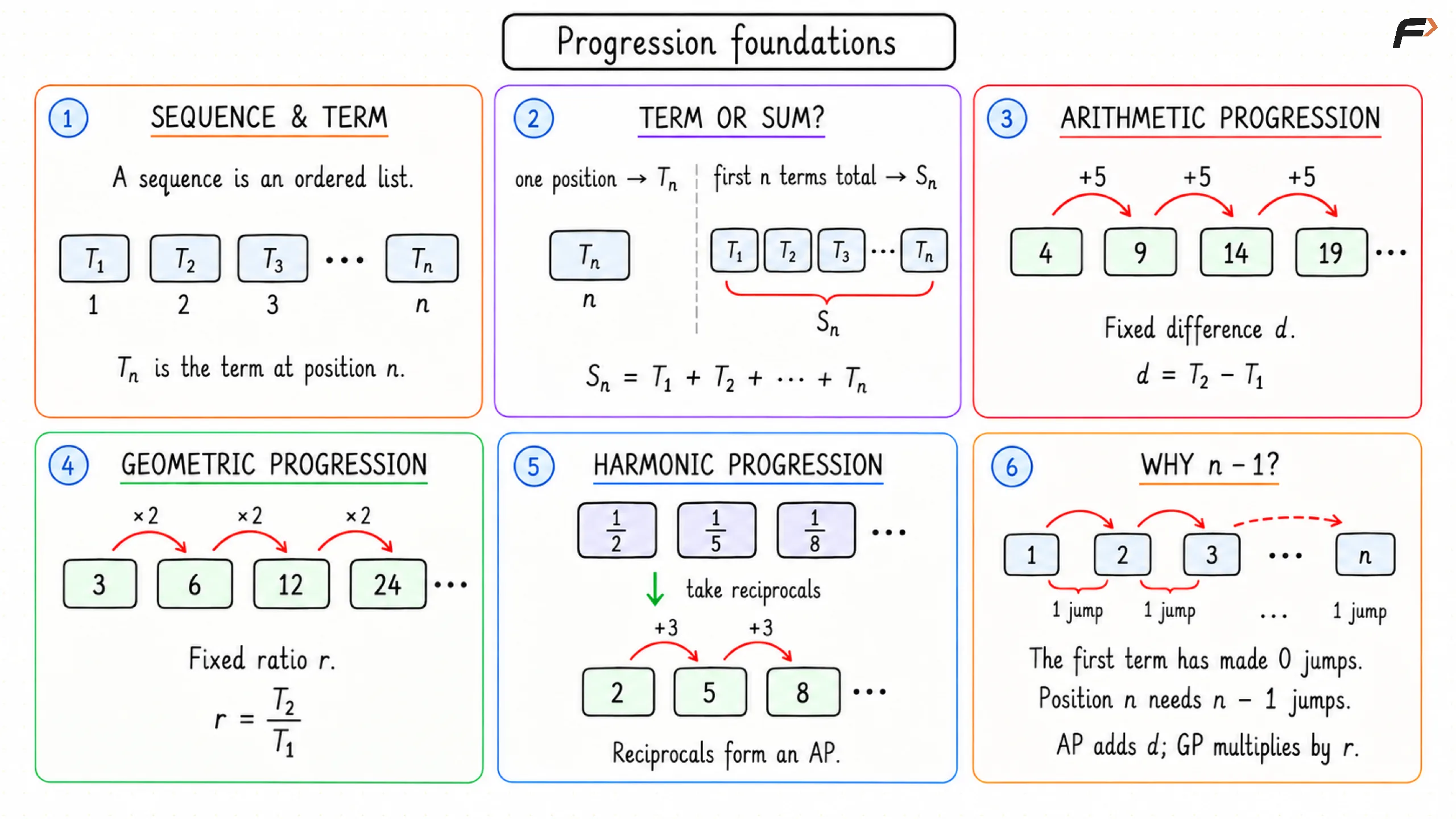
Progression foundations covering sequences, terms, sums, AP, GP and HP
Basics: Sequence, Term and Position
A sequence is an ordered list of numbers. Order matters because each number has a position. We usually write a sequence as:
Here, is the first term, is the second term and is the term in position . The letter is commonly used for the first term, so .
The dots do not mean that any numbers may be placed there. They mean the same rule continues. For example, in , the next term is 20 because the rule is to add 2.
A term is different from a sum
A single position, such as the 10th row, 12th deposit or 6th reward, needs one term. A total over 10 rows, 12 days or 6 rounds needs a sum.
| Wording | What to find |
|---|---|
| value on day 12 | |
| seats in row 10 | |
| total for 12 days | |
| sum of the first 10 terms | |
| which term equals 55? | solve for |
The symbol means the sum of the first terms:
How to Recognise AP, GP and HP
The safest method is to compare neighbouring terms. Do not choose a formula only because a sequence rises or falls.
| Type | What stays fixed? | Small example | Main test |
|---|---|---|---|
| Arithmetic progression (AP) | difference | subtract neighbouring terms | |
| Geometric progression (GP) | ratio | divide a term by the previous term | |
| Harmonic progression (HP) | difference between reciprocals | take reciprocals, then test for AP |
In an AP, the same number is added each time. Subtraction is included because adding a negative number makes the sequence fall. For , the common difference is .
In a GP, the same number is multiplied each time. A ratio between 0 and 1 makes positive terms shrink. For , the common ratio is .
An HP does not usually have a fixed difference or ratio in its original terms. Its reciprocals form an AP. For , the reciprocals are , which have common difference 3.
Arithmetic Progression: Equal Differences
An arithmetic progression is a sequence in which the difference between consecutive terms is constant. This fixed value is called the common difference and is written as .
Starting from the first term , the terms are:
The multiplier of is always one less than the position. The first term has made zero jumps, the second has made one jump, and the th term has made jumps. This gives the nth-term formula:
Case 1: Find one term of an AP
Example: A saving plan begins with a deposit of Rs. 5 on day 1. The deposit rises by Rs. 3 each day. Find the deposit on day 12.
The first deposit gives . The same Rs. 3 is added each day, so . We need the deposit on day 12, not the total deposited by then, so we use .
Day 12 is 11 jumps after day 1. Therefore:
First count the 11 equal increases, which add . Add this increase to the starting deposit:
The deposit made on day 12 is Rs. 38. This is one day's amount, not the sum of all 12 deposits.
Case 2: Find the position of a known value
When the value of a term is given but its position is unknown, place that value in and solve for .
Example: In the AP , which term is 55?
The first term is 7, and each term rises by 6, so and . The term value 55 is known and its position is missing. Therefore, set :
The sequence must rise by from its first term. Each jump adds 6, so the number of jumps is:
Eight jumps after the first position brings us to position . Therefore, 55 is the 9th term.
If solving the equation gives a non-positive or non-whole value of , the stated number is not a term of that AP.
Case 3: Find an AP from two known terms
If two terms are known, write one nth-term equation for each. Subtracting them removes and reveals .
Example: The 6th term of an AP is 41 and the 14th term is 9. Find the 20th term.
The terms fall as the position rises, so we should expect a negative common difference. Using :
There are 8 steps from the 6th term to the 14th term. Over those steps, the value changes by . Subtracting the equations shows the same idea:
Now use to find the starting value:
The 20th term is 19 equal steps after the first term:
The 20th term is . A negative term is valid because the AP continues decreasing by 4.
Sum of the First Terms of an AP
The sum of the first terms of an AP can be found with either of these equivalent formulas:
Here, is the last term being added, so . Use the first formula when , and are known. Use the second when the first term, last term and number of terms are easier to identify.
Why the AP sum formula works
Write a five-term AP forward and backward:
Every vertical pair has the same sum, , which is also . There are five pairs across the two copies of the sum. Dividing by 2 leaves one copy:
The same pairing works for any number of AP terms, so .
Case 1: A total that grows by a fixed amount
Example: An auditorium has 12 seats in its first row. Each new row has 2 more seats than the previous row. How many seats are in the first 10 rows altogether?
The word “altogether” asks for the sum, not only the number of seats in row 10. The first term is , the common difference is , and there are rows.
First, the expression inside the brackets finds the first term plus the last term:
There are 10 terms, so there are five pairs with a pair sum of 42:
The first 10 rows contain 210 seats in total.
Average of all terms in a finite AP
Because the first and last AP terms pair to the same total as the second and second-last terms, the average of all its terms is:
Example: An AP begins at 4 and ends at 20. Find the average of all its terms.
The terms are equally spaced, so their centre is halfway between the endpoints:
This result does not require the number of terms. It does require the full list to be a finite AP with the stated first and last terms.
Inserting Arithmetic Means
An arithmetic mean inserted between two endpoints is simply a missing AP term. If means are inserted between and , the complete sequence has terms and equal gaps.
Therefore:
The number of gaps is one less than the number of terms. Forgetting this is the most common error when inserting means.
Example: Insert five arithmetic means between 6 and 66. Find the fourth inserted mean.
The two endpoints and five inserted numbers make seven terms. Seven terms have six gaps, so the common difference is:
Starting from 6 and adding 10 across each gap gives:
The inserted means are . The fourth inserted mean is 46. Notice that it is the fifth term of the complete AP because the first endpoint comes before all inserted means.
Terms at Selected Positions Form Another AP
If we take every second, third or th position from an AP, the selected terms still form an AP. Each selected step skips the same number of original gaps.
For example, if the original common difference is , the even-position terms have common difference .
Example: An AP starts at 3 and has common difference 4. Find the sum of the even-position terms among its first 14 terms.
The even positions are , so there are 7 selected terms. The first selected term is:
The last selected term is:
These selected values form the AP . Its sum is:
The even-position terms among the first 14 original terms add to 217.
Geometric Progression: Equal Ratios
A geometric progression is a sequence in which each term is found by multiplying the previous term by the same nonzero number. That fixed multiplier is the common ratio, written as .
Starting from , its terms are:
The th position has received multiplications by , so:
Case 1: Find one term of a GP
Example: A layer count starts at 4 and triples at every step. Find the layer count at step 5.
The first value is . “Triples” means multiply by 3, so . We need the value at one position, so we use .
Step 5 is four multiplication jumps after step 1:
Since :
The layer count at step 5 is 324.
Case 2: Find the ratio from two GP terms
For two known terms and , division removes :
The exponent is the number of ratio jumps between the two positions.
Example: The third term of a GP is 12 and the sixth term is 96. Find the eighth term.
From position 3 to position 6 there are three jumps. Therefore:
So . From the sixth term to the eighth term there are two more jumps, and each jump doubles the value:
The eighth term is 384. Using the gap rather than either position alone is what makes the ratio calculation work.
A decreasing GP
A positive GP may decrease even though no subtraction is used. This happens when .
For example, if and , then:
Thus . Each term is half of the previous term. A negative ratio would make the signs alternate as the sizes change.
Sum of a Finite GP
For a GP with , the sum of the first terms is:
The same formula is often written as:
The two forms are equal. The first is usually convenient when , while the second keeps both numerator and denominator positive when .
Why the finite GP sum formula works
Begin with:
Multiply every term by :
Subtracting the first line from the second cancels all middle terms:
Factoring out and dividing by gives the formula. If , division by is impossible. In that special case every term equals , so .
Example: A reward begins at 2 points and doubles after every round. Find the total reward over 6 rounds.
The first reward is , the ratio is , and there are rewards. The word “total” tells us to use :
The power accounts for the repeated doubling in the sum formula. Therefore:
The rewards across all six rounds add to 126 points. The sixth reward alone would be , so it is important not to confuse the term with the total.
Sum of an Infinite GP
An infinite list has no last term. Its sum can still approach one finite number when its terms shrink quickly enough. For an infinite GP, this happens only when:
Under this condition, approaches 0 as grows. The finite-sum formula then becomes:
Example: Find the infinite sum .
The first term is . Every term is half the previous one, so . Because , the infinite sum exists.
The denominator is . Dividing by one-half is the same as multiplying by 2:
The terms continue forever, but their total approaches 128. If , the terms do not shrink towards zero, so this infinite-sum formula must not be used.
Inserting Geometric Means
When geometric means are inserted between and , the complete GP has terms and ratio jumps. Therefore:
This equation finds the common ratio. Once is known, multiply by it repeatedly to fill the missing terms.
Example: Insert three geometric means between 5 and 405. Find the second inserted mean.
The sequence has five terms in total, so there are four ratio jumps from 5 to 405:
Divide by 5 to isolate the repeated ratio:
For the positive progression intended here, . Starting at 5 and multiplying by 3 gives:
The three inserted means are 15, 45 and 135, so the second inserted mean is 45.
For some endpoint and gap combinations, a negative real ratio may also satisfy the equation. Check the wording and the possible signs instead of automatically choosing the positive root.
Product of the First Terms of a GP
The first terms are . Their product is:
Since :
Example: A GP has first term 2 and common ratio 3. Find the product of its first five terms.
The terms are . Multiplying them directly works, but the product formula shows how the powers combine:
The product of the first five terms is 1,889,568. A GP sum formula cannot be used when the required result is a product.
Harmonic Progression: Turn It into an AP
A harmonic progression is a sequence of nonzero numbers whose reciprocals form an arithmetic progression. If the reciprocal AP has first term and common difference , then its th term is . The corresponding HP term is the reciprocal:
Here, is the reciprocal of the first HP term. It is not necessarily the first HP term itself.
Case 1: Find an HP term
Example: An HP begins with . The AP formed by its reciprocals has common difference 2. Find the 7th term of the HP.
The reciprocal of the first HP term is 3, so the reciprocal AP begins at . Its common difference is .
First find the seventh term of that AP:
The value 15 belongs to the reciprocal AP. We need the HP term, so take its reciprocal:
The seventh HP term is . Stopping at 15 would leave us in the reciprocal AP instead of returning to the HP.
Case 2: Find the harmonic mean
If are consecutive terms of an HP, their reciprocals are consecutive terms of an AP. The middle reciprocal is the arithmetic mean of the outer reciprocals:
Solving this equation gives the harmonic mean formula:
Example: The numbers are consecutive terms of an HP. Find .
The middle number must be the harmonic mean of 10 and 30. Substitute the two outer values:
The numerator is twice the product, , and the denominator is the sum, :
Thus the three HP terms are . Checking the reciprocals gives , and the middle reciprocal is halfway between the other two.
Mixed and Non-standard Progression Patterns
Not every patterned series is a pure AP, GP or HP. Test before using a standard formula. A term may combine its position with another changing part.
Consider:
The first factors form an AP, while the powers form a GP. The general term is:
This is neither an AP nor a GP because both factors change. If only a small number of terms is requested, write them carefully and add.
Example: Find the sum of the first six terms of .
Substitute one at a time:
Now add the six actual terms:
The required sum is 321. A normal GP formula would be wrong because the ratio between complete terms is not constant.
Comparing an AP and a GP
An AP and a GP may share the same first term while later corresponding terms differ. Find each term with its own rule before subtracting.
Example: An AP and a GP both begin at 3. The AP has common difference 4, and the GP has common ratio 2. Find the difference between their sixth terms.
For the AP:
For the GP:
The requested difference is the GP term minus the AP term:
The difference is 73. Writing both terms separately prevents the AP difference and GP ratio from being mixed in one formula.
Common Mistakes
Using a sum formula for one term
The phrase “the 10th term” asks for . The phrase “the sum of the first 10 terms” asks for . Underline words such as on, in, total, altogether and sum before choosing a formula.
Using jumps for the nth term
The first term is already present before any jump occurs. That is why both AP and GP nth-term formulas use . Draw the first three positions if this feels unclear.
Dividing by the number of inserted means
If means are inserted, there are gaps between the endpoints. Include the gap before the first mean and the gap after the last mean.
Treating every growing sequence as a GP
Growth alone does not decide the type. Test differences and ratios. The sequence grows but is an AP. The sequence is a GP.
Forgetting the infinite-GP condition
The formula is valid only when . Checking this condition must come before substitution.
Forgetting to return from reciprocals in HP
Most HP calculations happen in the reciprocal AP. After finding the required reciprocal term, invert it to return to the HP.
Assuming a common difference or ratio must be positive
A decreasing AP may have . A positive decreasing GP often has , while a negative ratio makes signs alternate. Let the given terms decide the sign.
Formulas and Cheat Sheet
| Situation | Formula or method | Important condition |
|---|---|---|
| AP nth term | is the fixed difference | |
| AP sum | first terms | |
| AP sum with last term | ||
| AP average | complete finite AP | |
| Insert arithmetic means | gaps | |
| GP nth term | is the fixed ratio | |
| Finite GP sum | ||
| Infinite GP sum | only when | |
| Insert geometric means | ratio jumps | |
| Product of first GP terms | the required result is a product | |
| HP nth term | belongs to reciprocal AP | |
| Harmonic mean of | middle of three HP terms |
Safe Shortcuts
- To find an AP difference from and , use .
- To find a GP ratio from two terms, use , then take the required root carefully.
- For an AP sum, use when the last term is already known.
- For three AP terms , the middle value is .
- For three GP terms , . The sign of must fit the progression.
- For three HP terms , use when the denominator is nonzero.
A shortcut is safe only after the progression type and conditions are clear. It should shorten correct reasoning, not replace it.
Frequently Asked Questions
What is the difference between a sequence and a progression?
A sequence is any ordered list of terms. A progression is a sequence whose terms follow a defined pattern, such as a fixed difference or ratio. In aptitude mathematics, the words are sometimes used loosely, so always inspect the rule.
How can I quickly tell whether a sequence is AP or GP?
Subtract consecutive terms first. If the difference stays fixed, it is an AP. If not, divide each nonzero term by the previous term. A fixed ratio shows a GP.
Why is there an in AP and GP formulas?
The first term is at position 1 and has made no change yet. Reaching position requires jumps from the first term, whether each jump adds or multiplies by .
Can an AP have a negative common difference?
Yes. A negative common difference means the sequence decreases by the same amount each time. For example, is an AP with .
Can a GP have a fractional or negative common ratio?
Yes. A ratio such as one-half makes positive terms shrink. A negative ratio makes the signs alternate. For example, the sequence 3, -6, 12, -24 continues with a common ratio of -2.
When does an infinite GP have a finite sum?
It has a finite sum only when the absolute value of the common ratio is less than 1. This condition makes the terms approach zero. The sum is the first term divided by one minus the common ratio.
What is the easiest way to solve an HP question?
Take the reciprocal of every HP term and solve the resulting AP question. At the end, take the reciprocal again if the question asks for an HP term.
How many gaps are there when means are inserted?
If means are inserted between two endpoints, the complete list has terms and gaps. Both AP and GP insertion questions use this gap count.