Probability: Complete Beginner Guide with Detailed Examples
Probability is a number that tells us how likely an event is to happen. An event is simply the result or group of results we are interested in. A probability of 0 means the event cannot happen. A probability of 1 means it must happen. A value between 0 and 1 shows a chance between impossible and certain.
Suppose a fair coin is tossed. The possible results are head and tail, and both are equally likely. Only one of those two results is a head, so the probability of a head is . The denominator counts everything that could happen, while the numerator counts what we want.
That idea stays at the centre of the topic. The main work is usually not division. The main work is counting the full set of possible outcomes and the outcomes that satisfy the chosen event. We will learn that counting slowly through numbers, coins, dice, cards and balls before moving to combinations and draws without replacement.
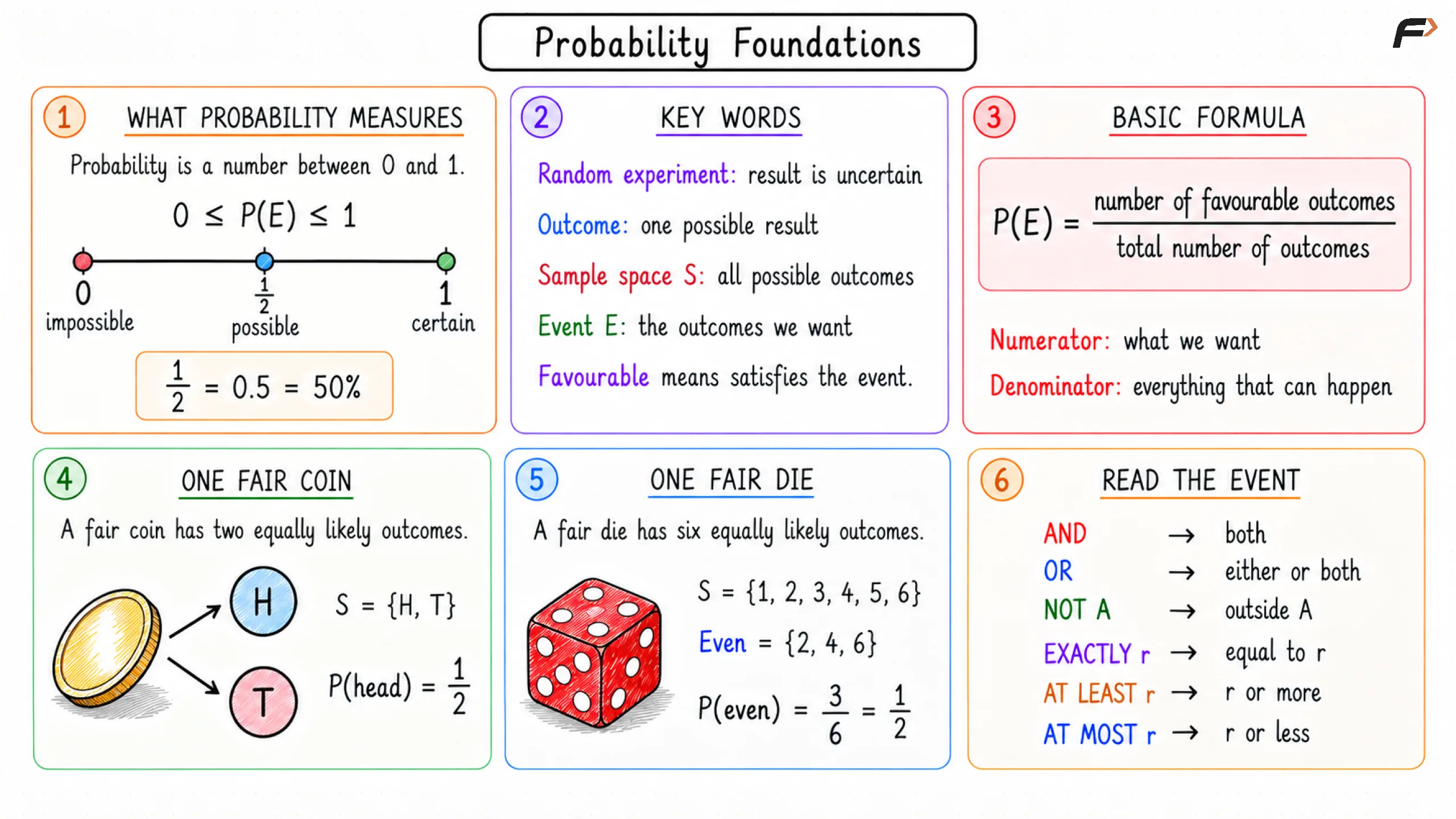
Probability foundations with the probability scale, key terms and basic formula
What Probability Measures
Probability can be written as a fraction, decimal or percentage. These three forms can describe the same chance:
A larger probability means the event is more likely. For example, is more likely than because three-fourths of the possible chance is larger than one-fourth.
The probability scale always stays between 0 and 1:
Here, means “the probability of event .” If a calculation gives a value below 0 or above 1, something has been counted incorrectly.
Impossible, possible and certain events
Rolling a 7 on an ordinary six-faced die is impossible, so its probability is 0. Rolling a number from 1 to 6 is certain, so its probability is 1. Rolling an even number is possible but not certain, so its probability lies between 0 and 1.
These simple checks help us judge an answer. If a bag has only a few blue balls, the probability of blue should not be close to 1. If almost every ball is blue, the probability should not be very small.
The Basic Words You Must Know
Probability uses a few special words. Their meanings are simple once we connect them to an example.
Random experiment
A random experiment is an action whose exact result is not known before it happens. Tossing a coin, rolling a die and drawing a card from a shuffled deck are random experiments.
“Random” does not mean that anything in the world can happen. It means the result is uncertain among a known set of possible results.
Outcome
An outcome is one possible result. When a die is rolled, 1 is one outcome, 2 is another outcome and so on.
When two coloured dice are rolled, an outcome must record both results. We can write to mean that the first die shows 2 and the second die shows 5.
Sample space
The sample space is the full list or set of all possible outcomes. It is often written as .
For one coin:
For one ordinary die:
The sample space becomes the denominator of the basic formula when all its outcomes are equally likely.
Event and favourable outcome
An event is the condition we want. If the event is “an even number appears on a die,” then the favourable outcomes are 2, 4 and 6.
The word favourable does not mean good or beneficial. It means an outcome satisfies the condition of the event being studied.
Equally likely outcomes
Outcomes are equally likely when each has the same chance. The six faces of a fair die are equally likely. The two sides of a fair coin are equally likely. The cards of a well-shuffled deck are treated as equally likely to be drawn.
This condition matters. We cannot blindly count outcomes if some outcomes are more likely than others. For example, a bent or weighted coin may not give head and tail with equal chance.
What “Complement” Means
The complement of an event means every possible outcome in which that event does not happen. In very simple words, a complement is the “opposite side” of an event.
Suppose the event is “the coin shows a head.” The only other possible result is a tail. Therefore, “tail” is the complement of “head.” If the event is “the die shows an even number,” its complement is “the die does not show an even number,” which means it shows an odd number.
An event and its complement always divide the complete sample space into two parts:
- the outcomes where the event happens
- the outcomes where the event does not happen
Nothing is left outside these two parts, and no outcome can belong to both parts at the same time. That is why their probabilities add to 1, which represents the whole sample space.
If an event is called , its complement is written as . We read as “not .”
This also gives:
The subtraction does not remove a random value. It removes every outcome where the event fails, leaving exactly the outcomes where the event succeeds.
A tiny bag example
Example: A bag contains 3 red balls and 2 blue balls. One ball is drawn. Let event mean “a red ball is drawn.”
There are 5 balls in total, and 3 of them are red:
The complement means “not red.” Since the bag contains only red and blue balls, not red means blue. There are 2 blue balls:
Together, the two probabilities cover every ball:
We could therefore find the red probability by subtracting the blue probability from 1:
How to recognise a useful complement
The complement method is most helpful when an event contains many cases but its opposite contains only one or two cases. For example, “at least one head in three coin tosses” includes one head, two heads and three heads. Its complement is simply “no head,” which means all tails. Counting one opposite case is shorter than counting several direct cases.
Common complement pairs are:
| Event | Its complement |
|---|---|
| At least one head | No head |
| At least one 6 | No 6 |
| Product is even | Product is odd |
| At least one blue ball | No blue ball |
| Card is an ace or spade | Card is neither an ace nor a spade |
The complement does not always mean changing one word mechanically. First describe all outcomes that make the original event false. That full opposite group is the complement.
The Basic Probability Formula
When all possible outcomes are equally likely:
The denominator answers, “How many equally likely results can happen?” The numerator answers, “How many of those results satisfy the event?”
Case 1: Selecting a numbered ticket
Example: Tickets are numbered from 1 to 30. One ticket is drawn at random. Find the probability that its number is a multiple of 4.
What is given? Every integer from 1 through 30 appears on one ticket. The words “at random” mean each ticket has the same chance to be selected.
What is asked? We want a ticket whose number is a multiple of 4. A multiple of 4 is a number obtained by multiplying 4 by a whole number.
There are 30 possible tickets, so the denominator is 30. Now list the multiples of 4 that do not go above 30:
There are 7 favourable tickets. Therefore:
The probability is . The next multiple, 32, is not counted because it lies outside the stated range.
Case 2: A condition with two parts
Example: One integer is chosen from 1 to 25, including both ends. Find the probability that it is odd and greater than 12.
The word “and” means both conditions must be true at the same time. A number that is odd but not greater than 12 is not allowed. A number greater than 12 but even is also not allowed.
There are 25 total integers. The odd numbers greater than 12 are:
There are 7 favourable numbers, so:
The probability is . Listing the values is safer than trying to count all odd numbers first and forgetting the second condition.
Case 3: Prime and square number events
A prime number is a whole number greater than 1 with exactly two positive factors: 1 and itself. Therefore, 1 is not prime. A square number is formed by multiplying a whole number by itself, such as and .
Example: One serial number is chosen from 1 to 50. Find the probability that it is prime and less than 20.
The total number of serial numbers is 50. The primes below 20 are:
There are 8 favourable numbers. Thus:
We simplify by dividing the numerator and denominator by 2. Simplifying changes the form of the fraction, not the chance it represents.
Understanding “And,” “Or,” “Not,” “Exactly,” “At Least” and “At Most”
Many probability mistakes come from reading these words too quickly. Before calculating, translate the sentence into allowed and not allowed cases.
| Word or phrase | Meaning |
|---|---|
| and | Both conditions must happen |
| or | , , or both may happen |
| Not | Every allowed result outside |
| Exactly | The count must be equal to |
| At least | or more |
| At most | or less |
| Neither nor | Not and not |
For example, “at least one head” includes one head, two heads, three heads and so on. “Exactly one head” includes only one head. The word exactly closes the door on every other count.
Probability with One Fair Die
The correct singular word is die, while dice is plural. An ordinary fair die has six equally likely faces:
Useful groups on one die are:
- even numbers:
- odd numbers:
- prime numbers:
- numbers greater than 4:
Case 1: Getting an even number
Example: A fair die is rolled once. Find the probability of an even result.
The six faces form the total outcomes. Three of them, 2, 4 and 6, are even. Therefore:
The answer also makes sense from pairing. Each even face can be paired with one odd face, so exactly half the faces are even.
Case 2: Getting a prime number
Example: Find the probability of a prime result on one fair die.
The prime faces are 2, 3 and 5. The number 1 is not included because it has only one positive factor. There are 3 favourable faces out of 6:
The probability is .
Probability with Two Dice
When two dice are rolled, an outcome records the first die and the second die. There are 6 choices for the first die. For each of those, there are 6 choices for the second die.
That is why the total number of ordered outcomes is:
The outcome is different from because the first and second positions have changed. Coloured dice make this easy to see: red 2 and blue 5 is different from red 5 and blue 2.
Why the probabilities multiply
Suppose the first die can show any of 6 values. No matter which value appears, the second die still has 6 possible values. We therefore have 6 rows with 6 outcomes in each row, giving .
This multiplication is a counting rule. It says that when one choice is followed by another choice, the total number of ordered paths is found by multiplying the choices at each step.
Case 1: Sum equals 7
Example: One red die and one blue die are rolled. Find the probability that their sum is 7.
There are 36 total ordered pairs. Now list every pair whose two values add to 7:
There are 6 favourable pairs. We include both and because the colours show which die gave which result.
The probability is .
Case 2: Sum equals 9
Example: Two fair dice are rolled. Find the probability that the sum is 9.
Start with the smallest first value that can still reach 9. If the first die shows 3, the second must show 6. Continue until the required second value would fall below 1:
There are 4 favourable outcomes out of 36:
The probability is . There are fewer ways to make 9 than 7, which is why this probability is smaller.
Case 3: Sum is at least 10
Example: Find the probability that the sum of two dice is at least 10.
“At least 10” means 10, 11 or 12. Count each allowed sum:
- sum 10: , giving 3 outcomes
- sum 11: , giving 2 outcomes
- sum 12: , giving 1 outcome
These cases cannot happen at the same time in one roll, so their counts are added:
Therefore:
The probability is .
Case 4: Difference equals 2
Example: Two dice are rolled. Find the probability that the gap between their values is 2.
The word “difference” here means the non-negative gap, so both orders are accepted. The favourable pairs are:
There are 8 favourable pairs:
The probability is .
Case 5: Both results satisfy a condition
Example: Find the probability that both dice show prime numbers.
Each die has three prime faces: 2, 3 and 5. The first die has 3 allowed choices. For each of them, the second die also has 3 allowed choices:
Out of 36 total outcomes:
The probability is . This also equals because each die has a one-half chance of showing a prime and the two rolls do not affect each other.
Coins and Complete Outcome Lists
A fair coin has two equally likely outcomes, and . For fair coins, each coin adds two possible choices, so the number of ordered outcome strings is:
For two coins, the outcomes are:
The strings and are different because the head appears in a different coin position.
Case 1: Exactly one head in two tosses
Example: Two fair coins are tossed. Find the probability of exactly one head.
“Exactly one” allows one head only. In the complete list, and satisfy the condition. has too many heads and has too few.
The probability is .
Case 2: All heads in three tosses
Example: Three fair coins are tossed. Find the probability of all heads.
Each coin has 2 choices, so there are total outcome strings. Only one string, , contains a head in every position.
The answer is . Another way to see it is that each coin needs a head, so .
Exactly Heads or Tails: Why Combinations Appear
Writing every outcome becomes slow when many coins are tossed. For “exactly heads,” we only need to choose which coin positions show heads. Once those positions are chosen, every remaining position must be a tail.
The number of ways to choose positions from positions is:
This is a combination because we are selecting a set of positions. Choosing positions 1 and 3 is the same selection whether we name 1 first or 3 first.
For fair coins:
Case 1: Exactly two heads in four tosses
Example: Four fair coins are tossed. Find the probability of exactly two heads.
There are total outcome strings. For a favourable outcome, choose 2 of the 4 positions for heads:
Each chosen pair makes one outcome. For example, positions 1 and 3 give . The other two positions automatically become tails.
The probability is .
Case 2: Exactly three tails in five tosses
Example: Five fair coins are tossed. Find the probability of exactly three tails.
The total number of outcomes is . Choose the 3 positions that will contain tails:
The two unchosen positions must be heads, so no second choice is needed.
The probability is .
At Least, At Most and the Complement Rule
The complement of event is the event that does not happen. It is written as . An event and its complement cover every possible outcome without overlap, so their probabilities add to 1:
Therefore:
The complement is useful when the event has many cases but the opposite has only one or a few cases.
Case 1: At least one tail
Example: Three fair coins are tossed. Find the probability of at least one tail.
“At least one tail” includes one, two or three tails. Listing all those outcomes works, but the only outcome outside the event is no tail, which means .
There are 8 total outcomes, so:
Subtract the opposite event from the full probability 1:
The probability is . We subtract because every outcome is either “at least one tail” or “no tail.”
Case 2: At most one head
Example: Four fair coins are tossed. Find the probability of at most one head.
“At most one” means zero heads or one head. These are separate cases, so count both.
There is one all-tail outcome for zero heads. For exactly one head, choose its position in ways. Therefore, favourable outcomes are:
Out of total outcomes:
The probability is .
Case 3: At least four heads
Example: Five fair coins are tossed. Find the probability of at least four heads.
Only two cases are possible: exactly 4 heads or exactly 5 heads.
Exactly 4 heads can occur in ways. Exactly 5 heads can occur in way. Add the cases:
Out of 32 total outcomes:
The probability is .
Case 4: At least one 6 on two dice
Example: Two fair dice are rolled. Find the probability that at least one die shows 6.
Direct counting would require first die only, second die only and both dice. The complement is shorter: neither die shows 6.
Each die then has 5 allowed values, 1 through 5. Therefore, there are no-6 outcomes out of 36:
Now subtract from 1:
The probability is .
Case 5: Even product on two dice
Example: Two dice are rolled. Find the probability that their product is even.
A product is odd only when both numbers are odd. If even one factor is even, the product becomes even. Therefore, the opposite event “product is odd” is easier to count.
Each die has 3 odd faces, so both odd gives outcomes:
Hence:
The probability is .
A Standard Deck of 52 Cards
A standard deck has 52 cards. It has four suits:
- hearts and diamonds are red
- clubs and spades are black
Each suit has 13 cards: ace, 2 through 10, jack, queen and king. Useful counts are:
| Card group | Count |
|---|---|
| One suit | 13 |
| Red cards | 26 |
| Black cards | 26 |
| Aces | 4 |
| Kings | 4 |
| Queens | 4 |
| Jacks | 4 |
| Face cards, meaning J, Q and K | 12 |
| Face cards in one suit | 3 |
These facts should be understood, not memorised as unrelated numbers. Four suits with 13 cards each give . Three face ranks across four suits give face cards.
Case 1: Drawing a heart
Example: One card is drawn from a well-shuffled deck. Find the probability of a heart.
All 52 cards are equally likely. There are 13 hearts, so:
The probability is , which matches the fact that hearts are one of four equal suits.
Case 2: Drawing a face card
Example: Find the probability of a face card.
Each suit has jack, queen and king, giving 3 face cards per suit. Across 4 suits:
Therefore:
The probability is . In the standard 52-card model, aces are not face cards.
Case 3: Two conditions joined by “and”
Example: Find the probability of drawing a black face card.
The card must be black and a face card. The black suits are clubs and spades. Each has 3 face cards, so:
Thus:
The probability is .
“Or” Events and Overlap
The word “or” in probability normally includes three possibilities: only , only , or both and . If we add the counts of and , anything in both groups is counted twice. We subtract the overlap once to leave it counted once.
For events and :
The symbol means “or,” while means “and,” which is the overlap.
Case 1: Heart or king
Example: One card is drawn. Find the probability that it is a heart or a king.
There are 13 hearts and 4 kings. The king of hearts belongs to both groups. Adding counts that card twice, so subtract it once:
Therefore:
The probability is .
Case 2: King or queen with no overlap
Example: Find the probability of drawing a king or queen.
There are 4 kings and 4 queens. One card cannot be both a king and a queen, so the overlap is zero:
The probability is .
Case 3: Red card or a 10
Example: Find the probability of drawing a red card or a card numbered 10.
There are 26 red cards and four 10s. Two cards, the 10 of hearts and 10 of diamonds, are both red and numbered 10. Subtract those 2 duplicate counts:
The probability is .
Case 4: Neither ace nor spade
Example: Find the probability that a card is neither an ace nor a spade.
“Neither ace nor spade” is the complement of “ace or spade.” Count the opposite event first.
There are 4 aces and 13 spades. The ace of spades is in both groups, so:
The probability of the opposite event is . Subtract it from 1:
The probability is .
Balls in a Bag: One Draw
When one ball is drawn at random, each physical ball is treated as one equally likely outcome. Balls of the same colour are still separate objects, but we can count them by colour because the event only asks about colour.
Case 1: Drawing one colour
Example: A bag has 5 red, 4 blue and 3 green balls. Find the probability of drawing a blue ball.
First count every ball:
There are 4 favourable blue balls. Therefore:
The probability is .
Case 2: Drawing a ball that is not green
Example: A bag has 6 red, 5 blue and 4 green balls. Find the probability that the selected ball is not green.
There are balls in total. A not-green ball may be red or blue, so the favourable count is:
Thus:
The probability is . We could also use the complement and get the same answer.
With Replacement and Without Replacement
The phrase with replacement means a selected item is put back before the next draw. The bag returns to its original condition, so the next probability stays the same.
The phrase without replacement means the selected item is not put back. The second draw has one fewer total item. If the first item came from the colour we are tracking, that colour count also falls by one.
This makes without-replacement draws dependent. The second probability depends on what happened first.
Why probabilities multiply for “first and then second”
To follow one complete path, both steps must happen. Suppose 8 of 15 balls are non-blue. After one non-blue ball is removed, 7 of 14 remaining balls are non-blue. The fraction of all two-step paths that follow this route is found by multiplying:
The first fraction keeps the paths with a suitable first ball. The second fraction keeps the suitable second paths from within that first group.
Case 1: No blue in two draws
Example: A bag has 3 red, 7 blue and 5 green balls. Two balls are drawn without replacement. Find the probability that neither is blue.
There are balls. Non-blue balls are the red and green balls, so there are .
For the first draw:
The first ball was non-blue and is not returned. Therefore, 14 total balls and 7 non-blue balls remain:
Both steps must happen, so multiply:
The probability is .
Case 2: At least one blue in two draws
Example: A bag has 8 red, 3 blue and 4 green balls. Two balls are drawn without replacement. Find the probability of at least one blue.
The direct event contains exactly one blue and exactly two blues. The complement “no blue” is shorter.
There are 15 balls, of which are non-blue. For no blue, both draws must come from those 12 balls:
Subtract from 1:
The probability is .
Why Combinations Work for Group Selection
When several balls are selected as one final group, the order usually does not matter. A group containing red ball 1 and red ball 2 is the same group whether ball 1 was picked first or second.
The number of groups of objects chosen from objects is:
The factorial means . The division removes repeated orders of the same selected group.
Probability using combinations is still favourable outcomes divided by total outcomes:
Case 1: Both selected balls are blue
Example: A bag has 4 red, 5 blue and 3 green balls. Two balls are selected. Find the probability that both are blue.
There are 12 balls in total. The number of unordered two-ball groups is:
For a favourable group, choose 2 balls from the 5 blue balls:
Therefore:
The probability is . This matches the sequential method .
Case 2: One red and one green
Example: A bag has 6 red, 4 blue and 5 green balls. Two balls are selected. Find the probability of one red and one green.
There are 15 balls, so total groups are:
For a favourable group, choose 1 of 6 red balls and 1 of 5 green balls. Every red choice can pair with every green choice:
Therefore:
The probability is . We multiply the two colour choices because one red choice must be paired with one green choice.
Case 3: All three balls have different colours
Example: A bag has 5 red, 6 blue and 4 green balls. Three balls are selected. Find the probability that all three have different colours.
With exactly three available colours, “all different” means one red, one blue and one green.
There are 15 total balls, so all possible three-ball groups number:
Choose one ball from each colour:
Thus:
The probability is .
Case 4: Exactly two red balls
Example: A bag has 7 red, 5 blue and 2 green balls. Three balls are selected. Find the probability of exactly two red balls.
There are 14 balls, so total groups are:
“Exactly two red” means choose 2 of the 7 red balls. The third ball must be non-red. There are non-red balls.
Therefore:
The probability is . We choose the non-red ball because “exactly two” does not allow a third red ball.
Case 5: No green ball
Example: A bag has 4 red, 4 blue and 6 green balls. Three balls are selected. Find the probability that none is green.
There are 14 total balls. All three-ball groups number .
If no ball is green, every selected ball must come from the red and blue balls. Favourable groups are:
Therefore:
The probability is .
Case 6: Both balls have the same colour
Example: A bag has 9 red, 2 blue and 4 green balls. Two balls are selected. Find the probability that they have the same colour.
The same-colour event has three separate cases: both red, both blue or both green. These cases cannot overlap in one two-ball group, so we add their counts.
Total groups are:
Favourable groups are:
Therefore:
The probability is .
Choosing Between Direct Counting, Complement and Combinations
The same probability can often be found in more than one way. The best method is the one that makes the counting clear and keeps the number of cases small.
Use direct listing when the sample space is small, such as one die or two dice with a fixed sum. Use a complement for events containing words such as “at least one,” “none,” “not” or “neither” when the opposite event is shorter. Use combinations when a group is selected and order does not matter.
Before choosing, make these checks:
- Are all basic outcomes equally likely?
- Does order create different outcomes?
- Is the event one case or several separate cases?
- Is the opposite event easier to count?
- Does the total change after an item is selected?
These checks prevent most formula mistakes before calculation begins.
Common Mistakes and Why They Are Wrong
Using favourable outcomes as the denominator
The denominator must count every equally likely result that can occur, not only the results we like. On two dice, the denominator is 36 even if only four pairs give the required sum.
Treating two dice as unordered
The ordered pairs and are different because the first and second dice have exchanged results. Forgetting the reverse pair often cuts the favourable count incorrectly.
Reading “at least” as “exactly”
At least two means two or more. Exactly two means only two. Write the allowed counts before doing any mathematics.
Adding “or” events without removing overlap
Adding hearts and kings counts the king of hearts twice. Subtract the overlap once unless the two events cannot happen together.
Multiplying when cases should be added
Use multiplication along one path where events happen together, such as first non-blue and then second non-blue. Use addition for separate possible cases, such as both red or both blue or both green.
Forgetting that counts change without replacement
After one ball is removed, both the total and possibly the favourable count change. Keeping the old denominator would treat the ball as if it had been replaced.
Using combinations when order matters
Combinations count final groups. Dice outcomes and ordered coin positions need their positions kept separate. Decide whether swapping two results creates a new outcome before choosing a counting method.
Formulas and Cheat Sheet
| Situation | Rule | Main reason |
|---|---|---|
| Equally likely outcomes | Count wanted outcomes over all outcomes | |
| Complement | Event and not-event cover the whole sample space | |
| Event or | Remove the overlap counted twice | |
| One path with both steps | Multiply step probabilities | Keep outcomes that pass every step |
| fair coins | Total outcomes | Each coin has 2 choices |
| Exactly heads in fair coins | Choose the head positions | |
| Two fair dice | Total outcomes | First die and second die form ordered pairs |
| Choose from | Order of the selected group does not matter | |
| Draw without replacement | Update numerator and denominator after each draw | The first selected item is no longer present |
| Exactly objects of one type | favourable groups | Choose the required type and fill the remaining places |
Safe Shortcuts
- For “at least one,” first test the complement: . Use it when counting no success is shorter than counting many success cases.
- For fair coins, total outcomes are . Exactly heads has probability because only the head positions need to be chosen.
- For two fair dice, use 36 ordered outcomes. Count and separately when .
- For a card event or , use . Subtract the overlap only once.
- For selections without replacement where order does not matter, combinations often give a shorter count than drawing step by step. Use the same counting style in both numerator and denominator.
- For “same colour,” add the separate cases for each colour, such as , then divide by all two-item groups.
A shortcut is safe only when the basic outcomes are equally likely and the event words have been translated correctly. It should reduce counting, not hide the sample space.
Frequently Asked Questions
What is probability in simple words?
Probability tells us how likely an event is. For equally likely outcomes, count the results that satisfy the event and divide by the total number of possible results.
Why is probability always between 0 and 1?
The favourable outcomes cannot be fewer than zero or more than all possible outcomes. Therefore, favourable divided by total cannot fall below 0 or rise above 1.
What is a sample space?
A sample space is the complete set of possible outcomes. For one fair die, it is . For two fair coins, it is .
When can I use favourable outcomes divided by total outcomes?
Use it directly when the basic outcomes being counted are equally likely. Fair dice, fair coins, randomly selected numbered tickets and cards from a well-shuffled deck normally satisfy this condition.
What is the difference between “and” and “or” in probability?
“And” requires both conditions in the same outcome. “Or” accepts either condition and also accepts their overlap unless the wording says otherwise.
Why do we subtract the overlap in an “or” question?
When the two event counts are added, an outcome belonging to both appears once in each count. Subtracting the overlap once leaves that outcome counted exactly once.
When should I use the complement rule?
Use the complement when the opposite event is shorter to count. It is especially useful for “at least one,” “none,” “not” and “neither” questions.
What is the difference between with replacement and without replacement?
With replacement puts the selected item back, so the next counts stay the same. Without replacement keeps it out, so the total falls and the next probability depends on the first result.
Why do we multiply probabilities?
We multiply along a path when every step on that path must happen. The first fraction keeps valid first steps, and the next fraction keeps valid second steps from within those first steps.
When should combinations be used in probability?
Use combinations when you are selecting a final group and the order of selection does not create a new group. Examples include choosing 2 balls from a bag or selecting which coin positions show heads.
Are and different outcomes for two dice?
Yes. The first number belongs to the first die and the second number belongs to the second die. Swapping them changes which die shows which value.
Is an ace a face card?
No. In standard aptitude questions, face cards are jack, queen and king. There are 12 face cards in a 52-card deck.
Summary
Probability begins with one simple fraction, but the fraction is only correct when the counting is correct. First identify the experiment, write the possible outcomes and translate the event words carefully. Then decide whether to list outcomes, use a complement, remove an overlap, multiply along a path or count groups with combinations.
For coins and dice, keep positions and order clear. For cards, know the deck groups and check overlap in “or” questions. For balls, notice whether a selected ball is replaced. If it is not replaced, update the counts before the next draw.
The formulas are not separate tricks. They all answer the same two questions: what can happen, and which of those outcomes satisfy the event? When those two counts are explained correctly, the probability follows naturally.