Percentage: Complete Concepts, Formulas and Detailed Examples
A percentage tells us how many parts we have out of 100 equal parts. The word “percent” means “for every hundred.” The symbol % is a short way to write the word percent. The central idea is to identify the whole value, the part being discussed and the value used as the base for comparison.
Imagine a box containing 100 chocolates. If 25 chocolates are strawberry flavoured, then 25 out of 100 chocolates are strawberry flavoured. We write this as 25%. If the box has 200 chocolates and 50 are strawberry flavoured, the percentage is still 25% because 50 out of 200 is the same share as 25 out of 100.
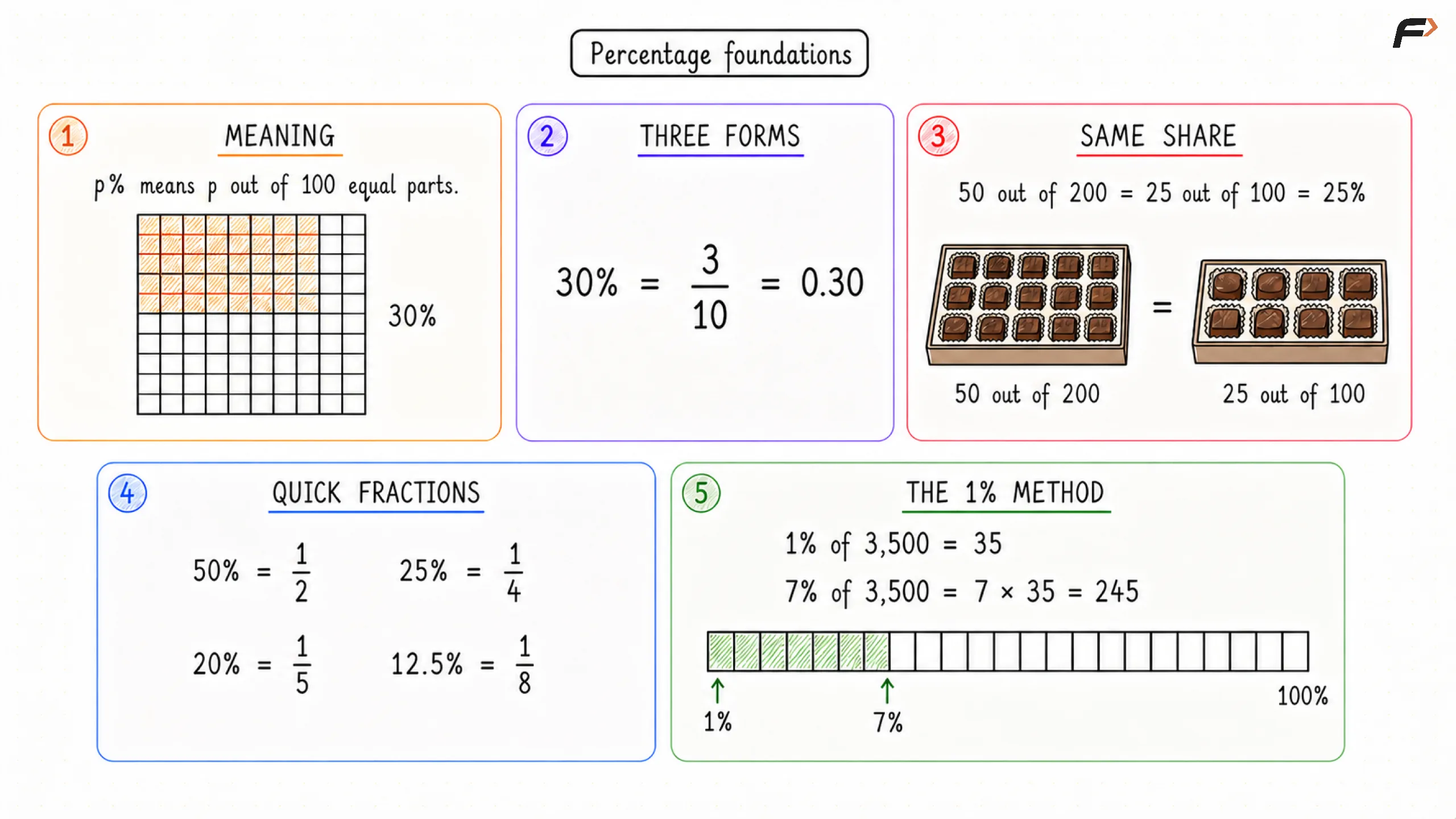
Percentage foundations: meaning, common fractions and the 1% method
Basics: What Does Percentage Mean?
The symbol % means “divided by 100.” Therefore:
For example:
All three forms describe the same share:
- 30% is the percentage form.
- is the fraction form.
- 0.30 is the decimal form.
Percentage is useful because it puts values of different sizes on the same scale of 100. A student who scores 40 out of 50 and a student who scores 80 out of 100 both score 80%. Their raw marks differ, but their share of the total is the same.
Percentage can be less than, equal to or greater than 100
- 0% means none of the whole.
- 50% means half of the whole.
- 100% means the complete whole.
- More than 100% means more than one whole. For example, 150% of 40 is 60.
Fractions, Decimals and Percentages
These three forms are closely connected. Learning to move between them makes later percentage ideas much easier.
Fraction to percentage
Multiply the fraction by 100%.
Small example: Convert to a percentage.
This says that 3 parts out of 5 are the same share as 60 parts out of 100.
Decimal to percentage
Multiply the decimal by 100 and add the percent sign.
Percentage to fraction or decimal
Divide the percentage number by 100. Then simplify if a fraction is needed.
Common values worth remembering
| Percentage | Fraction | Decimal |
|---|---|---|
These fraction forms are useful shortcuts. For example, finding 12.5% of a number is the same as dividing the number by 8.
Situation example: A drink contains 12.5% juice concentrate, and the total drink is 720 ml. How much concentrate is present?
What is given? The total is 720 ml, and the required part is 12.5% of it.
Why use the fraction shortcut? Since , we only need to divide 720 into 8 equal parts.
The drink contains 90 ml of concentrate. The remaining 630 ml is the other part of the drink.
The 1% method
If a percentage looks unfamiliar, first find 1%. Dividing a whole by 100 gives 1% of it. Then multiply that value by the required percentage.
Example: Find 7% of 3,500.
First find 1%:
Seven percent contains seven groups of 1%:
Therefore, 7% of 3,500 is 245. This method shows the meaning of the calculation instead of asking us to remember a separate trick.
Percentage of a number can be reversed
The value of of is the same as of because multiplication can be written in either order:
For example, 4% of 75 may not look immediate, but 75% of 4 is easy:
Use this only when it makes the numbers simpler. It changes the calculation order, not the meaning of the original situation.
Mixed-fraction percentages
A percentage may be written as a mixed fraction, such as . Convert it into an improper fraction before using it:
Situation example: A library issues 360 books, and are technical books.
Therefore, 80 of the issued books are technical books.
The Three Basic Percentage Relationships
Almost every basic percentage problem asks for one of three things:
- What percentage is the part?
- What is a given percentage of the whole?
- What was the whole when the part and percentage are known?
The three values are connected by one equation:
If we know any two values, we can find the third.
Finding What Percentage One Value Is of Another
Use this relationship when a part and its total are known and the percentage is missing.
The whole goes in the bottom because the part is being compared with the complete group.
Example: A library has 72 science books among 180 books. What percentage of the books are science books?
What we know: The science books are the part, so the part is 72. All books form the whole, so the whole is 180.
What is asked? We need to turn the share into a share out of 100.
Substitute the values:
Simplify before multiplying. Both 72 and 180 can be divided by 36:
Therefore, 40% of the books are science books. This does not mean there are 40 science books. It means science books occupy 40 out of every 100 equal parts of the collection.
Case 1: Marks
Example: Riya scores 390 marks out of 500. Find her percentage.
The marks obtained are the part, and the maximum marks are the whole.
Riya scored 78% of the available marks.
Case 2: A category inside a combined total
Example: A training report has 120 Java learners, 180 Python learners and 100 SQL learners. What percentage chose Python?
First find the whole group:
Python learners form the required part, which is 180.
So 45% of all listed learners chose Python. A common mistake is to divide by 180 or by only one of the other categories. The base must be the combined total of 400.
Finding a Given Percentage of a Quantity
Use this when the percentage and total are known, but the actual part is missing.
The words “of” and “from the total” often tell us to multiply.
Example: An aptitude test has 240 students. If 35% clear the first round, how many students clear it?
What is given? The whole group has 240 students. The clearing group is 35% of that whole.
Why multiply? The fraction tells us the share of the group that clears. Multiplying this share by 240 turns it into an actual number of students.
Cancel 20 from 240 with 100, or multiply directly:
Therefore, 84 students clear the round. The answer is a number of students, so it does not carry the percent sign.
Case 1: Monthly savings
Example: An employee earns Rs. 60,000 each month and saves 18%. Find the monthly savings.
The monthly income is the whole. Savings are the required 18% part.
The employee saves Rs. 10,800 each month. The amount spent would be the remaining 82%, not another 18%.
Case 2: Budget allocation
Example: A project budget is Rs. 2,40,000, and 35% is kept for software tools.
Rs. 84,000 is the software part of the full project budget.
Finding the Whole from a Known Part
Sometimes a part and its percentage are known while the whole is missing.
Start with:
To undo multiplication by , divide by it:
Example: 84 students are 35% of a group. Find the total group size.
What is given? The known part is 84, and it represents 35% of the whole group.
Write the relationship:
Move the fraction to the other side by dividing:
The original group contains 240 students. A quick check is 35% of 240, which returns 84.
Remaining Percentage and Complement
The complete whole is 100%. If one part is given, subtract it from 100% to find what remains.
Situation example: An employee spends 72% of a Rs. 75,000 income. How much is saved?
The money is divided into spent and saved parts. Together they must be 100%.
Now find 28% of the income:
The employee saves Rs. 21,000. We do not calculate 72% again because that is the amount spent.
Situation example: Out of 960 records, 25% are filtered out. How many remain?
If 25% are removed, remain.
The same answer can be found by removing of 960, which is 240, from 960.
Percentage Increase
A percentage increase compares how much a value grew with the value from which it started.
First find the actual increase:
Then compare it with the original value:
The original value is the base because the change began from there.
Example: An index rises from 800 to 920. Find the percentage increase.
What is given? The starting value is 800 and the ending value is 920.
First find how much was added:
Now compare this increase with the starting 800:
The index increased by 15%. Dividing by 920 would measure the change against the final value, which is not the starting base.
Case 1: Plant growth
Example: A plant grows from 40 cm to 50 cm. The increase is cm.
The plant grew by 25% of its original height. The actual growth is 10 cm, while the relative growth is 25%.
Percentage Decrease
A percentage decrease compares the amount lost with the original value.
Example: A pending queue falls from 900 tasks to 765 tasks. Find the percentage decrease.
The queue loses:
The loss started from a queue of 900, so 900 is the base:
The queue decreased by 15%. The final queue is 85% of the original because .
Case 1: Population fall
Example: A town's population falls from 80,000 to 68,000.
The town lost 15% of its starting population.
Finding the New Value After an Increase or Decrease
An increase of means the new value contains the original 100% plus another .
A decrease of leaves of the original.
The fraction or is called a multiplier. It tells us what share remains after the change.
Situation example: Population growth
A town has 50,000 residents and grows by 12%.
Method 1 is to find the increase first:
Method 2 uses the multiplier. After a 12% increase, the new population is 112% of the old population:
Both methods say the new population is 56,000.
Situation example: A 6.25% decrease
A population of 64,000 decreases by . Since , the amount lost is:
Reverse Percentage: Finding the Original Value
Reverse percentage starts with the value after a change and works backward to the value before the change. Do not subtract the given percentage directly from the final value. The percentage was based on the unknown original value.
After a increase:
Therefore:
After a decrease:
Case 1: Undoing an increase
Example: A user count becomes 960 after a 20% increase. Find the original user count.
What is given? The final value is 960. A 20% increase means the final value is 120% of the original.
Write 120% as a multiplier:
Undo the multiplication:
The original user count was 800. Check it by adding 20% of 800, which is 160. This gives .
Case 2: Undoing a decrease
Example: A candidate list becomes 680 after a 15% reduction. Find the original size.
A 15% reduction leaves 85% of the original.
The original list had 800 candidates. The reduction was 15% of 800, or 120, leaving 680.
Case 3: Original price before discount
Example: A jacket sells for Rs. 1,200 after a 20% discount. The selling price is the remaining 80% of the original price.
The discount was 20% of Rs. 1,500, which is Rs. 300. Subtracting it gives the Rs. 1,200 selling price.
Successive Percentage Changes
Successive means one change happens after another. The second percentage always acts on the result of the first change, not on the original value.
Example: A score of 500 first increases by 20% and then decreases by 10%.
After a 20% increase, 120% remains:
Now the 10% decrease is based on 600. A 10% decrease leaves 90%:
The final score is 540. Compared with the original 500, this is an increase of 40, or 8%.
We can combine the multipliers:
The factor 1.08 means the final value is 108% of the original.
Equal increase and decrease do not cancel
Suppose 100 increases by 20% and then decreases by 20%.
The final value is 96, not 100. The increase added 20, but the decrease removed 24 because it acted on the larger value 120.
An increase followed by an decrease gives an overall decrease of:
For , the loss is .
A decrease followed by the correct increase
A value of 960 increases by 12.5%, becoming 1,080. It then decreases by . Since , the decrease leaves :
These percentages undo each other because their multipliers, and , are opposites. The same percentage increase and decrease usually do not undo each other.
One Percentage of Another Percentage
In a multi-stage change, each new percentage uses the group left by the earlier stage.
Example: There are 800 applicants. 40% clear Round 1, and 25% of those are shortlisted. How many are shortlisted?
What is the important phrase? “Of those” means the 25% applies only to the people who cleared Round 1, not to all 800 applicants.
First find the Round 1 group:
Now find 25% of these 320 people:
Therefore, 80 applicants are shortlisted.
The two steps can also be joined:
Since , the final group is 10% of all applicants.
“More Than” and “Less Than”: Choose the Correct Base
The wording after “than” normally tells us the comparison base.
Example: Factory A makes 800 units and Factory B makes 1,000 units. By what percentage is A's output lower than B's output?
The difference is:
The phrase “lower than B” makes B's 1,000 units the comparison base:
Factory A produced 20% fewer units than Factory B.
To measure how much greater B's output is than A's, the base would be A's 800 units:
So A is 20% less than B, but B is 25% more than A. The statements look opposite, but their bases are different.
Percentage Points and Percent Change
Percentage points measure the direct gap between two percentages. Percent change compares that gap with the starting percentage.
Example: An error rate falls from 18% to 12%.
The direct gap is:
To find the percent decrease, compare that gap with the starting 18%:
Therefore, the rate fell by 6 percentage points, which is a decrease relative to its starting rate. These are two different measurements of the same change.
Case 1: Absentee rate
Example: An absentee rate falls from 20% to 15%. The direct drop is 5 percentage points.
The absentee rate decreased by 25%, not by 5%. It decreased by 5 percentage points.
Percentage Error
Percentage error tells us how large a measurement mistake is compared with the correct value.
First find the absolute error. “Absolute” means we care only about the size of the difference, so we ignore a negative sign.
Example: A measured length is 198 cm, while the actual length is 200 cm.
The measurement is 2 cm away from the true value:
The actual value is the correct base:
The measurement has a 1% error. Saying only “2 cm error” gives the actual gap, while 1% shows how large that gap is compared with the real length.
Situation-Based Percentage Examples
The formulas stay the same across different stories. The main task is to identify the part, whole and base.
Shopping price after a discount
A bag has a marked price of Rs. 2,000 and a shop gives a 15% discount. Find the selling price.
The discount is the amount removed:
Subtract it from the marked price:
The multiplier method gives the same result. A 15% discount leaves 85%, so .
Price after tax
A phone costs Rs. 20,000 before an 18% tax. Find the amount paid.
Tax is an increase, so the customer pays 118% of the original price:
The extra Rs. 3,600 is tax. The full Rs. 23,600 is the final bill.
Attendance when absentees are given
A class has 300 students, and 24 are absent. Find the attendance percentage.
Attendance counts present students, so first find how many are present:
Now compare present students with all students:
The attendance is 92%. The absent percentage is the remaining 8%.
Election votes and winning margin
Two candidates receive 56% and 44% of 25,000 valid votes. Find the winning margin.
The gap between their vote shares is:
This 12-point gap applies directly to all valid votes:
The winner receives 3,000 more votes than the other candidate.
A percentage-point lead
If a winner leads by 12 percentage points among 30,000 valid votes, the vote margin is:
A 12-point lead is the direct difference between vote shares. It is not a 12% increase over the runner-up's votes.
Sugar in a food sample
A 500 g sample contains 18% sugar.
The sample contains 90 g of sugar. The other ingredients weigh g.
Stock used and then added
A container begins with 800 litres. First, 15% is used. Then 50 litres are added.
Find the amount used:
Subtract it from the starting quantity:
Now add the fixed 50 litres:
The final quantity is 730 litres. The added 50 litres is a fixed amount, not a percentage, so it is added only after the percentage step.
Work completion report
A course has 320 assigned lessons, and 96 are complete. The completed lessons are the part and all assigned lessons are the whole.
The course is 30% complete, so 70% remains. In actual lesson counts, lessons remain.
A Reliable Step-by-Step Method
Use these steps whenever several percentage values are connected:
- Find the whole or base. Ask, “100% of what?”
- Find the part or change. Mark the number being discussed.
- Translate the wording. “Of” usually means multiply. “What percent” means part divided by whole. “After a reduction” often means reverse percentage.
- Use the original value for percentage change. The change started from that value.
- For repeated changes, work in order. The second percentage uses the new value.
- Keep percentage points separate. Subtract percentages for a point gap; divide by the starting percentage for relative change.
- Write the answer with the correct unit. Use
%for a percentage, people for people, Rs. for money and ml or g for quantities. - Check if the answer makes sense. A 20% part must be smaller than the whole. A value after a 15% decrease must be 85% of its start.
Common Mistakes and Why They Happen
Dividing by the final value during percentage change
An increase from 800 to 920 began at 800. The correct base is 800, not 920.
Treating a percentage as an actual quantity
35% is a share, not 35 students. We need the total before we can turn it into a student count.
Using the original value for every successive change
After the first change, the base changes. A later percentage acts on the new value.
Subtracting a percentage directly from the final value in reverse percentage
If Rs. 1,200 is left after a 20% discount, Rs. 1,200 is 80% of the original. Divide by 80%, rather than adding 20% of Rs. 1,200.
Confusing percent with percentage points
A rate falling from 20% to 15% drops by 5 percentage points but by 25% of its starting rate.
Choosing the wrong comparison base
For “A is less than B,” compare the difference with B. For “B is more than A,” compare it with A.
Forgetting to build the total
If categories are listed separately, add every category before finding one category's share of all categories.
Formulas and Cheat Sheet
| Situation | Formula or rule |
|---|---|
| Meaning of | |
| Find percentage | |
| Find a part | |
| Find the whole | |
| Remaining percentage | |
| Percentage increase | |
| Percentage decrease | |
| New value after increase | |
| New value after decrease | |
| Original before increase | |
| Original before decrease | |
| Successive changes | Multiply their separate multipliers |
| Equal rise and fall | Overall loss |
| Percentage-point gap | Subtract the two percentage values |
| Percentage error |
The heart of percentage is the base. Find what represents 100%, then decide whether you need a part, a percentage or the full value. For changes, use the original value as the base. For repeated changes, move one step at a time because every step creates a new base.
Safe Shortcuts
- Use of of when swapping the numbers makes the arithmetic easier. Both expressions equal .
- Replace an increase of by the multiplier , and a decrease by . This is useful for repeated changes and reverse percentage.
- To reverse a changed value, divide by the multiplier instead of subtracting the percentage. For example, divide by 1.2 to undo a 20 percent increase.
- For successive changes of and , the net percentage change is when increases are positive and decreases are written as negative.
- An increase and equal decrease of gives a net loss of percent. This works because the decrease uses the larger new base.
- Percentage-point change is final percentage minus initial percentage. Use percent change when the change is compared with the original percentage.
Each shortcut depends on choosing the correct base value. Use it only after deciding what represents the original 100 percent.
Frequently Asked Questions
What is percentage in simple words?
Percentage means a number of parts out of 100 equal parts. For example, 40% means 40 out of every 100, which is the same as or .
What is the basic percentage formula?
Use the value being discussed as the part and the complete group as the whole.
How do I find a percentage of a number?
Divide the percentage by 100 and multiply by the number. For example, 30% of 200 is .
How do I find the original value before a percentage increase?
If the final value comes after a increase, divide the final value by . This is the same as multiplying it by .
How do I find the original price before a discount?
Subtract the discount from 100% to find the remaining percentage. Divide the selling price by that remaining percentage. After a 20% discount, the selling price is 80% of the original.
Why do we divide percentage change by the original value?
The original value is the starting base from which the change happened. Percentage change tells us how large the change is compared with that start.
Do equal percentage increases and decreases cancel?
No. The second change uses a different base. A 20% increase followed by a 20% decrease leaves 96% of the original value, which is a 4% loss.
What is the difference between percentage and percentage points?
Percentage points are the direct gap between two percentages. A move from 20% to 15% is a drop of 5 percentage points. Compared with the starting 20%, it is a 25% decrease.
How do I know which number goes in the denominator?
Ask what value the part or change is being compared with. For a part of a whole, use the whole. For percentage change, use the original value. For “less than B,” use B as the comparison base.
What is a quick way to calculate common percentages?
Use familiar fractions. Find 50% by halving, 25% by dividing by 4, 20% by dividing by 5, 10% by dividing by 10 and 12.5% by dividing by 8.