Mensuration: Formulas, Concepts and Solved Examples
Mensuration is the part of mathematics that measures shapes. For a flat shape, we may measure its boundary or the space inside it. For a solid object, we may measure its outer surface or the space it can hold. The main decision is to identify exactly which part of the shape must be measured.
Think about a rectangular room. Skirting around its edge uses the perimeter, carpeting its floor uses the area, painting its walls uses surface area, and finding how much air it contains uses volume. The same room needs different formulas because each task measures a different thing.
The safest starting point is to draw the shape, label every length, and make all units the same. We can then move from lengths and flat shapes to boxes, tanks, cylinders, cones, hollow objects, combined regions and changing dimensions.
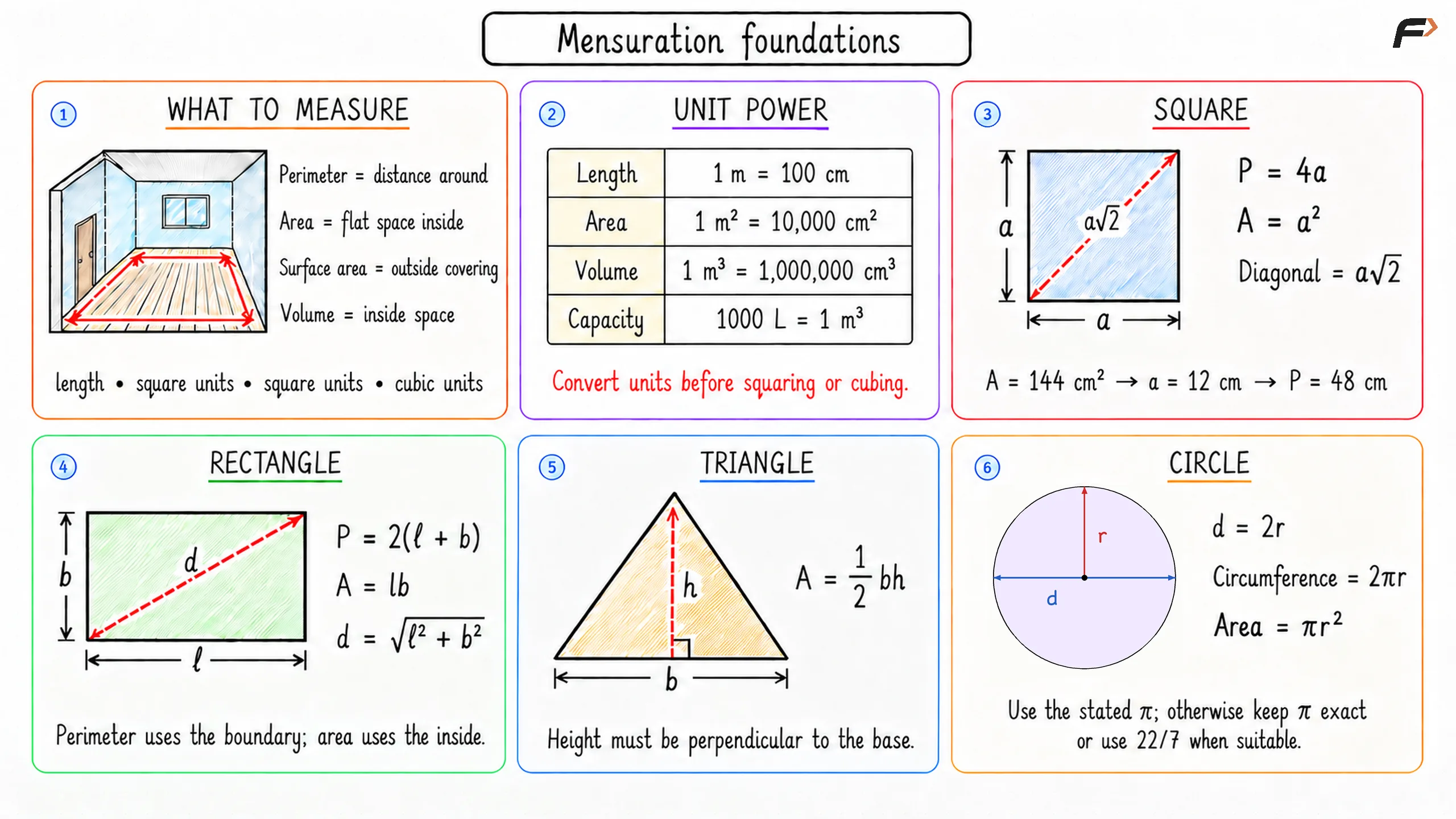
Mensuration foundations, units and basic shapes
Basics: Length, Perimeter, Area and Volume
Length measures distance from one point to another. It uses ordinary units such as centimetres, metres and kilometres.
Perimeter is the total distance around a flat shape. Imagine walking once around the boundary. Perimeter also uses ordinary length units.
Area measures the flat space covered by a shape. It uses square units because we count small unit squares. A rectangle that is 4 cm by 3 cm contains squares of size , so its area is .
Volume measures the three-dimensional space inside a solid. It uses cubic units because we count unit cubes. A box that is 4 cm long, 3 cm broad and 2 cm high contains unit cubes, so its volume is .
Surface area measures the total area of the outside faces of a solid. It uses square units, not cubic units.
Unit Conversion Without Mistakes
Make all measurements use the same unit before applying a formula.
For area, the conversion factor is squared:
For volume, it is cubed:
Capacity is the amount a container can hold:
Land area is often measured in hectares:
Never use . The factor 100 is for length, while area needs .
Square
A square has four equal sides and four right angles. If each side is :
The area is because the square has rows and columns of unit squares.
Example: A square has area . Find its perimeter.
We know the area, but perimeter needs the side. Start with:
The positive side length is:
Now add its four equal sides:
The answer uses centimetres because perimeter is a length.
Rectangle
A rectangle has opposite sides equal and four right angles. If its length is and breadth is :
The perimeter contains two lengths and two breadths. The diagonal formula comes from Pythagoras because the diagonal makes a right triangle with the sides.
Finding dimensions from perimeter and difference
Example: The difference between a rectangle's length and breadth is 15 m, and its perimeter is 150 m. Find its area.
Let the dimensions be and :
The perimeter gives:
Add the two equations. The terms cancel:
Then . Therefore:
Diagonal and area given together
Example: A rectangle has diagonal 13 cm and area . Find its perimeter.
Pythagoras gives:
Area gives . Perimeter needs , so use:
Lengths are positive, so . Therefore:
We found the needed sum without separately finding and .
Triangle and Circle Foundations
These shapes are not the main focus of the scripts, but they are needed to understand cones and cylinders.
For a triangle with base and perpendicular height :
A circle is described by its radius , which goes from its centre to its edge. The diameter crosses the full circle through the centre:
Its boundary length is the circumference:
Its area is:
Use the stated value of . If none is stated, leave an exact answer in terms of , or use when the numbers are multiples of 7.
Fencing and Boundaries
Fencing measures a boundary, so it uses length, not area.
Example: A rectangular field has area . One 20 ft side is left open, and the other three sides are fenced. Find the fencing length.
The open side is 20 ft. Use the area to find the other dimension:
The fence covers the opposite 20 ft side and two 40 ft sides:
Do not use the full perimeter because one side is not fenced.
Cost per metre
If a full boundary costs Rs. 3,300 at Rs. 15 per metre, first find the boundary length:
Then use the shape conditions to find its dimensions. Cost per metre belongs with perimeter, while cost per square metre belongs with area.
Percentage Change in Area
A rectangle's area depends on both length and breadth. When both dimensions change, their percentage factors multiply.
Example: Length increases by 10% and breadth increases by 20%. Find the percentage increase in area.
Let the original dimensions be and . The original area is .
A 10% increase leaves 110% of the length, or . A 20% increase gives .
The new area is 132% of the old area. Therefore, the increase is:
Adding 10% and 20% gives only 30%. The extra 2% comes because the 20% breadth increase also acts on the new 10% length increase.
Decreases in both dimensions
If length falls by 20% and breadth falls by 10%, their new factors are 0.80 and 0.90:
Only 72% remains, so the area decreases by 28%.
Measurement error in a square
If a square's side is measured 3% too large, take the true side as 100 and the measured side as 103.
The extra area is 609, so the percentage error is:
Area depends on the square of the side, so its percentage error is larger than the side error.
Paths, Diagonals and Distance Saved
The diagonal is the shortest straight path between opposite corners of a rectangle.
For a square of side , walking along two edges takes . Walking diagonally takes .
Compare the saving with the original edge path:
The common cancels:
Thus, the diagonal saves about 30% of the edge route.
Largest Square Tiles and the HCF
To cover a rectangular floor with the least number of equal square tiles and no cutting, use the largest square tile that exactly divides both floor dimensions. Its side is the highest common factor, or HCF, of those dimensions.
Example: A room is 10 m 50 cm by 4 m 50 cm. Find the least number of square tiles.
Convert both dimensions to centimetres:
The HCF of 1050 and 450 is 150. A tile is the largest that fits both directions.
A smaller tile would fit but would require more pieces, so it would not give the least number.
Roads Crossing Through a Rectangular Park
Two roads through the middle form a plus sign. Add the two road rectangles, then subtract their central overlap because it was counted twice.
Example: A park is 80 m by 60 m. Two roads of equal width cross through its middle. The remaining lawn is . Find the width.
The whole park area is:
Therefore, road area is:
The lengthwise road has area , and the breadthwise road has area . Their overlap is a square of area :
Factorise:
The two algebraic answers are 5 and 135. A 135 m road cannot fit inside a park only 60 m wide, so reject it. The road width is 5 m.
If only the paving cost is needed and the road area is already known, there is no need to find the width. Multiply the known road area by cost per square metre.
Cuboid and Cube
A cuboid is a box with length , breadth and height .
A cube is a cuboid whose three dimensions are equal to side :
Example: A cube has edge 4 cm. Its volume is:
The cubic unit shows that this is inside space, not surface area.
Open Boxes, Tanks and Wet Surfaces
An open tank has no top surface. Its inner area includes the bottom and four walls:
This can also be written as .
Example: A cistern is 8 m long, 6 m wide and contains water 2 m deep. Find the wet surface area.
Water touches the bottom:
It touches two long walls up to the 2 m water depth:
It touches two short walls:
Therefore:
Use water depth, not the full tank height, because the dry part is not touched by water.
Sheet folded into an open box
If squares of side are cut from all four corners of an by sheet, the folded box has:
For a 60 m by 40 m sheet with 10 m corner squares:
The corner size is removed twice from each original dimension, once at each end.
Floor, Ceiling and Four Walls of a Room
The floor and ceiling each have area , so together they cover . The four walls cover .
Example: A hall is 24 m long and 16 m broad. The combined floor and ceiling area equals the four-wall area. Find its volume.
Let the height be . Floor and ceiling area is:
Four-wall area is:
The areas are equal:
Now use all three dimensions for volume:
Capacity and Wall Thickness
External dimensions include the solid walls and bottom. Capacity gives only the empty space inside. For side walls of thickness :
An open cistern has no top thickness, so outside height minus inside height gives only the bottom thickness.
Example: An open cistern has capacity 16,000 litres. Its outside dimensions are 3.4 m by 2.7 m by 2.2 m, and its side walls are 10 cm thick. Find the bottom thickness.
Convert units:
Inside dimensions across the side walls are:
Let inside height be :
Therefore, bottom thickness is:
Rainfall and Water-Level Rise
A uniform layer of rain behaves like a very shallow cuboid:
Example: Rainfall of 2 cm falls on 2 hectares. Find the water volume.
Convert both measurements to metres:
Displacement
An object placed in water pushes aside, or displaces, an equal volume of water. That extra volume spreads across the tank's base.
If 50 people each displace , total displacement is:
For a tank base of 50 m by 20 m, the rise satisfies:
The tank's original water depth is not needed when only the rise is asked.
Cylinder
A cylinder has two equal circular bases and one curved side. If radius is and height is :
The curved surface can be imagined as a rectangle unwrapped from a can. Its length is the circle's circumference , and its breadth is the cylinder height . Therefore, its area is .
Using two cylinder measurements together
Example: A cylindrical pillar has curved area and volume . Find diameter to height ratio.
Divide volume by curved area. Common factors cancel:
Use the curved area with :
Diameter is , so:
If radius stays fixed and height doubles, shows that volume also doubles.
Hollow Cylinder and Pipe
A pipe has an outer cylinder of radius and an empty inner cylinder of radius . The material volume is:
If thickness is , then . Do not subtract thickness from the diameter only once. Thickness lies on both sides of the opening, but using radii makes the relation simply .
Example: An iron pipe is 14 cm long, external diameter 10 cm, and thickness 2 cm. Iron weighs 5 g per cubic centimetre. Find its weight.
Outer radius is cm. Inner radius is cm.
Using :
Density tells us the weight of one unit of volume. Multiply volume by 5 g per cubic centimetre:
If a cost per kilogram is also given, multiply the kilogram weight by that rate.
Cone
A cone has a circular base, a vertical height , radius , and slant height . These three lengths make a right triangle:
The main formulas are:
Total surface area adds the curved surface and circular base .
Example: A cone has height 12 m and slant height 13 m. Find its curved surface area.
First find the missing radius:
Now:
The answer is a surface, so it uses square metres.
Cone made by rotating a right triangle
If a right triangle is rotated around one shorter side, that fixed side becomes the cone's height. The other shorter side sweeps out the circular base and becomes the radius. The hypotenuse sweeps out the curved surface and becomes the slant height.
For a triangle rotated about its 9 cm side:
Volume Stays Constant When Material Is Reshaped
Melting, stretching or recasting changes the shape but not the amount of material when no material is lost. Therefore:
Silver drawn into a wire
A wire is a thin cylinder. Suppose of silver is made into wire of diameter 2 mm.
Radius is 1 mm, which is 0.1 cm. Let length be centimetres:
Using :
The radius had to be converted to centimetres because the volume was in cubic centimetres.
Several cubes melted into one cube
Suppose cubes of sides 3 cm, 4 cm and 5 cm are melted into one large cube.
The new volume is the sum of the old volumes:
If the new side is :
The combined old surface area is:
The new surface area is:
Their ratio is:
Volume stays constant, but surface area usually does not. Separate small objects expose more total surface than one larger object made from the same material.
Number of Bricks in a Wall
Treat the wall as one large cuboid and each brick as one small cuboid:
Example: A wall measures 8 m by 4 m by 20 cm. Each brick measures 20 cm by 10 cm by 8 cm. Find the number of bricks, ignoring mortar.
Convert the wall dimensions to centimetres:
If 10% of wall volume is occupied by mortar, doors or other space, bricks occupy only 90%. Multiply the wall volume by 0.90 before dividing.
Plastering, Painting and Cost
First decide which surfaces are covered. Then find that area and multiply by the cost per square unit.
For an open rectangular tank, walls plus bottom area is:
Example: A tank is 30 m long, 15 m wide and 8 m deep. Find the cost of plastering the bottom and four walls at Rs. 0.80 per square metre.
Bottom area:
Four walls:
Total area:
Cost:
If 10% of only the wall area is left unplastered, take 90% of the wall area and then add the full bottom. Reduce the bottom only when part of it is also excluded.
A Step-by-Step Mensuration Method
- Identify whether the object is flat or solid.
- Mark what is requested: boundary, area, surface area, capacity or volume.
- Draw and label the shape. For a tank or hollow object, separate inside and outside dimensions.
- Convert every measurement to one unit before multiplying.
- List the exact surfaces or regions included. Remove open tops, windows, lawns and overlaps when needed.
- Choose the formula and explain what every symbol means.
- Calculate in small steps and keep the unit attached.
- If material is reshaped, equate volumes, not surface areas.
- Apply percentage, density or cost only after finding the correct base measurement.
- Check whether the final unit matches the required measurement.
Common Mistakes
- Using ordinary units for area or square units for volume.
- Converting metres to centimetres but forgetting to square or cube the conversion factor.
- Using diameter as radius.
- Counting an open top in tank surface area.
- Using full tank height instead of water depth for a wet surface.
- Fencing all four sides when one side is left open.
- Adding percentage changes in length and breadth instead of multiplying their factors.
- Counting the central square of crossing roads twice.
- Subtracting wall thickness only once from an outside length.
- Using outer volume for the capacity of a thick-walled cistern.
- Using the full cylinder instead of subtracting the hollow inner cylinder.
- Mixing grams and kilograms before applying density or cost.
- Assuming surface area stays constant when objects are melted together.
- Ignoring the part of a wall occupied by mortar, doors or windows.
- Finding an intermediate side or road width and forgetting the final measurement that is required.
Formulas and Cheat Sheet
| Shape or idea | Formula or rule |
|---|---|
| Square perimeter | |
| Square area | |
| Square diagonal | |
| Rectangle perimeter | |
| Rectangle area | |
| Rectangle diagonal | |
| Triangle area | |
| Circle circumference | |
| Circle area | |
| Cuboid volume | |
| Cuboid total surface area | |
| Four walls of cuboid | |
| Cube volume | |
| Cube surface area | |
| Cylinder volume | |
| Cylinder curved area | |
| Cylinder total area | |
| Hollow cylinder volume | |
| Cone slant relation | |
| Cone volume | |
| Cone curved area | |
| Cone total area | |
| Capacity conversion | |
| Reshaping material | Volume before = volume after |
| Density or unit weight | Weight = volume weight per unit volume |
| Crossing roads |
Mensuration becomes manageable when the measurement is named before the formula. Ask whether the problem is about an edge, a flat region, an outer covering or inside space. Then make the units agree, include only the required parts, and attach the correct final unit.
Safe Shortcuts
- Write as soon as a circle gives diameter instead of radius. Most circle, cylinder and cone formulas require the radius.
- If every length is multiplied by , perimeter is multiplied by , area by , and volume by . This is safe only for similar shapes.
- For a uniform path or border, use outer area minus inner area. Decide first whether the stated width lies inside, outside or on both sides.
- The area of the four walls of a rectangular room is perimeter of floor height, or . Add the ceiling or floor only when it is included in the required surface.
- When one solid is melted and reshaped without loss, equate the volumes. Surface areas do not normally stay equal.
- Convert length units before squaring or cubing. A conversion factor of 100 in length becomes in area and in volume.
These shortcuts are safe only after the correct shape, required surface and units are identified. They shorten repeated calculation but cannot repair a wrong diagram or wrong dimension.
Frequently Asked Questions
What is the difference between perimeter and area?
Perimeter is the distance around a flat shape and uses length units. Area is the flat space inside the boundary and uses square units.
What is the difference between surface area and volume?
Surface area measures the outside covering of a solid, so it uses square units. Volume measures the space inside the solid, so it uses cubic units.
Why are area units squared and volume units cubed?
Area multiplies two lengths, such as length and breadth. Volume multiplies three lengths, such as length, breadth and height.
How do I know whether to use perimeter or area in a cost question?
Look at the rate. Cost per metre means a boundary job such as fencing. Cost per square metre means covering a surface, such as painting, paving or plastering.
How many litres are in one cubic metre?
One cubic metre contains 1,000 litres. Therefore, divide litres by 1,000 to convert capacity to cubic metres.
What does curved surface area mean?
It means only the bent side of a solid. It does not include the circular base or bases. Total surface area includes every closed outer surface.
Why is the overlap subtracted for crossing roads?
Adding the two road rectangles counts the centre square once as part of each road. Subtracting it once leaves that region counted exactly one time.
Why does volume stay constant during melting?
Melting changes the shape but not the amount of material when there is no loss. The before and after volumes are therefore equal.
How is the inner radius of a pipe found?
Subtract wall thickness from the outer radius. If the external diameter is 10 cm and thickness is 2 cm, the outer radius is 5 cm and inner radius is 3 cm.
How do I find the least number of square tiles?
Use the HCF of the floor's length and breadth as the largest possible tile side. Then multiply the number of tiles that fit along each direction.