Cube and Cuboid: Complete Beginner Guide with Easy Examples
A cube and a cuboid are solid shapes. A solid shape has length, breadth and height, so it takes up space.
A dice is shaped like a cube. A brick, room, carton or book is usually shaped like a cuboid.
The two shapes are closely related. A cube is a special cuboid in which length, breadth and height are all equal.
This article begins with faces, edges and vertices. It then builds through surface area, volume, diagonals, open boxes, painting, cutting, painted small cubes, recasting, cavities and packing.
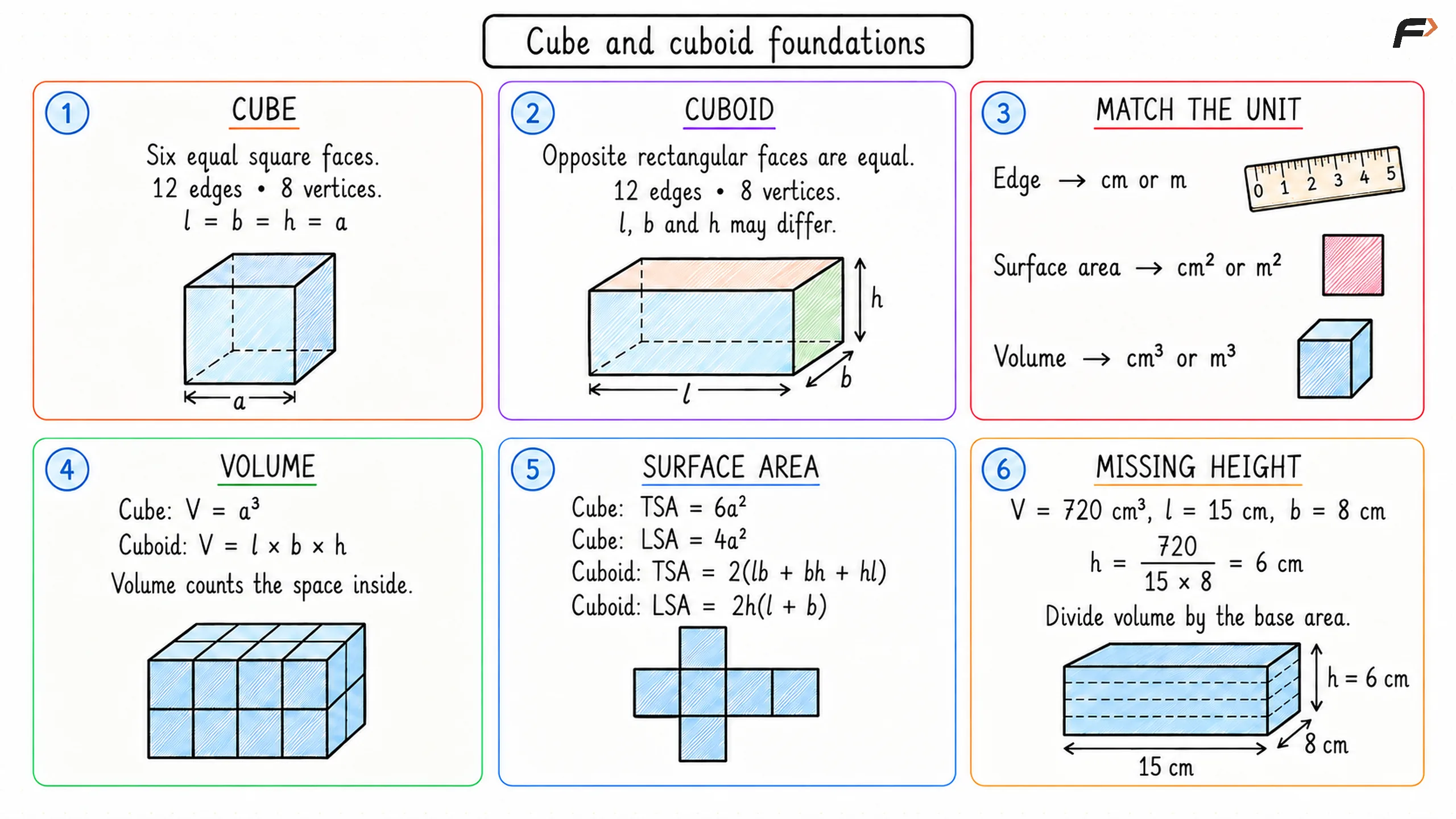
Cube and cuboid foundations, dimensions, faces, edges and vertices
Basics: Face, Edge and Vertex
A face is a flat surface of a solid.
An edge is a line where two faces meet.
A vertex is a corner where three edges meet. The plural of vertex is vertices.
Both a cube and a cuboid have:
- faces
- edges
- vertices
The difference is in their dimensions.
Cube
Every face is an equal square. Every edge has the same length, usually called .
Cuboid
Every face is a rectangle. Opposite faces are equal. Its length , breadth and height may be different.
Length, Area and Volume Units
The unit tells us what kind of measurement we have.
- An edge uses a length unit, such as cm or m.
- A surface uses a square unit, such as or .
- Space inside a solid uses a cubic unit, such as or .
Why does area use a square unit? A rectangle uses two directions:
Why does volume use a cubic unit? A solid uses three directions:
Writing for a volume is wrong even if the number is correct.
Volume of a Cube
A cube has equal length, breadth and height. Therefore:
Example: Find the volume of a cube with edge cm.
Solution:
- Base area:
- Multiply by height:
The same calculation is:
Answer:
Meaning: The cube can contain unit cubes of size .
Finding a Cube Edge from Volume
If , then the edge is the cube root of the volume:
Example: A cube has volume . Find its edge.
Solution:
We need a number that gives when multiplied by itself three times:
Therefore:
Answer: cm
Meaning: A cube of edge cm has dimensions cm.
Total Surface Area of a Cube
Imagine cutting a cube along some edges and opening it flat. We see six equal square faces. Each face has area .
TSA means total surface area, which includes every outside face.
Example: Find the total surface area of a cube with edge cm.
Solution:
- Area of one face:
- Area of six faces:
Answer:
Meaning: Covering the entire cube without overlap needs square centimetres of material.
Lateral Surface Area of a Cube
The word lateral means side surfaces only. For a cube, this means four side faces. The top and bottom are left out.
Example: Only the four side faces of a cube with edge cm are painted. Find the painted area.
Solution:
One face area is:
Four faces have area:
Answer:
Meaning: The result measures the belt-like area around the cube.
Volume of a Cuboid
The base of a cuboid is a rectangle with area . Multiplying by height gives volume:
Example: Find the volume of a cuboid with length cm, breadth cm and height cm.
Solution:
- Base area:
- Stack such unit-height layers:
Answer:
Meaning: The cuboid can hold one-cubic-centimetre blocks.
Finding a Missing Cuboid Dimension
From , any missing dimension equals volume divided by the product of the other two.
Example: A cuboid has base cm by cm and volume . Find its height.
Solution:
Answer: cm
Meaning: Six layers of volume make the full .
Total Surface Area of a Cuboid
A cuboid has three pairs of equal opposite faces:
- Two faces of area
- Two faces of area
- Two faces of area
Therefore:
Example: Find the total surface area of a cuboid measuring cm by cm by cm.
Solution:
Add one of each type, then double:
Answer:
Meaning: This is the cardboard area needed for a completely closed box, before allowing extra material for joining.
Lateral Surface Area of a Cuboid
The four side walls contain two faces and two faces.
Another way to understand it is:
Example: Four walls of a room measure m by m by m. Find the wall area, excluding floor and ceiling.
Solution:
Answer:
Meaning: This is the paintable area of the four walls before subtracting doors and windows.
Open-Top Cuboid
An open-top box has no top face. It includes the bottom and four side faces.
Example: Find the material area of an open tray with cm, cm and cm.
Solution:
Bottom area:
Four wall area:
Total material:
Answer:
Meaning: The missing top saves exactly compared with a closed cuboid.
Wire Frame of a Cube or Cuboid
A frame uses edges, not faces. A cube has equal edges.
A cuboid has four edges of each dimension:
Example: A wire is bent into a cube frame of edge cm. Find the wire length.
Solution:
Answer: cm
Meaning: Four top edges, four bottom edges and four vertical edges together use cm of wire.
Face Diagonal and Body Diagonal
A face diagonal lies on one rectangular face. A body diagonal joins opposite vertices through the inside of the solid.
For a rectangle of sides and , Pythagoras gives:
For a cube:
For a cuboid:
Body Diagonal of a Cube
Example: Find the body diagonal of a cube with edge cm.
Solution:
Base diagonal:
Body diagonal:
Answer: cm
Meaning: The body diagonal is longer than an edge and a face diagonal because it crosses all three dimensions.
Body Diagonal of a Cuboid
Example: Find the body diagonal of a cuboid measuring cm by cm by cm.
Solution:
First find the base diagonal:
Then combine it with height:
Answer: cm
Meaning: The dimensions form two familiar right triangles, -- and --.
Dimensions Given in a Ratio
If , write dimensions as . The value is the common scale.
Example: A cuboid has dimension ratio and volume . Find its total surface area.
Solution:
Dimensions are:
Now:
Answer:
Meaning: The ratio gives relative dimensions, while the volume tells how large the cuboid really is.
Painting Cost
Painting cost is area multiplied by rate per square unit.
Example: A closed tank measures m by m by m. All outside faces are painted at ₹18 per . Find the cost.
Solution:
Answer: ₹7,668
Meaning: Every one of the square metres costs ₹18 to paint.
Cutting a Large Cube into Equal Small Cubes
If large edge is and small edge is , the number along one direction is . For a cube:
Example: A cube of edge cm is cut into cubes of edge cm. Find their number.
Solution:
Answer: small cubes
Meaning: There are six cubes in each row, six rows in each layer and six layers.
Painted Cube: Understanding Locations
Suppose a large cube is painted on all six faces and cut into equal parts along each edge.
Every small cube belongs to one of four location types:
- Corner cube: exactly painted faces
- Non-corner edge cube: exactly painted faces
- Face-middle cube: exactly painted face
- Inner cube: no painted face
For , there are always corner cubes.
Exactly Two Faces Painted in a Cube
Each of the edges has small cubes. The two corner cubes on an edge have three painted faces, so remove them.
Example: A painted cube is cut into parts along each edge. Find cubes with exactly two painted faces.
Solution:
Answer: cubes
Meaning: The corners are excluded because each corner has three painted faces.
Exactly One Face Painted in a Cube
On each large face, remove one row along every edge. The remaining middle square has cubes. There are six faces.
Example: A painted cube is cut into parts along each edge. Find cubes with exactly one painted face.
Solution:
One face contributes:
Six faces contribute:
Answer: cubes
Meaning: Each counted cube touches one outside face only, so it has exactly one painted face.
No Face Painted in a Cube
Remove one outer layer from every side. The inner cube has cubes along each direction.
Example: A painted cube is cut into parts along each edge. Find cubes with no painted face.
Solution:
Answer: cubes
Meaning: The unpainted centre is a cube.
Painted Cuboid Cut into Small Cubes
Let the cuboid contain , and small cubes along its three directions.
Exactly two faces painted:
Exactly one face painted:
No face painted:
These formulas assume all six outside faces are painted and the divisions make equal small cubes.
Exactly Two Painted Faces in a Cuboid
Example: A painted cuboid is divided into , and small-cube parts along its dimensions. Find cubes with exactly two painted faces.
Solution:
Edges along the direction contribute:
Edges along the direction contribute:
Edges along the direction contribute:
Total:
Answer: cubes
Meaning: The formula counts all edge-middle cubes but excludes all eight corners.
Exactly One Painted Face in a Cuboid
Example: A painted cuboid is divided into , and parts. Find cubes with exactly one painted face.
Solution:
Two faces:
Two faces:
Two faces:
Total:
Answer: cubes
Meaning: None of these cubes touches an edge, so every one has only its outward face painted.
At Least One Face Painted
“At least one” includes one, two or three painted faces. It is usually quickest to subtract the unpainted inner cubes from all cubes.
Example: A painted cuboid is divided into , and parts. Find cubes with at least one painted face.
Solution:
Total cubes:
Inner cubes:
At least one face painted:
Answer: cubes
Meaning: The count includes every small cube touching the outside surface in any way.
Probability with Painted Cubes
When one small cube is selected at random:
Example: A cube is painted and cut into parts along each edge. Find the probability of exactly two painted faces.
Solution:
Answer:
Meaning: Out of every equally sized groups of small cubes, the probability represents such groups.
Melting and Recasting Without Loss
When solids are melted and reshaped without losing material, total volume remains the same. Surface area usually changes, but volume does not.
Example: Cubes of edges cm, cm and cm are recast into one cube. Find its edge.
Solution:
Let new edge be :
Answer: cm
Meaning: The new cube has a different outside area, but it contains exactly the same total volume.
Recasting Cubes into a Cuboid
Example: Thirty cubes of edge cm are recast into a cuboid with base cm by cm. Find its height.
Solution:
Old volume:
New base area:
Height:
Answer: cm
Meaning: Eight layers of base area use the entire old volume.
Recasting with Material Loss
If loss is , usable volume is:
Example: Forty-eight cubes of edge cm are recast into a cuboid with base cm by cm. Ten percent volume is lost. Find height.
Solution:
Original volume:
Usable volume:
Base area:
Height:
Answer: cm
Meaning: The lost cannot appear in the new cuboid.
Joining Cubes Face to Face
When two cubes join, the touching face of each cube becomes hidden. One join hides two faces.
For cubes in one straight line, there are joins.
Example: Five cubes of edge cm are joined in a straight line. Find the outside surface area.
Solution:
One face area:
Outside area:
Answer:
Meaning: The four contacts hide exactly eight square faces from view.
Cutting a Cube from a Corner
Removing a smaller cube from a corner has a surprising surface-area result.
Example: A cube of side cm is removed from one corner of a cube of side cm. Find the new total surface area.
Solution:
Original area:
Removed area:
New exposed area:
Net change is zero.
Answer:
Meaning: Volume decreases, but surface area stays unchanged for this exact corner-cube cut.
Cutting a Cubical Cavity into One Face
A cavity opening removes one square from the old surface. A cube-shaped hollow creates five new faces inside: four walls and a bottom.
Example: A cubical cavity of side cm is cut into the middle of one face of a cube of side cm. Find the new surface area.
Solution:
Original area:
One small square area:
Net increase:
New area:
Answer:
Meaning: A hollow can increase surface area because it exposes new inside walls.
Largest Equal Cubes from a Cuboid
For the largest cube that divides a cuboid exactly, its edge must divide all three cuboid dimensions. Use their HCF.
HCF means highest common factor, the largest whole number that divides every given number exactly.
Example: Cut a cm cuboid into the largest equal cubes. Find unused volume.
Solution:
Counts along dimensions:
Total cubes:
Used volume:
Original volume:
Unused volume:
Answer:
Meaning: Choosing an HCF-sized cube makes every dimension divide exactly, so no space remains.
Packing Fixed-Size Complete Cubes
If cube size is fixed and does not divide a dimension, take only the whole-number part of each division. This is the floor value.
Example: Pack complete cubes of edge cm inside a cm cuboid. Find unused volume.
Solution:
Complete cube counts:
Total complete cubes:
Cuboid volume:
Used volume:
Unused volume:
Answer:
Meaning: Empty strips remain because does not divide or exactly.
Open Box Made from a Rectangular Sheet
If squares of side are cut from all four corners of an sheet, folding creates:
Therefore:
Example: A cm by cm sheet has cm squares removed from every corner. Find the open box volume.
Solution:
New length:
New breadth:
Height:
Volume:
Answer:
Meaning: The removed square side becomes the box height, while both sheet dimensions shrink by twice that side.
Common Mistakes
Confusing cube and cuboid
A cube has all equal dimensions. A cuboid may have three different dimensions.
Mixing square and cubic units
Surface area uses square units. Volume uses cubic units.
Using total surface area for four walls
Lateral area excludes top and bottom.
Counting a top face on an open box
List the faces physically present before using a formula.
Using face diagonal when body diagonal is required
Cube face diagonal is , while body diagonal is .
Counting painted corners as exactly two painted faces
Corner cubes have three painted faces when all six large faces are painted.
Counting edge cubes inside the exactly-one-face group
Exactly-one-face cubes must lie away from all edges.
Forgetting to remove two outer layers
The inner count uses , not , because there is an outer layer on both ends.
Using cube formulas for a divided cuboid
When direction counts differ, use formulas rather than replacing all with one .
Adding surface areas during recasting
Recasting preserves volume, not surface area.
Applying loss to the new dimensions instead of volume
First reduce the available volume by the loss percentage, then use the new-shape formula.
Counting joined faces as exposed
Every face-to-face join hides two faces.
Assuming every cut lowers surface area
A cut can expose new faces. Compare removed outside area with newly exposed inside area.
Using HCF when cube size is already fixed
HCF finds the largest exact cube size. For a fixed size, count complete cubes with whole-number division.
Subtracting the corner square only once from a sheet dimension
One square is cut from each end, so base length and breadth each lose .
Cheat Sheet
| Concept | Formula | Meaning or condition |
|---|---|---|
| Cube volume | Three equal dimensions | |
| Cube total surface area | All six faces | |
| Cube lateral area | Four side faces | |
| Cube face diagonal | Across one square face | |
| Cube body diagonal | Through the inside | |
| Cube frame length | All twelve edges | |
| Cuboid volume | Base area times height | |
| Cuboid total surface area | All six faces | |
| Cuboid lateral area | Four walls | |
| Open-top cuboid area | Bottom and four walls | |
| Cuboid body diagonal | Opposite vertices | |
| Cuboid frame length | Four edges of each dimension | |
| Small cubes from a cube | Exact division required | |
| Cube, three painted faces | All corners, for | |
| Cube, exactly two painted | Non-corner edge cubes | |
| Cube, exactly one painted | Face interiors | |
| Cube, no paint | Inner cube | |
| Cuboid, exactly two painted | Edge interiors | |
| Cuboid, exactly one painted | Face interiors | |
| Cuboid, no paint | Inner cuboid | |
| At least one painted | Total cubes inner cubes | Easier than separate addition |
| Recasting without loss | Old total volume new volume | Shape changes only |
| Recasting with loss | Usable volume | Apply loss to volume |
| Joined cubes exposed faces | is number of joins | |
| Largest exact cube edge | No unused volume | |
| Open box from sheet | Corner square side is |
Safe Shortcuts
- Draw or list the faces included before selecting a surface-area formula.
- Use square units for area and cubic units for volume.
- Think “base area times height” for any cuboid volume.
- For a body diagonal, square all three dimensions, add and take the square root.
- In painted cubes, first identify location: corner, edge, face middle or inside.
- “Exactly two painted” means edge but not corner.
- “Exactly one painted” means face middle but not edge.
- “No paint” means remove one outer layer from both ends of every dimension.
- For “at least one painted,” subtract inner cubes from total cubes.
- In recasting, write a volume-balance equation before calculating dimensions.
- Apply material loss to total old volume before equating it to new volume.
- Every face-to-face join hides two faces.
- A corner cube cut removes and exposes three equal faces, so surface area stays unchanged.
- Use HCF only for the largest cube that divides all dimensions exactly.
- For a folded open box, subtract from both sheet dimensions and use height .
A shortcut is safe only after the included faces, inside volume or small-cube location is clear. It should shorten correct reasoning, not replace the picture of the solid.
Frequently Asked Questions
What is the difference between a cube and a cuboid?
A cube has six equal square faces and equal dimensions. A cuboid has rectangular faces and may have different length, breadth and height.
How many faces, edges and vertices does a cube have?
A cube has faces, edges and vertices. A cuboid has the same counts.
What is the volume formula for a cube?
For edge , volume is .
What is the volume formula for a cuboid?
For length , breadth and height , volume is .
What is total surface area?
It is the combined area of every outside face of a closed solid.
What is lateral surface area?
It is the area of the side faces only. For a cuboid, it is the area of four walls without floor and ceiling.
What is the body diagonal of a cube?
It is the straight inside line between opposite vertices, with length .
What is the body diagonal of a cuboid?
It is .
How many small cubes have three painted faces?
When all faces are painted and , the eight corner cubes have three painted faces.
How many small cubes have exactly two painted faces?
For a cube divided into parts per edge, the count is .
How many small cubes have exactly one painted face?
For a cube, the count is .
How many small cubes have no painted face?
For a cube, the inner count is .
Why do painted-cube formulas use n minus 2?
One outside position is removed from each end of a direction, so two positions are removed in total.
What remains constant during melting and recasting?
Volume remains constant when there is no material loss. Surface area and dimensions can change.
How is recasting handled when material is lost?
Find original volume, keep only the percentage that remains, then equate usable volume to the new solid's volume.
Why does removing a cube from a corner not change surface area?
Three equal outside squares disappear and three equal inside cut squares appear, so the changes cancel.
How do I find the largest cube cut from a cuboid?
Find the HCF of length, breadth and height. That HCF is the largest exact cube edge.
How is an open box formed from a sheet?
Cut equal squares of side from four corners. The base becomes and height becomes .
Summary
A cube is a cuboid with all three dimensions equal. Both shapes have six faces, twelve edges and eight vertices. Surface area measures covering in square units, while volume measures inside space in cubic units.
Cube formulas follow from equal square faces and equal dimensions. Cuboid formulas come from three pairs of opposite rectangles. Body diagonals use Pythagoras across three perpendicular dimensions.
Painted-cube counting becomes simple when small cubes are grouped by location: corners, edge middles, face middles and the inner block. Recasting keeps volume when there is no loss. Joins hide faces, cavities expose new faces, HCF gives the largest exact cube size, and folded-sheet boxes lose twice the corner-cut size from each base dimension.