Compound Interest: Concepts, Formulas and Solved Examples
Compound interest is interest calculated on the original money and on the interest already added to it. The starting money is called the principal. The final money after interest is added is called the amount. The central idea is to find how much the money changes in one compounding period and how many such periods pass.
Suppose you invest ₹100 at 10% per year. After one year, the interest is ₹10, so the amount becomes ₹110. In the second year, 10% is calculated on ₹110, not on the original ₹100. The second year's interest is ₹11, and the amount becomes ₹121.
This guide starts with that year-by-year growth. It then builds towards annual, half-yearly and quarterly compounding, missing values, depreciation, changing rates, fractional years, deposits, withdrawals, comparisons, effective annual rate and aptitude shortcuts.
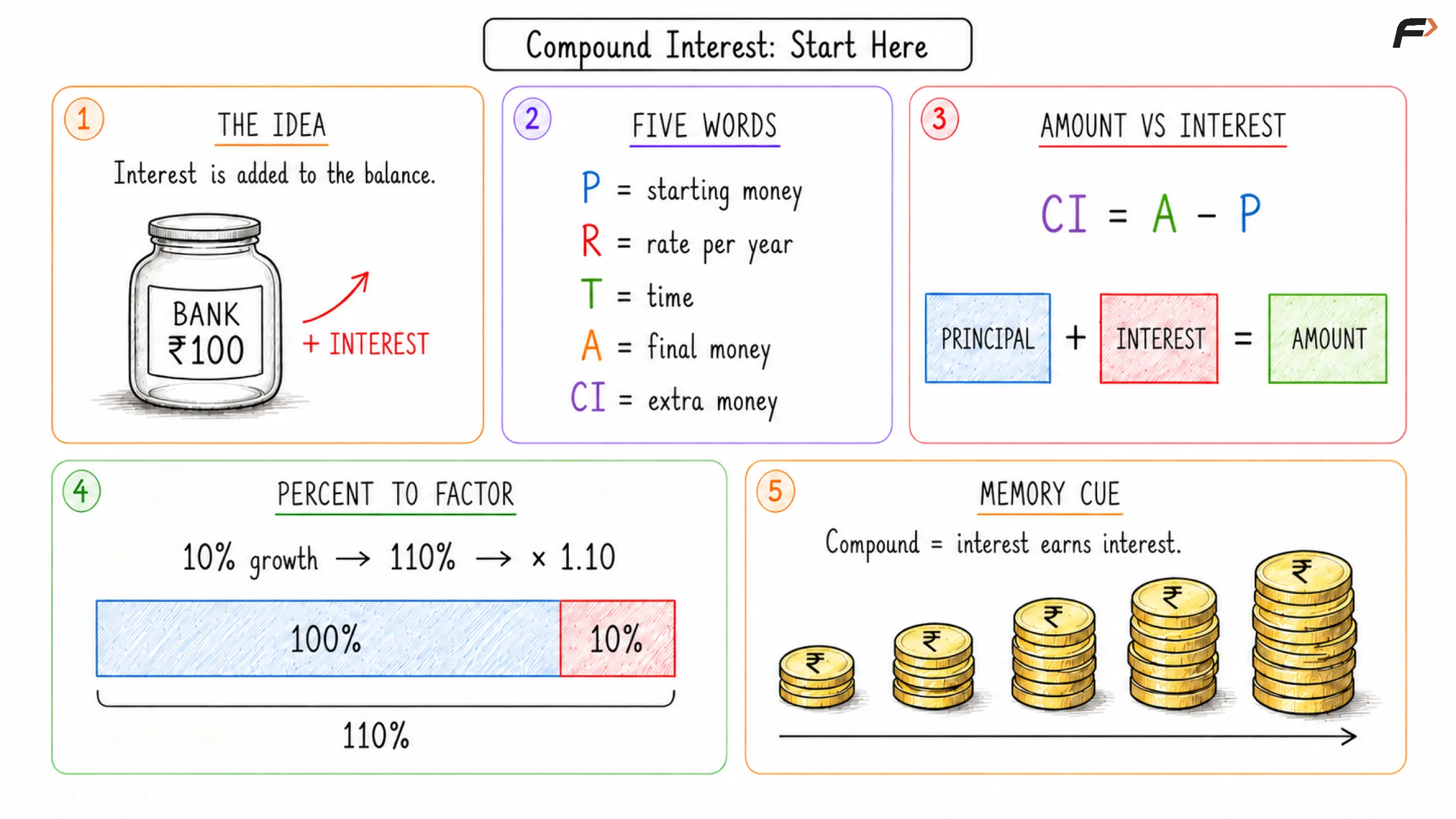
Compound Interest foundations
Basics: Principal, Rate, Time, Interest and Amount
- Principal, : the money invested or borrowed at the beginning.
- Rate, : the interest earned or charged in one year, written as a percentage.
- Time, : how long the money remains invested or borrowed.
- Interest: the extra money earned on an investment or paid on a loan.
- Amount, : principal plus all interest added by that time.
Therefore:
The amount includes the principal, so nothing is subtracted from it. Compound interest is only the extra money, so find the amount first and then subtract the principal.
Let us connect these words with a tiny example. Suppose you put Rs. 1,000 in a bank. This Rs. 1,000 is the principal. If the bank adds Rs. 100 as interest, the amount becomes Rs. 1,100. The interest is only the extra Rs. 100, while the amount is the full Rs. 1,100.
The phrase per annum means “for one year.” A rate of 10% per annum means 10% for each year. The phrase compounded annually means the interest is added to the balance once at the end of every year.
The Smallest Building Block: Percentage of a Number
Interest is a percentage of some money. To find of a value, multiply the value by .
For example, 10% of Rs. 500 is:
If a value grows by 10%, it keeps its original 100% and gains 10%. It becomes 110%, or 1.10 times its old value.
This number 1.10 is called a growth factor. A factor is simply the number by which we multiply the current balance.
Why Compound Interest Includes Interest on Interest
In simple interest, every year's interest is calculated on the original principal. In compound interest, each completed period's interest is added to the balance. The next period earns interest on this larger balance.
Example: Find the compound interest on ₹12,000 at 10% per year for 2 years, compounded annually.
What is given? The starting principal is Rs. 12,000. The rate is 10% for each year. The time is 2 years, and interest is added once each year.
What are we finding? We need the compound interest. This means we need only the extra money earned, not the full final balance.
Why solve year by year? This is the first example, so we will watch the balance change. The second year's interest must use the amount left after Year 1.
Year 1:
The first-year interest is added to the starting money:
So Year 2 begins with Rs. 13,200, not Rs. 12,000.
Year 2: The new principal is ₹13,200.
The answer Rs. 2,520 is the total extra money earned in two years. The second year's interest is Rs. 120 more than the first year's interest because the first year's Rs. 1,200 also earns 10%.
The Compound Amount Formula
For annual compounding at one fixed rate:
The expression is the growth factor for one year. At 10%, it is 1.10. Raising it to power applies the growth once for every year.
Why the power appears
For one year, multiply the principal by the growth factor once:
For two years, the first year's amount grows again by the same factor:
Two copies of the same factor can be written using power 2. The same idea gives power for years.
Example: Find the amount on ₹10,000 at 10% for 2 years.
What is given? We know , and . Annual compounding means one period is one year.
What are we finding? We need the amount, which is the full balance after two years. We should not subtract the principal at the end.
First turn the rate into a one-year growth factor:
There are two yearly periods, so this factor is used twice:
The answer Rs. 12,100 is the full money available after two years. The factor 1.21 means the amount is 121% of the principal. The compound interest alone would be Rs. 12,100 minus Rs. 10,000, which is Rs. 2,100.
Interest Earned During One Particular Year
First find the balance at the beginning of that year. Then calculate one year's interest on that balance.
Example: Find the interest earned during Year 2 on ₹8,000 at 5% annually.
What we know: Rs. 8,000 is invested at 5% per year. We need only the interest added during the second year, not all the interest from two years.
Why can we not use 5% of Rs. 8,000? Rs. 8,000 is the balance only at the start of Year 1. Before Year 2 begins, the first year's interest has already joined the balance.
After Year 1:
Year 2 begins with ₹8,400.
The answer Rs. 420 is only the interest added during Year 2. Using 5% of Rs. 8,000 would give Rs. 400 and would wrongly ignore the first year's added interest.
Finding the Rate
When principal, amount and time are known, place them in the amount formula and solve for .
Example: ₹10,000 becomes ₹12,100 in 2 years. Find the annual rate.
What is given? The principal is Rs. 10,000, the amount is Rs. 12,100 and the time is 2 years. The only missing value is the yearly rate.
Why use the amount formula? The formula directly connects the four values , , and . Put the three known values into it and leave as the unknown.
Divide by 10,000:
Take the positive square root:
The square root of 1.21 is 1.10 because . Now remove the original 1 from the growth factor:
Therefore, the annual rate is 10%. We use the positive root because a normal positive growth factor is not negative.
Finding the Principal
To work backwards from the amount:
Example: An amount becomes ₹14,520 after 2 years at 10%.
What is given? The final amount is Rs. 14,520, the rate is 10% and the time is 2 years. The starting principal is missing.
Why work backwards? Two years of 10% growth multiply the principal by . To undo multiplication by 1.21, divide the final amount by 1.21.
The answer Rs. 12,000 is the money that must have been present at the beginning.
Finding principal when compound interest is given
Sometimes only the compound interest is known instead of the final amount. At 10% for 2 years, the final amount is . Compound interest is the final amount minus the original principal:
If , then:
Here, 0.21 means that the two-year compound interest is 21% of the starting principal.
Half-Yearly Compounding
Half-yearly means interest is added every 6 months. One year has two compounding periods.
- Divide the annual rate by 2.
- Multiply the number of years by 2.
Example: Find the amount on ₹10,000 at 10% for 2 years, compounded half-yearly.
What is given? The principal is Rs. 10,000, the annual rate is 10%, and the time is 2 years. Interest is added every half-year.
What changes? One compounding period is now 6 months, not one year. The 10% annual rate must be shared across the two half-years, so each period uses . Two years contain half-year periods.
The balance grows by a factor of in each of those four periods:
The final amount is rounded to two paise. Annual compounding gives Rs. 12,100. Half-yearly compounding gives Rs. 55.06 more because part of the interest is added earlier and begins earning interest sooner.
Quarterly Compounding
Quarterly means interest is added every 3 months. One year has four quarters.
- Divide the annual rate by 4.
- Multiply years by 4.
If time is already given in quarters, use that number directly.
Example: Find the amount on ₹20,000 at 12% compounded quarterly for 6 quarters.
What we know: The principal is Rs. 20,000. The stated yearly rate is 12%. Interest is added every quarter, and the time is already given as 6 quarters.
How do we adjust the rate? A year has 4 quarters, so one quarter gets . The time is already counted in quarters, so the number of periods stays 6. Multiplying 6 by 4 would count the same conversion twice.
The answer Rs. 23,881.05 is the balance after six separate quarterly additions of interest.
General Formula for Any Frequency
If interest is compounded times per year:
Here, is the percentage rate for one period and is the total number of periods. Use annually, half-yearly and quarterly.
The top and bottom of the formula must speak the same time language. If the rate is per quarter, the power must count quarters. We cannot use a quarterly rate with a number of years because that would apply the rate too few times.
Small example: At 12% per year, compounded monthly, one month gets . Two years contain months. The amount would therefore be .
Effective Annual Rate
The nominal rate is the stated annual rate. The effective annual rate is the actual one-year increase after within-year compounding.
Example: Find the effective annual rate for 12% compounded quarterly.
What is given? The bank states 12% per year, but it adds interest four times during that year. We need the true percentage increase after all four additions.
Why is 12% not the final answer? Each quarter earns . Interest from the first quarter becomes part of the balance and earns interest in later quarters. This makes the full-year gain slightly more than 12%.
We can begin with Rs. 100 to make the percentage easy to see. After four quarterly growth steps, its value is:
The original Rs. 100 is not interest, so subtract it. The true gain is Rs. 12.550881 on Rs. 100. Therefore:
The effective annual rate is about 12.55%. The nominal rate is the stated 12%; the effective rate includes the extra interest earned within the year.
Fractional Years
Compare the leftover time with the compounding period. If interest is compounded annually for 2.5 years, only 2 full annual periods are completed. Find the amount after 2 years, then use simple interest on that amount for the remaining half-year.
Example: Find the amount on ₹10,000 at 10% compounded annually for 2.5 years.
What is given? The money stays invested for two full years and another half year. Interest is compounded annually, so a new compound step happens only after a complete year.
Why split the time? The first two years contain two complete annual periods. The last six months do not reach the next yearly compounding date. Under the usual fractional-period convention, calculate simple interest for this leftover time on the latest balance.
After 2 years:
Interest for the remaining half-year:
The answer Rs. 12,705 is the balance after two compound steps and one half-year simple-interest step. If 1.5 years is compounded half-yearly, the situation changes. It contains exactly 3 complete half-years, so all three periods use compound growth.
Different Rates in Different Years
When rates change, do not use one simple average. Apply each year's growth factor in order.
Example: ₹15,000 earns 8% in Year 1, 12% in Year 2 and 10% in Year 3.
What is given? The principal is Rs. 15,000, but each year has its own rate. We need the total compound interest after all three years.
Why can we not use one ordinary rate? The rate changes after every year. Each new rate acts on the balance created by the earlier rate, so we must follow the years in order.
After Year 1:
After Year 2:
After Year 3:
The three steps can also be written in one line:
The answer Rs. 4,958.40 is the extra money earned above the original Rs. 15,000. Multiplying the growth factors is just a shorter form of the same year-by-year work.
Increase Followed by Decrease
Equal percentage increase and decrease do not cancel because they act on different values.
Example: ₹1,00,000 rises by 10% and then falls by 10%.
What is given? The starting value is Rs. 1,00,000. It first rises by 10%, then the new value falls by 10%.
The first 10% is based on Rs. 1,00,000:
So the new value is Rs. 1,10,000. The second 10% uses this larger base:
After subtracting Rs. 11,000, the final value is Rs. 99,000. It is Rs. 1,000 below the original value. Since Rs. 1,000 is 1% of Rs. 1,00,000, the overall result is a 1% decrease.
In general, an rise followed by an fall gives a loss of .
Depreciation
Depreciation means a value falls by a percentage each period.
Example: A machine worth ₹80,000 loses 20% each year for 2 years.
What is given? The machine begins at Rs. 80,000. It loses 20% of its current value each year for two years.
If 20% is lost, 80% remains. In decimal form, 80% is 0.80. This is a shrinking factor, so we multiply by 0.80 once per year.
After the first year:
After the second year:
The formula combines these two steps:
The answer Rs. 51,200 is the machine's remaining value, not the money lost. The second year's loss is based on Rs. 64,000, so it is smaller than the first year's loss.
Difference Between Compound and Simple Interest
For one year, compound and simple interest are equal. For 2 years at the same annual rate:
Example: For ₹10,000 at 10% for 2 years:
What is given? Both methods use the same Rs. 10,000 principal, 10% annual rate and two-year time. We need only the amount by which compound interest is larger.
In Year 1, both methods give 10% of Rs. 10,000, which is Rs. 1,000. Under simple interest, Year 2 again gives Rs. 1,000. Under compound interest, the first year's Rs. 1,000 joins the balance and itself earns 10%.
That extra interest on the first year's interest is:
The shortcut formula produces the same value:
The answer Rs. 100 is not the full compound interest. It is only the extra amount that compound interest earns over simple interest. This shortcut is for the stated two-year annual pattern. Use the full method if the time, rate or frequency changes.
Deposits and Withdrawals at Different Times
Money added later has less time to grow. Money withdrawn stops earning interest. Follow the events in order.
Example: Deposit ₹5,000 today and another ₹5,000 after one year. Find the total at the end of Year 2 at 10% annually.
What is given? Two equal deposits are made on different dates. We want their combined value at the end of Year 2.
Why can we not join them at the start? The first Rs. 5,000 is present for two full years. The second Rs. 5,000 enters one year later, so it gets only one year of growth. Equal deposits do not have equal final values when their time is different.
The first deposit grows for 2 years:
The second deposit grows for only 1 year:
The answer Rs. 11,550 is the total value of both deposits at the same ending date.
Withdrawal between two years
Suppose Rs. 10,000 earns 10% annually, and Rs. 1,000 is withdrawn after the first year. First finish Year 1:
Now remove the Rs. 1,000 withdrawal:
Only this remaining Rs. 10,000 earns interest in Year 2:
The order matters. Interest is added first because the withdrawal happens after Year 1.
Comparing Investment and Loan Plans
Do not choose a plan only from its stated rate. Compounding frequency and fees affect the total.
- Adjust the rate and number of periods for each plan.
- Find each final amount separately.
- Add processing fees or other costs.
- Compare the final totals.
A plan with a slightly lower nominal rate can still cost more if it compounds more often or includes a fee.
Example: Compare two loans of Rs. 20,000 for two years. Plan A charges 10% compounded annually. Plan B charges 9% compounded half-yearly and adds a Rs. 300 fee.
What must we compare? For a loan, the cheaper choice is the one with the smaller total payment after including every fee. Looking only at 10% and 9% is not enough because the compounding times differ.
Plan A uses two yearly periods:
Plan B uses a rate of for each of four half-years:
Now add the fee to Plan B:
Compare the final costs:
Plan B is cheaper by Rs. 49.63. The fee almost removes its interest advantage, which is why every cost must be included.
Equivalent Constant Annual Rate
Different yearly rates can be replaced by one constant rate that produces the same amount.
Example: Find the constant annual rate equal to 10% in Year 1 and 20% in Year 2.
What does equivalent mean? We want one rate that, when used in both years, ends at exactly the same final amount as the changing rates.
Begin with a convenient principal of Rs. 100. After 10% growth, it becomes Rs. 110. After 20% growth on Rs. 110, it becomes Rs. 132. Therefore, the total two-year growth factor is 1.32.
Let the constant rate be .
The answer is about 14.89% per year. It is not exactly 15%, even though 15% is the simple average of 10% and 20%. Compound growth uses multiplying factors, and the second rate works on the amount created by the first.
Data Sufficiency
The goal is to decide whether the information gives one unique answer. Check Statement 1 alone, Statement 2 alone, and then both together.
To find an amount, we normally need principal, rate, time and frequency. To find a rate, we need enough information to connect principal and amount over a known time.
Example: An investment lasts two years with annual compounding. Find its rate.
- Statement 1 says the principal is Rs. 10,000.
- Statement 2 says the final amount is Rs. 12,100.
Check Statement 1 alone. Knowing only the starting money does not tell us how fast it grew. Many different rates are possible, so Statement 1 is not enough.
Check Statement 2 alone. Knowing only the ending money does not tell us where it started. Again, many rates are possible, so Statement 2 is not enough.
Now use both statements. We know , and . These values give one rate:
Solving gives . Therefore, neither statement works alone, but both statements together are enough. Data sufficiency asks whether an answer can be found uniquely, not whether we can do part of the calculation.
Finding the Final Amount as a Percentage of Principal
An amount can also be expressed as a percentage of the original principal without using a money value. Take the principal as 100%. The growth factor then changes that 100% directly.
Example: Money grows at 20% per year for two years. What percentage of the principal is the final amount?
What is given? We know the rate and time, but no rupee value is needed. We want the size of the final amount compared with the starting principal.
Take the principal as 100%. After the first year, it becomes:
In the second year, 20% acts on this new 120%, not the old 100%:
The same result comes from . Therefore, the final amount is 144% of the original principal. The compound interest alone is of the principal.
Comparing Annual and More Frequent Compounding
When principal, annual rate and total time are the same, adding interest more often usually gives a little more money. The extra amount comes from interest being added earlier.
Example: Rs. 20,000 earns 12% for one year. Find how much more interest half-yearly compounding gives than annual compounding.
Under annual compounding, the 12% interest is added once:
So the annual compound interest is Rs. 2,400.
Under half-yearly compounding, each half-year uses , and there are two periods:
So the half-yearly compound interest is Rs. 2,472. Subtract the two interest values, or simply subtract the two amounts because both started with the same principal:
Half-yearly compounding gives Rs. 72 more. That Rs. 72 is the interest earned in the second half-year on the interest added after the first half-year.
Finding principal from the extra half-yearly amount
Suppose half-yearly compounding at 10% gives Rs. 25 more than annual compounding after one year. Let the principal be .
Annual compounding gives . Half-yearly compounding uses 5% twice and gives:
The difference is given as Rs. 25:
The small factor 0.0025 is the extra growth caused by adding interest after six months.
Combining Several Separate Investments
Separate deposits may have different principals, rates or times. Find each value separately. Add them only after every deposit has been moved to the same ending date.
Example: Find the total maturity value of these annual investments:
- Deposit A: Rs. 10,000 at 10% for 2 years
- Deposit B: Rs. 8,000 at 5% for 3 years
- Deposit C: Rs. 12,000 at 8% for 2 years
Deposit A becomes:
Deposit B has a different rate and time, so calculate it separately:
Deposit C also gets its own calculation:
All three values are now measured at their maturity dates, so add them:
The final answer is the total amount from all three deposits. We could not put the principals into one compound formula because their rates and times were different.
Difference Between Two Investments with the Same Rate and Time
If two principals use the same rate and time, both are multiplied by the same growth factor. Their difference also grows by that factor.
Example: Two principals differ by Rs. 5,000. Both earn 10% annually for two years. Find the difference between their compound interests.
We do not need the two original principals separately. Treat Rs. 5,000 as the difference that grows for two years:
This Rs. 6,050 includes the original Rs. 5,000 difference and the difference in interest. Remove the original part:
Therefore, the larger principal earns Rs. 1,050 more compound interest over the two years.
A Step-by-Step Compound Interest Method
- Write what is given. Mark the principal, annual rate, total time and compounding frequency.
- Read what is asked. Amount and compound interest are not the same. For compound interest, subtract the principal after finding the amount.
- Find one period. Annual means one year, half-yearly means six months, and quarterly means three months.
- Match the units. Find the rate per period and the total number of periods.
- Draw a timeline when money or rates change. Follow deposits, withdrawals, changing rates and fees in the order they happen.
- Use a growth or shrinking factor. Growth uses and depreciation uses .
- Calculate slowly. Keep enough decimal places until the end, then round money to two decimal places when needed.
- Explain the answer. State whether it is the final amount, interest, remaining value, rate or difference between plans.
Common Mistakes
- Confusing amount with compound interest.
- Calculating every year's interest on the original principal.
- Halving the rate but forgetting to double periods for half-yearly compounding.
- Dividing a quarterly rate by 3 instead of 4.
- Converting time again when it is already given in quarters.
- Treating 2.5 years as 2.5 annual compound periods.
- Averaging changing rates instead of multiplying growth factors.
- Assuming an equal rise and fall cancel.
- Ignoring fees while comparing loans.
- Combining deposits made at different times as if they grew equally long.
Formulas and Cheat Sheet
| Situation | Formula or rule |
|---|---|
| Annual amount | |
| Compound interest | |
| compounds per year | |
| Half-yearly | Rate , periods |
| Quarterly | Rate , periods |
| Effective annual rate | |
| Depreciation | |
| Different yearly rates | Multiply all yearly growth factors |
| for 2 years | |
| Find principal | |
| Find annual rate | Solve |
The safest method is to draw a short timeline. Mark when interest is added, when the rate changes, and when money enters or leaves. Then find the rate per period and count the periods. Once those choices are correct, the calculation becomes straightforward.
Safe Shortcuts
- Use the growth factor for one annual increase. For several years at the same annual rate, raise that factor to the number of years.
- For exactly two years with annual compounding, . This shortcut is not valid unchanged for three years or for a different compounding frequency.
- For half-yearly compounding, use half the annual rate and twice the number of years. For quarterly compounding, use one-fourth of the rate and four times the years.
- For depreciation, multiply by for each period. Do not subtract the same rupee amount each year because depreciation uses the changing value.
- When yearly rates differ, multiply the yearly factors, such as . Average the rates only when an equivalent constant rate is specifically required.
- To find principal from a known amount, divide by the complete growth factor. This directly reverses compounding.
Use a shortcut only after checking the compounding period, rate changes and timing of deposits or withdrawals. A shorter formula is safe only when its exact conditions match the situation.
Frequently Asked Questions
What is the compound interest formula?
For annual compounding, and .
What is the difference between simple and compound interest?
Simple interest is calculated on the original principal. Compound interest is calculated on the growing balance, so earlier interest also earns interest.
How do I calculate half-yearly compound interest?
Divide the annual rate by 2 and multiply the years by 2. Use .
How do I calculate quarterly compound interest?
Divide the annual rate by 4 and multiply the years by 4. Use .
Why is the effective annual rate higher than the nominal rate?
Interest added during the year earns further interest before the year ends. The effective rate includes this extra growth.
How is depreciation related to compound interest?
Both use repeated percentage change. Growth uses , while depreciation uses .
Can I average rates that change every year?
Do not use a simple average. Multiply the yearly growth factors. If one equivalent rate is needed, take the correct root of the total growth factor.
How do I handle a fractional year?
Count complete compounding periods first. Handle leftover time according to the question's compounding rule. With annual compounding, aptitude problems commonly use simple interest on the latest amount for an incomplete year.