Calendar: Complete Beginner Guide with Easy Examples
Calendar aptitude studies the repeating relationship between dates, months, years and weekdays. A date names a day within a month, while a weekday tells whether that date is a Sunday, Monday and so on. The central decision is whether to move forward or backward, and then keep only the part of the day count that changes the weekday.
For example, 9 days after Monday is Wednesday. Seven of those days make one complete week and return us to Monday. Only the remaining 2 days move the weekday from Monday to Wednesday.
This article begins with the seven-day cycle, month lengths and leap years. It then builds through odd days, date counting, weekdays of given dates, repeated weekdays within a month, calendar repetition and longer date shifts.
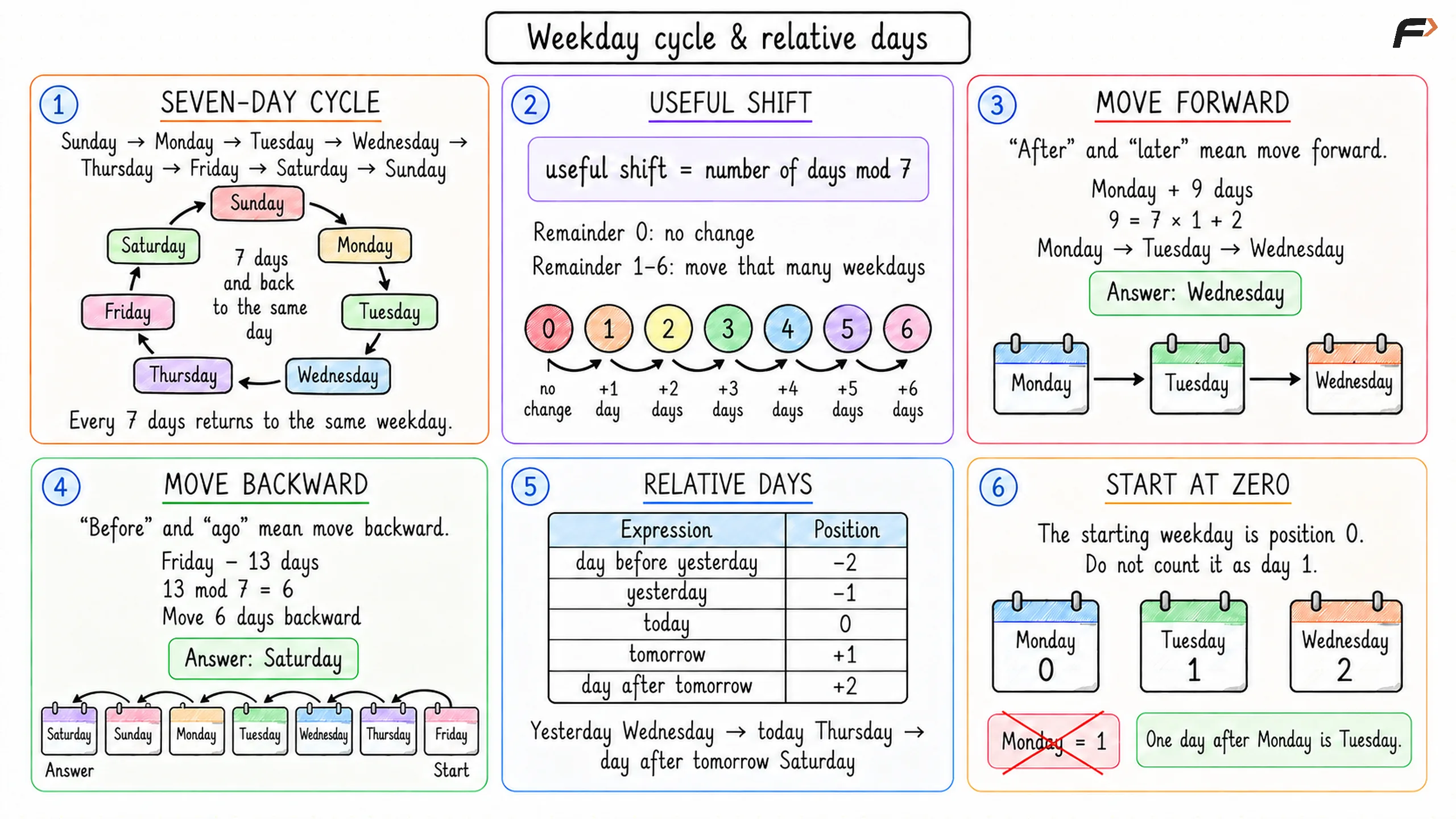
Weekday cycle, relative days and forward or backward movement
Basics: Weekdays Repeat Every Seven Days
The seven weekdays always appear in the same order:
After Saturday comes Sunday again. This makes weekdays a cycle of length 7. Moving by 7, 14, 21 or any other complete number of weeks returns to the same weekday.
The mathematical name for keeping only the remainder after division is modulo, written as “mod.” For weekday movement:
If the remainder is 0, the weekday does not change. If it is 1, move one weekday. If it is 6, move six weekdays.
Moving forward and backward
“After” and “later” mean move forward. “Before” and “ago” mean move backward. The starting weekday is position 0 because no day has passed yet.
Example: Today is Monday. What weekday will it be after 9 days?
What we know: Monday is the starting weekday, and the movement is 9 days forward.
What we are finding: We need the weekday reached after 9 complete days.
Why this method applies: Complete weeks do not change the weekday, so only the remainder after division by 7 matters.
Slow solution: Divide 9 by 7:
The full week returns to Monday. Move the remaining 2 days forward: one day reaches Tuesday, and the second reaches Wednesday.
Meaning of the answer: The weekday after 9 days is Wednesday.
Example: Today is Friday. What weekday was it 13 days ago?
Thirteen days contain one complete week and 6 extra days:
Because the wording says “ago,” move 6 days backward from Friday: Thursday, Wednesday, Tuesday, Monday, Sunday, Saturday.
Meaning of the answer: Thirteen days ago was Saturday. Friday itself is not counted as day 1.
Yesterday, tomorrow and the day after tomorrow
Relative words describe small shifts from today:
| Expression | Position from today |
|---|---|
| day before yesterday | |
| yesterday | |
| today | |
| tomorrow | |
| day after tomorrow |
Example: Yesterday was Wednesday. What day will the day after tomorrow be?
If yesterday was Wednesday, today is Thursday. Tomorrow is Friday, and one more day gives Saturday.
Meaning of the answer: The day after tomorrow will be Saturday.
Month Lengths
A calendar year has 12 months, but the months do not all have the same number of days.
| Month | Days in an ordinary year | Days in a leap year |
|---|---|---|
| January | 31 | 31 |
| February | 28 | 29 |
| March | 31 | 31 |
| April | 30 | 30 |
| May | 31 | 31 |
| June | 30 | 30 |
| July | 31 | 31 |
| August | 31 | 31 |
| September | 30 | 30 |
| October | 31 | 31 |
| November | 30 | 30 |
| December | 31 | 31 |
April, June, September and November have 30 days. February has 28 days normally and 29 in a leap year. Every other month has 31 days.
Month lengths matter whenever movement crosses a month boundary. They also decide how many times a weekday can appear in a month.
Leap Years in the Gregorian Calendar
An ordinary year has 365 days. A leap year has 366 days because February receives an extra day, 29 February.
Use these rules in order:
- A year not divisible by 4 is an ordinary year.
- A year divisible by 4 but not by 100 is a leap year.
- A year divisible by 100 is a leap year only when it is also divisible by 400.
A year ending in 00 is called a century year. The 400 rule prevents every century year from being treated as a leap year.
Example: Decide whether 2024 and 1900 are leap years.
What we know: The year 2024 is divisible by 4 and does not end in 00. The year 1900 is divisible by 100 but not by 400.
Why this method applies: The century rule changes the result for years ending in 00.
Slow solution: Since exactly and 2024 is not a century year, 2024 is a leap year. February 2024 therefore has 29 days.
For 1900, divisibility by 4 is not enough because the year ends in 00. Since 1900 is not divisible by 400, it is an ordinary year.
Meaning of the answer: The year 2024 has 366 days, while 1900 has 365 days.
The year 2000 is a useful contrast. It ends in 00 and is divisible by 400, so it is a leap year.
Odd Days
Odd days are the days left after removing complete weeks. The name does not mean odd numbers such as 1, 3 and 5. It means the remainder after dividing a day count by 7.
An ordinary year contains:
Therefore, an ordinary year has 1 odd day. A leap year contains:
Therefore, a leap year has 2 odd days.
Example: Find the total odd days in three ordinary years followed by one leap year.
Each ordinary year contributes 1 odd day, so the three ordinary years contribute . The leap year contributes 2 more:
Meaning of the answer: The four-year block shifts the weekday forward by 5 days. Since 5 is already below 7, no further reduction is needed.
Odd days in several months
Add the days in the required months, then take the remainder after division by 7.
Example: Find the odd days from January through April in an ordinary year.
The four month lengths are 31, 28, 31 and 30. Their total is:
Now remove complete weeks:
Meaning of the answer: January through April contribute 1 odd day in an ordinary year.
Finding a Weekday from a Known Weekday
When one date and its weekday are known, count the days between that date and the target date. Reduce the count modulo 7, then move forward or backward.
For two dates in the same month, the shift is simply the difference between their date numbers.
Example: If 1 January is Sunday, what weekday is 8 January?
The shift is:
Seven days make one complete week, so the remainder is 0.
Meaning of the answer: Both 1 January and 8 January are Sunday.
Moving across months
When the target is in a later month, count the full days in each month passed. Check February's length before adding it.
Example: If 1 January 2025 is Wednesday, what weekday is 1 March 2025?
The year 2025 is not divisible by 4, so February has 28 days. From 1 January to 1 March, January and February pass completely:
Reduce the shift:
Move three days forward from Wednesday: Thursday, Friday, Saturday.
Meaning of the answer: 1 March 2025 is Saturday.
Counting Days Between Two Dates
Date counts depend on whether the starting and ending dates are included. Read the condition before doing arithmetic.
For dates and in the same month:
| Counting condition | Number of days |
|---|---|
| exclude start, include end | |
| include both start and end | |
| exclude both |
Example: Count the days from 1 March to 15 March, excluding 1 March and including 15 March.
The starting date is excluded, so the first counted date is 2 March. The ending date is included. Therefore:
Meaning of the answer: The interval contains 14 days. Counting both endpoints would instead give 15 days.
For dates in different months, count the remaining days after the starting date, add complete months in between, and then add the target date's days. Keep the same inclusion rule throughout.
Finding a Date After or Before a Given Date
To find a new calendar date, move month by month and use up the required number of days. The starting date is day 0 for wording such as “60 days after” or “45 days before.”
Case 1: Moving forward across months
Example: What date is 60 days after 10 April 2026?
What we know: April has 30 days, May has 31 days, and the movement is forward.
What we are finding: We need the date reached after 60 full days.
Why this method applies: The movement crosses month boundaries, so each month's available days must be used in order.
Slow solution: From 10 April to 30 April is 20 days. After using those 20 days, days remain.
Moving through all 31 days of May leaves:
Nine more days into June reach 9 June 2026.
Meaning of the answer: The date 60 days after 10 April 2026 is 9 June 2026.
Case 2: Moving backward across months
Example: What date is 45 days before 20 July 2026?
Moving backward 20 days from 20 July reaches 30 June. This uses the days from 19 July back through 30 June, leaving:
Move another 25 days backward from 30 June. This reaches 5 June 2026.
Meaning of the answer: The date 45 days before 20 July 2026 is 5 June 2026. The starting date, 20 July, is not counted as the first day.
Finding the Weekday of Any Date
When no reference weekday is supplied, a date can be converted directly into a weekday. The Gregorian odd-days method used here assigns these codes:
| Remainder | Weekday |
|---|---|
| 0 | Sunday |
| 1 | Monday |
| 2 | Tuesday |
| 3 | Wednesday |
| 4 | Thursday |
| 5 | Friday |
| 6 | Saturday |
For a date with year written as a century part and final two digits , calculate:
The parts are:
- : century code
- : year code
- : month code
- : date number
- : leap adjustment
Century code
The century code repeats every 400 years:
| Years | Century code |
|---|---|
| 1600 to 1699 | 6 |
| 1700 to 1799 | 4 |
| 1800 to 1899 | 2 |
| 1900 to 1999 | 0 |
| 2000 to 2099 | 6 |
The compact calculation is:
For years from 2000 to 2099, .
Year code
Use the final two digits :
The floor brackets mean keep only the whole-number part. For 2026, :
Month code
The month code is the number of days before the month in an ordinary year, reduced modulo 7.
| Month | Code | Month | Code |
|---|---|---|---|
| January | 0 | July | 6 |
| February | 3 | August | 2 |
| March | 3 | September | 5 |
| April | 6 | October | 0 |
| May | 1 | November | 3 |
| June | 4 | December | 5 |
For example, 120 days come before May in an ordinary year. Since , May's code is 1.
Leap adjustment
The month codes are based on an ordinary year. In a leap year, subtract 1 for dates in January or February:
For March through December, or for any date in an ordinary year, .
Complete weekday calculation
Example: Find the weekday on 15 August 2026.
What we know: The date lies in the 2000s, so . The final two year digits are 26, August has month code 2, and the date number is 15. The year 2026 is ordinary, so .
Why this method applies: No starting weekday is supplied, so the codes count the complete weekday shift built into the date.
Slow solution: First find the year code:
Add all five parts:
Now reduce by 7:
Code 6 means Saturday.
Meaning of the answer: 15 August 2026 falls on Saturday.
Example: Find the weekday on 29 February 2028.
The century code is 6. The year code is:
February has month code 3, the date is 29, and 2028 is a leap year. Because the date is in February, use :
Meaning of the answer: Code 2 means Tuesday, so 29 February 2028 is Tuesday.
First and Last Weekdays of a Month or Year
The first day of a period is position 1. Therefore, its last day is one less than the total number of days later.
For a 30-day month, day 30 is 29 days after day 1. For a 31-day month, day 31 is 30 days after day 1.
Example: A 30-day month begins on Wednesday. What weekday is its last day?
The shift from day 1 to day 30 is:
Since , move one day forward from Wednesday.
Meaning of the answer: The last day is Thursday.
Example: A 31-day month ends on Friday. What weekday was its first day?
The last day is 30 days after the first. Since , move 2 days backward from Friday: Thursday, then Wednesday.
Meaning of the answer: The month began on Wednesday.
The beginning and end of a year
An ordinary year has 365 days, so 31 December is 364 days after 1 January. Since is exactly 52 weeks, both dates fall on the same weekday.
In a leap year, 31 December is 365 days after 1 January. That creates a shift of 1 weekday.
The next 1 January comes after the full year. Therefore, it shifts by 1 weekday after an ordinary year and by 2 weekdays after a leap year.
Example: If 1 January 2027 is Friday, what weekday is 1 January 2028?
The year 2027 is ordinary, so it contributes 1 odd day. Move one day forward from Friday.
Meaning of the answer: 1 January 2028 is Saturday.
Counting How Often a Weekday Appears in a Month
Every 28-day block contains exactly four complete weeks. Therefore, every weekday occurs at least four times in any month.
The extra days begin with the weekday of the first date:
| Month length | Complete weeks | Extra days | Weekdays occurring 5 times |
|---|---|---|---|
| 28 | 4 | 0 | none |
| 29 | 4 | 1 | first weekday |
| 30 | 4 | 2 | first two weekdays |
| 31 | 4 | 3 | first three weekdays |
Example: A 31-day month starts on Saturday. How many Sundays does it contain?
What we know: The month has 4 complete weeks and 3 extra days. Its first weekday is Saturday.
Why this method applies: Each complete week gives one Sunday. The extra days decide whether Sunday appears once more.
Slow solution: The 3 extra dates have the same weekday names as the first three dates: Saturday, Sunday and Monday. Sunday is in this extra group.
It appears 4 times in the complete weeks and once in the extra group:
Meaning of the answer: The month contains 5 Sundays.
A real month with an unknown starting weekday
First find the weekday of the month's first date. Then use its length and extra days.
Example: How many Fridays occur in May 2026?
Using the Gregorian code method, 1 May 2026 is Friday. May has 31 days, so its three extra weekdays are Friday, Saturday and Sunday.
Friday therefore occurs on 1, 8, 15, 22 and 29 May.
Meaning of the answer: May 2026 contains 5 Fridays.
Finding the Date of the Nth Weekday
Once the first occurrence of a weekday is known, later occurrences are 7 days apart.
If a month begins on weekday code and the target weekday has code , the first occurrence is on date:
The th occurrence is:
The resulting date must not exceed the number of days in the month.
Example: February 2024 begins on Thursday. Find the date of its third Monday.
Count from Thursday: 1 February is Thursday, 2 is Friday, 3 is Saturday, 4 is Sunday and 5 is Monday. Therefore, the first Monday is 5 February.
Each next Monday is 7 days later. The third Monday is two weekly gaps after the first:
Meaning of the answer: The third Monday is 19 February 2024.
Same Calendar Years
Two years have the same calendar only when both of these conditions match:
- They begin on the same weekday.
- They are the same type, either both ordinary or both leap years.
Move from year to year by adding 1 for each ordinary year and 2 for each leap year. When the total shift becomes a multiple of 7, the starting weekday has returned. Then check the type of the candidate year.
Example: Find the next year after 2010 with the same calendar as 2010.
The year 2010 is ordinary. Add the weekday shifts of each completed year. By the start of 2016, the total shift is 7, so the starting weekday matches. However, 2016 is a leap year, so its month lengths do not match 2010.
Continue the count. By the start of 2021, the total shift is 14, another multiple of 7. The year 2021 is ordinary.
Meaning of the answer: The next year with the same calendar as 2010 is 2021.
The complete Gregorian calendar repeats every 400 years because 400 years contain a whole number of weeks and the same leap-year pattern begins again.
Counting Leap Years and 29 February Dates
Each leap year contains exactly one 29 February. To count leap years up to year , use:
The subtraction removes century years that are not leap years. The final addition restores years divisible by 400.
For an inclusive range from year to year :
Example: How many 29 February dates occur from 2001 through 2020, including both years?
The leap years are 2004, 2008, 2012, 2016 and 2020. There is no century exception inside this range.
Meaning of the answer: Five leap years occur, so there are 5 dates named 29 February.
Common Mistakes
Counting the starting day as day 1
For “9 days after Monday,” Monday is day 0. One complete day later is Tuesday. The same rule applies when moving backward.
Using the date number instead of the difference
Day 30 is 29 days after day 1, not 30 days after it. Subtract the starting date number before reducing modulo 7.
Treating every year divisible by 4 as a leap year
Century years need the 400 test. The year 1900 is ordinary, while 2000 is leap.
Forgetting February when crossing months
February has 28 or 29 days depending on the year. Check the year type before adding month lengths.
Mixing inclusive and exclusive counts
Decide whether each endpoint is counted before subtracting dates. Changing the rule halfway creates an error of one day.
Applying the leap adjustment to every month
In the Gregorian code method, subtract 1 only for January or February of a leap year. Dates from March onward already follow the ordinary month-code table correctly.
Assuming a matching weekday means a matching calendar
Same-calendar years must also have the same year type. A leap year and an ordinary year have different February lengths even if 1 January matches.
Counting every weekday five times in a long month
A 31-day month has only three extra weekdays. Only the first three weekdays of that month occur five times.
Formulas and Cheat Sheet
| Concept or situation | Formula or rule | Condition or meaning |
|---|---|---|
| Weekday shift | Ignore complete weeks | |
| Forward movement | move ahead by | Words such as after or later |
| Backward movement | move back by | Words such as before or ago |
| Ordinary year | 365 days odd day | February has 28 days |
| Leap year | 366 days odd days | February has 29 days |
| Leap-year test | divisible by 4, except centuries must be divisible by 400 | Gregorian calendar |
| Same-month interval | Exclude start and include end | |
| Both endpoints included | Same month | |
| Weekday code | Sunday through Saturday | Used with modulo 7 |
| Gregorian weekday | Use the matching code table | |
| Century code | is the century part | |
| Year code | is the last two year digits | |
| Leap adjustment | Only Jan or Feb in a leap year | |
| First occurrence of weekday | Month begins on , target is | |
| th occurrence | first occurrence | Date must stay inside the month |
| Weekdays in a month | 4 each, plus extra days from the first weekday | Month length |
| Next year's first day | shift 1 after ordinary year, 2 after leap year | Uses the completed year |
| Same calendar | same 1 January weekday and same year type | Both conditions are required |
| Leap years through | Counts Gregorian leap years |
Safe Shortcuts
- Reduce a large day count modulo 7 before moving. This is safe because every removed group is a complete week.
- For a date in the same month, subtract date numbers first. Use the stated endpoint rule before adding or removing 1.
- A 28-day month has every weekday four times. In a 29-, 30- or 31-day month, only the first 1, 2 or 3 weekdays occur five times.
- Once the first required weekday in a month is known, keep adding 7 to list later occurrences.
- For a date exactly one year later, shift by 1 if the crossed year is ordinary and by 2 if it is leap. Check whether 29 February lies between the dates when the month and date differ.
- To count 29 February dates in a short range, list multiples of 4 and remove century exceptions. For a long range, use the leap-year counting formula.
- In a 2000 to 2099 weekday-code calculation, use century code 6. This shortcut is valid only inside that century block.
- When finding a date many days away, remove whole months in order and keep a visible remaining-day count.
A shortcut is safe only when its condition is clear. It should shorten correct reasoning, not replace the calendar rule or the endpoint check.
Frequently Asked Questions
What are odd days in calendar aptitude?
Odd days are the days left after removing complete weeks. They are the remainder when the total number of days is divided by 7.
How do I find a weekday after many days?
Divide the number of days by 7 and keep the remainder. Move forward by that remainder from the starting weekday. For a date before the starting point, move backward instead.
Why is the starting day not counted?
At the starting moment, zero complete days have passed. After one full day, the next weekday is reached. This is why “one day after Monday” is Tuesday.
What is the leap-year rule?
A non-century year is leap when it is divisible by 4. A century year ending in 00 is leap only when it is divisible by 400.
Why does an ordinary year shift the weekday by one day?
An ordinary year has 365 days, which equals 52 complete weeks plus 1 day. That extra day moves the next year's starting weekday forward by one.
How many times can a weekday occur in one month?
A weekday occurs either four or five times. Every month contains at least 28 days, which gives four complete weeks. The remaining 0 to 3 days decide which weekdays appear a fifth time.
How do I find the nth Monday or another weekday in a month?
Find the first occurrence of that weekday, then add 7 for each later occurrence. The third occurrence is 14 days after the first.
When do two years have the same calendar?
They must start on the same weekday and both must be ordinary years or both must be leap years. Matching only the first weekday is not enough.
What is the Gregorian odd-days method?
It combines a century code, year code, month code, date and leap adjustment. Their total modulo 7 gives a weekday code from Sunday 0 through Saturday 6.
Does the Gregorian calendar repeat?
Yes. Its complete weekday and leap-year pattern repeats every 400 years.
Summary
Calendar aptitude is built on one repeating fact: weekdays cycle every 7 days. Month lengths and leap years tell us how many days pass, while odd days tell us how far the weekday moves after complete weeks are removed.
Begin by deciding the direction and the endpoint rule. Then count the days, reduce weekday movement modulo 7, and check special conditions such as February, century years and same-calendar year types. These small checks make both short weekday shifts and long date calculations follow the same clear process.