Blood Relations: Complete Beginner Guide with Easy Examples
Blood relations describe how people are connected through birth, such as parent, child, brother, sister, uncle, aunt and cousin. Family relations can also come through marriage, such as husband, wife, mother-in-law and daughter-in-law. The central task is to follow the family path in the correct direction and then name the final relation.
For example, if Ravi is the father of Neha and Neha is the sister of Karan, Ravi is also Karan's father. Neha and Karan are siblings, so the parent named for one sibling is also the parent of the other.
We will begin with gender, generations and direct family words. Then we will move through maternal and paternal relations, marriage relations, cousins, family chains, pointing statements, coded symbols and data sufficiency.
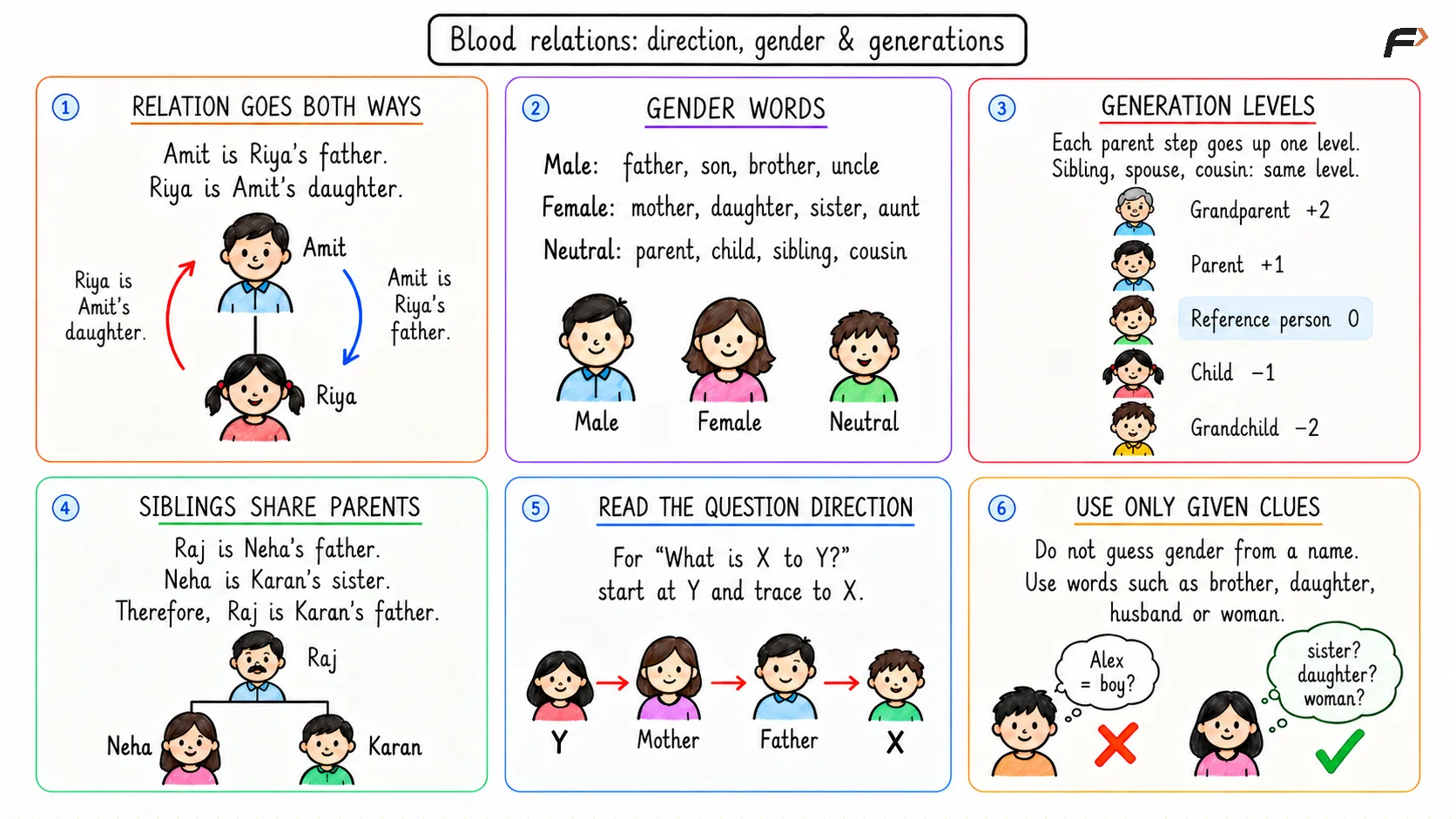
Blood relations direction, gender and generation levels
Basics: Person, Gender and Direction
A family relation always connects two people. The same connection has a different name when read in the opposite direction.
If Amit is the father of Riya, then Riya is Amit's daughter. “Father” describes Amit from Riya's side. “Daughter” describes Riya from Amit's side.
This is why the direction of the final relation matters. “How is Amit related to Riya?” and “How is Riya related to Amit?” do not have the same answer.
Gender words
Some family words tell us the person's gender:
- Father, son, brother, husband, uncle, nephew and grandfather are male relations.
- Mother, daughter, sister, wife, aunt, niece and grandmother are female relations.
- Parent, child, sibling, cousin and grandparent do not tell us gender by themselves.
Do not guess a person's gender from a name. Use only a clear word such as brother, daughter, husband or woman.
Example: Vikram is the brother of Pooja. Pooja is the daughter of Raj. How is Vikram related to Raj?
Solution: Pooja is the daughter of Raj, so Raj is Pooja's parent. Vikram is Pooja's brother, so Vikram is also Raj's child. Vikram is male, so the correct word is son.
Meaning of the answer: Vikram is Raj's son.
Generations in a Family
A generation is one level in a family tree. Parents are one generation above their children. Grandparents are two generations above their grandchildren.
It helps to treat the starting person's generation as level 0:
- A parent is at level .
- A grandparent is at level .
- A child is at level .
- A grandchild is at level .
- A sibling, spouse or cousin is at the same generation level.
The plus and minus signs are only tracking tools. They do not tell us the final family word by themselves. Gender and family side must still be checked.
Example: Nikhil is the father of Aarush. Aarush is the father of Eesha. How is Nikhil related to Eesha?
Solution: Begin with Eesha. Aarush is her father, so move one generation up. Nikhil is Aarush's father, so move one more generation up. Nikhil is male and is two generations above Eesha.
Meaning of the answer: Nikhil is Eesha's grandfather.
Example: Seema is the daughter of Raj. Raj is the son of Mohan. How is Seema related to Mohan?
Solution: Mohan is Raj's parent. Seema is Raj's daughter, so she is one generation below Raj and two generations below Mohan. Because Seema is female, she is Mohan's granddaughter.
Meaning of the answer: Seema is Mohan's granddaughter.
Parents, Children and Siblings
A parent is a father or mother. A child is a son or daughter. A sibling is a brother or sister.
When two people are stated to be siblings, aptitude problems normally treat them as having the same parents unless another condition is clearly given. This small rule connects many short family chains.
Example: Raj is the father of Neha, and Neha is the sister of Karan. How is Raj related to Karan?
Solution: Neha is Karan's sister, so Neha and Karan share their parents. Raj is Neha's father. Therefore, Raj is also Karan's father.
Meaning of the answer: Raj is Karan's father.
Example: Tina is the sister of Rohan, and Rohan is the son of Malini. How is Tina related to Malini?
Solution: Tina and Rohan are siblings, so Malini is also Tina's parent. Tina is female because she is called a sister. Therefore, Tina is Malini's daughter.
Meaning of the answer: Tina is Malini's daughter.
Marriage and Spouse Links
A spouse is a husband or wife. Marriage connects two people at the same generation level.
If Sam is Lisa's father and Mia is Sam's wife, Mia is Lisa's mother in the family described. In aptitude settings, a named husband and wife are usually treated as the parents of the stated child unless a different family condition is given.
Marriage relations must be handled carefully because they are not direct blood relations. They are often named using “in-law.”
Example: Mia is the wife of Sam, and Sam is the father of Lisa. How is Mia related to Lisa?
Solution: Begin with Lisa. Sam is her father. Mia is married to Sam and is therefore the female parent connected to Lisa through Sam.
Meaning of the answer: Mia is Lisa's mother.
Maternal and Paternal Sides
Maternal means connected through the mother. Paternal means connected through the father.
The brother of a mother is a maternal uncle. The sister of a mother is a maternal aunt. The brother of a father is a paternal uncle, and the sister of a father is a paternal aunt.
The mother's parents are maternal grandparents. The father's parents are paternal grandparents.
To find the correct side, do not look only at the final uncle or aunt. Trace whether the path first goes through the mother or the father.
Example: Karan is the son of Leela. Leela is the sister of Raj. How is Raj related to Karan?
Solution: Start at Karan and move to his mother, Leela. Raj is Leela's brother. The brother of one's mother is a maternal uncle.
Meaning of the answer: Raj is Karan's maternal uncle.
Example: Meena says, “Pooja is the sister of my father.” How is Pooja related to Meena?
Solution: Begin with Meena's father. Pooja is his sister. A father's sister is a paternal aunt.
Meaning of the answer: Pooja is Meena's paternal aunt.
Example: Eva's mother's mother is Zoe. How is Zoe related to Eva?
Solution: Move from Eva to her mother. Then move from that mother to her mother, Zoe. The path goes through Eva's mother, so Zoe is on the maternal side.
Meaning of the answer: Zoe is Eva's maternal grandmother.
Uncle, Aunt, Nephew and Niece
An uncle is commonly the brother of a parent. An aunt is commonly the sister of a parent. A parent's sibling's spouse is also called an uncle or aunt through marriage.
A nephew is the son of one's brother or sister. A niece is the daughter of one's brother or sister. These relations are read downward from the uncle or aunt's point of view.
Direction causes many errors here. If Karan is Raj's maternal uncle, then Raj is Karan's nephew or niece depending on Raj's gender.
Example: Karan is the brother of Leela, and Leela is the mother of Raj, a boy. How is Raj related to Karan?
Solution: Karan is Raj's maternal uncle. Turn the direction around. Raj is the male child of Karan's sister.
Meaning of the answer: Raj is Karan's nephew.
Example: Priya is the sister of Imran. Imran is the father of Sanaa. How is Sanaa related to Priya?
Solution: Sanaa is the daughter of Priya's brother. A brother's daughter is a niece.
Meaning of the answer: Sanaa is Priya's niece.
Cousins
Children of siblings are cousins. Cousins normally belong to the same generation.
To recognise this relation, first identify two brothers, two sisters, or a brother and sister. Then check whether the people being compared are their children.
Example: Tom is the son of Max. Max's sister is the mother of Chloe. How is Chloe related to Tom?
Solution: Tom belongs to Max's branch of the family. Chloe belongs to the branch of Max's sister. Both are one generation below the two siblings.
Meaning of the answer: Chloe and Tom are cousins.
Example: Soham's father's brother has a daughter named Ira. How is Ira related to Soham?
Solution: Soham's father's brother is Soham's paternal uncle. Ira is the daughter of that uncle. Soham and Ira are children of two brothers.
Meaning of the answer: Ira is Soham's cousin.
Relations Through Marriage and In-laws
An in-law relation comes through marriage. The exact word depends on the family path.
- A son's wife is a daughter-in-law.
- A daughter's husband is a son-in-law.
- A spouse's sister is a sister-in-law.
- A spouse's brother is a brother-in-law.
- A spouse's father is a father-in-law.
- A spouse's mother is a mother-in-law.
Some words such as uncle, aunt, nephew and niece may also be used for relations connected through a spouse. The blood path belongs to one spouse, but everyday family naming is usually extended to the other spouse.
Example: Raj is the father of Rahul. Rahul is the husband of Sneha. How is Sneha related to Raj?
Solution: Rahul is Raj's son. Sneha is Rahul's wife. Therefore, Sneha is the wife of Raj's son.
Meaning of the answer: Sneha is Raj's daughter-in-law.
Example: Pooja is the daughter of Sam and is married to Aakash. How is Aakash related to Sam?
Solution: Aakash is the husband of Sam's daughter. A daughter's husband is a son-in-law.
Meaning of the answer: Aakash is Sam's son-in-law.
Example: Nisha is married to Raj, and Maya is Raj's sister. How is Maya related to Nisha?
Solution: Raj is Nisha's husband. Maya is the sister of Nisha's husband. A husband's sister is a sister-in-law.
Meaning of the answer: Maya is Nisha's sister-in-law.
Example: R is the father of T, and T is the wife of U. How is R related to U?
Solution: T is U's wife. R is the father of U's wife. A wife's father is a father-in-law.
Meaning of the answer: R is U's father-in-law.
Reading a Family Chain
A long statement becomes easier when it is changed into short links. Begin with the person whose relation is being asked, then move through one relation at a time.
Do not try to hold the full sentence in memory. Write each direct link:
- K is father of L.
- L is mother of M.
- M is brother of N.
The sibling link tells us that L is also N's mother. K is then the father of N's mother.
Example: K is the father of L. L is the mother of M. M is the brother of N. How is K related to N?
Solution: L is M's mother. Since M and N are siblings, L is also N's mother. K is L's father. Therefore, K is the father of N's mother.
Meaning of the answer: K is N's maternal grandfather.
Pointing and Photograph Statements
In a pointing statement, the speaker uses words such as “my father,” “her mother” or “that man's son.” The safest method is to replace each phrase with a simpler family label.
Always identify the speaker's gender when the sentence provides it. Then handle words such as “only,” “no brother,” or “no sister,” because these clues remove other possible people.
“Son of my father”
Example: Priya points to a boy and says, “He is the son of my father.” How is the boy related to Priya?
Solution: Priya is a daughter of her father. The boy is a son of the same father. Therefore, they are siblings. Because the pointed person is male, the word is brother.
Meaning of the answer: The boy is Priya's brother.
“Only daughter of my mother”
The word only means there is exactly one person who fits that description.
Example: A woman says, “The mother of that boy is the only daughter of my mother.” How is the woman related to the boy?
Solution: Replace the long phrase:
The statement now says, “The mother of that boy is myself.”
Meaning of the answer: The woman is the boy's mother.
“My father's son” with no siblings
Example: A man says, “I have no brother or sister, but that man's father is my father's son.” Whose photograph is he describing?
Solution: Replace the phrase:
The statement becomes, “That man's father is myself.” Therefore, the speaker is the father of the man in the photograph.
Meaning of the answer: The photograph is of his son.
Removing an alternative with “no brother”
Example: James says, “I have no brother. Her father's father is my father.” How is the girl related to James?
Solution: The girl's father is a son of James's father. That son could normally be James or James's brother. The statement says James has no brother, so the second possibility is removed. The girl's father must be James.
Meaning of the answer: The girl is James's daughter.
Coded Blood Relations
In a coded relation, symbols such as +, # or * are given special meanings. Their usual mathematical meanings do not matter. Use only the meanings defined in the statement.
Decode one symbol at a time. Keep the order exactly as written. After decoding, solve the result like an ordinary family chain.
Example: Suppose means “A is the father of B,” and means “A is the sister of B.” Find R's relation to T in .
Solution: Decode : R is S's father. Decode : S is T's sister. Therefore, S and T have the same parents. R is also T's father.
Meaning of the answer: R is T's father.
Example: Suppose means “A is the mother of B,” and means “A is the brother of B.” Find L's relation to N in .
Solution: L is M's mother. M is N's brother, so M and N are siblings. L is therefore also N's mother.
Meaning of the answer: L is N's mother.
Stop when the required relation is already known
Some coded chains contain information beyond the part needed for the final relation. Extra information does not need to be used if the answer is already fixed.
Example: Suppose means “A is the father of B.” A longer code begins and then gives Renu's spouse and another sibling. How is Renu related to Raj?
Solution: The first link directly says Raj is Renu's father. Reverse that direction. Renu is female and is Raj's child.
Meaning of the answer: Renu is Raj's daughter. The later links do not change this direct relation.
Drawing a Simple Family Tree
A small diagram can prevent long chains from becoming mixed up. Use one level for each generation.
Keep spouses on the same level. Place children one level below their parents. Place siblings on the same level and connect them through the same parent line.
You can also use simple marks while writing:
- Write M beside a known male.
- Write F beside a known female.
- Use an upward arrow for a parent.
- Use a downward arrow for a child.
- Use a horizontal link for spouse or sibling, but label which one it is.
Do not use the same unlabelled horizontal line for both marriage and sibling links. They are different relations even though both stay in the same generation.
Example: Riya is the wife of Soham. Soham's sister is the mother of Ramesh, a boy. How is Ramesh related to Riya?
Solution: Ramesh is the son of Soham's sister, so Ramesh is Soham's nephew. Riya is Soham's wife, so the same family naming makes Ramesh her nephew through marriage.
Meaning of the answer: Ramesh is Riya's nephew.
Data Sufficiency in Family Relations
Data sufficiency asks whether the available statements are enough to give one definite answer. The task is not only to find a possible relation. We must check whether another relation is also possible.
Use this order:
- Test Statement I alone.
- Test Statement II alone.
- If needed, combine both statements.
- Check whether the combined information gives exactly one answer.
Do not bring information from one statement into the test of the other statement.
Both statements together are needed
Example: Statement I says A is the brother of B. Statement II says B is the mother of C. Can A's relation to C be found?
Solution: Statement I alone does not connect B to C. Statement II alone does not connect A to B. Together, A is the brother of C's mother. This gives one definite relation.
Meaning of the answer: Both statements together are sufficient, and A is C's maternal uncle.
Either statement alone is sufficient
Example: Statement I says Aarush is Maya's father and Maya is Nora's mother. Statement II says Aarush is the father of Nora's mother. Find whether Aarush's relation to Nora is clear.
Solution: Statement I alone gives Aarush as the father of Nora's mother, so he is Nora's maternal grandfather. Statement II says the same relation directly. Each statement gives a complete and definite path by itself.
Meaning of the answer: Either statement alone is sufficient.
Even both statements are not sufficient
Example: Statement I says Jack is the brother of Olivia. Statement II says Olivia is a parent of Ethan. Is Jack Ethan's paternal uncle?
Solution: If Olivia is Ethan's father, Jack is Ethan's paternal uncle. If Olivia is Ethan's mother, Jack is Ethan's maternal uncle. Both possibilities satisfy the statements.
Meaning of the answer: Even both statements together are not sufficient to prove that Jack is the paternal uncle.
Handling Unclear or Missing Information
A relation must be supported by the given family links. Do not silently add assumptions about gender, marriage, number of siblings or parentage.
If a word says “parent,” the person may be the father or mother. If a person is called a cousin, the gender is still unknown. If a name sounds male or female, that is not proof unless the statement or normal exam convention clearly fixes it.
When two answers remain possible, the correct conclusion is that the relation cannot be fixed. Finding one possible family tree is not enough.
Common Mistakes
Answering in the wrong direction
If A is B's uncle, B may be A's nephew or niece. Read the final wording again before naming the relation.
Guessing gender from a name
Use words such as son, sister, woman or husband. A name alone may not safely show gender.
Forgetting the maternal or paternal side
Trace whether the path passes through the mother or father before naming an uncle, aunt or grandparent.
Treating spouses as siblings
Both spouse and sibling links remain on the same generation level, but they are not the same relation. Label horizontal links clearly.
Calling every older male a grandfather
Generation level alone is not enough. An older male may be an uncle or father-in-law. Follow the exact path.
Ignoring “only,” “no brother” or “no sister”
These words remove alternative people. They often decide whether a phrase means the speaker or a sibling.
Reading a code symbol by its normal meaning
In coded relations, + may mean father and # may mean mother. Use only the definitions provided.
Using every coded link when the answer is already known
Later links may be extra information. Stop when the requested relation is fixed, then use later links only as a check.
Mixing data-sufficiency statements
Test each statement alone before combining them. Do not borrow a link from Statement II while claiming Statement I is sufficient.
Accepting one possible relation as definite
If two valid family trees give different answers, the information is not sufficient.
Cheat Sheet
| Family path or idea | Final relation | Condition or reminder |
|---|---|---|
| Male parent | Father | One generation above |
| Female parent | Mother | One generation above |
| Male child | Son | One generation below |
| Female child | Daughter | One generation below |
| Male sibling | Brother | Same generation |
| Female sibling | Sister | Same generation |
| Parent's father | Grandfather | Two generations above |
| Parent's mother | Grandmother | Two generations above |
| Child's son | Grandson | Two generations below |
| Child's daughter | Granddaughter | Two generations below |
| Mother's brother | Maternal uncle | Path goes through mother |
| Mother's sister | Maternal aunt | Path goes through mother |
| Father's brother | Paternal uncle | Path goes through father |
| Father's sister | Paternal aunt | Path goes through father |
| Sibling's son | Nephew | Male child of a sibling |
| Sibling's daughter | Niece | Female child of a sibling |
| Children of siblings | Cousins | Same generation |
| Son's wife | Daughter-in-law | Relation through marriage |
| Daughter's husband | Son-in-law | Relation through marriage |
| Spouse's brother | Brother-in-law | Relation through marriage |
| Spouse's sister | Sister-in-law | Relation through marriage |
| Spouse's father | Father-in-law | Relation through marriage |
| Spouse's mother | Mother-in-law | Relation through marriage |
| Generation tracking | Parent , child , same generation 0 | Gender and side must still be checked |
| Coded relation | Decode each symbol in written order | Ignore the symbol's normal meaning |
| Data sufficiency | Test I, test II, then combine if needed | One definite answer is required |
Safe Shortcuts
- Begin from the person named after “related to” and trace toward the other person. This keeps the answer direction clear.
- Mark each known male and female immediately, but do not guess gender from a name.
- Track parents as one level up, children as one level down, and siblings or spouses on the same level.
- If two people are siblings, a stated parent of one is normally the parent of the other in the described family.
- For maternal or paternal relations, identify whether the first parent link goes through the mother or father.
- Replace long pointing phrases with a short label, such as “my father's son = me or my brother.” Then use “only” or “no sibling” clues to choose.
- In coded relations, write the meaning above each symbol before connecting the people.
- Stop reading a coded chain once the requested relation is fixed, unless later information could contradict it.
- In data sufficiency, draw every valid possibility. If two answers remain, the information is not sufficient.
A shortcut is safe only when the family path, gender and answer direction are clear. It should shorten correct tracing, not replace it.
Frequently Asked Questions
What are blood relations in reasoning?
Blood relations are family connections formed through birth, such as parent, child, sibling, grandparent, uncle, aunt and cousin. Reasoning sets may also include relations through marriage.
What is the easiest way to understand a blood relation chain?
Break it into direct links. Mark gender, place people by generation, and trace from the person whose relation must be named.
How can I avoid answering in the wrong direction?
Rewrite the final task as “What is X to Y?” Then begin at Y and trace until you reach X. Name X from Y's point of view.
What is the difference between maternal and paternal relations?
Maternal relations come through the mother. Paternal relations come through the father.
What is a maternal uncle?
A maternal uncle is the brother of one's mother.
What is a paternal aunt?
A paternal aunt is the sister of one's father.
Who is called a nephew or niece?
A sibling's son is a nephew, and a sibling's daughter is a niece. These words can also be used for the same family connection through a spouse.
How are cousins related?
Cousins are children of siblings. They are normally in the same generation.
What does “in-law” mean?
An in-law relation is formed through marriage. Examples include father-in-law, daughter-in-law, brother-in-law and sister-in-law.
How should “my father's son” be read?
It can mean the speaker or the speaker's brother. A clue such as “I have no brother” makes it refer to the speaker.
Why is the word “only” important?
“Only” says exactly one person fits the description. It removes other possible siblings or children.
How are coded blood relations solved?
Replace every symbol with its given meaning, keep the written order, and then solve the resulting ordinary family chain.
What is data sufficiency in blood relations?
Data sufficiency checks whether one statement, the other statement, both together or neither gives one definite family relation.
Can a relation be fixed if a person's gender is missing?
Sometimes yes, if the final word is gender-neutral, such as parent or cousin. If the answer must distinguish father from mother or uncle from aunt, missing gender may make the information insufficient.
Summary
Blood relations become clear when each sentence is changed into small family links. Gender chooses words such as son or daughter, while generation levels separate parents, siblings and grandchildren. Direction decides which person's point of view gives the final answer.
Maternal relations pass through the mother, and paternal relations pass through the father. In-law relations come through marriage. Cousins are children of siblings, while nephews and nieces are the children of one's siblings.
Pointing statements depend on phrases such as “my father's son,” along with clues such as “only” or “no brother.” Coded relations must be decoded in order. Data sufficiency requires one definite answer, not merely one possible family tree.