Averages: Complete Concepts, Formulas and Detailed Examples
An average is one value that represents a group of values. The arithmetic mean is the average used throughout this topic. We find it by adding all values and dividing the total equally among the number of values.
Suppose three children have 2, 4 and 6 chocolates. Together, they have 12 chocolates. If the 12 chocolates are shared equally among the three children, each child gets 4. Therefore, the average is 4. The average does not say that every child originally had 4. It describes the equal-share level of the group.
This equal-share idea gives us the most important link in the topic. If we know the average and the number of values, we can rebuild the total. Once the total is known, adding, removing, correcting, combining or replacing values becomes a simple change to that total.
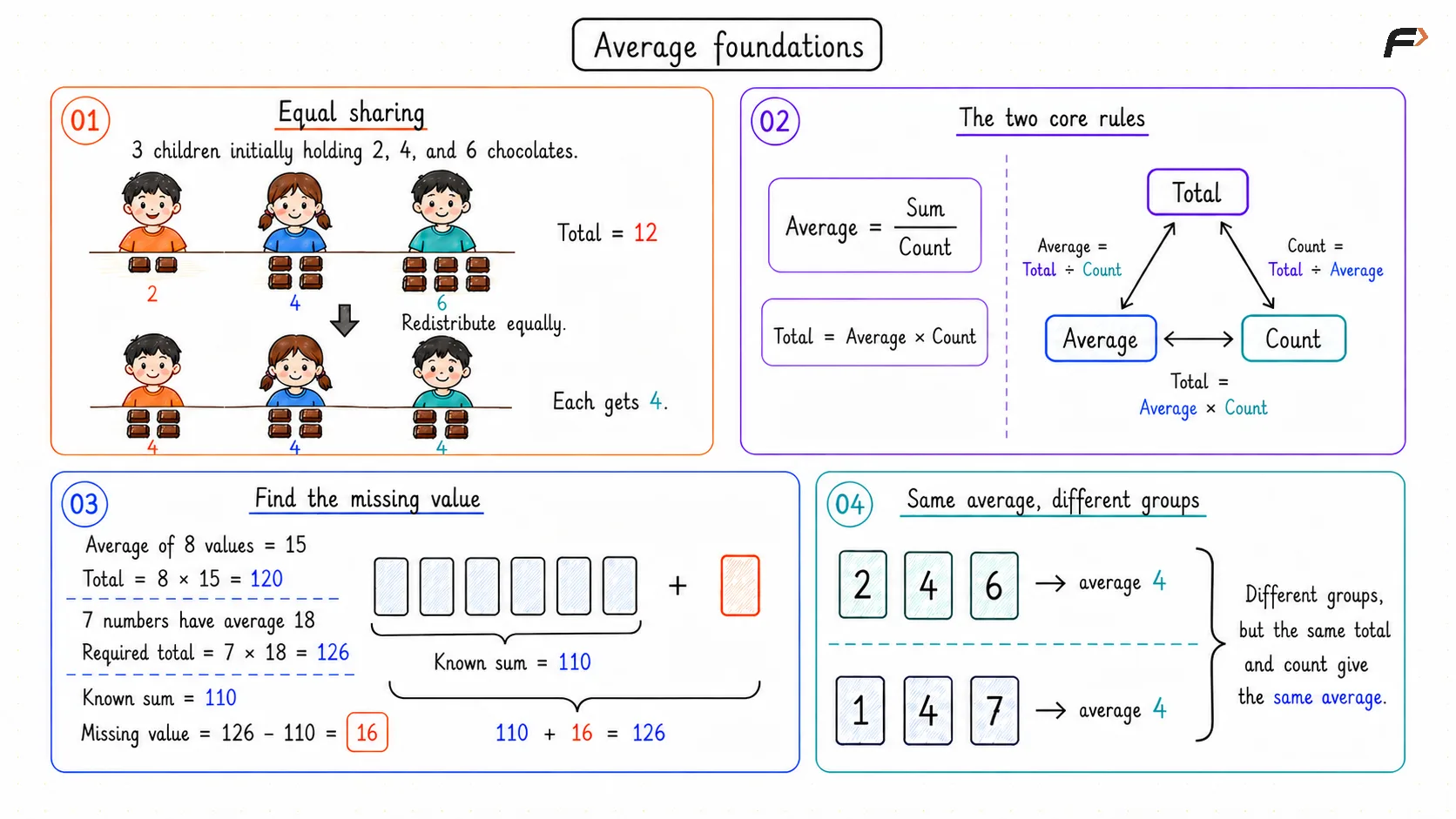
Average foundations: equal sharing, core rules and missing values
Basics: Sum, Count and Average
Every basic average relationship uses three values:
- Sum or total: all values added together.
- Count: the number of values.
- Average: the sum shared equally across the count.
The basic formula is:
For example, the average of 5, 7 and 12 is:
The sum is 24, the count is 3 and the average is 8.
The reverse formula: average into count gives total
If:
then multiplying both sides by the count gives:
This is the main tool for almost every idea in this chapter.
Small example: The average of 8 values is 15. Find their total.
We do not know the separate values, but we do not need them. A group of 8 values with an average of 15 has the same total as eight copies of 15.
So all eight values together add to 120.
What an Average Can and Cannot Tell Us
The average usually lies between the smallest and largest values in a group. It can equal one of the values, but it does not have to.
An average does not tell us every individual value. The numbers 2, 4 and 6 have average 4. The numbers 1, 4 and 7 also have average 4. Both groups have the same sum and count, so they have the same average even though their members differ.
The average may also be a decimal even when every value is a whole number. If four people have a total age of 101 years, their average is years. This is a shared mathematical value, not the age of one actual person.
Finding a Missing Value
When one value is missing, first rebuild the total that all values must have. Then subtract the sum of the known values.
Example: The average of 7 numbers is 18. Six numbers are 15, 16, 18, 20, 22 and 19. Find the seventh number.
What is given? There are 7 numbers and their average is 18. Six values are known, while one is missing.
Why begin with the total? The average of 18 means all seven numbers together must have the same sum as seven copies of 18.
Now add the six known numbers:
The missing number must complete the required total:
The seventh number is 16. A check is that , and .
Case 1: Required final test score
Example: Four trainee scores are 72, 68, 75 and 81. Find the fifth score needed for an average of 74.
Five scores with an average of 74 need a total of:
The four known scores add to:
Therefore:
The trainee needs 74 in the fifth test.
Adding One New Value
When a new value is added, both the total and the count change. Compare the old total with the new required total.
The formula is only a short form of “new total minus old total.”
Example: A team processes an average of 42 orders per day for 9 days. After Day 10, the average becomes 45. How many orders were processed on Day 10?
What is given? The first group has 9 days with average 42. The new group has 10 days with average 45.
First find the old total:
The new average of 45 across 10 days needs this total:
Only Day 10 was added, so the increase in total must be the Day 10 value:
The team processed 72 orders on Day 10. This high value raised the average from 42 to 45.
Removing One Value
When a value is removed, subtract it from the old total and reduce the count by one.
Example: The average of 11 measurements is 46. One measurement, 66, is removed. Find the new average.
The old total is:
Remove the value 66:
Ten measurements remain, so:
The new average is 44. It fell because the removed value, 66, was above the old average of 46.
Removing a named member
Twelve people have an average value of 65. Ria's value is 77. Find the average of the other 11 people.
The average of the remaining people is about 63.91.
Adding an Omitted Value
An omitted value is a value that should have been included but was left out. Add it to the earlier total and increase the count.
Example: The average of 19 values is 48. A twentieth value, 72, was omitted. Find the correct average.
The total used in the wrong calculation is:
Add the missed value:
The correct count is 20:
The correct average is 49.2. The average rises because the added value 72 is above the earlier average 48.
Correcting a Wrongly Recorded Value
A correction changes the total but not the count. Remove the wrong entry and add the correct entry.
Example: The average of 20 records was calculated as 54, but 73 was recorded as 37. Find the correct average.
The reported total is:
The written value is 36 too small because:
Add this missing 36 to the total:
The count remains 20 because no record entered or left the group.
The correct average is 55.8.
Correcting two mistakes
Forty values have a reported average of 62. The value 92 was written as 52, and the value 38 was written as 58.
The reported total is . The first error needs added. The second error includes too much, so subtract 20.
Replacing Values
Replacement means one value leaves and another enters. If the same number of values leave and enter, the count stays unchanged.
Example: The average of 12 values rises by 1.5 when 58 is replaced. Find the new value.
Why use the change in total? If an average rises by 1.5 across 12 values, the full total rises by 12 copies of 1.5.
Only one value changed, so the incoming value must be 18 larger than the outgoing 58.
The replacing value is 76.
Replacing two values
The average of 20 values increases by 3 when 45 and 55 are replaced by 80 and .
The whole total must rise by:
The old pair totals . Therefore, the new pair must total .
Combined Average and Weighted Average
When groups have different sizes, do not simply average their averages. A larger group contributes more values, so its average has more weight.
For two groups:
Here, and are group sizes, while and are their averages.
Example: Group A has 18 students with average 64. Group B has 12 students with average 74. Find the combined average.
Group A's total marks are:
Group B's total marks are:
Add the totals and counts:
The combined average is 68. The simple average of 64 and 74 would be 69, but that is wrong because the two groups are not equal in size.
Combining three groups
Three branches have counts and averages , and .
Finding the Average of a Remaining Group
When the whole group and one part are known, subtract the known part's total from the full total.
Example: Forty students have an average of 66. Fifteen of them have an average of 72. Find the average of the other 25 students.
The full total is:
The known group total is:
The other 25 students have this total:
Finding Group Sizes from Their Averages
If two group averages and the combined average are known, let one group size be and build an equation from totals.
Example: Two batches have averages 58 and 74. Together, 96 students have an average of 64. How many students are in the higher-average batch?
Let the number in the average-74 batch be . Then the average-58 batch has students.
Their totals must add to the full total:
Expand the brackets:
The higher-average batch has 36 students, and the other batch has 60.
Weighted Price and Mixture Average
Average cost is total cost divided by total quantity. When materials with different prices are mixed, quantity acts as the weight.
Example: A shop has 80 kg of material costing an average of Rs. 54 per kg. How much material costing Rs. 72 per kg should be added to make the final average Rs. 60 per kg?
The old total cost is:
Let the added quantity be kg. Its cost is Rs. . The new quantity is kg, and the new total cost is .
The required average cost is Rs. 60 per kg:
The shop must add 40 kg. The cheaper material begins below Rs. 60 and the added material lies above Rs. 60, so their mixture can reach Rs. 60.
Consecutive and Equally Spaced Numbers
Numbers are equally spaced when the gap between every pair of neighbours is the same. Examples include consecutive integers, even numbers and multiples of a fixed number.
Pairs from opposite ends have the same sum. Therefore:
For an odd number of equally spaced terms, this is also the middle term.
Example: Find the average of 9 consecutive integers starting from 34.
The nine numbers run from 34 through 42. Their middle, fifth number is 38.
Using the end values:
The average is 38.
Multiples in a range
The multiples of 6 from 6 to 72 are equally spaced. Their average is:
There is no need to add every multiple separately.
Excluding Values from a Number Range
When some values are excluded, remove both their sum and their count.
Example: Find the average of integers from 1 to 40 after excluding multiples of 5.
The sum of the first natural numbers is:
So the sum from 1 to 40 is:
The excluded multiples are 5, 10, 15, 20, 25, 30, 35 and 40. There are 8, and their sum is:
Remove their sum and count:
Age Averages and Time
When every person becomes years older, the average age also rises by . The total age rises by times the number of people.
Example: Six family members have a present average age of 28. Find their total age after 4 years.
Their present total age is:
Every one of the 6 people gains 4 years, so the total gains:
We need the total age, not the average age. Their average after four years would be years.
A person leaves and another joins later
Seven members have a present average age of 31. After three years, a currently 60-year-old member leaves and a one-year-old child joins.
Present total age:
After three years, the original seven members total:
The leaving member is then years old. Remove 63 and add the one-year-old child:
The count remains 7 because one leaves and one joins.
A Member Moving Between Groups
Follow the value from the first group into the second group. Use the first group's change to find the moved value.
Example: Group A has 30 students with average 70. Group B has 20 students with average 55. One student moves from A to B, and A's average becomes 69. Find B's new average.
Group A's old total is:
After one student leaves, 29 students remain with average 69:
The moved student's score is the difference:
Group B's old total is . Add the new score and increase its count to 21:
The correct new average is about 57.10.
Target Average for Remaining Tests or Periods
Find the final total needed, subtract what has already been achieved, then divide the remaining need by the remaining count.
Example: After 5 tests, a student's average is 68. What average is needed in the final 3 tests to finish with an average of 74?
There will be tests. The target total is:
The student already has:
Marks needed in the final 3 tests:
Required average across those tests:
The student needs an average of 84 in the remaining three tests.
Overlapping Groups
Two described groups may share some values. When their counts add to more than the full count, the excess is the overlap.
Example: The first 8 observations average 46, the last 7 average 52, and all 12 average 49. Find the average of the overlapping observations.
The separate group counts add to 15, but only 12 observations exist. Therefore:
The two group totals are:
Adding them counts the overlap twice. The full total counts it once:
Subtracting the full total leaves one copy of the overlap:
Pair Averages and Individual Values
Turn each pair average into a pair sum. Then combine or subtract those sums.
Example: The averages of , and are 54, 62 and 58. Find .
The pair sums are:
Adding all three counts every value twice:
Remove :
Two Missing Values with a Known Difference
First find the sum of the missing values. Then use their given difference.
Example: Eight scores have average 56. Six known scores total 318. The two missing scores differ by 10. Find the larger score.
The full total is:
The two missing scores total:
Let the smaller score be , so the larger is .
The larger score is .
Maximum Largest Value with a Fixed Average
When the total is fixed, making some values as small as possible leaves more total for the largest value.
Example: Ten distinct positive integers have average 20. Find the greatest possible largest integer.
Their fixed total is:
“Distinct positive” means the other nine values must be different and greater than zero. Their smallest possible values are 1 through 9.
The largest value receives everything left:
The maximum possible largest integer is 155.
When Every Value Changes in the Same Way
If the same number is added to every value, that number is added to the average. If every value is multiplied by the same factor, the average is also multiplied by that factor.
Situation example: The average salary is Rs. 40,000, and every salary increases by 12.5%.
Since every salary is multiplied by , the average is also multiplied by :
The new average salary is Rs. 45,000.
Average Speed
Average speed is always total distance divided by total time.
It is not always the simple average of the speeds.
Equal distances at two speeds
A person travels equal distances at 40 km/h and 60 km/h. Choose 120 km for each part because it divides easily by both speeds.
First-part time:
Second-part time:
For equal distances at speeds and , the shortcut is:
Running speed after removing halt time
A vehicle covers 180 km at an average speed of 45 km/h including a 0.5-hour halt.
Total trip time:
Actual running time:
The halt belongs in total journey time, but it must be removed when finding speed while the vehicle was actually moving.
A Reliable Way to Work with Averages
- Write the count and average. Do this for every group or stage.
- Turn each average into a total. Use total = average × count.
- Follow the story. Add incoming values, subtract outgoing values and correct wrong entries.
- Update the count. Adding or removing changes it. Replacing usually does not.
- Combine groups by totals. Never take a plain average of group averages unless their sizes are equal.
- For a target, find the final required total. Subtract the current total and share the remainder across the remaining count.
- For ages, move time first. Everyone already present grows older before someone leaves or joins.
- For speed, use total distance divided by total time. Decide whether halt time belongs in the requested speed.
Common Mistakes
Using average as if it were the total
An average of 20 across 10 values means a total of 200, not 20.
Forgetting to change the count
After removing one of 11 values, the new count is 10. A correction changes a value but keeps the count unchanged.
Taking a simple average of group averages
Groups of different sizes need a weighted average. The larger group contributes more values.
Correcting in the wrong direction
If 73 was written as 37, add 36. The recorded total is too small.
Averaging two speeds directly
For equal distances, the slower part takes longer, so the simple mean of the two speeds is wrong.
Using a leaving person's present age at a future time
If someone leaves after three years, increase that person's current age by three before subtracting it.
Trusting a nearby option instead of the calculation
If , an option such as 57.01 is a typo. Use the exact arithmetic.
Formulas and Cheat Sheet
| Situation | Formula or rule |
|---|---|
| Basic average | |
| Find total | |
| Added value | New total minus old total |
| Removed value | Subtract value and reduce count |
| Correct an entry | Old total wrong value correct value |
| Combined average | |
| Replacement change | |
| Equally spaced values | |
| First natural numbers | |
| Overlap count | |
| Target for remaining values | |
| Average speed | |
| Equal-distance average speed |
The safest approach is to think about the total hidden behind the average. Turn each average into a total, make the stated change, update the count and divide only at the end. This one idea connects simple averages, group averages, corrections, ages, targets, replacements and speed.
Safe Shortcuts
- Convert an average into a total immediately: total average count. Most missing-value and correction situations become simple addition or subtraction after this step.
- When one new value is added to old values with average , the new average is . Use it only when exactly one value is added.
- If one value is replaced, the change in total equals new value minus old value. The change in average is that difference divided by the unchanged count.
- For consecutive or equally spaced values, the average is the middle value when the list is symmetric. For an even count, it is the average of the two middle values.
- For two groups, use . A plain average of and is safe only when the group sizes are equal.
- If every value rises or falls by the same number, the average changes by that same number. If every value is multiplied by the same factor, the average is multiplied by that factor.
These shortcuts work only after the count and the group membership are clear. They shorten total-based reasoning but do not remove the need to check which values were added, removed or replaced.
Frequently Asked Questions
What is the basic average formula?
The reverse form is .
How do I find a missing number using an average?
Multiply the average by the full count to get the required total. Add the known values and subtract that known sum from the required total.
How do I find the combined average of two groups?
Multiply each group average by its group size. Add the group totals, then divide by the combined number of members.
Why can I not average two averages directly?
The groups may contain different numbers of values. A larger group must have more effect on the final average. A simple mean works only when the group sizes are equal.
What happens to the average when one high value is removed?
Removing a value above the old average lowers the average of what remains. Removing a value below the old average raises it.
What is the formula for a replacement question?
For values:
What is the average of consecutive numbers?
For equally spaced numbers, the average is . With an odd number of terms, it is also the middle term.
How do I solve target-average questions?
Find the total needed for the final target. Subtract the total already achieved. Divide what is still needed by the number of remaining tests or periods.
Is average speed the average of two speeds?
Not usually. Average speed is total distance divided by total time. For equal distances at speeds and , it is .