Analogy Reasoning: Complete Beginner Guide with Easy Examples
An analogy compares two pairs that have the same kind of connection. It is like saying, “These two things are connected in one way. Find another pair connected in the same way.”
Look at this simple pair:
A pen is used to write. A knife is used to cut. The objects are different, but the connection is the same. In both pairs, the first thing is a tool and the second word tells its main use.
Analogy is not only about knowing word meanings. It is mainly about seeing the exact connection between two things. The same idea can be used with words, letters and numbers.
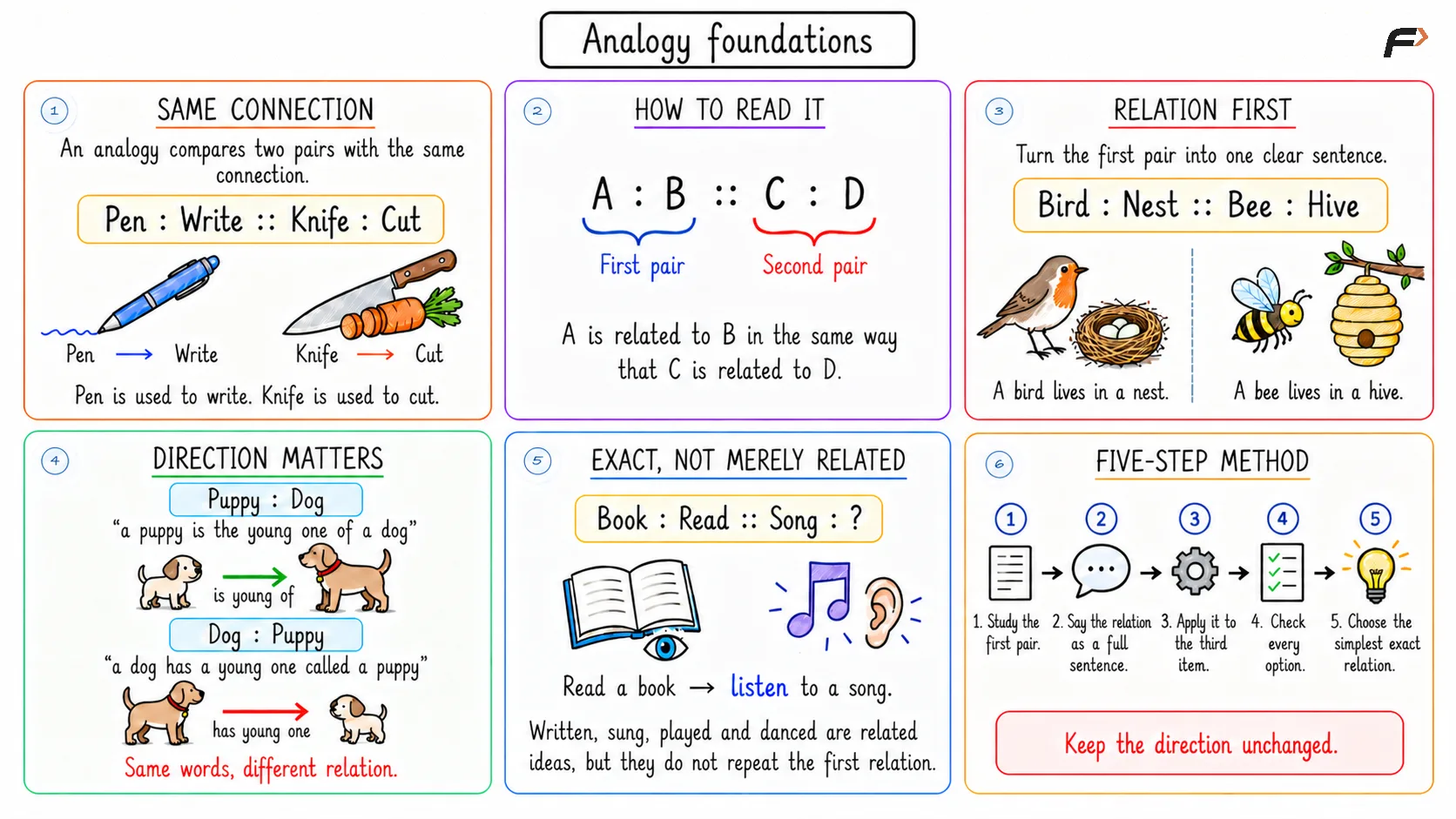
Analogy foundations and the five-step solving method
Basics: What an Analogy Really Means
An analogy is often written in this form:
Read it as:
A is related to B in the same way that C is related to D.
The two dots between and show one pair. The four dots between the pairs mean “in the same way as.”
For example:
The relation can be written as a small sentence:
- A bird lives in a nest.
- A bee lives in a hive.
The same sentence works for both pairs. That is why the analogy is correct.
The relation is the real answer
Do not look only for words that seem connected. Many words can be connected in some way. We need the same exact relation.
Suppose we have:
A song can be written, sung, played, heard or used for dancing. All these ideas are connected with a song. But the first pair tells us what to choose. We read a book, so we need the normal action done with a song. We listen to a song.
The answer is listen, not simply any word connected with song.
Direction of the Relation
The order of the words matters. A relation must work from the first word to the second word in both pairs.
Consider these two forms:
This means “a puppy is the young one of a dog.”
But:
This means “a dog has a young one called a puppy.”
The words are the same, but the direction has changed.
Example: Complete the analogy:
Options: Pilot, Airplane, Runway, Engine
Slow solution:
- Make the relation sentence: “A wheel is a part of a car.”
- Keep the same direction: “A wing is a part of ____.”
- A wing is a part of an airplane.
- An engine is also a part, so it cannot fill the place of the whole object.
- A pilot operates an airplane, and a runway is used for take-off and landing. Neither is the whole that contains a wing.
Answer: Airplane
Meaning: Wheel and wing are both parts. Car and airplane are the matching whole objects.
A Simple Step-by-Step Method
Use the following method for any analogy.
Step 1: Study the first pair
Ask, “How is the first item connected to the second item?” Do not look at the options yet if you can avoid it.
Step 2: Say the relation as a full sentence
For example:
- “A thermometer measures temperature.”
- “A puppy is a young dog.”
- “A carpenter mainly works with wood.”
- “Hot is the opposite of cold.”
A full sentence makes the direction clear.
Step 3: Apply the same sentence to the third item
If the relation is “instrument measures quantity,” then:
A barometer measures ____.
The missing word is pressure.
Step 4: Check every option
An option may be related but still be wrong. Ask whether it completes the exact same sentence.
Step 5: Choose the simplest exact relation
Do not create a long story when one clear relation explains the pair. A good rule should work in the same way for every part of the analogy.
Tool and Its Main Use
This relation joins an object with the main action done using that object.
Examples:
- Pen is used to write.
- Knife is used to cut.
- Needle is used to stitch.
- Broom is used to sweep.
The word main matters. A knife may also be washed, held or sharpened, but cutting is its direct use.
Example: Complete the analogy:
Options: Cut, Cook, Sharpen, Hold
Slow solution:
- A pen helps a person write.
- Use the same sentence for a knife: “A knife helps a person ____.”
- A knife directly helps a person cut.
- A knife may be used while cooking, but the knife itself does not cook.
- Sharpening is something done to the knife. Holding only describes how we use our hand.
Answer: Cut
Meaning: Both pairs connect a tool with the action it is made to perform.
Item and the Action Done With It
This looks close to tool and use, but the direction may be different. Here the first word can be something we receive, read, watch or hear.
Example: Complete the analogy:
Options: Write, Listen, Dance, Sing
Slow solution:
- We experience the words and ideas in a book by reading it.
- We experience a song by listening to it.
- “Sing” means to perform the song. That is not the same relation as reading a book.
- A song can support dancing, but dancing is not needed to receive the song.
- Therefore, “listen” gives the closest exact match.
Answer: Listen
Meaning: A book is read, while a song is listened to.
Living Thing and Its Home
This relation joins a living thing with the place where it normally lives.
Examples include bird and nest, bee and hive, lion and den, and horse and stable.
Example: Complete the analogy:
Options: Honey, Hive, Flower, Swarm
Slow solution:
- A bird lives in a nest.
- A bee lives in a hive.
- Honey is made by bees, but it is not their home.
- A flower is a place from which a bee may collect nectar.
- A swarm is a group of bees, not a place.
Answer: Hive
Meaning: Nest and hive are the matching homes.
Person and Workplace
This relation connects a worker with the usual place where that person works.
Example: Complete the analogy:
Options: Book, Office, School, Chalk
Slow solution:
- A hospital is a place, not a tool used by a doctor.
- Therefore, we need a place connected with a teacher.
- A teacher usually works in a school.
- A book and chalk are things a teacher may use.
- “Office” is too general. “School” is the direct match.
Answer: School
Meaning: Both pairs connect a person with the normal place of work.
Worker and Material
Some workers are closely connected with the main material on which they work.
Example: Complete the analogy:
Options: Brick, Iron, Paint, Glass
Slow solution:
- A carpenter shapes and joins wood to make doors, tables and other objects.
- A mason builds walls and structures using bricks or stone.
- Among the options, brick is the most direct and common match.
- Iron, paint and glass may be present in a building, but they do not match the worker-material relation as closely.
Answer: Brick
Meaning: Wood is a carpenter's main material, while brick is a mason's main material.
Person and the Work Created
This relation connects a creator with the thing that person creates.
Example: Complete the analogy:
Options: Drama, Pen, Poem, Library
Slow solution:
- A novel is a written work, not a writing tool or a place.
- A poet writes a poem.
- A pen is only a tool.
- A library stores books.
- A drama is more directly linked with a playwright in this type of analogy.
Answer: Poem
Meaning: Novel and poem are the works created by the matching writers.
Professional and the Item Checked
The work of some professionals is to inspect, correct or check a particular kind of record.
Example: Complete the analogy:
Options: Camera, Invoice, Manager, Accounts
Slow solution:
- An editor reads a manuscript carefully before it is published.
- An auditor checks accounts and financial records.
- An invoice is only one financial document. “Accounts” gives the wider and more direct match.
- A camera is unrelated, and a manager is a person rather than a record.
Answer: Accounts
Meaning: Both professionals carefully check the item named after them.
Part and Whole
In a part-and-whole relation, one item is a smaller piece of a larger object or system.
The direction must stay the same:
- Wheel is part of a car.
- Pedal is part of a bicycle.
- Keyboard is part of a computer system.
- Blood is part of the body.
Sometimes an option is also a part. That makes it tempting, but it cannot replace the whole object.
Example: Complete the analogy:
Options: Printer, Cable, Mousepad, Computer
Slow solution:
- A bicycle contains pedals.
- A computer system uses a keyboard as an input part.
- A printer is a separate device.
- A cable connects devices, and a mousepad is a surface used with a mouse.
- Computer is the matching whole.
Answer: Computer
Meaning: Pedal and keyboard are parts of the complete objects that follow them.
Young One and Adult
This relation connects the special name of a young animal with the adult animal.
Examples include puppy and dog, kitten and cat, calf and cow, and foal and horse.
Example: Complete the analogy:
Options: Lion, Mouse, Cat, Horse
Slow solution:
- A puppy grows into an adult dog.
- A kitten grows into an adult cat.
- Lion, mouse and horse are different kinds of animals.
Answer: Cat
Meaning: Puppy and kitten are the young forms; dog and cat are their adult forms.
Starting Stage and Developed Form
This relation shows what something grows or develops into.
Example: Complete the analogy:
Options: Bird, Nest, Shell, Feather
Slow solution:
- With suitable water, air and warmth, a seed begins to grow and becomes a plant.
- A young bird develops inside an egg and later comes out.
- A shell covers the egg, but the egg does not develop into a shell.
- A nest is the bird's home, and a feather is a part of a bird.
Answer: Bird
Meaning: Both pairs move from a beginning stage to the living form that develops from it.
Organ and Its Function
A body part or organ may be joined with the job it performs.
Example: Complete the analogy:
Options: Hands, Lungs, Skin, Eyes
Slow solution:
- Gills help a fish breathe in water.
- Humans breathe using lungs.
- Hands hold things, eyes help us see, and skin covers the body.
- Only lungs match the same function.
Answer: Lungs
Meaning: Different living things use different organs for the same basic job of breathing.
Instrument and Measurement
An instrument is often connected with the thing it measures.
Examples:
- Thermometer measures temperature.
- Barometer measures air pressure.
- Hygrometer measures humidity.
- Speedometer measures speed.
- Rain gauge measures rainfall.
Example: Complete the analogy:
Options: Pressure, Humidity, Speed, Rainfall
Slow solution:
- Copy the relation sentence: “A barometer measures ____.”
- A barometer measures atmospheric pressure, which means the pressure of the air around us.
- Humidity, speed and rainfall have different instruments.
Answer: Pressure
Meaning: Both pairs connect a measuring instrument to what it measures.
Quantity and Unit
This relation connects something measured with the unit used to state that measurement.
An instrument and a unit are not the same. A thermometer is an instrument. Celsius is a temperature unit.
Example: Complete the analogy:
Options: Celsius, Kilogram, Metre, Volt
Slow solution:
- Decibel tells us the level or loudness of sound.
- Celsius tells us how hot or cold something is.
- Kilogram is for mass, metre is for length, and volt is for electrical potential.
Answer: Celsius
Meaning: Decibel and Celsius are the matching units.
Opposite Meaning
Two words may show opposite qualities or ideas. This is also called an antonym relation. An antonym is simply a word with an opposite meaning.
Example: Complete the analogy:
Options: Careful, Extravagant, Wise, Economical
Slow solution:
- A lenient person allows more freedom. A strict person follows or applies rules firmly.
- A frugal person spends carefully and avoids waste.
- An extravagant person spends much more than needed.
- Careful and economical are close to frugal, not opposite to it. Wise is also not the opposite.
Answer: Extravagant
Meaning: Each pair contains words with opposite meanings.
Sign or Action and What It Shows
An action can express a feeling, opinion or response.
Example: Complete the analogy:
Options: Silence, Disapproval, Joy, Demand
Slow solution:
- People clap after something they like. This action is applause.
- Approval means that they accept, support or like it.
- Booing is a negative sound used when people dislike or reject something.
- That response is called disapproval.
Answer: Disapproval
Meaning: The two actions show opposite responses.
Access Method and the Thing Opened
This relation connects something that gives access with the protected thing it opens.
Example: Complete the analogy:
Options: Keyboard, Screen, Wallet, Account
Slow solution:
- A physical key matches a lock and opens it.
- A password is a secret set of characters used to enter an account.
- A keyboard may be used to type the password, but the password does not unlock the keyboard.
- A screen displays information, and a wallet stores things.
Answer: Account
Meaning: A key gives physical access, while a password gives digital access.
List and the Place It Describes
Some documents show the items available at a place.
Example: Complete the analogy:
Options: Library, Shelf, Reader, Ticket
Slow solution:
- A restaurant uses a menu to show what can be ordered.
- A library catalogue shows which books are available and where they can be found.
- A shelf holds books, but it is not the full place represented by the catalogue.
- A reader is a person, and a ticket gives entry or permission.
Answer: Library
Meaning: Both documents organise and show the items offered by a place.
Group and Its Collective Noun
A collective noun is a special word used for a group. For example, “pride” can mean a group of lions.
Example: Complete the analogy:
Options: Shoal, Flock, Herd, Pack
Slow solution:
- Many fish swimming together can be called a shoal.
- A flock is commonly used for birds.
- A herd is common for animals such as cattle or deer.
- A pack is common for wolves or dogs.
Answer: Shoal
Meaning: Pride and shoal are the matching collective nouns.
Object and the Larger Formation
Many small starting pieces can combine or grow to form something larger.
Example: Complete the analogy:
Options: Cement, Road, Building, Wall
Slow solution:
- One seed does not instantly equal an orchard. It is a starting item that can grow into one of the trees in an orchard.
- One brick is a starting building piece.
- Many bricks can be used to make a building.
- A wall is also made of bricks, so it is a close option. However, a wall is only one part of a building. “Building” better matches the larger complete formation, just as an orchard is the larger complete place.
Answer: Building
Meaning: Small starting units help form a much larger whole.
Place and Surrounding Area
This relation connects a place or object with the larger area around it.
Example: Complete the analogy:
Options: Forest, Mountain, Sea, River
Slow solution:
- An oasis is a small fertile area within a dry desert.
- An island is land surrounded by water.
- Among the choices, sea gives the normal surrounding area.
- A river can sometimes flow around a piece of land, but “sea” is the standard direct match for an island.
Answer: Sea
Meaning: Oasis and island are special areas found within or surrounded by the larger environments named after them.
Condition and the Function It Affects
Some analogy pairs connect a health condition with the body function or feeling it affects.
Example: Complete the analogy:
Options: Memory, Appetite, Speech, Vision
Slow solution:
- A person with insomnia finds it hard to sleep properly.
- Anorexia is linked with a serious reduction or loss of appetite.
- Appetite means the desire to eat.
- Memory, speech and vision do not give the matching relation.
Answer: Appetite
Meaning: The first condition affects sleep, while the second is linked with appetite.
Result and Its Source
Sometimes the first item is produced when the second thing acts in a certain way.
Example: Understand this relation:
Slow explanation:
- Light falls on a mirror and comes back, allowing us to see a reflected image.
- Sound can travel to a surface such as a wall or mountain.
- When that sound comes back, we hear an echo.
- An echo is not only a voice. Any suitable sound can produce an echo.
Meaning: Reflection is linked with a mirror, while an echo is the returning form of sound.
Important Part and Larger System
A part-and-whole relation can also compare two complete systems by matching their important parts.
Example: Understand this relation:
Currency supports buying, selling, earning and spending in an economy. Blood carries oxygen and nutrients through the body. The two items do not do the same physical job, but each is an important moving part of its larger system.
This type of analogy is more thoughtful than a simple object-part relation. First check the simple factual meaning. Then ask what role the part plays inside the larger system.
Number Analogies
A number analogy uses the same mathematical rule in both pairs.
For example:
The rule is not simply “add 16,” because applying that to 6 gives 22. A better rule is:
For 4, this gives . For 6, it gives .
How to find a number rule
Try common rules in a sensible order:
- Addition or subtraction
- Multiplication or division
- Square or cube
- Square or cube followed by a small addition or subtraction
- A rule using the original number, such as
- A digit rule, such as reversing the digits
The same rule must work completely for both pairs. Avoid a rule that is possible but strangely complicated.
Multiplication by the next number
Example: Complete the analogy:
Slow solution:
- Start with .
- The next whole number is .
- Multiply them: .
- Now start with .
- Its next whole number is .
- Apply the same rule: .
Answer:
Meaning: Each number is multiplied by the number immediately after it.
Square and add one
Example: Complete the analogy:
Slow solution:
- Check the first pair: .
- Add : .
- Keep the exact same two steps for .
- Square : .
- Add : .
Answer:
Meaning: The rule is .
Cube and add one
Example: Complete the analogy:
Slow solution:
- Cube means multiplying a number by itself three times.
- .
- Add to get .
- Apply the same rule to .
- .
- Add : .
Answer:
Meaning: The rule is .
Cube and add the original number
Example: Complete the analogy:
Slow solution:
- Cube : .
- Compare with . The difference is .
- This suggests the rule .
- Cube : .
- Add the original number: .
Answer:
Meaning: The rule uses both the cube and the starting number.
Reversing digits
Example: Complete the analogy:
Slow solution:
- In , the last digit moves to the front.
- The middle digit stays in the middle.
- The first digit moves to the end.
- Reverse in the same way.
- The order becomes .
Answer:
Meaning: Read the digits from right to left.
Letter Analogies
Letter analogies use alphabet positions or letter order. It helps to remember:
The rule may move every letter forward, move every letter backward, use opposite letters, reverse the whole word, or add letter values.
Same Forward Shift
In a forward shift, each letter moves the same number of alphabet places.
Example: Complete the analogy:
Slow solution:
- Count from to : . This is a move of places.
- Check . It is also places.
- Check . It is also places.
- Move forward places to get .
- Move forward places to get .
- Move forward places to get .
Answer:
Meaning: The same alphabet shift is applied to every letter.
A one-place forward shift
Example: Complete the analogy:
Slow solution:
- becomes .
- becomes .
- becomes .
- becomes .
- Join the new letters without changing their order.
Answer:
Meaning: Each letter moves to the next alphabet letter.
Wrap-around at Z
If a forward shift goes past , continue again from .
For example, with a shift:
This is called wrap-around. The alphabet is treated like a circle.
Opposite Letters
In an opposite-letter pattern, the first and last alphabet letters form a pair, then the second and second-last form a pair, and so on:
The position values of opposite letters always add to .
Example: Complete the analogy:
Slow solution:
- is the third letter from the beginning.
- is the third letter from the end, so .
- is fourth from the beginning.
- is fourth from the end, so .
- Keep the positions in order: becomes .
Answer:
Meaning: Each letter is replaced by the letter equally far from the other end of the alphabet.
Different Shifts in Different Positions
Not every letter must move in the same direction. Sometimes one position moves forward while another moves backward.
Example: Complete the analogy:
Slow solution:
- Treat each letter place separately.
- First place: move forward by one to get .
- Second place: move backward by one to get .
- Join them in their original positions.
Answer:
Meaning: Different positions can have different rules, but each position must repeat its own rule.
Reversing Letter Order
Sometimes the letters do not change at all. Only their order changes.
Example: Complete the analogy:
Slow solution:
- The last letter of is . Write it first.
- Before is . Write it next.
- Then write .
- Write the first letter last.
Answer:
Meaning: Read the original word from right to left.
Adding Alphabet Positions
A group of letters can be changed into a number by using their alphabet positions.
Example: Complete the analogy:
Slow solution:
- Write the alphabet values: , , .
- Add them: .
- Do not join them as . The first pair proves that the values are added.
Answer:
Meaning: The number is the total of all alphabet positions in the letter group.
How to Choose Between Two Possible Rules
Sometimes more than one rule can explain a single pair. For example, becoming could mean “multiply by ” or “square the number.” One pair alone may not clearly separate those rules.
Use these checks:
- Use the second starting item. See which rule produces one of the options.
- Prefer a common clean rule. Square, cube, fixed shift and reverse are common. A strange multi-step rule needs stronger proof.
- Use every part of the pair. A letter rule must explain every letter, not just the first one.
- Keep the same direction. Do not switch from part-to-whole into whole-to-part.
- Check meaning, not only association. “Bee” is connected with honey, flower, swarm and hive, but only hive is its home.
Common Mistakes
Choosing a word that is merely related
A related word is not enough. Turn the first pair into a sentence and demand the same sentence from the second pair.
Reversing the direction
“Wheel is part of car” is not the same direction as “car has wheel” when the missing position changes. Follow the order exactly.
Using a weak relation when a stronger one exists
“Doctor is connected with hospital” is true but too weak. “Doctor works in hospital” is exact and helps identify teacher and school.
Ignoring the main or usual connection
A knife is used during cooking, but its direct function is cutting. Choose the closest standard relation.
Treating instrument and unit as the same relation
A thermometer measures temperature. Celsius is a unit of temperature. These are two different relation types.
Stopping after checking one letter
A letter rule must work for every position. If three letters fit but one does not, the rule is wrong.
Forgetting alphabet wrap-around
After , a forward shift continues from . Before , a backward shift continues from .
Changing the letter order without proof
First check whether letters shift while staying in place. Reverse or rearrange them only when the first pair shows that order change.
Using a complicated number rule too early
Try basic operations, squares, cubes and digit order before creating a long rule.
Applying a rule to the result instead of the starting item
If the rule is , both parts use the original . For , calculate , not .
Ignoring a close option
Close options are useful checks. Explain exactly why each one fails. This prevents guessing.
Formulas and Cheat Sheet
| Analogy type | Quick rule or relation sentence | Small example |
|---|---|---|
| Tool and use | “The first item is used to do the second action.” | Pen : Write |
| Living thing and home | “The first lives in the second.” | Bird : Nest |
| Person and workplace | “The first works in the second.” | Doctor : Hospital |
| Part and whole | “The first is a part of the second.” | Wheel : Car |
| Young one and adult | “The first is the young one of the second.” | Puppy : Dog |
| Creator and creation | “The first creates the second.” | Poet : Poem |
| Worker and material | “The first mainly works with the second.” | Carpenter : Wood |
| Instrument and quantity | “The first measures the second.” | Thermometer : Temperature |
| Quantity and unit | “The first is measured in the second.” | Temperature : Celsius |
| Opposite meaning | The two words have opposite meanings. | Hot : Cold |
| Group name | “A group of the first is called the second.” | Lion : Pride |
| Number using next integer | ||
| Square and add one | ||
| Cube and add one | ||
| Cube and add original | ||
| Alphabet position | ||
| Opposite letter | Position values add to | |
| Fixed letter shift | Move each letter by the same amount | |
| Wrap-around | Continue from after | |
| Reverse order | Read letters or digits from right to left |
Safe Shortcuts
- Say the relation in one full sentence before looking for the missing item.
- Keep the direction unchanged. Read both pairs from left to right.
- For word analogies, check the main, direct and usual relation first.
- For number analogies, try simple operations, squares, cubes and digit reversal in that order.
- For letter analogies, write to only when position values are needed.
- When every letter changes, mark the movement above each position, such as .
- For opposite letters, use the fact that their position values add to .
- If letters or digits are unchanged but appear in a new order, test reversal before arithmetic.
- Reject an option if even one letter, digit or direction fails.
- When two rules seem possible, apply both to the new starting item and compare the options.
A shortcut is safe only when it repeats the exact relation. It should save time after the relation is understood, not replace careful thinking.
Frequently Asked Questions
What is analogy in reasoning?
Analogy is a comparison between two pairs that share the same relation. If is related to in one way, must be related to in the same way.
How do I identify the relation in an analogy?
Turn the first pair into a short sentence. For example, “A bird lives in a nest.” Then use the same sentence with the third item.
Why is direction important in analogy?
The order tells us which item is the part, whole, worker, workplace, cause or result. Reversing the order can change the relation.
What are the main types of word analogy?
Common types include tool and use, person and workplace, part and whole, young one and adult, creator and creation, worker and material, opposite meaning, instrument and measurement, quantity and unit, home, group name, source and result.
What is the difference between a related word and a correct analogy word?
A related word has some connection with the given word. A correct answer repeats the exact connection shown by the first pair.
How do I solve a number analogy?
Find the mathematical rule that changes the first number into the second. Apply the same complete rule to the third number. Start with simple operations before trying squares, cubes or mixed rules.
How do I solve a letter analogy?
Compare matching letter positions. Check forward shifts, backward shifts, opposite letters, reversals and alphabet-position values. The rule must explain every letter.
What are opposite letters in the alphabet?
They are letters equally far from opposite ends: and , and , and , and so on. Their position values add to .
What happens when a letter shift goes past Z?
Continue again from . For example, moving forward by two places gives .
Should I check every option?
Yes. Even after finding a likely answer, checking the options helps catch a reversed direction, one wrong letter or a relation that is only partly correct.
What should I do when two number rules seem possible?
Apply both rules to the third number. Usually only one result appears among the options. Prefer the simpler common rule when both seem possible.
Are collective nouns important in word analogies?
Yes. Words such as pride, shoal, flock, herd and pack are used for groups and often appear in animal-group analogies.
Is vocabulary enough to solve analogy?
Vocabulary helps, but it is not enough. You must also identify the relation and its direction. Even familiar words can form different relations.
How can I avoid confusing instrument and unit analogies?
Use complete sentences. “A thermometer measures temperature” shows instrument and quantity. “Temperature is measured in Celsius” shows quantity and unit.
What is the best way to improve at analogies?
Learn common relation types, practise writing relation sentences, revise basic alphabet positions, and always explain why the wrong options fail.
Summary
An analogy says that two pairs share the same connection. The safest method is to study the first pair, write its relation as a clear sentence, keep the direction unchanged, apply it to the third item, and check every option.
Word analogies may use function, home, workplace, material, creation, part and whole, young and adult, opposite meaning, measurement, unit, group name or result. Number analogies repeat one mathematical rule. Letter analogies may use shifts, opposite letters, alphabet values or reversed order.
The best answer is not simply related to the given word. It is the answer that repeats the first relation exactly, clearly and in the same direction.