Algebra: Concepts, Formulas and Solved Examples
Algebra is a part of mathematics in which letters represent numbers. A letter such as may stand for a number that we do not know yet, or a number whose value can change. We use known relationships to simplify an expression or find a missing number.
For example, says that an unknown number becomes 8 after adding 3. Subtracting 3 from both sides gives . We do the same operation on both sides because an equation is like a balanced weighing scale.
This small balance idea is the base of equation solving. Before using it in larger problems, we need to understand the pieces of algebra, how signs work, and why brackets must be opened carefully.
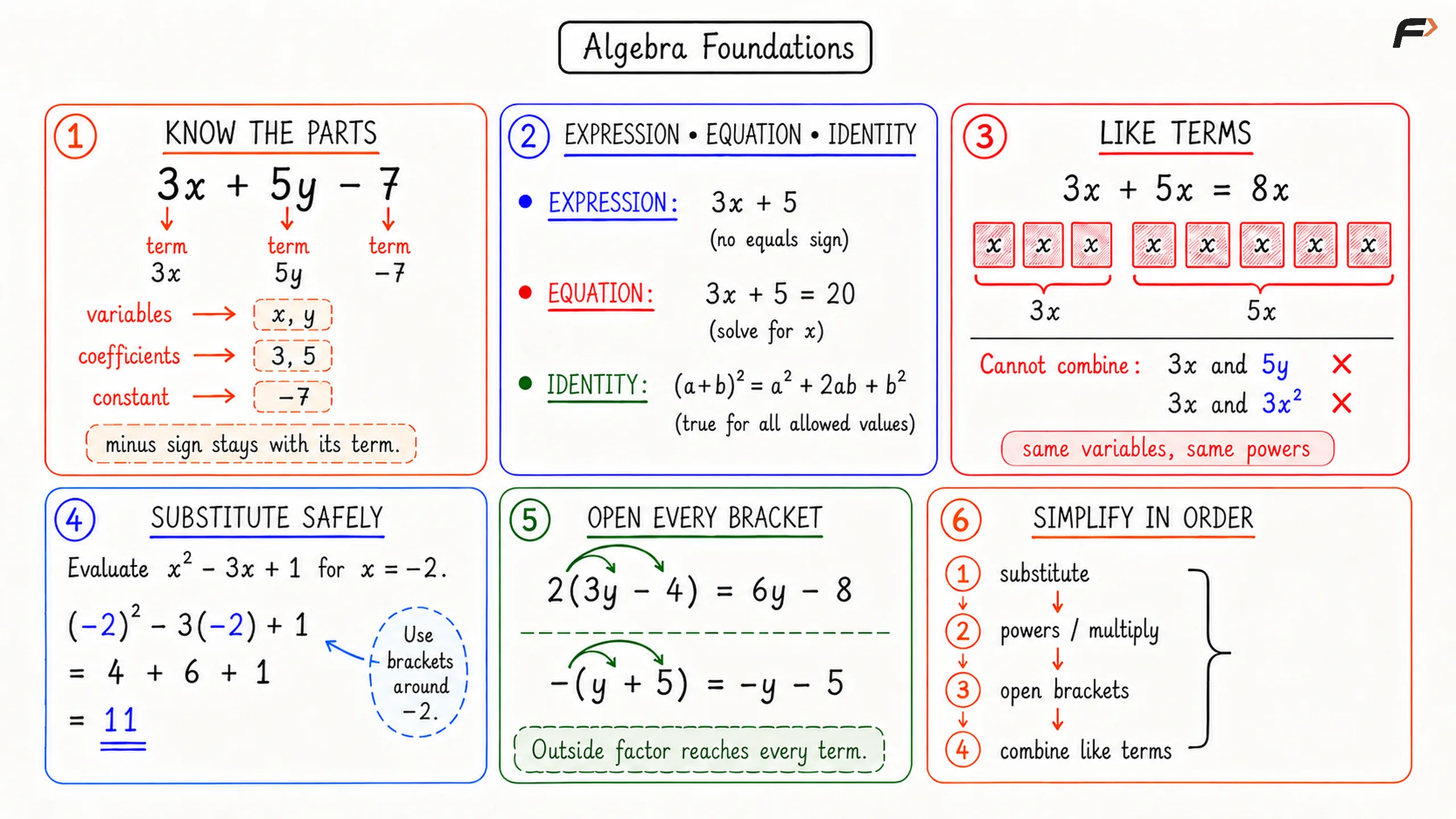
Algebra foundations, terms, substitution and brackets
Basics: Numbers, Variables, Terms and Expressions
A variable is a letter that represents a number. In , the value of is not yet known. The letter is only a name for that missing number.
A constant is a fixed number. Its value does not change. In , the number 4 is a constant.
A term is one part of an expression. A plus or minus sign separates one term from the next term. Keep a minus sign with the term that follows it.
Consider:
It has three terms: , and . The variables are and . The constant term is , not 7, because its minus sign belongs to it.
The number multiplying a variable is its coefficient. The coefficient tells us how many copies of the variable we have. For example, means , so its coefficient is 3.
The coefficient of in is , because . If we see only , its coefficient is 1 because .
A power tells us how many times a value is multiplied by itself. In , the 2 means . In , the 3 means .
An expression such as has no equals sign. We can simplify it or find its value when is known, but we cannot usually solve it by itself.
An equation such as says that the expression on the left has the same value as the expression on the right. We solve it by finding the value of that makes this statement true.
An identity is an equality that is true for every allowed value. For example, is true no matter which numbers replace and .
Like Terms and Simplification
Like terms have exactly the same variable part, including the same powers. We can add and because both are groups of . Three apples plus five apples make eight apples. In the same way, .
We cannot combine with because they use different variables. We also cannot combine with because and are different variable parts.
Example: Simplify .
First group the terms and the number-only terms:
Now subtract the coefficients of the terms and add the constants:
The coefficient of after simplification is 3.
Substitution: Replacing a Variable with a Number
Substitution means replacing a variable with a known number. Imagine that the letter is an empty box. If , put into every box marked .
Use brackets around a negative value. The brackets show that the complete number, including its minus sign, is being squared or multiplied.
Example: Find when .
Step 1: Replace every with .
. Also, because the product of two negative numbers is positive.
Step 2: Work out the power and multiplication.
Step 3: Add the remaining numbers.
Writing without brackets can be misunderstood as . Brackets make the intended square clear.
Opening Brackets with the Distributive Property
When a number multiplies a bracket, it multiplies every term inside:
This is called the distributive property. Think of 2 bags, with each bag containing . Both parts inside the bag are present twice, so .
Example: Simplify .
Open the first bracket:
A minus sign before a bracket means the whole bracket is multiplied by . Therefore, the sign of every term inside changes:
Now combine like terms:
The final answer is . The two original brackets are gone, and no more like terms remain.
The most common bracket error is changing only the first sign after a minus. Since multiplies every term, every sign inside must change.
Solving a Linear Equation
A linear equation has a variable whose highest power is 1. Examples are and . Solving an equation means finding the value that makes its left and right sides equal.
Think of an equation as a balanced weighing scale. If we remove 3 kg from only one side, the scale will no longer balance. If we remove 3 kg from both sides, it remains balanced. This gives us the safe rule: whatever operation we perform on one side, we must perform on the other side.
Our goal is to leave the variable alone. We undo addition with subtraction, undo subtraction with addition, undo multiplication with division, and undo division with multiplication.
Example: Solve .
Step 1: Open the bracket. The 3 multiplies both and :
Step 2: Combine like terms on the left. Since :
Step 3: Put the variable terms on one side. Subtract from both sides:
Step 4: Leave alone. Add 2 to both sides:
Check by substituting 15 into the original equation. Both sides become 43, so the answer is correct.
Finding the variable may be only the first step when the required value is an expression. For example, if , then and . If the required value is , substitute 16 to get .
Equations containing fractions
Fractions do not change the main balance rule, but they can make calculations harder to see. We can clear them by multiplying the complete equation by the lowest common multiple, or LCM, of all denominators.
Example: Solve:
The LCM of 4 and 6 is 12 because 12 is the smallest positive number divisible by both 4 and 6. Multiply every term, including the 5, by 12:
Multiplying only one fraction by 12 would break the equality. The whole equation must be multiplied.
Turning Words into Equations
Word problems hide an equation inside a sentence. Do not start calculating while reading. First choose a letter for the unknown, then translate one phrase at a time.
- A number:
- Twice a number:
- Five more than a number:
- Five less than three times a number:
- One-fourth of a number:
- Two numbers in the ratio : and
Example: Seven less than twice a number is 23. Find the number.
What is unknown? The number itself, so let it be .
Translate the sentence. “Twice a number” means . “Seven less than twice a number” means take 7 away from , giving . The word “is” means equals.
Solve the equation. Add 7 to both sides so the subtraction disappears:
Check the meaning. Twice 15 is 30. Seven less than 30 is 23, so 15 is the required number.
The word “than” matters. “Five less than ” means , not .
One Variable Defined Through Another
Sometimes one variable is described using another. Phrases such as “twice,” “three times” and “half” tell us the relationship.
- “A is twice B” means .
- “A is three more than B” means .
- “A is half of B” means .
If one variable is already known, substitute its value into the relationship.
Example: and is twice . Find .
Simultaneous Linear Equations
Simultaneous equations are equations that must be true at the same time. If two equations contain the same two unknowns, they can often give one exact value for each unknown.
The elimination method makes one variable disappear by adding or subtracting the equations. We can eliminate a variable when its coefficients are equal and have opposite signs for addition, or equal and have the same sign for subtraction.
Example: Solve and , then find .
Label the equations so we can refer to them clearly:
Add equations (1) and (2). The and cancel because their sum is zero:
We now know , but we still need . Substitute into the simpler second equation to find :
Therefore, .
Simultaneous equations containing fractions
First clear the fractions in both equations. After that, use the same elimination method.
Example:
The LCM of 2 and 3 is 6. Multiply every term in both equations by 6:
The coefficients of are 2 and 3. Their LCM is 6. Multiply the first equation by 3 and the second by 2 so both equations contain :
Subtract the second new equation from the first. The terms cancel:
Substitute into :
Therefore, .
Forming Two Equations from a Word Problem
Example: Ten tickets include adult and child tickets. An adult ticket costs Rs. 12, a child ticket costs Rs. 7, and the total is Rs. 95. Find the number of adult tickets.
There are two unknown counts, so use two variables. Let adult tickets be and child tickets be .
The first condition is about the number of tickets. Together, the two types make 10 tickets:
The second condition is about money. The adult tickets bring rupees and the child tickets bring rupees:
This time, substitution is easy. From the first equation, . Put this expression in place of in the cost equation:
So 5 adult tickets were bought. Then , so there were also 5 child tickets. The cost check is rupees.
The key was not to mix the two totals. One equation counted tickets, while the other counted money.
Age Relationships
Age relationships can also be written as equations. The important rule is that the same number of years passes for every person. If a son's present age is , then after 12 years it is . If the father's present age is , then after 12 years it is , not .
Example: A father is three times as old as his son. After 12 years, the father will be twice the son's age. Find the son's present age.
Let the son's present age be . The father's present age is .
After 12 years:
At that time, the father is twice the son's age:
Subtract and then subtract 12:
The son is now 12 and the father is now 36. After 12 years, they will be 24 and 48. Since 48 is twice 24, the answer is correct.
Algebraic Identities
An identity is a pattern that stays true for every allowed value. It lets us expand brackets quickly and also helps us recognise expressions that can be shortened.
The first square identity comes from multiplying by itself:
Each term in the first bracket multiplies each term in the second bracket. This gives , and the two middle terms combine to .
Example: If exceeds by 45, find .
The phrase “A exceeds B by 45” means . Therefore:
Expand:
The positive and negative cancel. This is why an expression that first looked quadratic becomes a simple linear equation:
Another useful result comes from subtracting the square-of-a-difference identity from the square-of-a-sum identity:
If and , the value is:
The identity saves us from separately calculating and , though that check also gives .
Factorisation of a Quadratic Expression
Factorisation is the reverse of opening brackets. It rewrites one expression as a product of simpler expressions. For example, expanding gives , so factorising takes us back to .
For , look for two numbers whose product is and whose sum is . The product condition helps create the first and last terms. The sum condition helps create the middle term.
Example: Factorise .
Here, , and . We need two numbers with product and sum 7.
The pair 1 and 10 has the correct product but its sum is 11, so it does not work. The pair 2 and 5 has product 10 and sum 7, so it works.
Split into , then group the terms:
Both groups now contain the bracket . Take this common bracket outside:
Multiplying the factors back gives the original expression, which checks the answer.
Solving Quadratic Equations by Factorisation
A quadratic equation has highest power 2 and standard form:
Example: Solve .
We need two numbers with product 12 and sum . Because the product is positive and the sum is negative, both numbers must be negative. They are and .
Now use the zero-product rule. If two numbers multiply to make zero, at least one of them must be zero. Therefore:
Therefore, or . The larger root is 4.
Both values can be checked in the original equation. For , . For , .
The Discriminant and Nature of Roots
Not every quadratic factorises easily. The quadratic formula works for every quadratic equation with :
The part inside the square root is called the discriminant:
- If , its square root gives a positive number, so the plus and minus signs produce two different real roots.
- If , its square root is zero, so the plus and minus forms give the same root.
- If , there is no real square root, so there are no real roots.
Example: Find if has equal positive roots.
Compare it with . Here , and .
Equal roots require :
Taking square roots gives two possible values, and . We must not choose yet because another condition says that the equal roots must be positive.
When , the equal root is . If , the root is 4. If , the root is . Only the first root is positive, so .
Sum and Product of Quadratic Roots
If roots of are and :
These formulas let us find expressions involving roots without first calculating each root.
Example: The roots of are and . Find .
Here, , and . Therefore:
We need the sum of the squares. Start with a known identity and move the middle term:
We did not need to find the two roots separately. As a check, the equation factorises to . The roots are 1 and 5, and .
Reciprocals and Rational Equations
The reciprocal of a non-zero number is . A number multiplied by its reciprocal equals 1. For example, the reciprocal of 5 is , and .
Zero has no reciprocal because division by zero is not allowed.
Example: The reciprocal of is .
The denominator cannot be zero, so . Now cross multiply:
Therefore, . Checking gives , which matches the original equation.
Square Roots and Radicals
A square root asks, “Which non-negative number multiplied by itself gives this value?” For example, because .
Squaring and taking a square root can undo each other, but a value found after squaring should be checked in the original equation. Squaring can sometimes create an answer that did not satisfy the starting equation.
Example: Solve .
The square root is already alone. Square both sides to remove it:
Substitution confirms that .
To simplify a radical, look for a perfect-square factor inside it. A perfect square is a number such as 1, 4, 9, 16 or 25 that comes from squaring a whole number.
For 50, the largest perfect-square factor is 25, so . For 18, it is 9, so .
Only like radicals can be combined, just as only like algebraic terms can be combined. We can add and because both have . We could not combine and into one like term.
Polynomial Remainder Theorem
A polynomial is an expression made from variables, whole-number powers and coefficients, such as . When a polynomial is divided by , the remainder theorem says that the remainder is .
The number is the value that makes the divisor zero. For , that value is 2. For , that value is .
Example: Find the remainder when is divided by .
The divisor becomes zero at , so calculate instead of doing long division:
The remainder is 5. This avoids polynomial long division.
Expressions Involving
Example: If , find .
The required expression looks like the square of the given expression, but the square creates one extra middle term. Use the square identity:
Since , the middle term is . Move this extra 2 to the other side:
Here , because must be defined.
Linear Inequalities
An inequality compares values instead of saying they are exactly equal.
- means is less than 7.
- means is greater than 7.
- means is less than or equal to 7.
- means is greater than or equal to 7.
We solve an inequality like an equation, with one special rule: multiplying or dividing every part by a negative number reverses the sign. The reason is that multiplication by a negative reflects numbers across zero. For example, , but after multiplying both numbers by , we get .
Example: Solve .
Add 5 to both sides:
Divide by positive 3, so the sign stays the same:
For , dividing by reverses the sign, giving . Adding or subtracting a negative number does not flip the sign. Only multiplication or division by a negative number does.
Absolute Value Inequalities
Absolute value is distance from zero, so it is never negative. For example, both 5 and are 5 units from zero. Therefore, and .
The expression is the distance between and 3. The statement says that is less than 5 units away from 3.
In general, , where , means lies between and :
Example: How many integers satisfy ?
Add 3 to all three parts:
The values strictly between and 8 are . Count them carefully: there are 9 integer values. The endpoints and 8 are not included because the signs are , not .
Arithmetic Progression
An arithmetic progression, or AP, is a list of numbers that changes by the same added amount each time. This fixed amount is called the common difference .
In , each term is 4 more than the previous term. Therefore, .
Example: Find the 15th term of
The formula has because moving from the first term to the th term takes jumps. To reach the 15th term from the first term, we make 14 jumps.
Here, the first term is , the common difference is , and .
Geometric Progression
A geometric progression, or GP, is a list in which each term is made by multiplying the previous term by the same number. This fixed multiplier is called the common ratio .
In , every term is 3 times the previous term, so .
Example: A counter starts at 1 and doubles after every step. How many steps are needed to show 32?
The sequence is . The first value exists before any step. After one step, the counter shows 2. After two steps, it shows 4.
Using and in the formula:
Since , and . The value 32 is the sixth term, but the starting value exists before any step. Therefore, it takes steps.
This difference between term position and number of multiplications is a common aptitude trap.
For the same reason, if a display starts at 2 and is multiplied by 3 five times, the required value is the sixth term:
Common Mistakes
- Combining terms that do not have the same variable part.
- Forgetting brackets around a substituted negative number.
- Changing only one sign when removing a bracket after a minus.
- Moving a term across an equation without applying the same operation to both sides.
- Multiplying only part of an equation when clearing fractions.
- Translating “less than” in the wrong order.
- Using elimination without first matching coefficients.
- Choosing factors by product but forgetting to check their sum.
- Accepting both parameter values without checking whether roots must be positive.
- Forgetting restrictions such as in reciprocal expressions.
- Failing to reverse an inequality after dividing by a negative number.
- Including endpoints in a strict inequality.
- Confusing the term number of a GP with the number of multiplication steps.
A Step-by-Step Algebra Plan
When an algebraic relationship has several parts, use this order:
- Read what must be found. It may ask for , another variable, or an expression such as .
- Write down the known facts. For a relationship written in words, choose variables and turn each condition into an equation.
- Simplify each side. Open brackets and combine only like terms.
- Identify the type of relationship. It may be linear, simultaneous, quadratic, an inequality, a sequence, or a remainder calculation.
- Use one matching rule at a time. Keep both sides balanced when solving an equation.
- Continue until the requested value is found. Finding may only be an intermediate step.
- Put the answer back into the original statement. Also check restrictions such as a denominator not being zero.
Formulas and Cheat Sheet
| Concept | Rule or formula |
|---|---|
| Distributive property | |
| Square of a sum | |
| Square of a difference | |
| Difference of squares | |
| Quadratic form | |
| Discriminant | |
| Quadratic formula | |
| Sum of roots | |
| Product of roots | |
| Remainder on division by | |
| Absolute value below | |
| AP nth term | |
| GP nth term |
Algebra becomes easier when each line has one clear purpose. First simplify brackets and like terms. Then identify the kind of relationship, choose the matching rule, and keep both sides balanced. Finally, substitute the result back into the original statement to check it.
Safe Shortcuts
- In a linear equation containing fractions, multiply every term by the LCM of the denominators first. This is safe only when the same nonzero multiplier is applied to both sides.
- Use when both matching squares appear. Expanding each square separately gives the same result but takes longer.
- For , look for two numbers whose sum is and product is . This shortcut finds the roots only when such factorisation is easy and exact.
- Use the discriminant to judge the type of roots without solving the full quadratic: gives two real roots, gives one repeated real root, and gives no real roots.
- If , square it to get . This is safe only when .
- When multiplying or dividing an inequality by a negative number, reverse the inequality sign immediately. Marking this step prevents the most common inequality error.
A shortcut is safe only when the expression has the required form and all restrictions are checked. It should shorten correct algebra, not replace the equation steps.
Frequently Asked Questions
What is the difference between an expression and an equation?
An expression has numbers, variables and operations but no equals sign. For example, is an expression. An equation states that two expressions are equal, such as , and can often be solved for an unknown.
What are like terms in algebra?
Like terms have the same variables raised to the same powers. For example, and are like terms because both have . However, and are not like terms because their powers are different.
Why must we perform the same operation on both sides?
Both sides represent equal values. Applying the same valid operation preserves that equality, like adding the same weight to both sides of a balanced scale.
When does an inequality sign reverse?
It reverses only when both sides are multiplied or divided by a negative number. It does not reverse when a negative number is merely added or subtracted.
How do I choose numbers for quadratic factorisation?
For , find two numbers whose product is and whose sum is . Check both conditions. Then split the middle term using those numbers, make two groups, and take out common factors.
What does the discriminant tell us?
tells the nature of the roots. A positive value gives two different real roots, zero gives equal real roots, and a negative value gives no real roots.
What is the difference between AP and GP?
An AP has a constant difference between consecutive terms, so it repeatedly adds the same value. A GP has a constant ratio, so it repeatedly multiplies by the same value.
Why should I check an algebra answer?
Substitution can catch sign mistakes, incorrect roots and values that make a denominator zero. Put the answer back into the original question whenever possible.
What is a coefficient in algebra?
A coefficient is the number multiplying a variable. In , the coefficient of is 7. In , the coefficient is . Simplify the expression before naming a final coefficient.
How do I remove brackets correctly?
Multiply the number or sign outside the bracket by every term inside. If a minus sign is directly before a bracket, treat it as multiplication by , so every sign inside changes.
What does “less than” mean in an algebra word problem?
The order matters. “Five less than ” means . Start with the quantity after the word “than,” then subtract 5 from it.
When should I use elimination or substitution?
Use elimination when coefficients can be made equal easily, especially when opposite terms already cancel. Use substitution when one equation already gives one variable alone or makes it easy to write one variable in terms of the other.
Can squaring both sides create a wrong answer?
Yes. Squaring can make a false negative form look valid, so always put answers back into the original radical equation. This extra check removes any answer that works only after squaring.
What is the difference between a root and a square root?
A root of an equation is a value that makes the equation true. A square root is a number that produces a given value when multiplied by itself. The word “root” depends on the context.